
Ratatouille Stir Fry
Eggplant, zucchini, red bell pepper, onion, garlic, stir fry
Last night I made this stir fry. We had some veggies in the refrigerator that needed to be cooked but I didn’t want to just do the same old thing I normally do, which is either straight sautéed in olive oil and salt, or baked in olive oil and salt. Also, the original plan for the eggplant we bought was to slice it thin, egg wash, bread it, and fry it, but I was feeling like that was going to be too heavy for the night. So, instead I did a search for eggplant, zucchini, pepper recipe, and this is one of the recipes that came up.
I chose this one because I actually had all of the ingredients for it, except for the fresh basil which I wish I had because I know it would have made the dish that much better. But even without it it was really really tasty.
One thing to note, I had to do the eggplant in two batches because when I put it all in at once, half of the pieces were piled on top of other pieces and not getting cooked. So I removed about half, laid the remaining ones flat in the pan, and let them cook. Once cooked I removed them and brought the second half in.
I also didn’t use as much salt as this recipe called for. It felt a little bit excessive so I scaled it back. I rather under salt while cooking and add salt later on my dish.
I paired this recipe with leftover turkey from Christmas that I had frozen. A nice easy dinner for a Sunday night.

Workout Journal: Diet
The formula does not change
I’ve had another realization recently that everyone’s approach to weight loss is the same. It doesn’t matter who you talk to or who you listen to, but its always the same. I had this realization while listening to Ethan Suplee on The Joe Rogan Experience.
When you ask someone what they did to lose a shit ton of weight, it’s never this big complicated plan that they undertook. It’s always the same.
I cut out sugar and refined carbohydrates and replaced them with fruits and vegetables, and whole grains. I only eat lean protein, and I exercise. It doesn’t matter what types of fruit, or what types of exercise. The key is just in eating those whole foods, eliminating the other ones, and starting to make yourself move for 30 - 60 minutes per day in some rigorous way. It’s basically what Ethan Suplee did to go from 550 lbs to under 300.
It is really that simple and it really is the same for every single person on the planet. Now how they convince themselves to make the change, and how they get themselves to commit to it long term, what their reason for the change is, that might all differ. But even that seems to be a pretty uniform thing. Someone has a health scare. They do it because they are a new mom or dad. They set a goal to run a race, climb a mountain, and need to get in better shape to do it. They’re incentivized by a work program, or their friend group. Or maybe their kids convince them. Whatever it is, it doesn’t really matter. They all represent a shit in mindset that says I want to feel better for X reason.
Some people might follow a certain diet, like paleo, keto, carnivore, or Whole360. But again, that doesn’t matter. You don’t have to follow a name brand diet. Because the foundation of all of those diets is that they are devoid of processed foods, added sugar, and refined carbohydrates, and they are loaded with whole foods and lean protein.
So whether you accomplish that by only eating meat. OR eating a lot of healthy fats. OR eating a lot of raw nuts, it doesn’t matter. The formula is the same.
Eliminate added sugar, eliminated refined carbohydrates, and eliminate processed foods and the weight will fall off, and you will immediately start to feel better.
My fiancé got diagnosed with stage IV metastatic breast cancer last April. Immediately upon finding out we cut sugar and refined carbohydrates out of her diet (cancer consumes sugar at a rate 100x normal cells). Within two months she lost nearly 20 lbs, and she only weighed about 116 lbs to start. Her mother, at my fiancé’s nudging, recently did the same thing. She stopped putting agave in her coffee throughout the day, and replaced her morning toast with fruit. She’s down 6 lbs in less than a month. She’s in her 70s. My father who’s 66 did it as well. He cut out all the junk, all the added sugar, and he’s lost over 30 lbs and is now shopping for new clothes.
The formula is the same. It doesn’t matter your gender, your ethnicity, your age. You just have to find your reason and your motivation to do it. And what better reason is there than to feel happier, more energetic, and clear minded. I don’t know of any.
Plant Based Meat Alternatives Are Bad, Kind Of, Depends Who You Ask
Processed anything is bad. We can stop researching now.
If you want to be confused, then read this article in Heathline. A new study was published assessing the health risks of eating plant based meat alternatives for vegetarians. In other words, ultra processed food that is devoid of animal protein. The takeaway.
“Researchers examined health outcomes for over 3,300 vegetarians by comparing those who consumed plant-based meat alternatives to those who didn’t eat these processed foods.
Vegetarians who ate plant-based meat alternatives had a higher risk of depression, increased inflammation, slightly higher blood pressure, and lower levels of a protein associated with HDL (“good”) cholesterol.
In spite of these changes, the researchers wrote that, in general, eating plant-based meat alternatives did not have any extra health risks for vegetarians, although they called for additional research on the possible links to depression and inflammation.”
When I read something like this I’m not sure if what I’m reading is actually real. Or if the author actually knows what they wrote. Or if they have even the slightest bit of a conscientiousness or awareness.
When I think about my diet, and the foods I avoid and the ones I incorporate, I generally try to avoid ones that lead to an increased rate of depression, 42% in this study, higher inflammation and blood pressure, and lower levels of good cholesterol. I don’t think that’s crazy to say and I don’t think that’s controversial.
If I said “here eat this foods, they are going to increase your chance of being depressed by 42%, increase inflammation throughout your body and your blood pressure, while lowering your good cholesterol,” I assume you would tell me to fuck off, and probably ask me why I’m trying to kill you.
But according to the research experts in this study, all of those side effects are not a cause for concern. According to these research experts, their conclusion is that “in general, eating plant-based meat alternatives did not have any extra health risks for vegetarians.” Really? Did we read the same study or do we need to redefine what health risk means?
It is exactly this type of “reporting” that has led to the insane health epidemic that we’re seeing in this country and that’s growing all over the world. This confusing, no real answer, wishy washy reporting, that always seems to ease your concerns after telling you that what you’re eating is killing you.
I can only assume that somewhere along the line the study authors and the author of this article were paid by plant based meat alternative companies to bend the reality into something that seems harmless. Otherwise, what would be the motivation other than complete incompetence?
It seems like the reason for this conclusion that plant based meat alternatives do not lead to extra health risks is because the study authors did not see a link between these processed foods and heart disease. Which I can only assume is the link they were after.
“Researchers wrote in the paper that despite these changes, eating plant-based meat alternatives did not significantly increase a person’s heart-related risks.”
It’s amazing to me that rather can ringing the bell on the 5 alarm fire that this report is, the researchers feel ok with the results.
“In conclusion, while no clear health risks or benefits were associated with PBMA [plant based meat alternatives] consumption in vegetarians, the higher risk of depression, elevated CRP, and lower apolipoprotein A levels in PBMA consumers suggest potential inflammatory concerns that warrant further investigation.”
Even if there is no direct link to “heart-related risks,” which I’m not sure I understand because I always understood high blood pressure and low HDL to be early signs of heart disease, shouldn’t there be an extrapolation of the trend to say that people who are depressed and have increased inflammation will eventually develop other chronic diseases as they age? I’m not a doctor, research, scientist, nutritionist, and I would bet my life that there is a connection.
But really all of that is not even the biggest tragedy of the study. The biggest tragedy is in calling it a “study” to begin with. The “study” included 3,300 people who were identified as being vegetarians based on a “a 24-hour dietary recall questionnaire, which everyone completed at least two of.”
Said another way, before the study started, participants completed a survey about what they ate in the previous 24 hours, and then the participants biomarkers were monitored for the next 14 years! but their diet was never questioned again. They were assumed to have maintained the same diet over the 14 year period.
“In addition, data on people’s diets were gathered mainly at the beginning of the study rather than throughout. So researchers wouldn’t know if a person’s diet has shifted since the start.”
Levels of physical activity, stress, sleep, and consumption of alcohol, all things that could impact someone’s health, were also not monitored.
These studies mean nothing. Their conclusions mean nothing. Every second we waste analyzing a “study” like this or even conducting a “study” like this is a second we could have spent actually helping someone. Every dollar we spend on “studies” like this are dollars wasted that could have went towards providing people with real wholesome and nutritious foods that we know conclusively leads to improved health. I’m not sure I understand how people believe the jury is still out. Processed food, added sugar, refined carbohydrates are the reason that America and the world is getting sicker and sicker. This has been well established for decades. But somehow we keep giving “experts” the leeway to discover the cause and come up with a cure.
Healthline: Meat Substitutes Linked to 42% Higher Depression Risk in Vegetarians
Food Frontiers: Plant-Based Meat Alternatives Intake and Its Association With Health Status Among Vegetarians of the UK Biobank Volunteer Population
Greed and Corruption
Kind of the Same Thing. Both Corrode our Society.
Greed
If you’re Kevin Hart or LeBron James, why are you doing Draft Kings commercials? I don’t know what either of them are worth, but I’m sure they’re each in the hundreds of millions of dollars in wealth. So could they really being selling their souls for a few more million? They’re better than that right?
So does that mean that they each believe that they should be using their celebrity status to promote online gambling? One of the most addictive addictions of all the addictions. In states that have legalized online gambling calls to help lines have increased 400 - 700 percent. So it couldn’t be that either right? So what are they doing? This is the question I ask myself every time I see a wealthy celebrity endorsing a substance or activity or food that clearly is contributes to illness and despair.
It’s the question I asked myself when I saw Tom Brady, Ben Affleck, Matt Damon, and others, doing a Dunkin’ Donuts commercial during the Super Bowl. Arguably the best football player to ever grace the field and two mega actors endorsing one of the biggest sugar dealers in the world (I don’t know who’s worse, them or Starbucks). Sugar, an addictive substance which has been directly implicated in the increasing rates of obesity and metabolic disease, leading to an increased prevalence of chronic disease.
Or when I’ve watched Reggie Miller endorse Wendy’s during basketball games, giving the impression to young viewers that Wendy’s was part of his path to becoming one of the greatest basketball players in history.
How often do you think Tom frequented Dunkin during his career, or Reggie Wendys?
How much money would it take for any one of these people to not promote something that’s detrimental to society? What would it take for them to not only not promote addictive habits, foods, and substances, but promote the opposite. To take out an ad spot talking about all the things they’ve done to get to the level of success they have achieved. To talk about what kind of food and beverages you should consume if you want to be an athlete. The kinds of habits and discipline it takes to achieve your dreams. To invest their time and money and take out a 30 second ad during the Super Bowl to talk about why these foods, substances, and habits, are killing us?
It’s a mental illness really. This tenacious quest for more. More money, more fame, more status, more houses, more cars. And in the end all we get is more illness.
Everyone says they want better for the people. More for the people. And yet when it comes time to show it, they act in direct contrast to their words. It’s an illness that has been allowed to penetrate through all of society, and promoted by those with the power to end it.
Corruption
At this moment in history, out of all the people I could think of that the US could place a bounty on, including more than one war criminal, President Maduro of Venezuela is not one of them.
The US alleges that for over 20 years Maduro and his government have collaborated with a Colombian rebel group to smuggle cocaine into America, causing devastation throughout the country. If that was true, and the government was actually concerned with pervasive drug, then the Sackler family, owners of Perdue Pharma, should find out what their bounty is soon. I’d expect it to be many multiples of the one place on President Maduro.
I mean, Perdue Pharma is responsible for not one but two drug epidemics in this country. The first was valium which they began selling in the 1960s. Under false claims that overstated its benefits and understated its risks, mainly its addictive properties, valium quickly became a number one selling drug in the country. Then, in the 90’s, following the exact same script, they shot OxyContin to the top of the charts, and while OxyContin sales may have faded since then, the widespread use of opioid drugs has not. Claiming hundreds of thousands of lives, and ruining many more. Communities were ravaged but the effects of OxyContin and subsequent drugs that filled the void left by tighter restrictions placed on prescription opioids.
Not only was there never a bounty out for any one of them, and there never will be, those criminals walk free amongst us. Punished only monetarily, forced to pay fines that are completely disproportionate to the hell they caused and the wealth they gained off of other people’s misery.
So what is the bounty on President Maduro really all about then? The answer is oil and not getting what the US wants. Venezuela is home to the largest oil reserve in the world. And the US has been after control of that oil for nearly a decade. Starting in 2017 the US began placing financial sanctions on Venezuela. In 2019 and 2020 they implemented sanctions on Venezuela’s ability to sell oil internationally. Oil accounts for more than half of its fiscal revenue. So its no surprise that the sanctions crippled Venezuela’s economy, which is the impact the US was hoping for.
Only it didn’t cause the change they were after.
While the goal of the sanctions was to put pressure on Maduro and other leaders who the US deemed as illegitimate, the effects, as are typical of sanctions, was only felt by the people. The crippled economy caused a humanitarian crisis. But rather than topple the government and force change at the top, many Venezuelans decided to flee. Many ended up here in America. Who could blame them?
Struggling to survive and with little hope for the future if they stayed in Venezuela, what other choice did they have?
So after nearly a decade of economic strangulation failed to create the change they wanted, they pivoted to plan B. Directly and openly remove him from office.
This is a move that the US had turned to time and time again throughout its history. They’ve used it all over the world, but perhaps most frequently in South America. When the US doesn’t get what it wants, it forces change at the top. First it tries with economic sanctions, seizure of assets, and embargoes on a country’s main exports. And when that doesn’t work, they try by force.
They did it in 1954 in Guatemala. After the democratically elected president announced a plan to redistribute land acquired illegally by American owned United Fruit Company, the CIA backed and funded a coup to remove him. [read: The Fish That Ate the Whale]
They did it in the 50s and 60s in Cuba. First with an embargo on sugar, it’s main export, then with the failed Bay of Pigs invasion in 1961. While they intended to remove Fidel Castro from power, it only led to a firmer grip on the nation, and a tighter relationship between Cuba and the Soviet Union. [read: Cuba: An American History]
Throughout much of the 1900s the US interfered repeatedly with the coffee trade in Latina America in an attempt to keep prices down. [read: Uncommon Grounds]
And it seems like just for shits in the 2000s the US helped block a raise in Haiti that would have raised the minimum wage to 62 cents per hour.
So no this is not about cocaine. This is about the US government once again putting their hands where they don’t belong, and once again ignoring the real issues at home. This is about oil, but its also about placing blame. About finding a scapegoat for the drug epidemic in this country. And who better than the president of a Latin American country.
Time, attention, and resources that should be used to fix problems at home and implement solutions, are instead sent abroad. As things get worse around the world, it should be of little surprise that they collapse here as well, and perhaps deservedly so. We can’t escape the despair we sow abroad. Eventually it has to come home to roost.
First Meal Post Holidays
This year the holidays were preceded by a long vacation, and proceeded by extended family time, making getting my diet right all the more difficult

I was in Japan and Hong Kong for 16 days at the end of November. We got back two days before Thanksgiving. After that, my family came to visit and celebrate my birthday. Less than two weeks after that we celebrated my fiancés birthday. Twice. Once with her friends. And again with her parents who came to visit. A few days later her brother and his family came to visit and celebrate Christmas. We hosted Christmas Eve and Christmas. From the moment we got home from our trip to Asia, up until a couple of days before Christmas, we were both sick on and off. Congestion. Coughing. Headaches. Body aches. Poor sleep. It was basically a month of feeling like shit and eating like shit.
I tried whenever I could to sneak in a healthy homemade meal or a protein shake, but it was impossible to string more than one or two meals together without being interrupted by something out of the scope of my normal diet. But, I tried anyway, knowing that while I couldn’t control all of my meals, if I could manage some of them, that eventually I’d be able to get back on track, and that those few small healthy meals would help offset the impact of the bad ones. So here I am on the day after Christmas trying to get back on track with a lunch filled with quality proteins, fats, fruits, and vegetables. I won’t really be out of the weeds until all of our family has left after the new years, but I’m not going to lose sight of my goal and lose total focus. Even during holidays, times of celebration, and visits from family, I know I can play a role in limiting the damage.
Post Christmas Salad:
Mixed greens
Broccoli sprouts
Cherry tomatoes
Avocado
Blueberries
Red onion
Tuna with homemade mayo/yogurt dressing
Hamburger with blue cheese, Swiss cheese, bacon
Dressing: homemade pesto, olive oil, red wine vinegar, salt
The Behavior of Change
My views based on my experiences.
Life is short, you have more time than you think.
“You have to choose in order to decide”
That’s something that I’ve realized recently which is kind of a mind fuck. Life is short, but you have more time than you need. What does that mean? It means that you don’t have to rush. It means that you can take your time. It means that while we know our time on this earth is finite, it doesn’t necessitate rushing through life to get everything done, lest we miss out on the most important moments.
This idea has been kind of a revelation to me in recent years. For the first 30+ years of my life, and my 20s to early 30s in particular, I’ve viewed time as the ultimate enemy. And with time always seeming to pass by without stopping, I predicated myself on squeezing the most out of each moment, each day, and each week. Going slow, taking a break, was a waste from my perspective. The old saying “I’ll sleep when I’m dead” was something that replayed often in my mind. It didn’t make sense to take my time. Not when we all knew the same thing. That one day we’d run out of time and be dead.
In recent years though I started to realize how this self-imposed pressure to always be busy and to eek out as much work as possible, was actually to my detriment. In my personal life, it meant overlooking important things that people I loved were trying to tell me. From a physical perspective, it meant multiple injuries. And from my professional life, it meant never being able to accomplish any of the big things I dreamed of, because I was too quick to move on before ever finishing.
I also realized how this rush to complete task after task often meant incorrectly completing a task the first time, which caused me to go back and have to redo it. Wasting more time than if I had just taken my time and paid attention on the first attempt.
On the one hand, time is always running out, and it creates this immense amount of pressure to get everything done before it’s too late. But on the other hand, if all we do is rush through life, then we miss out on life itself.
But perhaps the biggest revelation has been as I’ve been looking back over the last 6 years of my life. Over those 6 years I never gave myself a break. I never even contemplated completely checking out, or completely disconnecting. If I did for say a month, 2 months, 3 months, or maybe even a year, I would’ve wasted so much time that I could have been busy working. That I could have been busy accomplishing my goals.
Well, the reality is that I never took any long period of disconnection over the last 6 years. I’ve risen early, and gone to bed the same. I’ve worked hard during the time I was awake, and focused on all the things I wanted to accomplish. I mostly put aside the beautiful and fun parts of life, because I viewed them as a distraction. But as I sit here 6 years later I wonder how much of a difference it really would’ve made. If I had actually taken the extra time. Slowed down. Picked my head up and looked around. How much different would the position I find myself in right now be? My guess, not much. In fact, I’m convinced that I would be even further ahead.
I listened to poet David Whyte recently on the Tim Ferriss show. He said that most people are 4 - 5 years behind their true self. I think over the last 6 that’s where I’ve been. So, this idea of living the slow life to take in more, and catching up to myself, is something I plan on using now and in the future.
Website Idea
A website dedicated to showing repeating headlines throughout history to show people that were just living the same shit over and over again. I just saw this headline “Meghan Trainor Says Lifting Weights Helped Her Shed Pounds and Boost Energy Levels” and it made me think of it. How many times have I seen this headline before just replaced with someone else’s name? How is this news……. Please someone smack me. 😩
Parting thought
The next time you start thinking about what you don’t want to do, try thinking about what it is that you do want to do, and do that. But don’t do nothing.
The Behavior of Change
My views based on my experiences.
Perception is reality
Food is food. Medicine is medicine. Poison is poison.
Let’s not confuse things.
It’s not even that food is medicine it’s that all this other shit is fucking poison. Framing food as medicine creates skepticism because people already have a perception of what medicine is, and it’s not food. Let’s let medicine be medicine. Food be food. And poison be poison. And clear up any confusion.
See, I do think medicine has the power to heal. In specific cases there are medicinal therapies that can help. But mostly, healing doesn’t come from eating real food, it comes from the elimination of poisonous ones.
It would kind of be like telling a smoker that oxygen heals. So they stop smoking, stop inhaling CO2 and nicotine and all of the other harmful substances in cigarettes, only breathing oxygen, and cite oxygen as the medicine. But it’s not. The poisonous cigarette was the culprit. And when they stopped that their body began to heal.
Or telling someone who drinks soda that water is medicine. It’s not. If a soda drinker replaces their soda with water, the water has no healing benefits. The elimination of liquid sugar called soda is the reason they begin to heal.
Food is medicine. Sounds nice. Hippocrates said it a million years ago. Let food be thy medicine and medicine be thy food. Yes, food has vitamins, minerals, macros, that you need, but are they really healing? If that’s all the stuff you already need, then is it healing or maintaining?
Food is medicine feels complicated. It feels like extra work. Medicine not only already has its own perception about what it is, but it also has its own perception about what it means to take medicine. And I don’t think food should be mixed up in that.
I also think that by emphasizing real food as medicine it lets the food industry off the hook for the toxic substances that it creates. It doesn’t put enough emphasis on the illness that their products create. It shifts the focus away from their poison and onto eating healthy food, and I don’t think that anything will change until the products that they make are banned or severely limited.
Recently there was that stupid debate going on about Fruit Loops Canada versus Fruit Loops America and the ingredients in each. RFK Jr, someone I actually like, was arguing that we need to make our Fruit Loops like that of Canada’s with less toxic ingredients, but that misses the point. The issue is not what’s in Fruit Loops, the issue is that Fruit Loops exists as a cheap, accessible, and easy choice for consumers. Another inane debate that’s been going on is people trying to push McDonalds to go back to using beef tallow for their french fry oil instead of the seed oil they switched to many years ago. The issue isn’t the oil. The issue is that McDonalds, and garbage like it, are allowed to exists as cheap, accessible, and abundant options for people.
Ban the poison and fix our health.
To avoid the perils of the products manufactured by the ultra processed food industry requires a heightened state of awareness and vigilance. It requires preparedness to head out into the world and not fall victim to these substances. For my finances birthday we rented a few lanes at the local bowling alley. We had a 5:30 - 8 pm slot. Too early to eat dinner, too late to wait to be done. I knew I was going to be hungry, and I knew the only options at the bowling alley would be highly processed and refined poison devoid of anything even resembling food. So before walking out of the door I stuffed a piece of steak and a 1/4 of an avocado into my mouth. I figured at the very least it would take the edge off, and hopefully prevent me from indulging in bowling alley food until I got home.
I ended up eating one slice of bowling alley pizza. Not terrible, and I did enjoy it, but I was able to avoid the french fries, chicken fingers, and three varieties of birthday cakes that her friends brought. But how many people have the time, awareness, or dedication to do that? My senses are not many, and understandably so.
One other lady that joined us to bowl also didn’t indulge in any food. She’s training to do some mountaineering this winter and looking to lose a few pounds.
But we were in the minority, and when cheap toxic food is the only option, most people are going to have a hard time turning it down.
Timing the market
To understand why you can’t time the market, take the simple case of United Healthgroup. Previously trading at an all time high of $630 per share, is now (at the time of this writing) down to $489 in the weeks following the murder of their CEO, Brian Thompson. Down over 20% in a few short weeks. Unpredictable and therefore impossible to time. That of course is an extreme example, but I think the extreme examples are the ones that provide the most clarity because it’s hard to dispute the facts. COVID, when the market dropped 40% in a matter of days, is another extreme but important example. You can’t time the market.
Peloton growing too fast and being unable to keep up with demand, followed by the death of a child using the treadmill, coupled with the death of an actor using a peloton on a TV show, crashing the stock to an all time low is another clear cut example. None of that could be predicted. Peloton’s stock has never recovered.
Over the last few years, with this lesson in mind, I’ve been selling off my individual holdings, and reinvesting them slowly into ETFs. The major one in my portfolio being VTI. While an ETF like VTI will swing with the market, the swings will be far less volatile than say what happened with UNH. After COVID a number of my stocks went from all time highs, to all time lows, and after seeing my money dry up, I realized I had learned my lesson and that I needed to do what I can to prevent that from happening again in the future.
Some of the individual stocks I got out of, like Uber and Netflix, went on to rebound to new highs, and in theory I lost out on that upside. But gains in the stock market are only made when you sell. Otherwise they are just unrealized. And it’s very easy to get enamored with your “unrealized” gains and have them slip out from under you without you even noticing. Separating your emotional buy-in for a stock is an important part of the game. Not getting too greedy is just as important.
If you want to win the market, then you need to believe in long term gains. Sticking it out for the long term and putting your money into ETFs that provide the least amount of volatility and the most amount of stability. Another small bonus is the dividend that comes with most (if not all) ETFs. Use those dividends to reinvest in the security and I think you’ll have a winning strategy you can’t go wrong with.
Proud of myself
I’m proud of myself. And not because of doing the hard things or working hard. Working hard and doing the hard thing has always come naturally to me. As naturally as working hard can. I’m sure there’s a trauma reason behind it.
But no, I’m proud of myself for doing the small things, taking my time, and not pushing myself too hard.
I went skiing the other day and my boot was killing me. Normally I would’ve just kept going, not wanting to waste time stopping. Not wanting to be a bitch having to stop to fix my boot. It’s skiing, isn’t your boot supposed to hurt? But instead, I stopped. Took my boots off and relaxed enough to fix my boot, relieve the pain, and even write myself this note.
Even going skiing was an accomplishment for me. My in laws were coming in that same day and I still had a lot of things I wanted to before they got in. The house needed to be cleaned. There were a couple of pieces of furniture I wanted to pick up. Some minor groceries I wanted to get for them. In a past life I would’ve put my desire to go skiing and be outside for a few hours aside, and decided that it was more important to get every little last thing done. And then for the next few days I would’ve suffered as I had ignored that calling to get outside. Which would’ve been a far worse result than if I didn’t get everything done on time at the house.
But this time I decided to take a chance. To go skiing and see what happens. See if I can get everything done anyway. See if in the long run the time outside, listening to my inner voice, outweighed rushing to get everything done and stressing myself out. Like I said, in so many words, I’ve always been good at stressing myself out and pushing through. Relaxing and taking time for me has never been a skill of mine.
But not this time. I think I’ve started to feel a shift. Figuring out that balance is more important than nonstop work.
Follow up note… it worked. I got everything done, and had an awesome day on the mountain.
Sleep
Sleep is the most important thing. If you don’t get good sleep, nothing else will matter. You can go a few nights with bad sleep and get by, but those days will eventually catch up, and you won’t make much progress during that time. In fact you’ll likely regress.
That’s why everything you do should be with sleep as the priority. What foods should I eat and what foods should I avoid? What drinks should I have and what drinks should I avoid? Should I back off my exercise or push hard? What should my technology hygiene look like? What should I engage with and what should I avoid? How’s stress impacting my sleep and how can I improve it?
Because the thing is, that while some of this will require short term sacrifices, the benefits of quality sleep will very quickly begin to outweigh them. Your body will begin to heal and transform. Your mind will be clear. Your relationships will improve. It will be easier to make better food choices. It will be easier to be active. Nothing in life escapes the impact of poor sleep. And everything improves with good sleep.
Health
I want to be healthy so that I can participate fully in life. Health as a stand alone has never been the focus for me. Health has always been a means to an end. To be able to wake up and say yes to any invitation that comes my way. Yes I want to take that trip. Yes I want to climb that mountain. Yes, let’s go to the beach. Yes, yes, yes.
I want to wake up and feel good. And to me that’s health. And it’s not possible without health. I fear how many people don’t wake up feeling that way. How many people have felt poor for so long that they no longer know how poor they feel. Often worse. It upsets me.
Death Penalty
Something just dawned on me that should’ve seemed obvious before. While reading Judgment at Tokyo, I read about how the lead judge of the trial agonized over sentencing any of the accused war criminals to the death penalty. He had never sent anyone to death before.
Which made me realize, and ask myself the question: if a judge sentences someone to death, doesn’t that make them a murderer? Even if the accused is convicted of heinous crimes, doesn’t that make the judge equally as heinous?
I know the idea is to serve justice and protect society, but it’s kind of like the abortion question. An abortion is killing a baby. You might agree with the procedure or not, but at the end of it, a life has ended. Same goes for the accused.
You may or may not agree with it, but at the end of the day, when someone is executed for a crime, the people involved have taken a life.
The Behavior of Change
My views based on my experiences.
Thoughts and download from the week.
At a minimum, there’s two things you can learn from other people. What to do and what not to do.
Sports
I like watching endurance sports like the UFC (MMA), cycling, or even motorcycle racing like MotoGP. To me these are the hardest sports because they require the athlete to remain focused on their technique over long periods of time, well after fatigue and pain have set in. And I think that dynamic adds a different level to the athlete and the sport that you don’t get from other sports.
I also like watching them because it makes you realize what the human body is capable of. When two UFC fighters go five hard rounds all bloodied and battered, it makes you realize just how far you really can push it.
When cyclists race for the finish line on day 21 of the Tour de France, or when a MotoGP rider all of a sudden finds a new best lap time as the races comes to the end, you really understand what it means to push it.
And I try to use that in my normal life to do shit I don’t want to do. Whether that’s working out or sitting down to write, I ask myself what one of those guys would do if they were me. And of course it always makes me do it.
I also love these sports because they are international. You get to see the best of the best from around the world, representing their country, their history, and their culture. That also brings a different element to the sport.
And I guess lastly, it’s that they’re individual sports, supported by a dedicated team of people, which allows you to get to know the athlete on a far more intimate level. And for me, it’s a lot easier to get behind an individual than it is a team.
We hold the answers that we seek.
You can have a bad idea without all of your ideas being bad. I think that’s the trap. Believing that because you made a mistake you’re just going to keep making mistakes, so, instead of trusting your gut, you start to distrust it. And, the result is an inability to make progress. Because you get stuck questioning everything your gut is telling you to do.
Or, you’re just too afraid. You’re too scared and can’t see how an action plays out on the other side, and you second guess yourself. You delay gratifying that urge, you get stuck in delay.
That was one of the most profound things I’d heard in a long time. I had just begun toying with the idea that being able to follow my intuition would be the key to my success. The key to living a happy and fruitful life. But I did not have anything to base it on other than my own thoughts and experiences.
I found, simply enough, that on days when I was able to lead with my gut, that my days were happier, they were more care free, and they went smoothly. It was a feeling for which I had no concrete examples, I just knew I felt better.
Jen and I went out to dinner one night with friends. There business partner who happened to be visiting from Italy joined us. Over dinner Jen and I got to know him, and we learned what a successful and intelligent man he was.
At one point in the evening we were all talking when he leaned in and said, “I’ve found that the most successful people I know, don’t spend a lot of time in delay. If they want a boat, they buy a boat. If they want to paint their house green, they paint their house green.”
It was so profound to me because in that moment I found context in what I had been feeling and unable to describe. And it was coming out of the mouth of someone who, in a short amount of time, I had gained a lot of respect for.
Delay is the word that I grapple with. Not wanting to delay, but not wanting to do something stupid. Or do something I’ll later regret. But I’ve found that the only way to ever really know is to do it. And hope for the best.
On the evening before Jen and I’s first trip together, she asked me what I was writing in my journal. I said, jokingly, “I hope it goes well.” We both laughed hard, and that’s been an inside joke for us ever since. But it’s also kind of been a motto we live by, or at least try to live by.
“I hope it goes well” kind of sums up the only expectation you can set. Because it can not go well, and sometimes it doesn’t, but, with the right intentions, most of the time it does.
Which comes back to the initial thought. You can make mistakes without everything you do becoming a mistake. Even if you’ve made a few mistakes. I think there’s always a path waiting if you’re willing to silence the noise around you and really tune into your gut.
You have to clean up the environment around you. You have to be aware of what you’re consuming. And you have to filter through the distractions, and eliminate the ones that don’t serve your purpose.
Following our intuition for life is the thing that I think we’re missing the most, and we’re more scared than ever to do it. Mainly, I think, because our environment is so littered with garbage at every turn, that we’re just not able to tune in to ourselves.
Judging
The thing I judge people the most harshly about is not doing the things they want. And it’s probably because that’s when I’m the harshest critic of myself. When I think about something I want to do and then don’t follow through on it. Or find myself a year later, two years later, three years later, still talking about that thing and never having done it. That is for sure the thing that pisses me off the most, and it’s the thing that can keep me trapped in my head the most.
Because when I’m not acting on something I want, or something I want to do or try, that’s when I feel the most stuck. So, when I see it or hear it from other people, it causes the biggest reaction from me. Because I don’t want them to sit with that stuck feeling, the way I have so many times.
I know how awful that stuck feeling is, and I also know how liberating it is, and euphoric even, when you finally do the thing you’ve been thinking about and wanting to do. In my experience, it doesn’t always mean going full fledged and making it happen right away even. Sometimes just exploring the idea more fully, and allowing it to spread its wings, going from a thought to a possibility, can be enough.
There’s been times when there’s something I want to do that’s eating away at me, and then when I go and actually explore it, I realize I didn’t want it in the first place. But I needed to do the work so I could clear my mind.
I just feel like too many people with the means to change their life never do. And they sit stuck with what ifs in their mind that were never given the chance to become possibilities. And I think a life spent that way is the ultimate waste, and the saddest.
Stop saying this is the best time to be alive.
Who’s it the best time for? Not the people in Gaza. Not the people in Syria. Not the people in Ukraine. Not the people in North Korea. Not the people in Venezuela. Not the people in much of Africa. Not the nearly 5 million innocent people who have been killed either by direct or indirect warfare in the middle east since 9/11. Not the hundred of thousands of homeless and drug addicted people living in the richest country in the world. Not the 50+ million people who don’t have enough nutritious food to be healthy, stress free, and prosperous. And not the many more who suffer on the fringe both here in America and around the world, who’s storied we don’t even know about because they aren’t dire enough to make the news.
So who is it the best time to be alive for? The people that say it. The people that have the privilege of believing that.
Perhaps it is the best time for information. The best time for resources. The best time for medicine. The best time for innovation. But despite that, there remains a significant portion of the population, the overwhelmingly majority in fact, who’s not the best time to be alive.
So again, please stop saying it is the best time to be alive because there are billions of people around the world who would argue against that, and be right.
In fact I would argue that for anyone who’s conscious, awake, aware, and paying attention, that it is actually the worst time to be alive. To be able to see so clearly the possibilities and watch how they are undermined and squandered at every turn by greedy, maniacal, and heartless people with zero morals, ethics, or integrity.
Yes, for those of us paying attention, there has never been a worse time to be alive.
Two random thoughts
If you start with the assumption that everyone is actually good, then you can start to try and figure out where they went wrong that made them not so. But if you start with the assumption that everyone is bad, then you automatically dismiss them, and there’s nothing to try and figure out.
News is actually just gossip. They’re just telling you what someone did, or what some country did, or what some group did, the same way a friend, colleague, or family member might. They’re not telling you why or even interested in knowing why, the same way a friend, colleague, or family member wouldn’t. They’re only interested in spreading the gossip and hijacking your attention and your emotions.
Big Time Cheat Meal (for me anyways)
Sometimes you have to feed the beast and cheat!
Left over pad Thai noodles (this is the third meal I’ve gotten out of one order, and each time I’ve eaten more than I’ve wanted to. It could’ve easily been 4 or 5 meals, but it’s hard not to over indulge pad Thai noodles, which is the reason I typically just stay away).
180 grams of slow cooked whole chicken to make sure I fill out, because noodles don’t fill me.
Two handfuls of broccoli, and 1 handful of raw red cabbage, to make sure that I wash all this down with adequate amounts of fiber.

A Messy Salad
It looks messy and tastes even better
Avocado, raw red onion, raw red cabbage, tomato, blue cheese stuffed olives (3), pickle (1), strawberries (3), rosemary honey cooker beets (1/2), cucumber, spinach.
Two cans of wild, sustainable sardines (36 total gram of protein).
Dressed with dijon mustard, medium spiced locally made salsa, drizzle olive oil, blackberry balsamic vinegar, bourbon balsamic vinegar (both vinegars locally made), and 3 generous pinches of salt

Summer Salad
A refreshing summer salad to refuel after a challenging trail run
Sorry it’s posting in the winter.
I went for a challenging trail run this morning. This was the first of many meals I’d eat throughout the day.
In reality, this was the fourth thing I consumed. One, a piece of dark chocolate before my run. Two, an RX bar, dark chocolate chip. Three, a Colorado Palisades peach 🍑 that dripped all over me on the car ride home.
But, this salad:
Arugula, red Russian kale, and radish from our garden
Locally grown tomato, cucumber, carrot, red cabbage, red onion, and celery
Locally raised pastured chicken
Strawberries and almonds
I also used some blackberry and bourbon balsamic vinegar bottled here locally by a chef
Tasty, tasty dish, dressed with generous amounts of salt, olive oil, balsamic glaze, mustard, and locally bottle salsa
Yum yum yum

Sundays are for BBQing
Get some local beef and mix up some homemade burgers. Grill up some local veggies.
This past Sunday we did the BBQ thing. Red peppers and zucchini tossed in olive oil and salt and charred on the grill. Grilled white onion. And homemade beef burgers, mixed with spices and blue cheese. Almost everything on our dishes was local (except for the cheese and sauces). The sourdough bread we used as buns is from a local bakery an hour or so from our house.
Everything tastes better when it comes from somewhere close and is made in small batches. Less processing, less ingredients, more flavor, more nutrients.
I love a good burger BBQ day.


The Big Salad
I can’t think of a big salad without thinking of Seinfeld
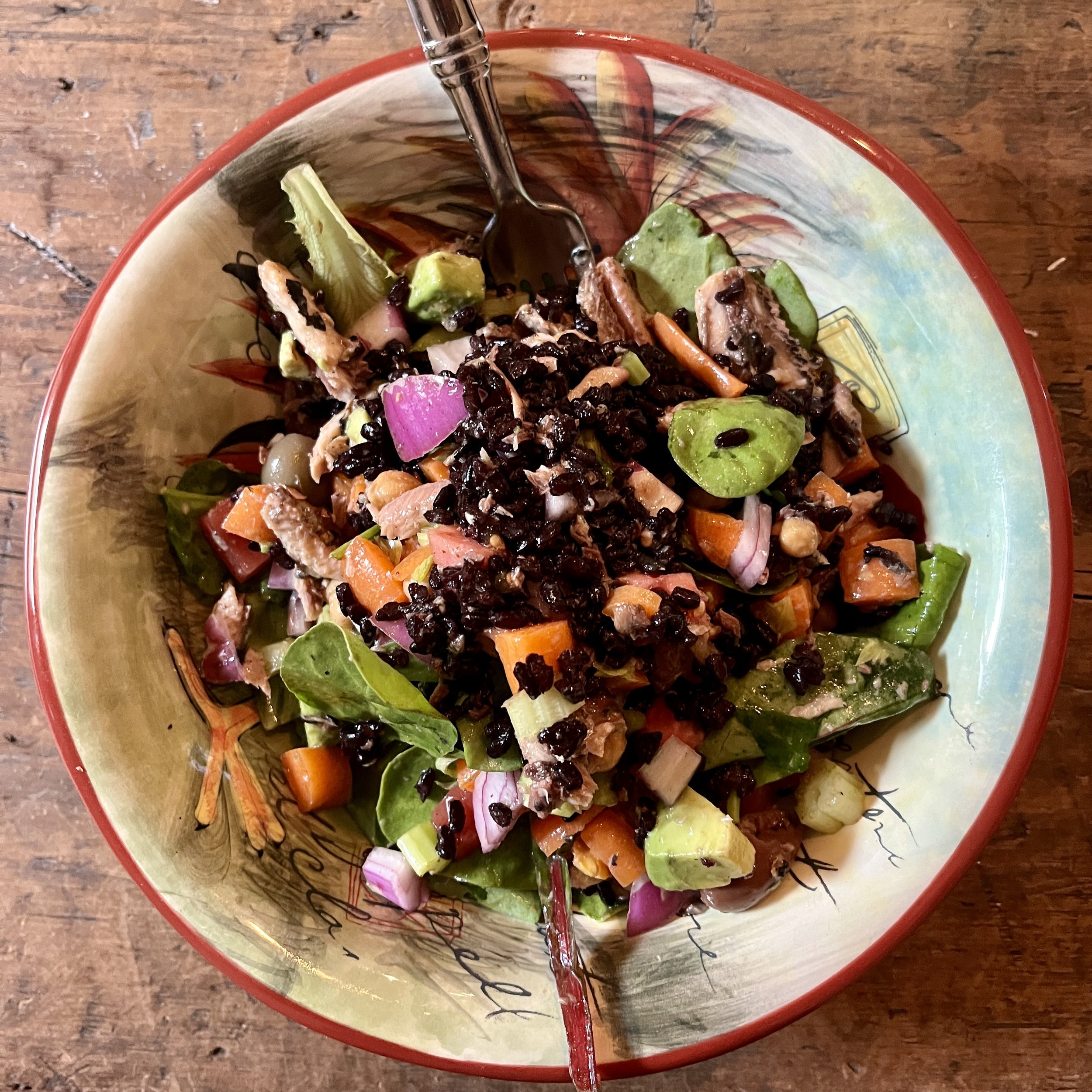
Mixed greens
Black rice
Roasted chickpeas
Avocado
Raw carrot
Celery
Tomato
Olives
Raw red onion
Sardines (1 can)
Olive juice
Olive oil
Lunch: Salmon and a side salad
Simple salad and a hunk of wild fish 🐟 😋
Wild sockeye salmon (bought frozen and thawed), pan fried for 3 minutes per side on medium heat. Simple seasoning, olive oil and salt
Side salad: mixed greens, apple, olives, grated Parmesan, roasted romanesco, oil, vinegar, and salt

Bowl of yogurt
Perfect way to start the day

Strauss European Style yogurt is my favorite. My mom and I discovered it on a trip in Wyoming at a cool little breakfast spot. Luckily my local grocer, Natural Grocers, sells it.
6 spoonfuls of yogurt
Almonds, walnuts, pecans, Brazil nuts
1 date, 2 prunes
1/2 tangerine
Sprinkle of chia seeds
Splash of homemade almond milk
Perfect way, to start the day.
The Behavior of Change
My views based on my experiences.
Thoughts and download from the week.
“Most frustration comes from not having a plan, or from not being open to changing when the plan you have fails.”
Eating Late
Every night it’s a struggle to not eat a snack after dinner and before bed. I know how much better I sleep, and therefore how much better I feel the next day when I don’t have a late night treat, and yet I fight myself on it every night.
Food is so good, it makes it so hard. It feels so right at the time, but I immediately regret it because I know I’m not going to sleep as well as I could have if I just listened to that voice saying “don’t do it,” “you don’t need it.” Instead of listening to the voice that says, “who cares,” “you deserve it.”
I used to think that if I just had something healthy and light, like a bowl of fruit, or something satiating, like protein powder mixed with soy milk, that it would be okay. But it’s not. It’s better than cake, or cookies, or ice cream, but it’s still not good.
Often times I rationalize eating something by convincing myself that I didn’t have enough calories that day, or enough of a certain macro, usually protein, to cover me for my workout. But it’s really just that, a rationalization to eat when I don’t need or want to.
If you’re reading this and thinking “wow this guy is tormented by food.” You’d be right. It wasn’t always like this for me. It started when I started training for triathlons a few years ago. Back then I always felt like I couldn’t consume enough calories to keep up with the long and hard days of training. There was no way, without a proper nutrition plan, which I didn’t have, to stay on top of the calories and macros I needed. As a result I always felt hungry and depleted. So I began over analyzing my food, and questioning what I was consuming with every bite. Even though I’ve been removed from that training style for a couple of years now, it’s taken time to undo that programming.
Tracking my food for 6 months helped. I learned that I was over-consuming fats, and under-consuming proteins (the latter of which I think was contributing to the feeling of being depleted). Balancing my diet, getting closer to the right amount of macros, has helped repair my relationship with food, but I know there is still more work to do.
But, no matter how much my that relationship improves, I doubt it will ever be easy. Because really, aren’t we all tormented by food in this country? Isn’t that why 70 percent of the population is either overweight or obese? And why everyone is always trying to lose weight and failing? I don’t think you can live in this country and not be tormented by food. Food in this country is available in endless abundance, it’s accessible everywhere you turn, and it’s extremely affordable. There is always an opportunity to shove something delicious in your mouth. Not something nutritious, but something delicious. Something ultra-processed, loaded with sugar, and of low quality, actually stripped of its nutrition. Something that tastes good, feels good, and hits all those sensory pleasure zones in your brain. No, we all struggle with it.
A rancher at a regenerative agriculture conference I went to said it best, “our addiction to convenience is killing us.”
So I wage the daily battle against food. Some days I win, some days I lose. I just try to string together more winning days than losing ones. Staying away from ultra processed foods, foods loaded with added sugar, fat, and sodium.
If there’s one thing that The Comfort Crisis brought to light for me, it’s that in this modern world you need to be actively fighting back the comforts that are all around us and making us sick. You can’t take a day off.
It’s an unfortunate thing, but if we want to achieve and maintain our health, it is going to require work, because the environment in this country doesn’t support a healthy lifestyle. It’s on you to create one for yourself.
10,000 Steps
I think 10,000 steps, when combined with a diet rich in whole foods and devoid of processed foods and added sugar, is actually a good number to strive for that can make you healthy and keep you there. The problem I see is that getting to 10,000 steps in a given day is really hard. I like to think that I’m very active. I workout for a minimum of one hour per day. I don’t have a desk job that keeps me tied to a chair for 8 hours or more. I spend 3 - 5 hours per days standing in my kitchen cooking meals and cleaning up after them. I walk my dog 2 - 3 times per day. On most days I do some type of yard work, that might include mowing the lawn, watering our flower and vegetable beds, or weeding. And still, most days, I don’t even come close to 10,000 steps. In fact, the Garmin watch I recently bought came set with a daily step goal of 7,222 (no idea where that number comes from), and I rarely even hit that number. The only time I hit this number is if I go for a run or a hike.
But I do recognize that on days when I hit that 7,000 number, or even better yet, I get up and over that 10,000 step number, I feel better. The difference is noticeable. My energy levels are better. My mood is better. I eat better. I sleep better. Everything is better. I’m just not convinced that 10,000 steps is a realistic figure for 99 percent of the population. For most of us, getting enough steps in would require a gargantuan effort. But I’m also not sure what is, or what other metric might be that could have the same benefits as 10,000 steps, but also be achievable.
No One Size… Many Sizes
We say there is no “one size fits all” when it comes to diet and exercise. That each of us are unique, and what works for you might not work for me. And what works for me, might not work for you. And that’s true, but we need to go one level deeper. Because, unfortunately, it’s even more complex than that.
What works for you is going to change throughout various times in your life. What works when stress is low, probably won’t work when stress is high. What worked when you were 25, doesn’t work when you’re 30, 35, or 40. What works when you’re catching a full night of Zzzzs, doesn’t work when your baby is waking you up multiple times per night. What works when you’re home, might be hard to replicate on the road.
That’s why, beyond any diet or exercise advice, you need to be vigilant about which situation you find yourself in, and adapt to meet it. You need to dial into the signals that your body is sending you.
Someone changes their life by going on the ketogenic diet, but after 6 months, they suddenly aren’t feeling well. It’s not working, and they’re constantly craving something sweet. Maybe it’s time to start incorporating some fruit. Or they’ve become tired of eating so much meat. Maybe it’s time to start eating more fish.
Or they always worked out in the morning, but now they start work earlier, and they have a longer commute, both of which are cutting into their morning workout. Can they wake up a little bit earlier to get in a workout? Is there time during lunch? At the end of the day? Instead of exercising 5x per week, can they squeeze in 3? Something, anything, just to keep the momentum and build on the habit.
There are so many examples, so many ways life is going to interrupt your plan, and I think that’s the problem that a lot of people face. They are unable to recognize why their routine is no longer effective, and rather than investigate why and make some changes, they throw the whole plan away and regress back to baseline, or worse, below it.
I think it’s very important to realize first that what’s going to work for you is specific to you. But second that you’re going to need to stay on top of it and manage it throughout different times in your life. The way I like to think about it is using a golf analogy (I don’t golf, but it works). I like to always stay as close to the pin as possible, so it’s never too hard to make my putt. What do I mean?
Let’s say I go on vacation where I’m sure to indulge in food I wouldn’t normally eat. Well I’ll try and keep at least one meal per day, but usually two, close to my normal diet when I’m home. This way, when I do get home, my routine hasn’t drifted too far off, and it makes it easier to ease back into my normal diet.
Let’s say that I have family visiting, and working out for 60 - 90 minutes isn’t possible without looking like I’m offending my guests. Rather than completely skipping my workout, I might just put together a 30 minute workout that keeps the routine and momentum alive for when my family leaves and I have my time back.
I’m constantly thinking about how I need to adapt my plan to fit the current situations in my life, always keeping the focus on staying as close to the pin as possible. Consistency is the key. Consistency is where progress is built. Figure out what you need to do to stay and consistent and not let life interrupt your plan.
Senate Testimony on the Health Crisis in this Country
I listened to Brigham Buehler, Casey Means, and Calley Means all on Joe Rogan talking about the testimony they gave in front of the Senate discussing the growing health crisis in this country. All three of these guests expressed some level of gratitude that they were able to present their case and lay out the facts about why and how we’ve gotten into such a mess. But the one thing I didn’t hear from any of them was anger or disdain for the fact that we even had to have a testimony to begin with. That no one that sits in the Senate has any idea about what’s going on in this country. That they are so unaware, or at least claim to be, of the fact that toxic food, plastics, and prescription drugs are murdering people in this country. They needed to hear it from a panel of experts.
Perhaps my view is biased because health, diet, food, exercise, longevity, and health span, are all things that I think about and read about on a daily basis. But holy shit, the health crisis in this country is the biggest issue we face as a nation, with ripple effects throughout every aspect of our lives. And the members of the senate don’t have a clue as to what’s going on, and yet they are the ones voting on bills, policies, and funding that directly impact the trajectory of this epidemic.
Maybe I don’t know how government and politics works, but my assumption would be that the people leading the country should know a little bit about what’s going on in the country before they get to lead it. I question how much these members actually pay attention. How many of them actually read. How they spend their free time, or any of their time, because time and time again, they are fucking clueless.
Perhaps it’s a product of the fact that some politicians have been politicians for decades. Decades! Spending their time campaigning, going to parties, and kissing the assess of the people that give them money. It’s outrageous and it’s becoming harder and harder to accept the extreme level of incompetence that exists in our government.
Three good podcast episodes
Joe Rogan and Diane Boyd - Diane K. Boyd is a wildlife biologist who has devoted decades to studying wolves. She is the author of "A Woman Among Wolves: My Journey Through Forty Years of Wolf Recovery."
Joe Rogan and Israel Adesanya - Joe sits down with Israel Adesanya, a mixed martial artist competing in the Middleweight division of the UFC. He is the subject of the documentary "Stylebender," available now.
Peter Attia and Anne Lembke - #321 – Dopamine and addiction: navigating pleasure, pain, and the path to recovery | Anna Lembke, M.D.
Establishing a new political party
With one focus. Health.
The Health Party
I want to start a new political party called The Health Party, whose whole mission will be to discuss current events and policy decisions purely from the lens of personal and public health.
I think everyone would agree that their health, and the health of their loved ones, is their number one priority above everything else. That everything we do, is done with the survival of ourselves and those we love in mind. So, with that in mind, the idea is to analyze current events and policy decisions to determine how they are impacting our health, and choose where we want to throw the weight of our support, based on this idea.
For instance. There’s a new Farm Bill [link] that’s going to get passed this year. In that bill will be billions of dollars that the government is going to pay farmers. Currently, all of the money will go to subsidizing conventional farming. Farms that grow rows and rows, acres and acres, of commodity crops like wheat, seed, grain, corn, and potatoes. These farmers all spray the food they grow with endless amounts of insecticides, fungicide, herbicide, and any other type of “side” you can imagine, as they prep their fields for planting, during the growing season, and while harvesting. Not only does the food get it, but because of their proximity to these chemicals, the farmers and farmhands are also exposed.
So, when considering our health and the health of those around us, should we continue to subsidize these farms? The answer is obviously no. No, we do not want to continue to subsidize growing methods that produce food that is killing us. No, we don’t want to continue to subsidize food that is used to make sugars, like high fructose corn syrup, ultra-processed foods, and to feed animals raised on feed lots (CAFOs [link]). No, that is not where we want to spend our money. Our tax payer money.
But, we should do something with the money. So, should we use it to incentivize those farmers to begin transitioning to healthier farming methods, like regenerative agriculture? A method of farming that has been proven to grow healthier and more humanely raised foods, that can heal the land and heal the population. Yes. We know the harm that pesticides and conventional farming practices have on the land and our health, so we should use that money to begin to transition away from them.
I think it can be that simple.
I read an article the other day that said the estimated cost to transition from conventional farming to regenerative farming globally is between $200 - $450 billion. But that same article also stated that it will be hard to make that transition because farmers have not been able to secure the funds they need to transition, which is one of the main struggles that farmers face. Obtaining required capital from banks and other financial institutions. So they’re stuck, unable to change.
If we move that $70 billion in the farm bill that is currently ear marked to subsidize conventional growers, and give it to farmers that are trying to improve, then we’ll already be 15 - 35 percent of the way there (depending on what end of the estimate you believe).
I think when policy, bills, and current events are analyzed purely from a personal health perspective that almost all of them will be that easy.
I hope you join.
Sincerely,
The Health Party.
Fruit and Veggie Pulp Chips
A better option than store bought, plastic packaged, veggie chips

My girlfriend has been juicing a lot recently, which extracts a lot of the fruit or veggies nutrients and leaves behind excess pulp (fiber) that usually goes to waste.
We’re always looking for ways to reduce waste, so this week she used the pulp and made these veggie chips.
She added spices, soy sauce, and ground flax seed to the pulp, and then formed it in to chip shapes, and placed them in the dehydrator for 12 hours.
We woke up to these healthy, tasty, and crispy chips.

The Behavior of Change
Random thoughts, perspectives, insights, and experiences I’ve had during the week that have shifted my view or focus.
Thoughts and download from the week.
To know what you prefer instead of humbly saying Amen to what the world tells you you ought to prefer, is to have kept your soul alive - Robert Louis Stevenson
Doing what’s easy and rationalizing
Never mind the fact that it’s taking me away from the thing I actually want to do, which is read my book. Never mind the fact that I never feel nearly as good after 30 minutes on my phone as I do after 30 minutes of reading. My ability to rationalize, and my desire to do what’s easy, keeps me from reading, and encourages me to pick up my phone instead.
Reading, my brain tells me, is unproductive. Reading, will not lead to any tangible success or achievement. My phone, by contrast, holds all the tools I need to be productive. I can research an idea. Search for a hike. Write down notes. Edit videos. Get caught up on email. Check in on the market. My phone, my brain tells me, will help me achieve my goals, while reading is just procrastination.
This is an example of the back talk that goes on in my head when that little voice, my intuition, tells me what I need, and my programming tells me what I “should” (that bad word) do instead.
It doesn’t happen with just reading. It happens when that little voice starts yapping “go workout, you’ll feel better,” and my brain says, “nah, let’s eat.” It happens with writing. “Write it down later, you’ll remember.” With watering and cleaning up the garden. With stopping for gas. Or going to the store. “Let’s do ______ (anything else) instead.”
I started reading a new book this week. The Artist’s Way, by Julia Cameron. She calls this internal dialogue your censor. In the War of Art, Steven Pressfield calls it The Resistance. I call it rationalization and doing what feels easy. I’ve determined that a succesful and happy life lies in the ability to recognize when rationalizing versus acting. It lies in the ability to listen to my intuition, that first voice, and ignore the resistance, that second voice. And that’s what I’ve been working on doing.
But it’s not easy, and it doesn’t always work.
For weeks my intuition had been telling me to go do a float. And for weeks I’d been telling it no, we don’t need it, we’re fine how we are. I’ve notice it’s usually the thing I’m resisting the most that I need the worst, and success relies on identifying resisting what I need. That turned out to be the case with my float, but unfortunately I let it get to critical levels, brain fog that impacted my productivity and mood, before finally making an appointment.
Sure as shit, the float was exactly what was needed, and I came out of it feeling mentally clear and physically rejuvenated. Why had I resisted going for so long and ignore that nagging voice? Why do I continue to lack the confidence to immediately act on what my mind and body’ are telling me to do? Why do we as humans go against the things that we know to be true? It’s such an odd thing to me. We know, and ignore.
We know what’s good for us when it comes to diet, drugs, drinking, exercise, relationships, work, stress, and yet more often than not, we ignore it, and do the opposite. We know how much better we will feel if we do these things, but we don’t. We remember the last time we did this things how good it felt, but we still don’t. We know, then we rationalize, then we ignore, and do what’s easy instead.
A reminder about other peoples expectations
When I’m stressing about situations that involve other people and their expectations of me, I try to relax my nerves by thinking about how I would feel if the roles were reversed.
A recent example included a fellow classmate in a kettlebell class I’m taking. During class everyone was given a partner. We were assigned to watch our partner (this was via zoom) do a Turkish get up, and make mental notes of what they did well, and where there were opportunities for improvement. After class we were tasked with sharing these observations with one another via our group text.
Immediately after class the group chat blew up with everyone sharing their feedback. A ping of anxiety rushed through me. Fuck, I forgot what I wanted to tell him. I remembered thinking that a few moves on his way up could’ve been tighter, and that the way down looked good. But I couldn’t remember in enough detail to actually be helpful, and it started to freak me out. I was new to this group, I didn’t want to be a bad partner and appear as though I hadn’t been paying attention.
I couldn’t remember what I wanted to tell my partner, and it was eating away at me.
After an hour or so of letting it consuming me, I decided to turn the tables. I asked myself, how would I feel if I didn’t get any feedback? Would I feel let down and like my partner didn’t care? Would I be mad, angry, or want my partner to be upset about it? Or, would I assume that, like me, he’s just bad at taking mental notes, or didn’t get a great look at the screen, or some other reason why he had nothing to share, and it wouldn’t bother me? I realized it was the latter, and that I needed to stop worrying.
About a year ago my brother rented a house in upstate New York. He was there with his family, wife and three kids. The house was on a lake, and while everyone around them was out enjoying the water on canoes, kayaks, and paddle boards, the house he rented had nothing. But he saw that his neighbor did. So, one day he went over, knocked on the door with his three kids and asked if he could borrow a kayak and a couple of paddle boards. To his surprise the gentleman that answered the door, an older man, said “Absolutely. We bought these for our grandkids but they never come over. Use them for as long as you want. Make yourself at home.” So they did.
For the week they were there they used his water crafts.
After he returned home he wanted to do something nice for the neighbor, but he didn’t know what. He decided to send them a hand written thank you note, along with a picture of his kids on the lake using their watercrafts. We were talking one night and he asked me, “do you think that’s enough?”
I thought for a minute and then I said, “Well, put yourself in his shoes. How would you feel if you got a card and a couple of cute pictures? Would that be enough for you?”
“I never thought about it that way,” he said, “It would.” I could even sense a smile come through the phone as he reversed roles and thought about himself in this guys shoes.
As humans we have a tendency to overthink how other people are going to react. We tend to think that everything is a bigger deal than it really is, and that we’re not doing enough. I know I do.
The next time you feel this way, swap places with the person you’re worried about and ask, “how would I feel?” The answer should be enough to allow yourself to move on.
That’s not to say you won’t encounter people who do not feel the way you do, or people who do make a bigger deal and expect more. But, use yourself as the yard stick to judge the situation by. You’re a reasonable person, as most people are, so your response is the best judge you have.
Side note, as of this writing, I haven’t received feedback from my partner either, and I haven’t thought twice about it.
Healing in an unstable environment
The argument I’d make is that you can’t heal in an unstable environment. I’d argue that you can only heal when you’re in an environment that offers unconditional love, support, and security. If your stability is under constant threat, then its hard to make room to heal.
I’ve now been in a stable environment for three years, and during that time I’ve begun to heal.
That environment for me is the one my girlfriend and I have created. There have been challenges, scares, and mis-understandings, but it’s always been stable because of our love for each other. The love we have, the support we show each other, creates a stable environment, regardless of what’s going on around us.
It’s something I’ve really been able to notice since we moved and begun to settle down. Prior to meeting Jen I had felt like I was all over the place. I moved to Los Angeles by myself in 2019, and despite living there for 3 years, I never really felt settled. I was alone, and I knew Los Angeles was not where I wanted to put down roots. And I wasn’t even sure I wanted to put down roots anywhere. Even though it caused me some feelings of anxiety, I always thought I would just live a semi-nomadic life, moving around every few years.
But now we’ve started to create a home, and I’ve noticed that no longer feeling like a nomad has put me at ease and it’s allowed me to heal physically and emotionally.
Being in one place, it’s been very clear to me how much I’m benefiting from it. My mood is generally better and my emotions are more balanced. My perception of things, and my role is much clearer. My ability to change has been one of the most apparent things to me. I always believed in the ability to change who you are through manipulation of the mind, but to see it play out in real time is something I’d never experienced in my life. I’ve been able to decide to change, and make it happen.
I’ve also seen profound changes in my writing, which I attribute to having a clearer mind. And I’ve also noticed an improved overall sense of control in my energy and effort, and specifically in my ability to pull back on the reins before I go over a cliff.
But the most profound thing, perhaps because it is so tangible, has been the daily chipping away at my chronic injury that has nagged me since 2020. I always held out hope that I’d one day be able to begin to heal, which is the reason I never stopped trying, but in the back of my mind I had begun to accept that this was just how I was going to have to live. Chronically injured, in pain, and never returning to my full form.
But in the last three months I’ve seen and felt dramatic improvements that I attribute to feeling stable. This new environment we’ve created has allowed me to be consistent, and know that I can be consistent into the future. The fear that I need to fix it today, because I don’t know what tomorrow will bring, is gone. And so I’ve been able to take my time and focus on small improvements.
Jen and I have always believed that my injury was part energetic and part physical. Energetically I’m getting to express myself and “release” what’s been building up inside of me through consistent writing, and things like the wake up workout challenge. Physically, I’m learning new modalities through reading and taking classed I’d been waiting to take until the time was right.
That’s all to say, which is probably not what you would have expected to hear, that my personal experience has taught me that we cannot expect people living in unstable environments to be healthy, heal, and prosper. The expectation for people who are struggling to keep a roof over their head, put food on the table, working multiple jobs, and in poor health, to recover, be better, and improve, is unrealistic. The environment in this country for millions of people is unstable at best, dire at worst, and until we improve upon those conditions for these people, we can’t expect anything to change.
A light healthy snack: Apple, Nuts, Nut Butter Drizzle
Balanced and nutritious snack for any time of day

Long day today after a long week. I didn’t get to workout until 5 pm. I finished at 6, did some other chores, and before I knew it it was 6:45.
I wanted a snack before a late dinner, so this is what I had.
3/4 sliced apple. Pecans, almonds, walnuts, Brazil nuts. Drizzle of Nutzo Keto Nut Butter.
Glass of soy milk.
I love nut butter, and I’ve been eating a ton of it recently, but in reality is is a processed food. In this case that means, to me at least, that I’m not getting the digestive benefits of having to chew and digest a nut. So, I cut back the nut butter and added more nuts.
I have no idea how much of a difference it makes, if any, but I think there has to be some logic to it.
Anyway, this is a nice healthy snack that’s okay to indulge in.
Cheers