
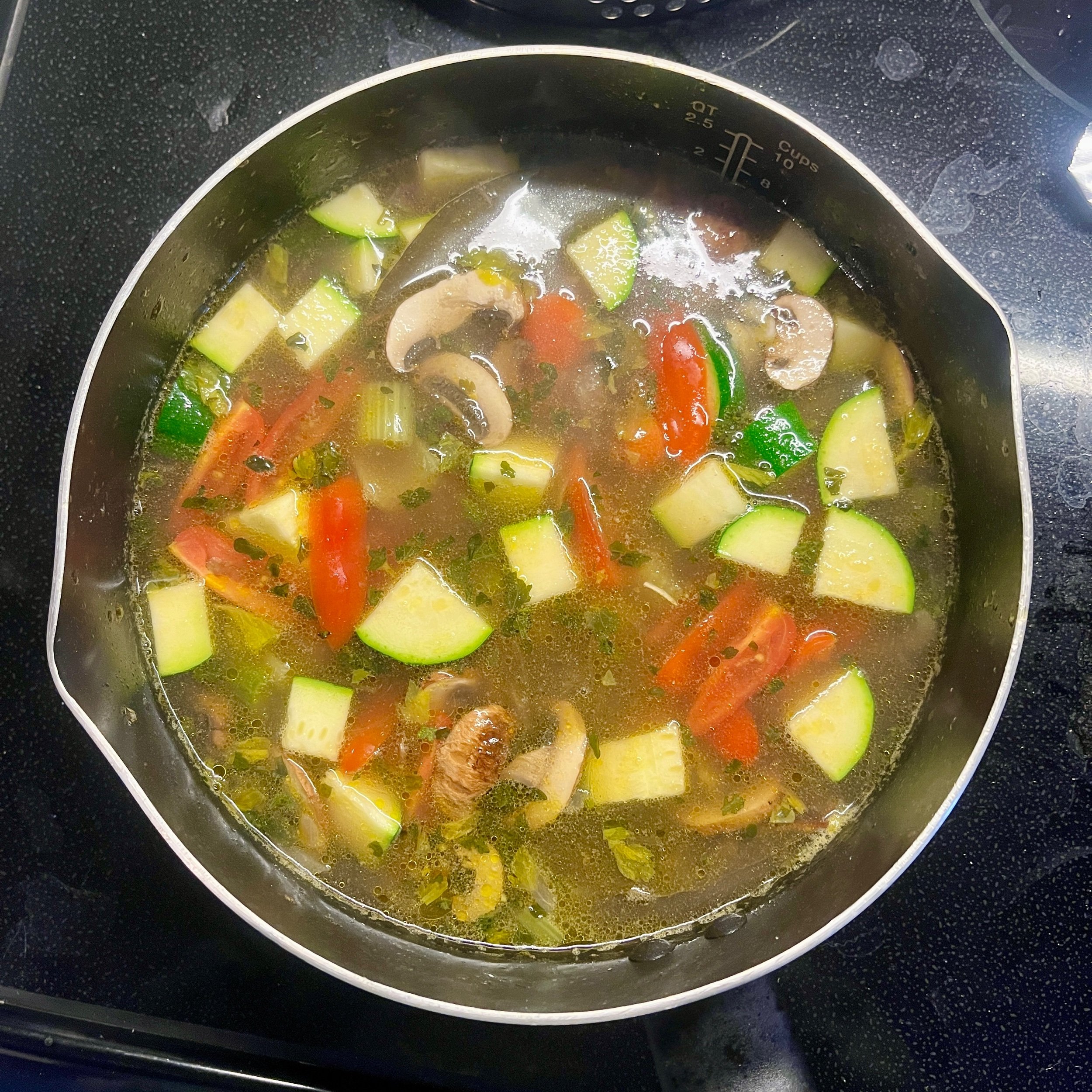
Kidney Bean and Mushroom Soup
Another easy and delicious way to incorporate more vegetables into your life.
A slightly different twist on a soup I’ve come to love. Check out this hearty recipe and keep some soup in your fridge.
Cooking Instructions:
Bring a pot to medium heat. Add 2 tbsp of olive to the pan, and then add 2 chopped carrots, 1/2 chopped celery stalk, 4 cloves of chopped garlic, 2 slices of red onion. Allow to cook for about 5 minutes.

Then add: 2 cups of vegetable broth, 2 cups of water, 4 oz of sliced cremini mushrooms, 2 bay leaves, 1 tsp of dry parsley, 2 pinches of sea salt and a few cracks of fresh black pepper. Bring to a boil and then down to a simmer and allow to cook for 20 minutes.

Then add: 1 can of rinsed kidney beans, 1/2 chopped zucchini, 1/2 cup of chopped tomatoes. Allow to cook at a simmer for another 25 minutes.
Remove the bay leaves and enjoy!


Collagen Supplement: Yay or Nay?
The evidence of collagen supplementation’s benefits is scarce, but the importance of it’s role in the body is not debatable.
Last week my cousin asked me my opinion on collagen protein. I didn’t have one. I’ve never actually taken it and didn’t know much about it. But I had been meaning to look into, so I took my cousin’s question as a push to finally do some research.
I turned first to my new favorite nutritionist, EC Synkowski. She put out this podcast episode, On Collagen as a Supplement, in June 2021, which packed a lot of good information into a 25 minute episode. And I also found this post from the Cleveland Clinic useful.
The takeaway: Collagen is the most abundant protein in the body, comprising 25 - 30 percent of all the body’s proteins, and is most prevalent in connective tissues like cartilage, bones, ligaments and the skin, where it provides structure, support and strength.
As we age our body produces less collagen and existing collagen breaks down. The best way to prevent the breakdown and decreased production of collagen is to avoid excess exposure to the sun, smoking, and a diet that’s high in sugar and refined carbohydrates.
Eating a well balanced diet that’s complete with fruit, nuts, vegetables and moderate amount of meat and fish, akin to the Mediterranean diet, is the best way to promote the production and longevity of collagen in the body.
Evidence to prove the effectiveness of collagen supplementation is inconclusive, but modest improvements in skin health and a reduction in pain from osteoarthritis has been shown.
So, should you take a collagen supplement or not?
While evidence of its benefits are lacking, given the important role that collagen plays in the body, taking 10 - 20 grams of hydrolyzed collagen powder daily also won’t hurt, and doesn’t seem like a bad idea.
This is the amount that EC Synkowksi consumes with her morning coffee. If for no other benefit, she says it’s an easy way to get a jumpstart on her daily protein target of .7 grams per pound of bodyweight.
As for which one to take, this post from Eatingwell.com provides a good breakdown.
For me? I’ve been trying to limit my dependence on protein supplementation, so I’m still debating what I’ll do. I’ve been limiting myself to one shake a day, 12 ounces of water, 26 grams of unflavored Naked Nutrition Casein protein, and a splash of coffee for flavor.
But I’m curious to know what your perspective is and if you take a collagen supplement or not? Or if you will after reading this. Let me know if the comments below.

Follow Your Intuition to Health
Click here: OneSource Health, January 7, 2024
“Man has no Body distinct from his Soul…” - The Unsettling of America
My view of health is always evolving. And after the last handful of books, articles, podcasts and shows (i.e The Blue Zones on NetFlix) I’ve come across, it’s occurred to me that the key to longevity is really much simpler than we’ve been lead to believe. We (I) spend so much time, energy and money in pursuit of a “healthy” life. But in places around the world where people live the longest and most robust lives, they only worry about one thing. Living.
Being present. Spending time with people they love. Doing the things they like, and taking a break when they’ve had enough. And the pursuit of all those things leads to a life abundant in movement, love, happiness, and a simple and nourishing diet. Not the other way around.
There’s no right supplement, exercise, or diet that makes the difference. The difference is in their ability to follow their intuition, and avoid the pitfalls of modern society.
The Unsettling of America: Culture & Agriculture, by Wendell Berry
On a recent podcast Andrew Huberman recommended reading the works of Wendell Berry. I had never heard of him. But I did some research and found this interview, Going Home with Wendell Berry, which prompted me to buy, The Unsettling of America: Culture and Agriculture. Originally published in 1977, it remains today one his most well known and influential pieces of literature. In addition to being an author, Wendell Berry is an environmental activist, and has been a farmer in rural Kentucky since the mid 1960s. These credentials I think give him a unique perspective that’s hard to find.
Collagen Supplement: Yay or Nay?
Last week my cousin asked me my opinion on collagen protein. I didn’t have one. I’ve never actually taken it and didn’t know much about it. But I had been meaning to look into, so I took my cousin’s question as a push to finally do some research.
Colon Cancer On The Rise
This article, Colon Cancer is Rising in Young Americans. It’s not Clear Why, caught my attention because of the last line, “Its not clear why.” This is same line that exists in one form or another in every article written about the declining health of our population and increased prevalence of disease.

Sowing Doubt In Health
The medical industrial complex continues to use news outlets to sow doubt in our minds
This article, Colon Cancer is Rising in Young Americans. It’s not Clear Why, caught my attention because of the last line, “Its not clear why.” This is same line that exists in one form or another in every article written about the declining health of our population and increased prevalence of disease.
There’s this line from a different Washington Post article about the exponential rise of fatty liver disease in children, “Speculation about what was causing the rise and diversity of cases was wide-ranging. Maybe it had something to do with the average ambient room temperature.”
Or this one from an article from the AP News, “Obesity is not a lifestyle problem. It is not a lifestyle disease. It predominately emerges from biological factors.”
Despite all three articles pointing directly to the abundance and accessibility of sugar and ultra-processed foods in our diet, and living a more sedentary life as the cause, with just one line or quote from an “expert,” they all make a point of sowing doubt to that theory. It’s just enough to make us believe that we can’t help ourselves. That we need to turn to the “specialists.” And it keeps us consumers of the drugs and surgeries they’re selling.
I’m halfway through reading Merchants of Doubt. A book dedicated to exposing the very real industry tactic that exists around sowing doubt in society. It’s a technique that was first developed by big tobacco to undermine the very clear link researchers discovered in the 1950s - 1960s between cigarettes and its link to cancer.
Since then it’s a technique that’s been used across many industries. And it’s very evident to me, that it’s been adopted by the healthcare industry in recent times. The money is made on the manufacturing and selling of treatments, and medications, and performing surgeries. It doesn’t benefit the healthcare industry to prevent disease. That’s why the term “sick care” has come to replace healthcare in recent years. The medical industrial complex is doing whatever it can to keep us reliant on their “care.”

A Good Book: The Unsettling of America
A great book that beautifully articulates the reasons behind the deterioration of our society
On a recent podcast Andrew Huberman recommended reading the works of Wendell Berry. I had never heard of him. But I did some research and found this interview, Going Home with Wendell Berry, which prompted me to buy, The Unsettling of America: Culture and Agriculture. Originally published in 1977, it remains today one his most well known and influential pieces of literature. In addition to being an author, Wendell Berry is an environmental activist, and has been a farmer in rural Kentucky since the mid 1960s. These credentials I think give him a unique perspective that’s hard to find.
In the 46 years since it’s publication, the tragedy of The Unsettling of America, as Wendell Berry puts it, “is that it is true.” The problem, which he masterfully articulates, is that in a world based on capitalism and competition, where exploiters and salesman abound, the promise of future progress and economic growth never actually delivers for the masses.
“If competition is the correct relation of creatures to one another and to the earth, then we must ask why exploitation is not more succesful than it is. Why, having lived so long at the expenses of other creatures and the earth, are we not healthier and happier than we are? Why does modern society exist under constant threat of the same suffering, deprivation, spite, contempt, and obliteration that it has imposed on other people and other creatures? Why do the health of the body and the health of the earth decline together? And why, in consideration of this decline of our worldly flesh and household, our “sinful earth,” are we not healthier in spirit?”
He later goes on to say:
“It is not necessary to have recourse to statistics to see that the human estate is declining with the estate of nature, and that the corruption of the body is the corruption of the soul. I know that the country is full of “leaders” and experts of various sorts who are using statistics to prove the opposite: that we have more cars, more super-highways, more TV sets, motorboats, prepared foods etc., than any people ever had before - and are therefore better off than any people ever before. I can see the burgeoning of this “consumer economy” and can appreciate some of its attractions and comforts. But that economy has an inside and an outside; from the outside there are other things to be seen.”
The growing disconnect between humans and their intuition that he describes throughout the book continues to deepen by every relevant metric to this day. The gap in income inequality. The degradation of our land. Life expectancy. Drug use, overdoses and loneliness. And an overall sense of increasing unrest have all moved in the wrong direction. In the four plus decades since its publication, Wendell Berry’s thesis remains as true now as ever before.
If you don’t have the time or desire to read this book then I implore you to at least read the interview mentioned above, Going Home with Wendell Berry.
This podcast episode with regenerative farmer Will Harris, who speaks with the same ferocity as Wendell Berry does, also pairs well with the book or the interview. (Fun fact: Jen and I met Will Harris on his farm in Blufton, Georgia last valentine’s day).


Chicken Salad Surprise!
Red and green lentils, homemade chicken salad and brussel sprout yum!
Lentils. Chicken Salad. Brussels.

Chicken Salad (makes 1 serving). Chop up 1/2 a large chicken breast and one slice of red onion and place them together into a food processor (I have a mini Ninja which works great). Pulse it a few times until mixed. Add 1/2 chopped apple, and pulse until mixed. Add a few almonds and walnuts. Pulse until mixed. Add 1 tbsp of honey dijon mustard, stone & ground mustard, Buffalo Primal Sauce, and Sweet Baby Rays hot sauce. Pulse until mixed. Add 2 tbsp of olive oil and a few pinches of salt and pepper. Pulse until desire consistency is reached.

Lentils. Add 3 cups of water or vegetable brother to a pot. Add 1 cup of green lentils. Bring to a boil, then reduce to a simmer and cover. Cook for 45 minutes, covered. Taste for tenderness before removing from heat. Strain the lentils and return them to the pot.
Brussels. Set a pan to medium-high heat. Cut the stems off and quarter or halve them (if bigger). Toss in a bowl with 1 tbsp of olive oil and two pinches of salt. Add brussels to the pan. Add a splash of water to the pan and cover. Let cook undisturbed for 5 minutes. Toss and cover for another 5.
Assemble. Add enough lentils to cover the bottoms of the bowl. Add a handful of brussel sprouts. Drizzle with 1 tbsp of olive oil and 2 pinches of salt. Add the chicken salad and drizzle with fig balsamic vinegar.
Buon Appetito!!

Baked Spicy Mustard Wild Salmon
Spiced up salmon to have ready for any meal
When I find something I like in the kitchen I tend to try it on every dish I can. Here I’m using this delicious fermented chile paste to spice up my baked salmon!
Preheat the oven to 425.
In a small bowl mix:
1 tbsp of stone ground mustard
1 tbsp of Dijon mustard,
1 tbsp of fermented chile paste
1 tbsp of soy sauce.


I’m using frozen wild salmon I bought at Whole Foods and defrosted in the refrigerator overnight.
Take 2 filets from the packaging and pat them as dry as possible. They’ll be a lot of water since they were frozen.
Place aluminum foil on a baking sheet, add 1 tbsp of olive oil and 2 pinches of sea salt.
Place the 2 filets on the baking sheet, skin side down, and then evenly coat them with your mustard and chile mixture. Place in the oven and cook for 7 minutes.


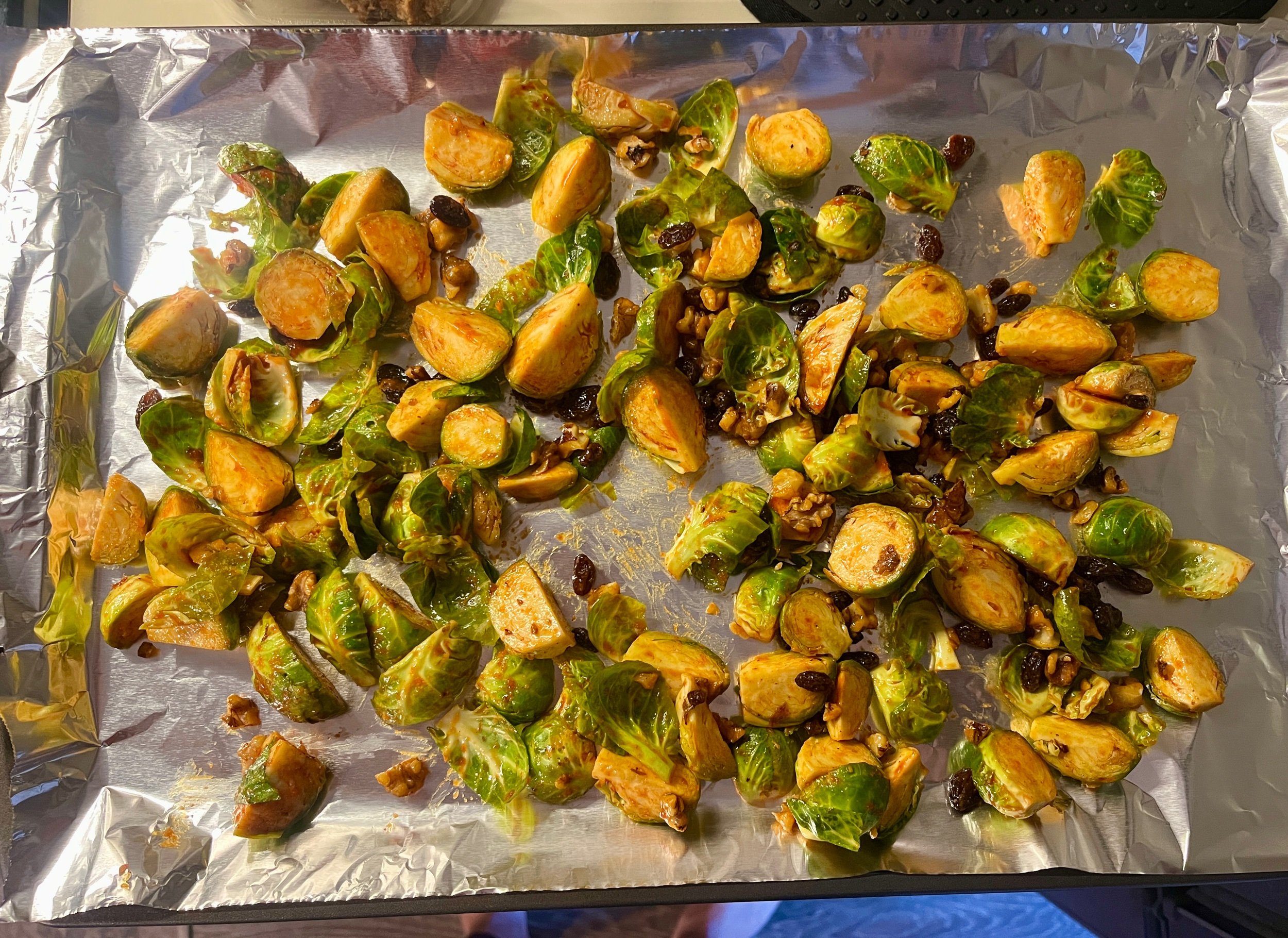
Spicy Roasted Brussels
Fermented chile paste and buffalo sauce add some nice flavor to roasted brussels
A different take on brussels to add some spice to your life!
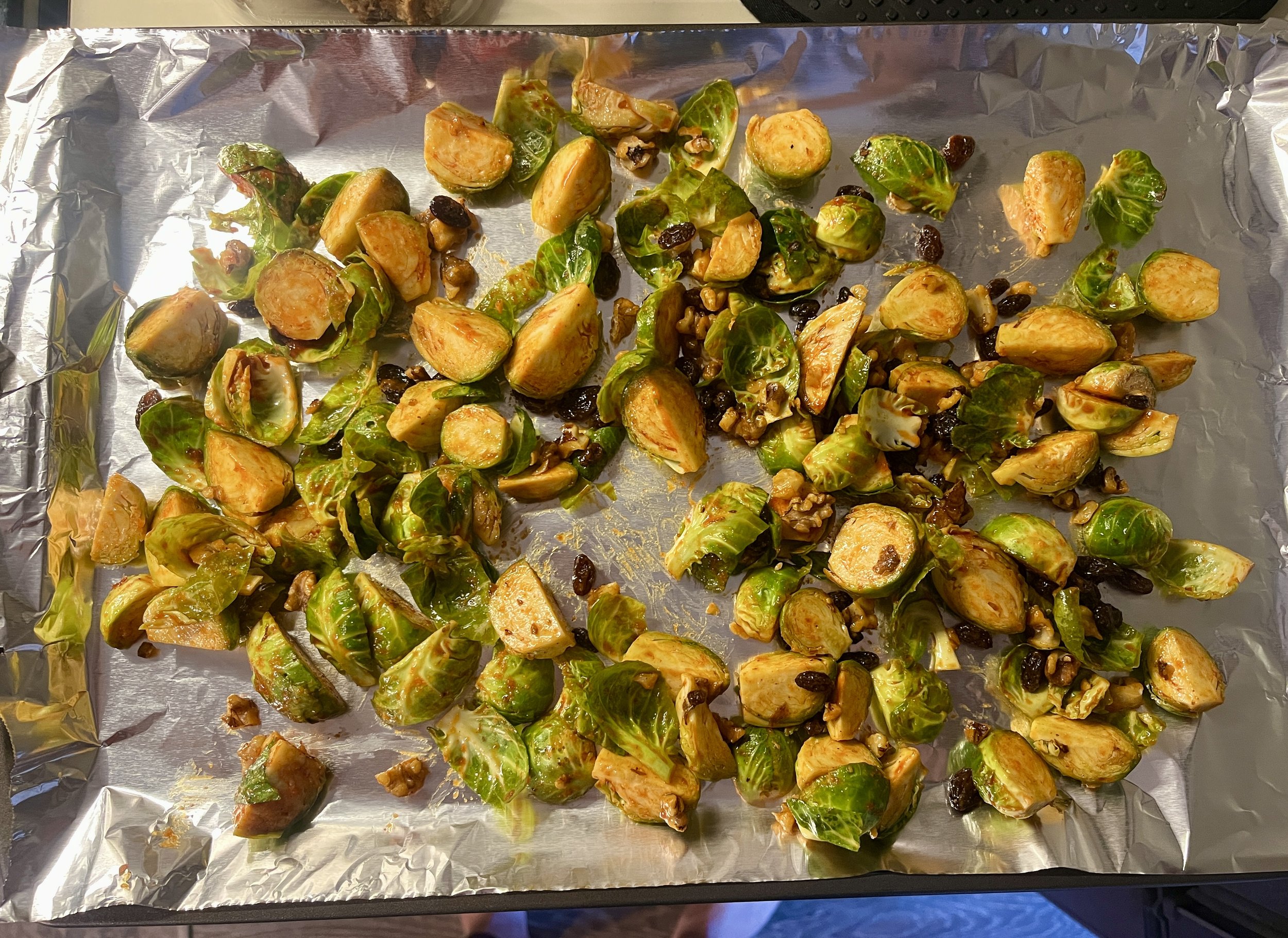
Preheat the oven to 425.
Cut the stems off the brussels and then quarter them.
Toss them the brussels in a bowl with:
2 tbsp of olive oil
1 tbsp of Primal Buffalo Sauce
1 tbsp of Fermented Chile paste
1/2 tbsp of sweet baby rays hot sauce (any hot sauce will do)
And 2 pinches: salt, black pepper, onion powder, garlic powder and a few dashes of chili powder.
Mix with your hands to evenly coat the brussels.
Add 1 handful of chopped walnuts, and 1 handful of raisins.
Spread out on a baking sheet and let cook for 15 minutes. I did 20 and they came out really crispy, aka burnt, see below, but I like them that way so 🤷♂️.

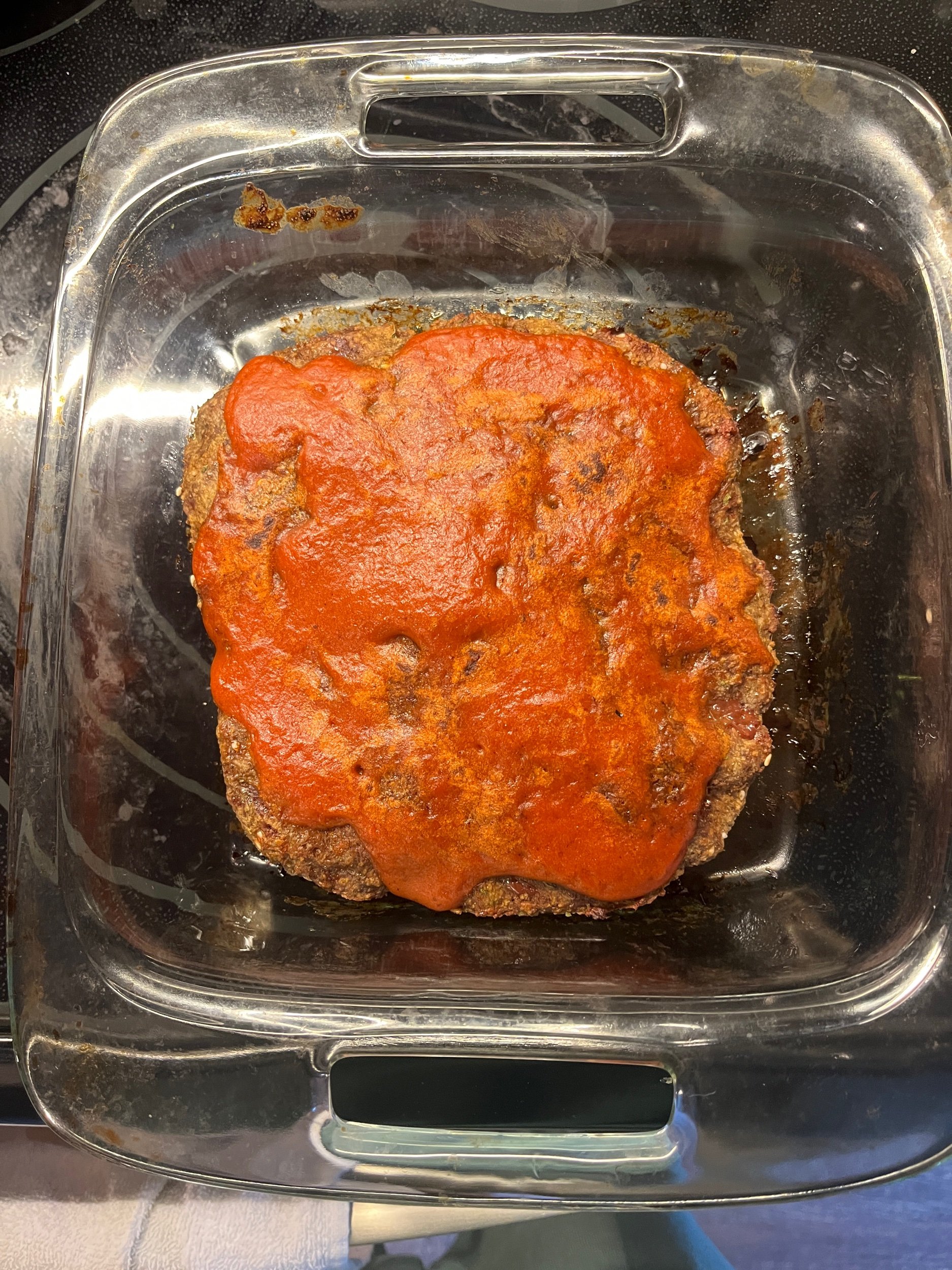
Venison Meatloaf
Skip the beef and go for some venison to change things up!
Check out this delicious venison meatloaf recipe. Venison is a leaner choice than beef, while still providing a very similar nutrient profile. This is an easy one to make and keep in the fridge for a protein packed option.
Preheat the oven to 350
Mix in a bowl:
1 beaten egg
1/2 cup of bread crumbs
1 tbsp of brown sugar
1/2 tsp of stone ground mustard
1/2 tsp fermented chile paste
1/2 tsp garlic powder
1/2 tsp onion powder
1/4 tsp thyme
1 tsp of chicken renderings from whole Chicken Crock Pot
Dash of pumpkin spice
Dash of cayenne pepper

Add 1 lb of First Light Farms Venison and mix fully with your hands
Spread the contents of the bowl evenly into a 9 x 9 Pyrex dish
Cook at 350 for 40 minutes

In a small bowl mix the sauce to go on top of the meatloaf
1 tbsp of fermented chile paste
1 tbsp of primal buffalo sauce
1/2 tbsp of stone ground mustard
1/2 tbsp of Dijon mustard
2 pinches of sea salt
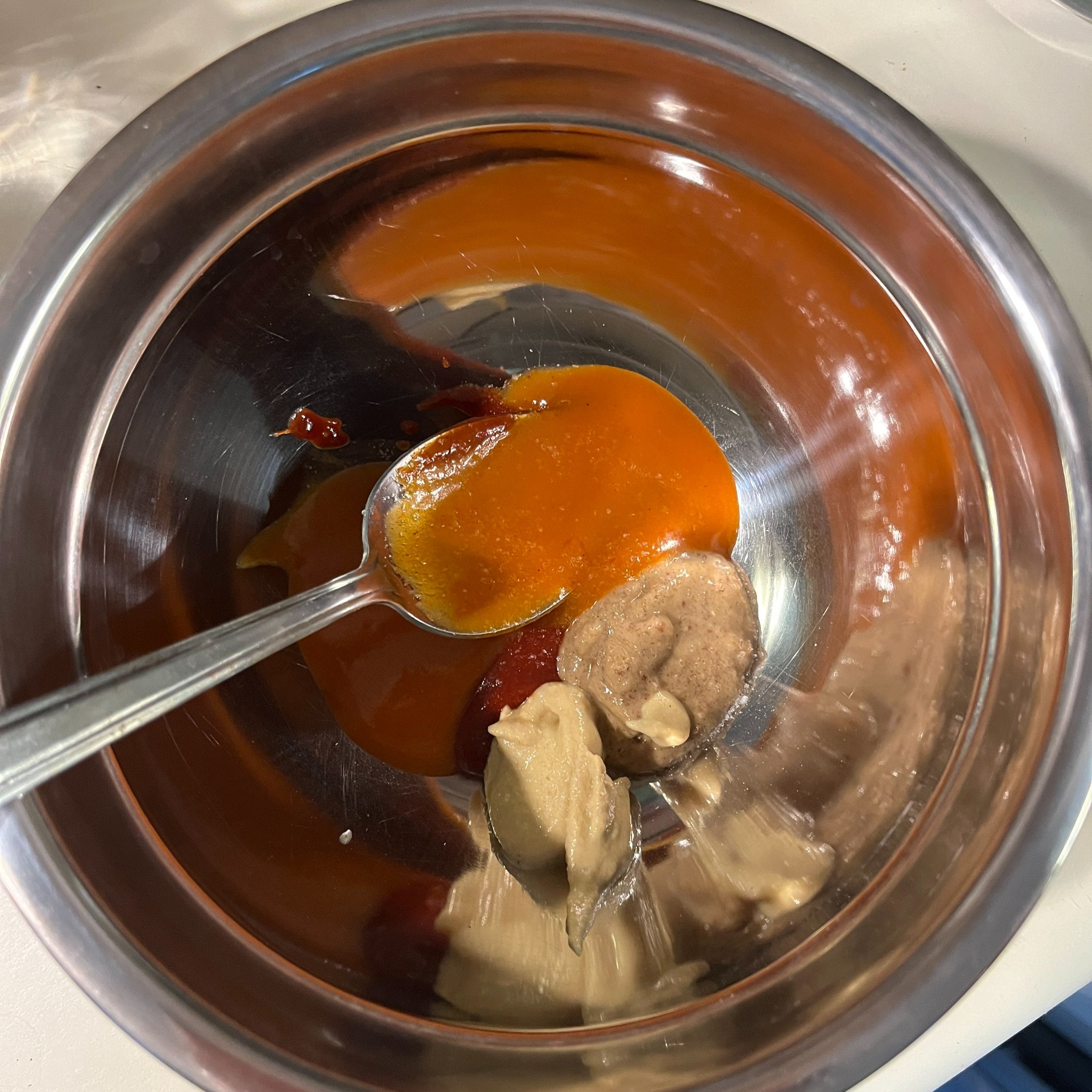
After 40 minutes remove the meatloaf from the oven, and turn on the broiler. Spread the sauce as evenly as possible across the top and place back under the broiler for 60 - 90 seconds.

Cut the meatloaf into four even squares and enjoy it with a dish like this. Meatloaf, garlic mashed potatoes (topped with 1 tbsp of ghee and chopped red onion) and boiled broccoli! Enjoy!


How Sleep and Holiday Dinner Affect Glucose
Some surprising and not so surprising reasons my glucose has been acting up
After it felt like I was starting to understand what was impacting my glucose readings, this past week threw me for a loop. After some technical difficulties applying a new continuous glucose monitor (CGM), that cost me a week of data, I finally got a new one on and connected in time for Christmas dinner on Monday December 25th.
Christmas Dinner
Christmas is a big deal for my girlfriend and I. In my life I’ve never had Christmas without family, and my girlfriend only ever had Christmas without her family once. We’re used to big home cooked meals with our parents and siblings. But at the end of October we moved a 3 days drive away to Colorado, and we weren’t returning home for the holidays. So we needed to figure out Christmas dinner on our own. And after an expensive and mediocre experience ordering out for Thanksgiving, we really wanted to make Christmas special.
So we cooked a meal mostly inspired by food my girlfriend is used to, which luckily for me meant she did most of the cooking. A turkey was too much meat for just the two of us, plus we didn’t have the necessary equipment to cook one, so we opted instead to make a whole chicken in the crock pot. My girlfriend also made two of her favorite dishes, pineapple bake (bread, crushed pineapple, butter and cream), a sweet and savory dish akin to a bread pudding, and green bean casserole. Plus garlic mashed potatoes, and roasted carrots, parsnips and cauliflower for balance. And cookies for dessert.
We ate an early dinner at 4 pm.

As discussed in a previous post I made sure that morning to eat a low carb, high protein and fat meal of baked wild salmon, roasted brussels sprouts and sautéed bell peppers, avocado and finished with olive oil, to try and limit the damage. I also followed up Christmas dinner with a salad of tomato, raw red onion, blueberry, avocado, apple and chicken.
I was surprised to see that within 30 minutes of dinner, despite a plate loaded with simple carbohydrates, my glucose only spiked 37 points. And within an hour it had returned to baseline. I was conscious during dinner to consume my chicken, green bean casserole and vegetables (protein, fat and fiber) before the mashed potatoes and pineapple bake, a tactic recommended by Levels that slows the absorption of glucose into your bloodstream, but I was still pleasantly surprised with the result.
But even more surprising were the days to come. And for the wrong reasons.
The remainder of my week remained mostly steady, although on Tuesday following Christmas I did experience two 30+ point spikes. But neither one of these seemed out of line. The first one was caused by two bowls of berries that I ate after a prolonged period that day of not eating. The second was a plate of leftovers. In both cases it also made sense to me because the day before I had gone off my normal eating habits with Christmas dinner, and I assumed by body was working to get back to baseline.

The most surprising of data came the following Sunday, New Years Eve, and continued through Tuesday. For New Years Eve we stayed in and cooked. This time we made venison meatloaf, the same garlic mashed potatoes and boiled broccoli. On the surface it seemed like a balanced meal, and in comparison to Christmas I had about half the amount of carbohydrates on my plate.

But within 45 minutes of eating my glucose spiked 58 points and remained elevated for 2 hours (compared to only 1 hour for all the previous spikes discussed in this post). On Monday I experienced two spikes lasting a total of 4 hours. The first spurred by green lentils, which had never had this affect before, and the second from 2 handfuls (not bowls this time) of blueberries. And on Tuesday lentils again caused a spike, this time 56 points. None of it made sense.
If Christmas dinner, which was certainly richer in carbohydrates, only caused a 37 point spike, then why was this meal and subsequent healthier carb meals causing these swings. I started to wonder what else might be at play, and I started looking into possible causes other than the quality and quantity of carbohydrates.

The first thing that occurred to was that the meatloaf contained added brown sugar and breadcrumbs, plus simple carbohydrates and sugar from the homemade sauce on top. But I only ate 1/4 of the meatloaf, so I doubted that could’ve caused such a surge. The other metric that made me doubt this was the cause was my average glucose was steady at about 10 points higher than normal. Something else was going on.
I was beginning to think it was sleep related. So searched and found this study, the Impact of Insufficient Sleep on Glucose, which was summarized on the Levels Health blog.
In short, sleep efficiency, duration of sleep, and the time you go to bed and wake up each day, all play a role in your glucose levels and in your ability to control glucose the next day. Maintaining an early bedtime, getting uninterrupted sleep and sticking to a regular sleep pattern have all been shown to lower glucose levels and improve glycemic control.
My habits over the prior few days had all been in direct opposition to that advice.
In the nights leading up to these spikes, my sleeping habits had been off. I hadn’t been getting less sleep than usual. About 5 hours per night, down from 6 - 7. I also had been going to bed closer to midnight as opposed to my 10 o’clock routine, and waking up earlier, between 4 - 5 am instead of between 6 - 7 am. My lack of consistency, duration, and sleep quality were now showing up in my elevated and volatile glucose levels.
I wasn’t happy, but I also wasn’t surprised. Sleep has become a key component of longevity and health span for this very reason. It greatly impacts your metabolic health.
Since I had anticipated that lack of sleep might be impacting me, Monday night I went to bed closer to 10 pm, and followed that up again last night. I’ve continued to wake up at 4:30 am, but I’ve felt rested. So far today my glucose has remained steady, but my avg glucose remains elevated around 100 mg/dL. Heeding the advice of the study, I also ate a low carb breakfast of chicken, brussels and peppers, and a couple of handfuls of blueberries for dessert.
But I’m confident sleep and stress are my issue and I’m going to continue to pay attention to both of those over the next week, while also staying away from garlic mashed potatoes and other simple carbs.

Set It and Forget It Crock Pot Chicken
Work smarter not harder by meal prepping a 5 lb chicken in the slow cooker
Every now and then I come across something so life changing that I wonder how I never knew about it and I want to share it with everyone I know. Slow cooking a whole chicken in the crock pot is one of those things.
From a cost, effort, and taste perspective, there is no reason not slow cook a chicken with regularity. Have 4 - 5 lbs of high quality protein readily available to add to any dish is just one more reason to follow this recipe. I made my first whole chicken on Christmas, and have made two more since. I’m just loving this.
It was just the two of us for Christmas this year, so a whole Turkey seemed like too much food. We also didn’t have all the necessary equipment to cook a turkey. Plus by the time we committed to cooking, we had run out of time to defrost a turkey (which apparently takes 3 days in the fridge). So we bought a 5 lb chicken instead and cooked it in the crock pot.
The best part? Once the chicken is setup, it’s completely mindless. And clean up is just one tray. The recipe does require a crock pot (which you can buy here for less than $40).
Buy a whole frying chicken. Unwrap it and remove the bag containing the gizzards (if it has one). The first chicken I bought didn’t have one but the second did, and I failed to remove it (yikes!).
In a small bowl mix the following seasonings:

1 tsp of salt
1 tsp chili powder
1 tsp onion powder
1 tsp garlic powder
1 tsp of herbs de Provence
1 tsp cayenne pepper
1 tsp thyme
1 tsp of cracked black pepper
Cut an onion into quarters and separate the layers and then lay the slices evenly along the bottom of the crock pot. There is no need to add water or anything else to the crock pot.

Mix all the spices and then rub down the chicken. Make sure to get inside the wings, thighs and drumsticks.
Place the chicken in the crock pot. We cooked a 5 lb chicken and set the heat to high and cooked it for 6.5 hours.
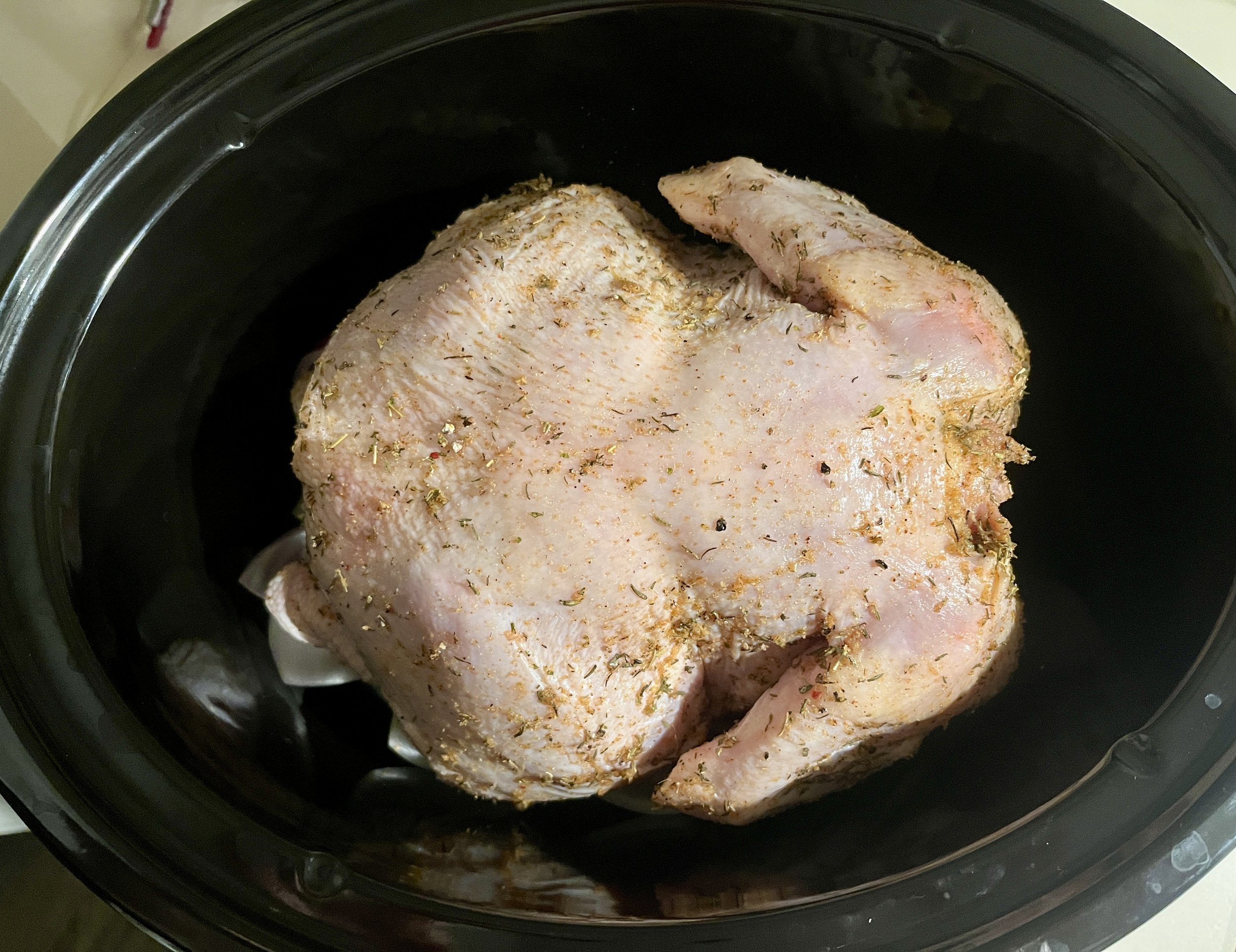
Once finished, pull the meat from the bone. The meat should slide off with ease. Throw out the bones and carcass. Add the meat to any dish for a delicious treat of protein!


Try This Move: Wide Grip Push Ups
Work your outer chest with wide grip push ups
Wide Grip Push Up
Start in a plank position. Move your hands two hand widths past your shoulders. Tuck your tail bone, squeeze your glutes. Rotate your elbows slightly back and in.
Descend to the ground, stopping a fists width off the ground. Keep your tailbone tucked, glutes tight, core engaged as you drive your hands through the floor back to the starting position.
3 sets x 10 repetitions
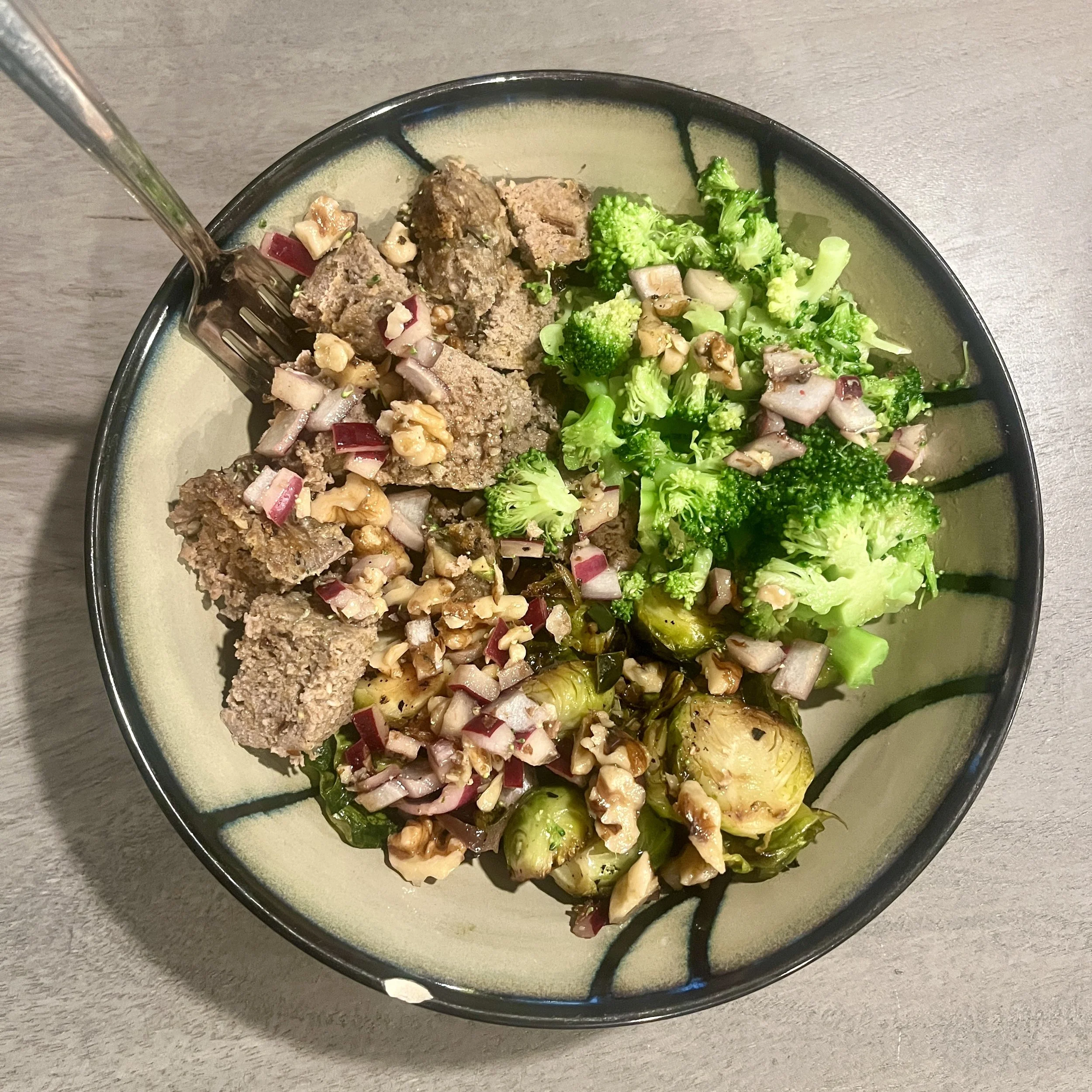
Beef and Broccoli Bowl
Veggies and beef bowl

Ground beef patty, with brussel sprouts, broccoli and dressing.
Beef patty. Bring a pan large enough to fit the meat to med-high heat, add a tbsp of olive oil. Use 1 lbs of 100% grass fed and finished or pasture raised ground beef. In a mixing bowl add the ground beef, 6 pinches of salt, 6 pinches of black pepper, 2 tbsp mustard, 2 tbsp Primal Buffalo Sauce, 1 egg (beat it before adding it), and 1/4 cup panko bread crumbs. Mix it all together.
Make 4 equal size meatballs using your hands. Add each meatball to the pan individually and flatten until each resembles a hamburger. Cook for 4-5 minutes undisturbed and then flip for another 4-5.
Brussel sprouts. Set a pan to medium-high heat. Cut the stems off and quarter or halve them (if bigger). Toss in a bowl with 1 tbsp of olive oil and two pinches of salt. Add brussels to the pan. Add a splash of water to the pan and cover. Let cook undisturbed for 5 minutes. Toss and cover for another 5.
Broccoli. Chop two broccoli crowns into bite size pieces. Bring a pot of water to boil. Add broccoli and let cook for 3 - 5 minutes. Once strained, add the broccoli back to the pan, add 2 pinches of salt and a tbsp of ghee and mix.
Dressing. 1 handful chopped walnuts, 1 slice of chopped onion, 2 tbsp of red wine vinegar, 1/2 tbsp of olive oil and 2 pinches of sea salt.
Assemble. Add 1 patty cut into bite size pieces, 1 handful of broccoli, 1 handful of brussel sprouts and drizzle with homemade dressing.
Buon Appetito!!
New Year, Happy and Healthy You!
Click here: OneSource Health, December 31, 2023
“People who live the longest have two dispositional traits in common: a positive attitude and a high degree of emotional awareness”
Happy New Year! Like you, I have big plans for this coming year. Growing this newsletter and my website continues to excite me. To help me stay focused and motivated I’ve been working on my 2023 Year In Review and 2024 Goals. They’re both simple documents that I created for myself in 2020 when I was looking for reassurance and guidance about my path. It’s a simple way to acknowledge your accomplishments over the previous 12 months, and visualize the next 12. Give it a try.
And if you’re looking for a good book to start the year, check out my Top Ten Favorites from 2023.
A Good Book, Podcast and Article
Ikigai: The Japanese Secret to a Long and Happy Life, by Héctor García and Francesc Miralles
I’ve realized recently that health begins with happiness. It doesn’t matter how much you move or how healthy you eat, if you’re unhappy then health will always evade you. This realization made this Ikigai, the perfect book to end the year and rein in the new one. You can find the book here, and read my takeaways here.
The Consistency Project with EC Synkowski: on Sleep Supplements, Separating Hype from Evidence
Last week I shared my takeaways from Tim Ferriss’ conversation with Andrew Huberman, Ph.D. This sleep stack, which I subsequently purchased, was part of those takeaways. This week I found an episode of The Consistency Project on sleep. I listened expecting to hear overlap and confirmation of Huberman’s advice. Boy was I wrong. You can listen here and read my takeaways here.
The Financial Samurai: 10 Helpful Financial Moves To Make Every Year
With the New Year in mind I also took Sam Dogen’s (The Financial Samurai) advice and did an exercise of “10 Helpful Financial Moves to Make Every Year.” You can read the article here and read my takeaways here.
Moves and Workouts to Try
Last Workout in the 4 Part Series
Over the last 3 weeks I’ve shared 3 variations of this full body workout. Each week the exercises have progressed in difficulty. This week, Progression IV, is the most challenging of them all. Give it a try, or work on the first one, two and three before advancing.
More Ways To Challenge Yourself With Push Ups
Having fun with exercise requires knowing all the moves. Check out these 4 push up variations to inject some excitement into your routine.
Modifying Workouts and Exercises
Sometimes our plans get interrupted. Like when the gym closes for Christmas or you run out time before finishing your workout. This week I shared two workouts I modified to complete them at home. Staying consistent is rule numero uno!
Shrimp and Seaweed Handrolls
Check out my one of my favorite meals, and many more by clicking here. Buon Appetito!

A Good Article on Annual Financial Moves to Make
Using The Financial Samurai’s guidelines, I went through and did a financial health check to kickoff the new year.
The Financial Samurai published a great post this week. 10 Helpful Financial Moves to Make Every Year. I decided it would be a good exercise to work through each one.
Review your asset location - Investors should rebalance at least twice a year.
My overall portfolio split:
70% in the stock market. 20% of which is in 401K and Roth IRA, and the rest is invested in 7 individual stocks and 1 ETF.
10% is in real estate through Fundrise, which will drop to <5% as of January 1 after liquidating half of that investment.
5% is in passive investments.
15% is in cash, increasing ~20% as of January 1. Since we’ve just relocated, and are focused on building our lives I don’t want to be beholden to the performance of the market. I’m still not convinced that we won’t experience a downturn in the next 12 - 18 months, and I’d rather have the cash on hand to invest in a house, a business, or cheap stocks, then manage the stress of selling stocks while the market is down. It helps that with increased interest rates my cash is earning 5%. In liquidating a lot of my positions I did miss out on additional gains in the last quarter of the year, but those extra gains assume I actually pulled money out while the market was up (see lesson #1 here). The term unrealized gains exists for a reason.
Review Your Income and Spending - Chances are high you're spending more than you realize
A review of credit card bills and an estimate of cash spent shows that last year we spent just slightly more than I would’ve guessed. We had some big expenses that I hadn’t anticipated (3 weeks in Switzerland, a 3 month road trip), but we also lived rent free for the summer and during our road trip our rent expense was limited to hotels and Airbnb’s.
Declutter and Donate to Charity - What expense are you currently carrying that you didn’t realize you picked up, and get rid of them in the new year.
Other than rent, our recurring monthly bills are minimal, and in 2024 we’ll lose some (interest free debt) and pick up others (health insurance, car expense). Variable expenses (as opposed to fixed expenses) like food, travel and health items (gym, supplements etc…) make up the bulk of our expenses. So we can limit them if needed. Since our expenses are not overly extravagant, trying to reduce the cost of living for us seems futile. Instead I’ll be focused on increasing top line income in 2024.
Update Your Resume
It’s hard to update your resume when you haven’t worked in five years. Very likely the reason I haven’t received one positive response from the 40 applications I’ve submitted over the last 1.5 years. Just one more reason I can’t go back to work.
Part of this rule is to look back at everything you’ve accomplished over the lat year, which is an exercise I started doing back in 2020. In the beginning of January I write My Year In Review, followed by Goals and Plans. In the review I go as far as listing individual books I read, miles I ran, or countries I visited. I take stock of my financial position, and I do a reassessment of my allocations (Rule #1 for Sam). In my look forward, I layout things I want to accomplish. A specific trip. Getting involved in a certain industry. I also start thinking about expenses that are coming up, which investment(s) I need to liquidate, and how to do this while achieving my financial goals.
Keep Yourself and Your Family Safe - Besides health care, please make sure your housing insurance, car insurance, and personal property insurance coverage are enough
A few years ago I explored purchasing life insurance. At the time I thought there was an opportunity to use it as an investment. When I found out I was wrong I nixed the whole idea. But now that we’re starting to build a life together I’m going to explore my options again.
Review Your Estate - At least have a will, or have an updated will if your financial circumstances have significantly changed.
Similar to life insurance I never felt the need to have a living will. But that’s changed. I’ve seen advertisements for Livingwill.com and given the simplicity of my life I’m going to explore to see if using this site is a possibility.
Forecast Future Tax Liabilities - Plan for your future tax liabilities by doing a pro formal analysis on your expected income and expenses.
In 2023 I liquidated a sizable amount of my stock portfolio and I have long term capital gains taxes as a result. One reason I liquidated a large portion was to invest in ourselves and a home as I mentioned above. The second reason is that I plan on generating taxable income this year. Since taxable income and capital gains combine to raise your tax bracket, by selling stocks in 2023 I’ve lowered the tax burden in 2024.
Tie Up Loose Ends - Start the new year with the least amount of baggage possible so you have maximum momentum to achieve your new goals.
His list is mostly financial, mine is more functional.
Colorado driver’s license (appt Jan 2)
Annual doctors visit (appt Jan 9)
Car registration
Taking care of all of these to do items won’t directly help with achieving financial goals, but they can indirectly hurt them. Having a long to do list takes energy and attention away from achieving bigger goals. Knocking off these items on your list frees up that brain space to focus.
Run Your Investment Portfolio Through A Free Checker
The Financial Samurai suggests using Empower’s Retirement Fee Analyzer. I haven’t done this and I probably won’t. It requires linking all of your accounts to their website, and that’s something that I’ve become skeptical of in recent years. I like to limit who has access to my information. With that said, millions of people use these apps, and if you’re inclined for a free checkup, go for it. I give my portfolio a lot of attention, and I feel confident that it’s in a good position.
Rekindle Neglected Relationships
If I’ve neglected you over the last year, I apologize and I’ll do better in 2024. Living on the road, moving and focusing on building a life takes its toll. But I love every one of you and I plan on being more present in 2024.
Bonus: Work On Your X-Factor
This is it. I’m doing it. It’s taken me five years to figure out what I’m doing, but now that I’m here I feel great about it. In 2024 I plan on building this newsletter, building my website, and growing my reach to see how many people I can connect with on promoting health, wealth and happiness!

A Good Book For A Happy and Long Life
“Mens sana in corpore sano,” a sound mind in a sound body, the health of one is connected to the other.
Ikigai, The Japanese Secret to a Long and Happy Life
“Mens sana in corpore sano,” a sound mind in a sound body, the health of one is connected to the other.
Ikigai, is one of the most practical and concise books I’ve ever read on the fundamentals of life. It reminded me a lot of The Lion Trackers Guide to Life (a book I’ve gifted and re-read multiple times) for the simplicity and authenticity of its message. Through research and interviews of residents of Okinawa, home to the longest life expectancy in the world, authors Hector García and Francesc Miralles deliver a comprehensive guide to living your most fulfilling life.
Okinawa is one of the five Blue Zones first identified by Dan Buettner. While each of the Blue Zones differs in location, language, and culture, researchers have identified a few common traits they all share. Regular exercise, locally sourced whole food diets, a purpose (an Ikigai), and being part of a strong community.
People who live the longest also limit avoidable stress (the cause of most health problems according to the American Institute of Stress, read Why Zebras Don’t Have Ulcers to learn how this work), maintain a positive outlook on life, and have a high degree of emotional awareness.
Put simply, “the grand essentials to happiness in this life are something to do, something to love, and something to hope for.” Finding your Ikigai, roughly translated as “the happiness of always being busy,” covers all of it.
And as you might assume, the opposite is also true. Being sedentary, lacking purpose, being distracted by money, power and material goods, and overthinking causes anxiety, stress and subsequently disease.
I found this quote in the book from Shoma Morita, creator of Morita Therapy, a technique that teaches patients to accept their emotions, particularly insightful:
“A donkey that is tied to a post by a rope will keep walking around the post in an attempt to free itself, only to become more immobilized and attached to the post. The same thing applies to people with obsessive thinking who become more trapped in their own suffering when they try to escape from their fears and discomforts”
It’s estimated that we have 60,000 thoughts per day. And most of them are not good. Getting tied around your thoughts is not hard to do.
In Ikigai authors Hector Garcia and Francesc Miralles also talk about the importance of “flow,” a term coined by psychologist Mihaly Csikszentmihalyis, and described as “the pleasure, delight, creativity, and process when we are completely immersed in life.” They go further to say “Concentrating on one thing at a time may be the single most important factor in achieving flow.” It turns out that contrary to popular belief, when we multi-task and “ask our brains to switch back and forth between tasks, we waste time, make more mistakes, and remember less of what we’ve done.”
Ikigai, the book and the phrase, are about living in the now, and enjoying the things that bring us pleasure. By freeing ourselves from distractions, and focusing on the things that we truly find joy in, we too can achieve a long and happy life.

A Good Podcast On Sleep
EC Synkowski spent this Episode of The Consistency Project debunking Andrew Huberman, and now I’m torn.
Last week I shared my takeaways from Tim Ferriss’ conversation with Andrew Huberman, Ph.D. A recommended sleep stack, which I subsequently purchased, was part of those takeaways. This week I found an episode of The Consistency Project on sleep. I listened expecting to hear overlap and confirmation of Huberman’s advice. Boy was I wrong. In fact, the episode is mainly dedicated to calling his recommendations into question for lacking scientific basis (something EC Synkowski emphasizes).
I got my stack in the mail Friday. In two nights of use I’ve found it easier to disassociate from my thoughts at bedtime (a benefit Huberman spoke about) and therefore fall asleep quicker, and I’ve experienced deeper sleep. This is purely anecdotal as I don’t wear a sleep tracking device. Perhaps it’s just placebo, something EC Synkowski discusses. I bought a 60 day supply and I’ll at least see that through, but I’m still pretty conflicted based on EC Synkoskiw’s advice that not one of the benefits Huberman cited has been scientifically proven.
It’s worth noting that a main reason for her skepticism is an overall disbelief in supplements, regardless of their purported benefits. Her belief, which I share, is that most everything can be achieved by getting diet and exercise right. Regardless, since these are two experts I regard highly I’m determined to understand how they could differ so greatly and I’ll be looking into the “disconnect” over the next few weeks.
If you need help sleeping, she recommends following these 14 Guidelines for sleep published by The American Academy of Sleep Medicine.
Keep a consistent sleep schedule. Get up at the same time every day, even on weekends or during vacations.
Set a bedtime that is early enough for you to get at least 7 hours of sleep.
Don’t go to bed unless you are sleepy.
If you don’t fall asleep after 20 minutes, get out of bed.
Establish a relaxing bedtime routine.
Use your bed only for sleep and sex.
Make your bedroom quiet and relaxing. Keep the room at a comfortable, cool temperature.
Limit exposure to bright light in the evenings.
Turn off electronic devices at least 30 minutes before bedtime.
Don’t eat a large meal before bedtime. If you are hungry at night, eat a light, healthy snack.
Exercise regularly and maintain a healthy diet.
Avoid consuming caffeine in the late afternoon or evening.
Avoid consuming alcohol before bedtime.
Reduce your fluid intake before bedtime.
It’s a lengthy list, but with the right routines, you can easily knock off most of them. We follow as many as we can and have an informal routine. Every night as bedtime approaches, around 10 o’clock in our house, we start turning off and down the lights. We set the temperature to 67 Fahrenheit (Jen thinks it’s 68). We don’t drink ☑️, and I try diligently to not have caffeine after 12 noon. I also stretch every night for 4 minutes before bed. Quad stretch, calf stretch, hamstring stretch, and elevated pigeon on the bed. I hold each position for 30 seconds (4 muscles, 2 sides, = 4 mins). Stretching really helps get me into bed relaxed.
Which ones do you practice? Which ones do you struggle with? What’s one thing you could change that would improve your sleep habits?

Spicy Roasted Carrots
Spice up your carrots with this easy and delicious recipe
Cooking Instructions:
Preheat the oven to 425.
Cut 5 - 6 carrots in half, and then again lengthwise. Then cut on a slant into bite size pieces and toss in a bowl or cooking dish (glass Pyrex works).
Add 4 pinches of sea salt.
Add 4 pinches of black pepper
Add 2 tbsp of olive oil.
Add 1 tbsp of fermented chili paste.
Add 1 tsp of hot sauce.
Toss with your hands until the carrots are evenly coated.
Place in the oven and cook for 20-25 minutes (23 was the magic number for me).
Add a handful to any dish for a delicious treat!

Delicious and Hearty Lentil Soup
Veggie lentil soup is great dish to have on hand and dress up with chicken or more veggies.
Green lentils have become one of my favorite foods. And making lentil soup is a great way to enjoy them. Check out this hearty recipe and keep some soup in your fridge.
Cooking Instructions:
Bring a pot to medium heat. Add 2 tbsp of olive to the pan, and then add 2 chopped carrots, 1/2 chopped celery stalk, 4 cloves of chopped garlic, 2 slices of chopped white or yellow onion. Allow to cook for about 5 minutes.
Then add 2 cups of vegetable broth, 1 cup of water, 1/2 cup of lentils, 3 sliced campari tomatoes, 2 bay leaves, 1 tsp of dry parsley, 2 pinches of sea salt and a few cracks of fresh black pepper. Bring to a boil and then down to a simmer and allow to cook for 20 minutes.

Then quarter 6 - 8 crimini mushrooms and add them to the pot. Allow to cook for another 25 minutes.

Remove from heat and enjoy!

Top 10 Books Read in 2023
My favorite 10 books read in 2023.
Every year I get great pleasure out of reading good books, and I’m always pushing those books onto my friends and loved ones who I think would enjoy them as well. This year I’m sharing the Top 10 books I read (not published) in 2023. The list includes book dedicated to Personal Development, Personal Finance / Financial Freedom, Non-Fiction, and Fiction.
Each one of these books shaped my year in a different way and I hope that they can do the same thing for you.
Happy Reading!
Personal Development
Atomic Habits: An Easy and Proven Way to Build Good Habits and Break Bad Ones, by James Clear - I put this book off for a long time, dismissing it’s popularity as a fluke. But I bought a copy after listening to James Clear on the Joe Rogan Experience [link] and realized how closely I aligned with what he had to say. After reading Atomic Habits it became clear why the book is so popular. For me, it built on the concepts and knowledge I gained from The Power of Habit by Charles Duhigg, but it also provided actionable ways to improve. Combined, these two books create the perfect framework to re-route and build better habits.
Scattered Minds: The Origins and Healing of Attention Deficit Disorder, by Gabor Matè - Scattered Minds builds on the lessons from In The Realm of Hungry Ghosts (what really causes addiction). Attention Deficit Disorder is not what you think it is. In fact, nothing is. Our lives and who we are, or who we think we are, are all shaped by the experiences and traumas we’ve faced throughout our lives. Every experience shapes you. After reading this book you’ll have a better understanding of human behavior, your own struggles with ADD/ADHD, and have greater sympathy for those struggling around you.
The Age of Scientific Wellness: Why the Future of Medicine Is Personalized, Predictive, Data-Rich, and in Your Hands, by Leroy Hood and Nathan Price - It’s no secret that the healthcare system is broken. I saw it firsthand in my 10 years working in the industry. This book provides hope that big shifts in technology and ways of monitoring our health will usher in a new age of healthcare that is desperately needed. I loved this book, and although it sounds dense, it’s really well written and an easy read. If you’re curious about the future of healthcare, and/or you want to know where the opportunities might be, then this is a great book to read.
Personal Finance / Financial Freedom
Buy This, Not That: How To Spend Your Way To Wealth And Freedom, by Sam Dogen (aka The Financial Samurai) - I wish I read Buy This, Not That 15 years ago (it wasn’t out then) when I was just starting my career. I wish I read it 5 years ago when I left my job. I really think this book is a must read for anyone who is looking for a practical and informative guide on how to achieve independence and wealth. Sam lays out actionable items, and provides real world examples to relate to. He also does it in a way that is easy to understand and follow. For followers of the Financial Samurai blog and newsletter, this book wraps up the lessons he teaches us each week with a nice little bow. I've already purchased an additional copy for my 16 year old nephew and I plan on buying a few more for people who I know could benefit. Great book.
Same As Ever: Timeless Lessons on Risks, Opportunity, and Living a Good Life, by Morgan Housel - I enjoyed this book more than his first book, The Psychology of Money. Which is saying a lot. Same As Ever thought offers more practical advice that can be used across all areas of your life. There were a handful of chapters, like Time Horizons and Trying Too Hard, which really hit home for me. This book and Buy This, Not That both came into my life at the exact right, when after 5 years of hiatus, I’m starting to put the pieces back together and planning for the future. I loved this book and would recommend it to anyone.
Non-Fiction
A Place of My Own: The Architecture of Daydreams, by Michael Pollan - Only Michael Pollan can bring a writing shed to life. And do it while simultaneously teaching us about the interconnectedness of our lives and nature. This book is engaging and written with the same elegance that is present in all of his books. The book is also filled with practical information and lessons on how to approach building a structure. This book, like all of his, has inspired me to keep reading, writing, and looking for the connections around us.
Uncommon Grounds: The History of Coffee and How It Transformed Our World, by Mark Pendergast - Coffee, like most commodities, has a brutal past. This book reminded me a lot of the story told in The Fish That Ate The Whale. Deception. Greed. U.S. backed governments coups. These are all part of coffee’s history. In spite of it’s horrid past, the production of coffee and the industry around it, has come a long way. The difference between what you see today at your local or chain coffee shop and what you’ll learn in this book will shock you and make you appreciate the ease at which we now consume our most important drug.
The New Fish: The Truth About Farmed Salmon and the Consequences We Can No Longer Ignore, by Simen Saetre and Kjetil Ostli - As a health freak who lived on salmon (mostly farmed, yikes) for years, I recently become interested to learn more about the farmed fish industry. The New Fish is a really well written piece of investigative journalism that dives into the farmed salmon and aquaculture industries, their practices, who holds influence over them, and what some people are doing to try and change it. Everyone should know where their food comes from, and with 70 percent of the worlds salmon now coming from farms, it behooves all of us to learn what that means and what impact it has. This book is about farmed salmon, but the tactics used are the same in every industry. Farmed fish, compared to livestock farming, is still in its infancy. It’s interesting to learn how an industry developed so quickly around something no one knew anything about. This is a great read.
Fiction
The Invention of Wings, by Sue Monk Kidd - The Invention of Wings is a beautifully written piece of historical fiction. Set in Charleston, South Carolina, this books tells the story of a young slave and her reluctant master, a child herself, who are fighting to realize the same dream. Freedom. We picked this book up last winter on a road trip through the south, where the history of slavery retains a permanent place in the local culture. The Invention of Wings will take you on a journey, and bring you front and center to bear witness to the atrocities and injustices that occurred, and continue to shape the lives of so many people today.
Black Dog Escape, by WL Bach - On the surface Black Dog Escape is about a former Navy SEAL fighting the demons of war and trying to make a new life for himself after retiring from combat. But I found there was a lot for non-combat citizens to relate to as well. We all have something that tugs at our happiness, and can bring us into a dark place. As Plato says and WL Bach quotes in the book, "Be kind, for everyone you meet is fighting a hard battle." For the main character, Jack, it’s his war induced PTSD, and for the rest of us it’s the relative trauma we’ve experienced in our lives. I chose to read Black Dog Escape to take a break from all the self-improvement and health related books I’d been immersed in this year. Turns out, this was one of the best self-improvement books I read all year.