
A Good Article on Annual Financial Moves to Make
Using The Financial Samurai’s guidelines, I went through and did a financial health check to kickoff the new year.
The Financial Samurai published a great post this week. 10 Helpful Financial Moves to Make Every Year. I decided it would be a good exercise to work through each one.
Review your asset location - Investors should rebalance at least twice a year.
My overall portfolio split:
70% in the stock market. 20% of which is in 401K and Roth IRA, and the rest is invested in 7 individual stocks and 1 ETF.
10% is in real estate through Fundrise, which will drop to <5% as of January 1 after liquidating half of that investment.
5% is in passive investments.
15% is in cash, increasing ~20% as of January 1. Since we’ve just relocated, and are focused on building our lives I don’t want to be beholden to the performance of the market. I’m still not convinced that we won’t experience a downturn in the next 12 - 18 months, and I’d rather have the cash on hand to invest in a house, a business, or cheap stocks, then manage the stress of selling stocks while the market is down. It helps that with increased interest rates my cash is earning 5%. In liquidating a lot of my positions I did miss out on additional gains in the last quarter of the year, but those extra gains assume I actually pulled money out while the market was up (see lesson #1 here). The term unrealized gains exists for a reason.
Review Your Income and Spending - Chances are high you're spending more than you realize
A review of credit card bills and an estimate of cash spent shows that last year we spent just slightly more than I would’ve guessed. We had some big expenses that I hadn’t anticipated (3 weeks in Switzerland, a 3 month road trip), but we also lived rent free for the summer and during our road trip our rent expense was limited to hotels and Airbnb’s.
Declutter and Donate to Charity - What expense are you currently carrying that you didn’t realize you picked up, and get rid of them in the new year.
Other than rent, our recurring monthly bills are minimal, and in 2024 we’ll lose some (interest free debt) and pick up others (health insurance, car expense). Variable expenses (as opposed to fixed expenses) like food, travel and health items (gym, supplements etc…) make up the bulk of our expenses. So we can limit them if needed. Since our expenses are not overly extravagant, trying to reduce the cost of living for us seems futile. Instead I’ll be focused on increasing top line income in 2024.
Update Your Resume
It’s hard to update your resume when you haven’t worked in five years. Very likely the reason I haven’t received one positive response from the 40 applications I’ve submitted over the last 1.5 years. Just one more reason I can’t go back to work.
Part of this rule is to look back at everything you’ve accomplished over the lat year, which is an exercise I started doing back in 2020. In the beginning of January I write My Year In Review, followed by Goals and Plans. In the review I go as far as listing individual books I read, miles I ran, or countries I visited. I take stock of my financial position, and I do a reassessment of my allocations (Rule #1 for Sam). In my look forward, I layout things I want to accomplish. A specific trip. Getting involved in a certain industry. I also start thinking about expenses that are coming up, which investment(s) I need to liquidate, and how to do this while achieving my financial goals.
Keep Yourself and Your Family Safe - Besides health care, please make sure your housing insurance, car insurance, and personal property insurance coverage are enough
A few years ago I explored purchasing life insurance. At the time I thought there was an opportunity to use it as an investment. When I found out I was wrong I nixed the whole idea. But now that we’re starting to build a life together I’m going to explore my options again.
Review Your Estate - At least have a will, or have an updated will if your financial circumstances have significantly changed.
Similar to life insurance I never felt the need to have a living will. But that’s changed. I’ve seen advertisements for Livingwill.com and given the simplicity of my life I’m going to explore to see if using this site is a possibility.
Forecast Future Tax Liabilities - Plan for your future tax liabilities by doing a pro formal analysis on your expected income and expenses.
In 2023 I liquidated a sizable amount of my stock portfolio and I have long term capital gains taxes as a result. One reason I liquidated a large portion was to invest in ourselves and a home as I mentioned above. The second reason is that I plan on generating taxable income this year. Since taxable income and capital gains combine to raise your tax bracket, by selling stocks in 2023 I’ve lowered the tax burden in 2024.
Tie Up Loose Ends - Start the new year with the least amount of baggage possible so you have maximum momentum to achieve your new goals.
His list is mostly financial, mine is more functional.
Colorado driver’s license (appt Jan 2)
Annual doctors visit (appt Jan 9)
Car registration
Taking care of all of these to do items won’t directly help with achieving financial goals, but they can indirectly hurt them. Having a long to do list takes energy and attention away from achieving bigger goals. Knocking off these items on your list frees up that brain space to focus.
Run Your Investment Portfolio Through A Free Checker
The Financial Samurai suggests using Empower’s Retirement Fee Analyzer. I haven’t done this and I probably won’t. It requires linking all of your accounts to their website, and that’s something that I’ve become skeptical of in recent years. I like to limit who has access to my information. With that said, millions of people use these apps, and if you’re inclined for a free checkup, go for it. I give my portfolio a lot of attention, and I feel confident that it’s in a good position.
Rekindle Neglected Relationships
If I’ve neglected you over the last year, I apologize and I’ll do better in 2024. Living on the road, moving and focusing on building a life takes its toll. But I love every one of you and I plan on being more present in 2024.
Bonus: Work On Your X-Factor
This is it. I’m doing it. It’s taken me five years to figure out what I’m doing, but now that I’m here I feel great about it. In 2024 I plan on building this newsletter, building my website, and growing my reach to see how many people I can connect with on promoting health, wealth and happiness!

A Good Book For A Happy and Long Life
“Mens sana in corpore sano,” a sound mind in a sound body, the health of one is connected to the other.
Ikigai, The Japanese Secret to a Long and Happy Life
“Mens sana in corpore sano,” a sound mind in a sound body, the health of one is connected to the other.
Ikigai, is one of the most practical and concise books I’ve ever read on the fundamentals of life. It reminded me a lot of The Lion Trackers Guide to Life (a book I’ve gifted and re-read multiple times) for the simplicity and authenticity of its message. Through research and interviews of residents of Okinawa, home to the longest life expectancy in the world, authors Hector García and Francesc Miralles deliver a comprehensive guide to living your most fulfilling life.
Okinawa is one of the five Blue Zones first identified by Dan Buettner. While each of the Blue Zones differs in location, language, and culture, researchers have identified a few common traits they all share. Regular exercise, locally sourced whole food diets, a purpose (an Ikigai), and being part of a strong community.
People who live the longest also limit avoidable stress (the cause of most health problems according to the American Institute of Stress, read Why Zebras Don’t Have Ulcers to learn how this work), maintain a positive outlook on life, and have a high degree of emotional awareness.
Put simply, “the grand essentials to happiness in this life are something to do, something to love, and something to hope for.” Finding your Ikigai, roughly translated as “the happiness of always being busy,” covers all of it.
And as you might assume, the opposite is also true. Being sedentary, lacking purpose, being distracted by money, power and material goods, and overthinking causes anxiety, stress and subsequently disease.
I found this quote in the book from Shoma Morita, creator of Morita Therapy, a technique that teaches patients to accept their emotions, particularly insightful:
“A donkey that is tied to a post by a rope will keep walking around the post in an attempt to free itself, only to become more immobilized and attached to the post. The same thing applies to people with obsessive thinking who become more trapped in their own suffering when they try to escape from their fears and discomforts”
It’s estimated that we have 60,000 thoughts per day. And most of them are not good. Getting tied around your thoughts is not hard to do.
In Ikigai authors Hector Garcia and Francesc Miralles also talk about the importance of “flow,” a term coined by psychologist Mihaly Csikszentmihalyis, and described as “the pleasure, delight, creativity, and process when we are completely immersed in life.” They go further to say “Concentrating on one thing at a time may be the single most important factor in achieving flow.” It turns out that contrary to popular belief, when we multi-task and “ask our brains to switch back and forth between tasks, we waste time, make more mistakes, and remember less of what we’ve done.”
Ikigai, the book and the phrase, are about living in the now, and enjoying the things that bring us pleasure. By freeing ourselves from distractions, and focusing on the things that we truly find joy in, we too can achieve a long and happy life.

A Good Podcast On Sleep
EC Synkowski spent this Episode of The Consistency Project debunking Andrew Huberman, and now I’m torn.
Last week I shared my takeaways from Tim Ferriss’ conversation with Andrew Huberman, Ph.D. A recommended sleep stack, which I subsequently purchased, was part of those takeaways. This week I found an episode of The Consistency Project on sleep. I listened expecting to hear overlap and confirmation of Huberman’s advice. Boy was I wrong. In fact, the episode is mainly dedicated to calling his recommendations into question for lacking scientific basis (something EC Synkowski emphasizes).
I got my stack in the mail Friday. In two nights of use I’ve found it easier to disassociate from my thoughts at bedtime (a benefit Huberman spoke about) and therefore fall asleep quicker, and I’ve experienced deeper sleep. This is purely anecdotal as I don’t wear a sleep tracking device. Perhaps it’s just placebo, something EC Synkowski discusses. I bought a 60 day supply and I’ll at least see that through, but I’m still pretty conflicted based on EC Synkoskiw’s advice that not one of the benefits Huberman cited has been scientifically proven.
It’s worth noting that a main reason for her skepticism is an overall disbelief in supplements, regardless of their purported benefits. Her belief, which I share, is that most everything can be achieved by getting diet and exercise right. Regardless, since these are two experts I regard highly I’m determined to understand how they could differ so greatly and I’ll be looking into the “disconnect” over the next few weeks.
If you need help sleeping, she recommends following these 14 Guidelines for sleep published by The American Academy of Sleep Medicine.
Keep a consistent sleep schedule. Get up at the same time every day, even on weekends or during vacations.
Set a bedtime that is early enough for you to get at least 7 hours of sleep.
Don’t go to bed unless you are sleepy.
If you don’t fall asleep after 20 minutes, get out of bed.
Establish a relaxing bedtime routine.
Use your bed only for sleep and sex.
Make your bedroom quiet and relaxing. Keep the room at a comfortable, cool temperature.
Limit exposure to bright light in the evenings.
Turn off electronic devices at least 30 minutes before bedtime.
Don’t eat a large meal before bedtime. If you are hungry at night, eat a light, healthy snack.
Exercise regularly and maintain a healthy diet.
Avoid consuming caffeine in the late afternoon or evening.
Avoid consuming alcohol before bedtime.
Reduce your fluid intake before bedtime.
It’s a lengthy list, but with the right routines, you can easily knock off most of them. We follow as many as we can and have an informal routine. Every night as bedtime approaches, around 10 o’clock in our house, we start turning off and down the lights. We set the temperature to 67 Fahrenheit (Jen thinks it’s 68). We don’t drink ☑️, and I try diligently to not have caffeine after 12 noon. I also stretch every night for 4 minutes before bed. Quad stretch, calf stretch, hamstring stretch, and elevated pigeon on the bed. I hold each position for 30 seconds (4 muscles, 2 sides, = 4 mins). Stretching really helps get me into bed relaxed.
Which ones do you practice? Which ones do you struggle with? What’s one thing you could change that would improve your sleep habits?

Spicy Roasted Carrots
Spice up your carrots with this easy and delicious recipe
Cooking Instructions:
Preheat the oven to 425.
Cut 5 - 6 carrots in half, and then again lengthwise. Then cut on a slant into bite size pieces and toss in a bowl or cooking dish (glass Pyrex works).
Add 4 pinches of sea salt.
Add 4 pinches of black pepper
Add 2 tbsp of olive oil.
Add 1 tbsp of fermented chili paste.
Add 1 tsp of hot sauce.
Toss with your hands until the carrots are evenly coated.
Place in the oven and cook for 20-25 minutes (23 was the magic number for me).
Add a handful to any dish for a delicious treat!

Delicious and Hearty Lentil Soup
Veggie lentil soup is great dish to have on hand and dress up with chicken or more veggies.
Green lentils have become one of my favorite foods. And making lentil soup is a great way to enjoy them. Check out this hearty recipe and keep some soup in your fridge.
Cooking Instructions:
Bring a pot to medium heat. Add 2 tbsp of olive to the pan, and then add 2 chopped carrots, 1/2 chopped celery stalk, 4 cloves of chopped garlic, 2 slices of chopped white or yellow onion. Allow to cook for about 5 minutes.
Then add 2 cups of vegetable broth, 1 cup of water, 1/2 cup of lentils, 3 sliced campari tomatoes, 2 bay leaves, 1 tsp of dry parsley, 2 pinches of sea salt and a few cracks of fresh black pepper. Bring to a boil and then down to a simmer and allow to cook for 20 minutes.

Then quarter 6 - 8 crimini mushrooms and add them to the pot. Allow to cook for another 25 minutes.

Remove from heat and enjoy!

Top 10 Books Read in 2023
My favorite 10 books read in 2023.
Every year I get great pleasure out of reading good books, and I’m always pushing those books onto my friends and loved ones who I think would enjoy them as well. This year I’m sharing the Top 10 books I read (not published) in 2023. The list includes book dedicated to Personal Development, Personal Finance / Financial Freedom, Non-Fiction, and Fiction.
Each one of these books shaped my year in a different way and I hope that they can do the same thing for you.
Happy Reading!
Personal Development
Atomic Habits: An Easy and Proven Way to Build Good Habits and Break Bad Ones, by James Clear - I put this book off for a long time, dismissing it’s popularity as a fluke. But I bought a copy after listening to James Clear on the Joe Rogan Experience [link] and realized how closely I aligned with what he had to say. After reading Atomic Habits it became clear why the book is so popular. For me, it built on the concepts and knowledge I gained from The Power of Habit by Charles Duhigg, but it also provided actionable ways to improve. Combined, these two books create the perfect framework to re-route and build better habits.
Scattered Minds: The Origins and Healing of Attention Deficit Disorder, by Gabor Matè - Scattered Minds builds on the lessons from In The Realm of Hungry Ghosts (what really causes addiction). Attention Deficit Disorder is not what you think it is. In fact, nothing is. Our lives and who we are, or who we think we are, are all shaped by the experiences and traumas we’ve faced throughout our lives. Every experience shapes you. After reading this book you’ll have a better understanding of human behavior, your own struggles with ADD/ADHD, and have greater sympathy for those struggling around you.
The Age of Scientific Wellness: Why the Future of Medicine Is Personalized, Predictive, Data-Rich, and in Your Hands, by Leroy Hood and Nathan Price - It’s no secret that the healthcare system is broken. I saw it firsthand in my 10 years working in the industry. This book provides hope that big shifts in technology and ways of monitoring our health will usher in a new age of healthcare that is desperately needed. I loved this book, and although it sounds dense, it’s really well written and an easy read. If you’re curious about the future of healthcare, and/or you want to know where the opportunities might be, then this is a great book to read.
Personal Finance / Financial Freedom
Buy This, Not That: How To Spend Your Way To Wealth And Freedom, by Sam Dogen (aka The Financial Samurai) - I wish I read Buy This, Not That 15 years ago (it wasn’t out then) when I was just starting my career. I wish I read it 5 years ago when I left my job. I really think this book is a must read for anyone who is looking for a practical and informative guide on how to achieve independence and wealth. Sam lays out actionable items, and provides real world examples to relate to. He also does it in a way that is easy to understand and follow. For followers of the Financial Samurai blog and newsletter, this book wraps up the lessons he teaches us each week with a nice little bow. I've already purchased an additional copy for my 16 year old nephew and I plan on buying a few more for people who I know could benefit. Great book.
Same As Ever: Timeless Lessons on Risks, Opportunity, and Living a Good Life, by Morgan Housel - I enjoyed this book more than his first book, The Psychology of Money. Which is saying a lot. Same As Ever thought offers more practical advice that can be used across all areas of your life. There were a handful of chapters, like Time Horizons and Trying Too Hard, which really hit home for me. This book and Buy This, Not That both came into my life at the exact right, when after 5 years of hiatus, I’m starting to put the pieces back together and planning for the future. I loved this book and would recommend it to anyone.
Non-Fiction
A Place of My Own: The Architecture of Daydreams, by Michael Pollan - Only Michael Pollan can bring a writing shed to life. And do it while simultaneously teaching us about the interconnectedness of our lives and nature. This book is engaging and written with the same elegance that is present in all of his books. The book is also filled with practical information and lessons on how to approach building a structure. This book, like all of his, has inspired me to keep reading, writing, and looking for the connections around us.
Uncommon Grounds: The History of Coffee and How It Transformed Our World, by Mark Pendergast - Coffee, like most commodities, has a brutal past. This book reminded me a lot of the story told in The Fish That Ate The Whale. Deception. Greed. U.S. backed governments coups. These are all part of coffee’s history. In spite of it’s horrid past, the production of coffee and the industry around it, has come a long way. The difference between what you see today at your local or chain coffee shop and what you’ll learn in this book will shock you and make you appreciate the ease at which we now consume our most important drug.
The New Fish: The Truth About Farmed Salmon and the Consequences We Can No Longer Ignore, by Simen Saetre and Kjetil Ostli - As a health freak who lived on salmon (mostly farmed, yikes) for years, I recently become interested to learn more about the farmed fish industry. The New Fish is a really well written piece of investigative journalism that dives into the farmed salmon and aquaculture industries, their practices, who holds influence over them, and what some people are doing to try and change it. Everyone should know where their food comes from, and with 70 percent of the worlds salmon now coming from farms, it behooves all of us to learn what that means and what impact it has. This book is about farmed salmon, but the tactics used are the same in every industry. Farmed fish, compared to livestock farming, is still in its infancy. It’s interesting to learn how an industry developed so quickly around something no one knew anything about. This is a great read.
Fiction
The Invention of Wings, by Sue Monk Kidd - The Invention of Wings is a beautifully written piece of historical fiction. Set in Charleston, South Carolina, this books tells the story of a young slave and her reluctant master, a child herself, who are fighting to realize the same dream. Freedom. We picked this book up last winter on a road trip through the south, where the history of slavery retains a permanent place in the local culture. The Invention of Wings will take you on a journey, and bring you front and center to bear witness to the atrocities and injustices that occurred, and continue to shape the lives of so many people today.
Black Dog Escape, by WL Bach - On the surface Black Dog Escape is about a former Navy SEAL fighting the demons of war and trying to make a new life for himself after retiring from combat. But I found there was a lot for non-combat citizens to relate to as well. We all have something that tugs at our happiness, and can bring us into a dark place. As Plato says and WL Bach quotes in the book, "Be kind, for everyone you meet is fighting a hard battle." For the main character, Jack, it’s his war induced PTSD, and for the rest of us it’s the relative trauma we’ve experienced in our lives. I chose to read Black Dog Escape to take a break from all the self-improvement and health related books I’d been immersed in this year. Turns out, this was one of the best self-improvement books I read all year.

Chicken Thigh Fruit & Veggie Salad
A sweet and savory salad to enjoy

Chicken thigh salad: Arugula, tofu, beets, chickpeas, tomato, red onion raspberry, blueberry. With homemade sauce
This bowl has a lot going on, but it’s still light while being satiating.
Chicken. Buy a pack of organic free range chicken thighs (pasture raised is best if you can get it). Preheat the oven to 425. Put the chicken thighs into a Pyrex. Coat them lightly in enough olive oil so they don’t stick to the dish. Add a pinch of salt to each one (each side), black pepper, onion powder, garlic powder and a touch of cayenne pepper. Add a little water to the dish. Leave them right side up. Cook at 425 for 20 minutes.
Beets. Buy 3-4 loose organic beets. Remove the skin. Cut them into quarters (1/8s if they’re large). Place in a pot, add water so covered by 1-2 inches of water. Add two pinches of salt. 1 tbsp of red wine vinegar. Bring to a boil then reduce to a simmer for 60 minutes.
Chickpeas. Preheat the oven to 350. Drain and rinse one can of organic garbanzo beans. In a bowl mix beans, 1 tbsp olive oil, 2 pinches of sea salt, generous amounts of black pepper, 2 - 3 pinches of cayenne pepper, and lemon juice from 1/2 a lemon if you have it. Line a tray with aluminum foil. Spread beans evenly, not on top of each other. Roast for 13-15 minutes (longer if you’d like a crunchier chickpea).
Homemade Sauces. 1 tbsp Primal Buffalo sauce, 1 tbsp olive oil, 1/2 tbsp red wine vinegar, 1/2 tbsp fig balsamic vinegar, 2 pinches of sea salt.
Assemble. Add a handful of arugula, a handful of blueberries, a handful of raspberries, 1 small sliced tomato, 1 slice of tofu chopped into bite size pieces, and 1 slice of red onion chopped. Add 1 chicken thigh chopped into bite size pieces, 1 handful of beets, 1 handful of chickpeas. Drizzle homemade sauce over the top.
Buon Appetito!!
Year In Review And Planning For The Future
Acknowledge your accomplishments, and plan for your dreams
The New Year is here and with that comes the urge to set New Years Resolutions. Feeling that urge a few years ago I sat down to write some resolutions, and ended up with something a little different.
It was just after I had left my job and I was feeling kind of low. A whole year had gone by and there was nothing quantifiable in my life it seemed to reassure me I was doing good. For 10 years my life had been centered around work, and without a paycheck or the potential for a year-end bonus, it felt empty. I knew I had accomplished a lot in that first year away from work, but they weren’t the type of accomplishments I had become used to, so I was having trouble seeing it.
I had raced in my second Ironman. Traveled for 3 months on 3 different continents. I drove across the country for the first time, and found a new home in Los Angeles. I had also read more books than ever before, and started a writing practice (albeit a small and inconsistent one). But alas, none of these things were a measurable form of progress the way watching my bank account grow was, or purchasing a home can be. Things I had become used to seeking.
But still, it was all the things I promised myself I would do when I resigned, and that meant something to me. I decided to sit down and document it all and make it measurable by quantifying it. And that’s when my Year In Review was born.
Now in it’s fifth year, my Year In Review is a simple word document where, for a couple of hours, I get to relish in all the things I’ve done over the previous 12 months. By jogging my memory, and going through notes and photos, I compile a detailed, unstructured, and lengthy document that chronicles the year, leaving nothing off as “too small.”
I include trips that friends and loved ones took to visit me (or me to them). Titles and authors of books I’ve read. Countries I’ve visited for the first second, or third time. New activities I tried, and progress in old ones. Like in 2020 I included a graph of all the miles I swam, biked and ran compared to the year before. I even include great restaurants I was fortunate to dine at.
I also include ideas for new businesses. Websites I launched and subsequently closed. A section for my finances, summarizing my portfolio’s performance, and what I spent the most money on.
That’s all to say, nothing is off limits.
Every year as I go through this exercise a sense of accomplishment steadily comes over me. Seeing everything written down takes it from the abstract and makes it real. The amount of things that we all accomplish in a given year is insane. And by the end I begin to realize that I didn’t waste a year, but rather I kept good on most of the promises I made to myself.
But inevitably, there’s always more to do, and in that first year as I was finishing my list, I naturally started thinking about all the things I wanted to do that had eluded me.
Initially I started writing all of the things I’d failed to accomplish, but then I thought better of it, and instead turned my “failures” into next year’s goals. And that’s when Goals and Plans was born.
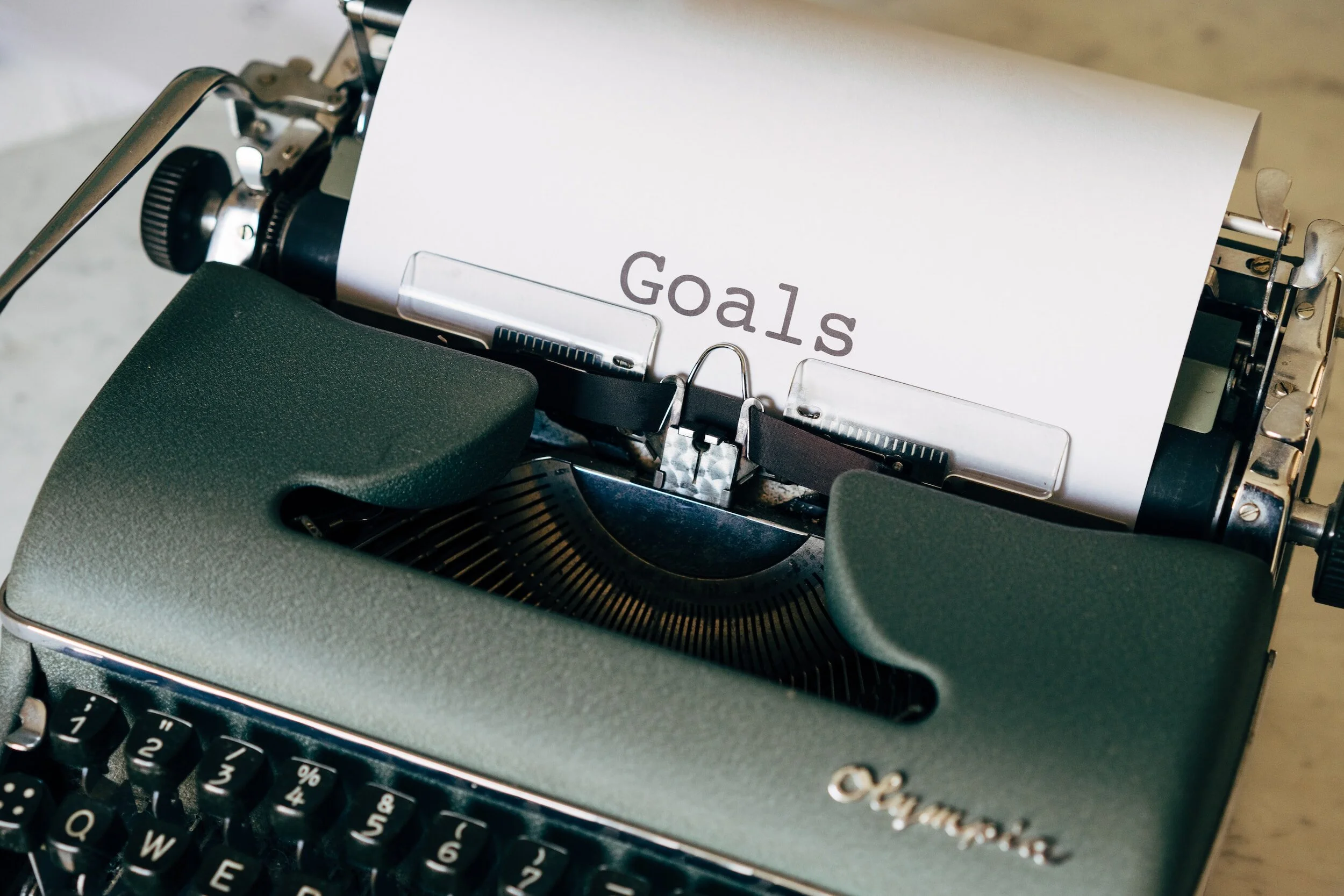
Similar to Year In Review, Goals and Plans is about taking the time to think about, visualize and put to paper everything you want to accomplish. I then take it a step further and build out a short, vague plan with quarterly targets. And similar to Year In Review, nothing is considered too small.
My goals have included things as mundane and simple as “read 12 book this year” by “reading 3 books per quarter.” And as audacious as “Outperform the market by 25%”(note: I did not achieve this goal), by “developing a quarterly review and reconciliation process of my investments.”
Not everything comes true. But I’m amazed every time one does. Like this one, “To learn about the food system by working on a farm.” Or my goal to find a life partner in 2021 (this was an actual goal).
When I looked back on my Goals and Plans document, and saw some of my plans realized, I became a believer. While many of my goals were not achieved (like writing my first book in 2021, yikes, that was a long shot), this was proof enough that the system could work. And I’ve continued this practice ever since.
The years fly by and our lives are so busy. It’s easy to think just another year has come and gone, what have I done? It’s easy to think you didn’t get to do all the things you wanted to. Or that you failed because you didn’t stick to your New Year’s Resolutions. Life has a way of throwing us curveballs, and I’d challenge this thinking and say you’ve accomplished a lot more than you think. Maybe not everything you accomplished was on your “to-do” list, but I’d bet that you did way more than you think, if you take the time to reflect on it.
So I challenge you to sit down and in painful detail try and recall all the things you did do.
Brought another child into the world.
Moved towns, cities, homes, jobs.
Attended 6 yoga classes.
Helped take care of a loved one.
Cooked Christmas dinner for the first time.
Took a trip to visit family I hadn’t seen in years.
Invested the maximum into my 401K.
Whatever it is, keep the list running. Even things that we are “supposed to be doing,” get included. And at the end of that list, think about what you still want to accomplish. It doesn’t matter how big and audacious, or how small and trivial, put it all down. Then chart out 1 quarterly target for each goal that you think will help you achieve it.
If you never look back at these document until you sit down to do it again next year, that’s fine. It doesn’t matter. The work is in sitting down and giving yourself all the credit you deserve for the year you had, and giving yourself the time to manifest everything you want.
This is a method that works for me and continues to evolve. I’ve still got plenty of goals to accomplish, but it never gets old to see all that I’ve done, including the unplanned (moved to Colorado), and to get excited for the future. I hope it works for you and helps you better appreciate everything you do, while setting your sights on taking control of your future.
Happy New Year. I know it’s going to be a good one.
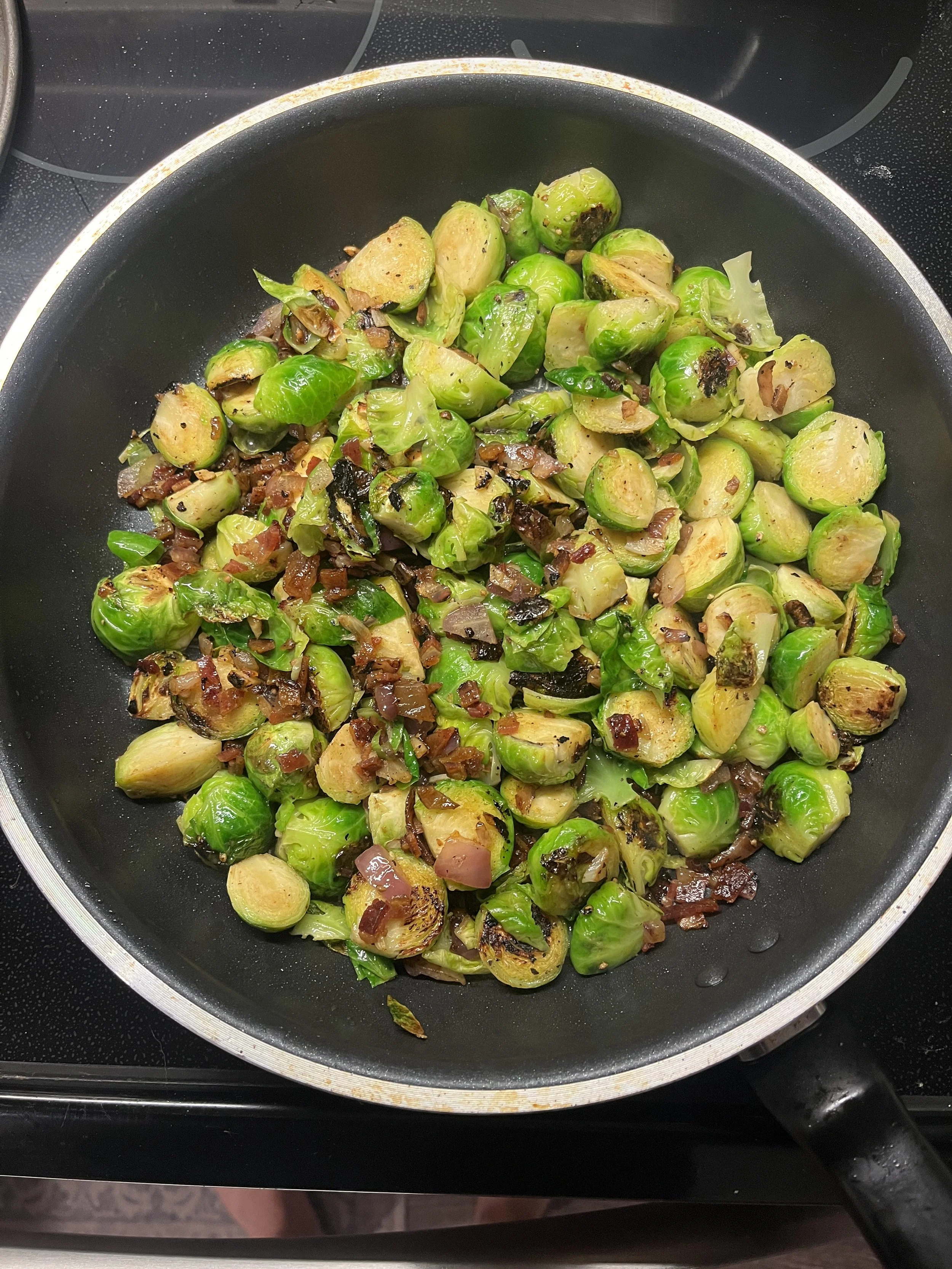
Bacon N Brussels
Quick and easy recipe with a lot of flavor
Brussels sprouts are my favorite vegetable to cook and eat. They absorb flavor really well, they’re easy to cook, and they work well with a variety of flavors. You can sauté, bake or even boil them (although I’ve never tried). And best of all, they are super healthy! This recipe is a tasty way to enjoy brussels!
Bacon n Brussels.
Preheat a pan to medium heat. Add 1 tbsp of olive oil, 2 cloves of garlic and 1 slice of chopped red onion to the pan and cook for 4 - 5 minutes. While that’s cooking, prepare the brussels.

Cut off the stems and then quarter them (please excuse the beet juice on my cutting board).

Toss in a bowl with the sautéed garlic and onion from above. Add 2 tbsp of olive oil and 2 pinches of salt to the bowl and toss.
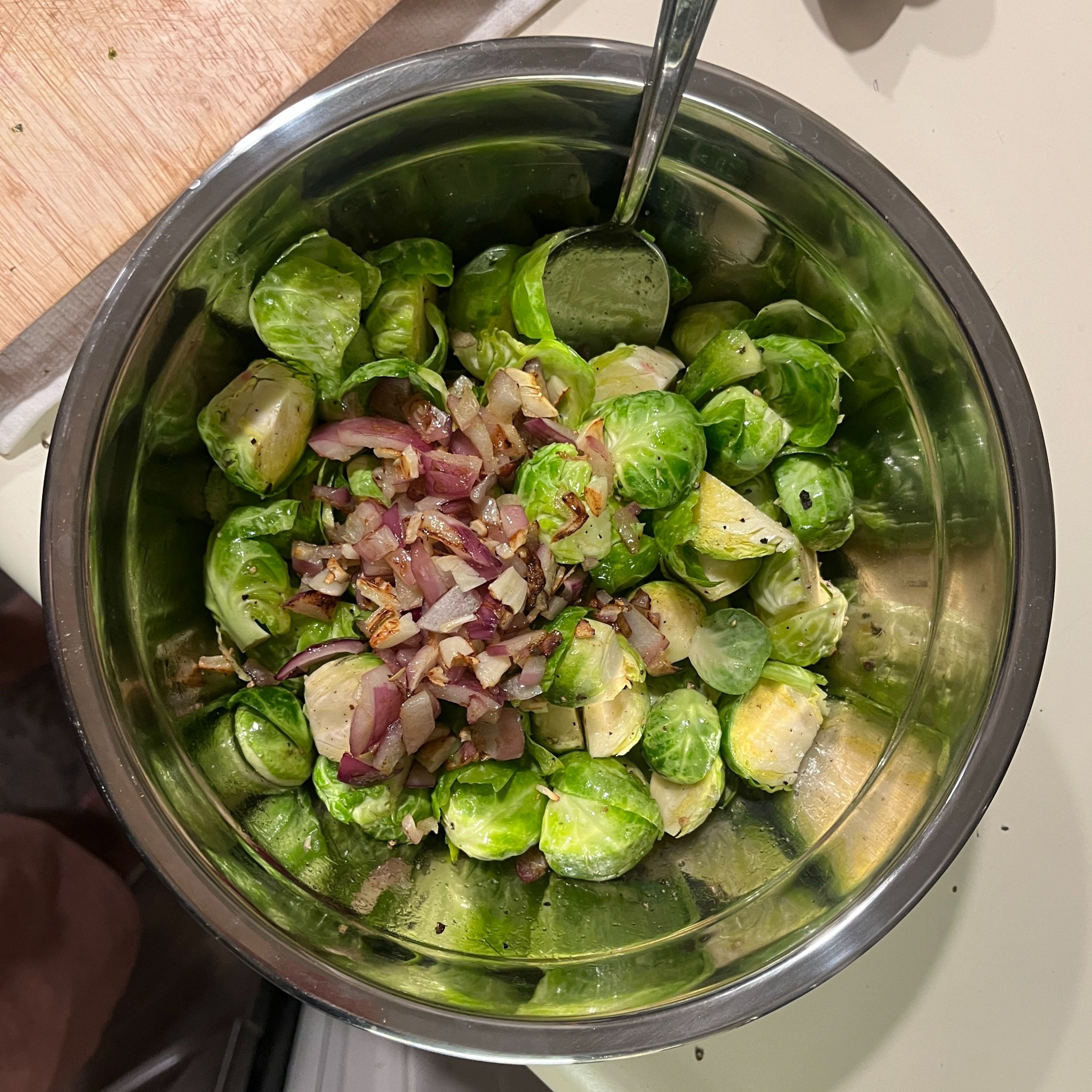
Dump the Brussels into the preheated pan, and add a few splashes of water to create steam. Cover the Brussels and let them cook for 5 minutes. After 5 minutes remove the lid and add 2 pieces of cooked chopped bacon. Add another splash of water and cover for another 4 minutes. Test for doneness and then remove from heat.

Add to your favorite bowl, like this dish with: Hearty lentils, fermented chili chicken thighs, bacon n brussels, chopped raw red onion, olive oil, red wine vinegar and sea salt.

Enjoy!

Shrimp Handrolls at Home
Mushroom, broccoli, avocado, this is a complete dish!

This dish is one of our favorites that we cooked all the time. But we’ve been on the move for almost a year and neglected this dish as a result. I made it the other night for my girlfriend’s birthday and it was even better than I remembered.
Shrimp and Seaweed Handrolls
Argentina wild shrimp (from Trader Joe’s), boiled broccoli, sautéed mushrooms, brown rice, sliced avocado (1/4 per person) and chopped raw red onion (1 slice).
Mix the shrimp, broccoli, mushrooms, brown rice, avocado and red onion in a bowl.
Cut a few seaweed sheets in half. Add a spoonful or two from the bowl, and finish with soy sauce. Wrap the seaweed into a handroll and enjoy!
Cooking Instructions:
Shrimp. The shrimp comes frozen. Thaw 10 - 12 shrimp either overnight in the fridge or on the counter in a bowl. Preheat a pan to med-high heat. Once thawed, pat them dry with a paper towel and put them in a bowl. Add 2 pinches of sea salt, 1 tbsp of olive oil, 1 tbsp of fermented chile paste, and 1/2 a tsp of chili flakes. Mix all together.
Add a 1 tbsp of olive oil to the pan and lay the shrimp down. Cook for 3 minutes undisturbed and then flip and cook for another 3 minutes.
Boiled broccoli. Chop two broccoli crowns into bite size pieces. Bring a pot of water to boil. Add broccoli and let cook for 3 - 5 minutes. Once strained, add the broccoli back to the pot, add 2 pinches of salt and a tbsp of ghee, butter or olive oil and mix.
Sautéed Mushrooms. Bring a pan to medium-high heat. Add a tbsp of olive oil. Slice the mushrooms into quarters (baby bellas or crimini), toss lightly with olive oil (1 - 2 tbsp) and salt (2 pinches, and add them to the preheated pan. Add a few splashes of water and cover. Leave undisturbed for 5 minutes, then toss, cover again, and let sit for another 3 - 5 minutes.
Brown rice. Bring 2 cups of water to a boil then add 1 cup of rice, reduce to simmer and cover. Allow to cook for the cook time on your package (cook time differs for each type).


Try This Move: Uneven Renegade Rows
Work your posterior chain, back, real deltoids and shoulders with this move.
Uneven Renegade Rows
The best match I had was a 30 lb Ruck Plate and a 35 lb Kettlebell. I evened it out by adjusting the reps (2 sets x 5 reps per arm, 1 set x 10 reps per arm).
Stand with your feet about shoulder width, in a comfortable position. Tuck your tail bone, squeeze your glutes, engage your core and hinge to come down towards the weights.
Grab the weights firmly. Lift your chest away from the ground, bringing both weights off the ground.
Start the movement by activating your shoulder, rear deltoid and then lats on one arm, and then lower the weight back down as you keep those muscles engaged. Repeat the movement on the other side.
Make sure to breath and keep your glutes to your rear deltoids engaged.

Salmon Lentil Bowl!
Try this simple salmon and lentil bowl!

Lentils, wild salmon, tomato, avocado, red onion
Lentils. I have a bulk mix of red and green lentils. Depending on what you buy, the cooking time will vary. Check the packaging. These instructions are based on my mix.
Rinse 1 cup of mixed lentils and let them soak for 60 minutes. Add 3 cups of water or vegetable brother to a pot. Add the lentils. Bring to a boil, then reduce to a simmer and cover. Cook for 30 - 40 minutes, covered. Taste for tenderness before removing from heat.
Strain the lentils and return them to the pot.
Wild Salmon. Preheat the oven to 425. Lightly coat both sides of the salmon filet (or filets if cooking multiple) with olive oil. Place the filet skin up on a baking sheet lined with aluminum foil. Add a pinch of salt (or two) to each filet and black pepper. Cook for 8 minutes (longer if desired).
Assemble. Add one ladle of lentils. Add one filet of salmon. Top with 1/4 sliced avocado, 1 small slice tomato and one slice of chopped red onion. Add two pinches of sea salt, 1 tbsp of olive oil and red wine vinegar to taste.
Buon Appetito!!

Lentils and Meatloaf
Lentils, beef patty, brussel sprouts, mushrooms, avocado and red onion
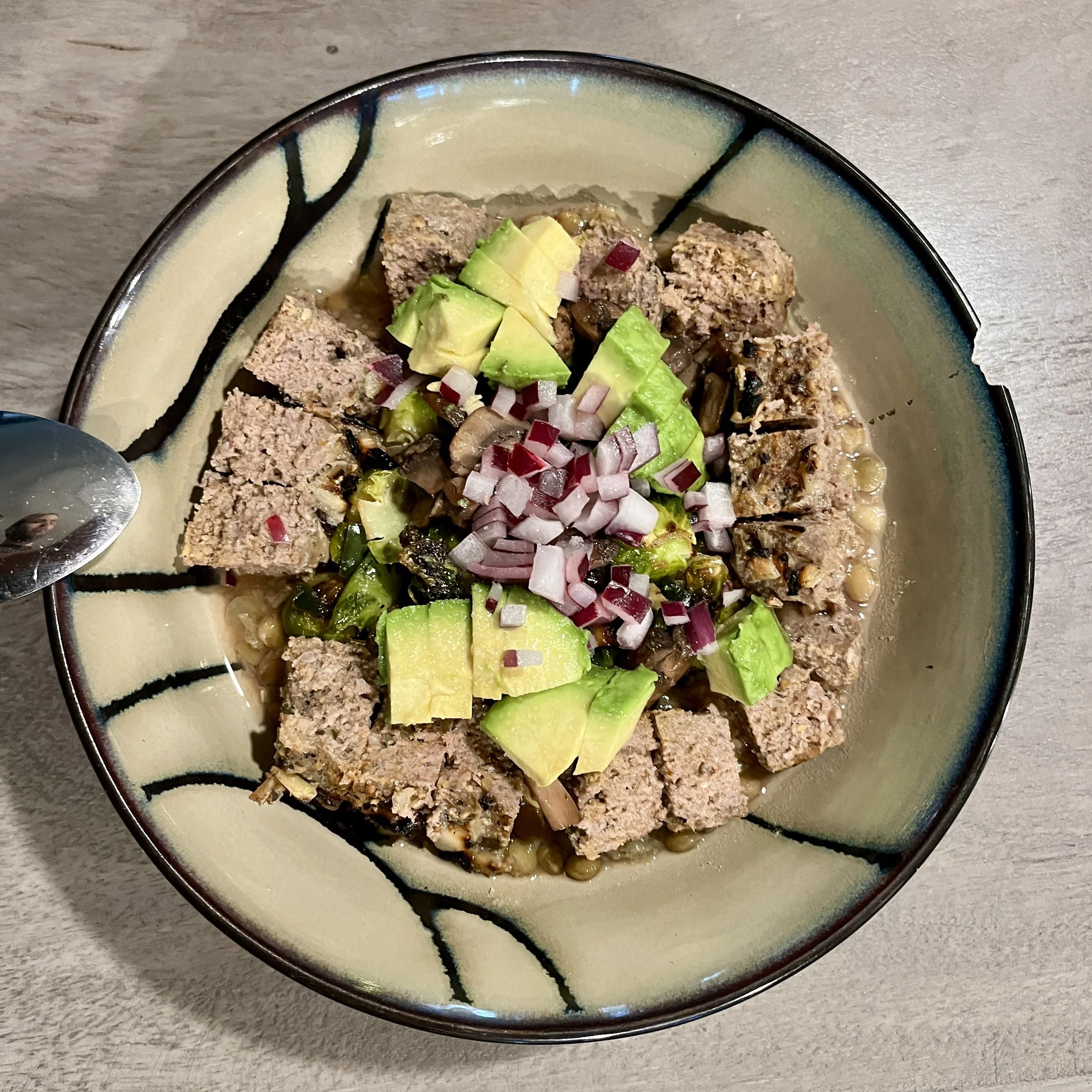
Lentils, ground beef patty, brussels, mushrooms, avocado and red onion.
Lentils. I have a bulk mix of red and green lentils. Depending on what you buy, the cooking time will vary. Check the packaging. These instructions are based on my mix.
Rinse 1 cup of mixed lentils and let them soak for 60 minutes. Add 3 cups of water or vegetable brother to a pot. Add the lentils. Bring to a boil, then reduce to a simmer and cover. Cook for 30 - 40 minutes, covered. Taste for tenderness before removing from heat.
Strain the lentils and return them to the pot.
Beef Patty. Bring a pan large enough to fit the meat to med-high heat, add a tbsp of olive oil. Use 1 lbs of 100% grass fed and finished or pasture raised ground beef. In a mixing bowl add the ground beef, 6 pinches of salt, 6 pinches of black pepper, 2 tbsp mustard, 2 tbsp Primal Buffalo Sauce, 1 egg (beat it before adding it), and 1/4 cup panko bread crumbs. Mix it all together.
Make 4 equal size meatballs using your hands. Add each meatball to the pan individually and flatten until each resembles a hamburger. Cook for 4-5 minutes undisturbed and then flip for another 4-5.
Brussels. Set a pan to medium-high heat. Cut the stems off and quarter or halve them (if bigger). Toss in a bowl with 1 tbsp of olive oil and two pinches of salt. Add brussels to the pan. Add a splash of water to the pan and cover. Let cook undisturbed for 5 minutes. Toss and cover for another 5.
Mushrooms. Organic baby bellas are good. Bring a pan to medium-high heat. Add a tbsp of olive oil. Slice the mushrooms, and add them to the preheated pan. Leave undisturbed for 5 minutes, then toss and let sit for another five.
Assemble. Add 1/2 cup cooked lentils to the bottom of a bow. Chop one patty into bite size pieces. Add a handful of brussel sprouts and a handful of mushrooms. Add 1/4 sliced avocado, and one slice chopped red onion. top with red wine vinegar and two pinches of sea salt.
Buon Appetito!!

A Good Podcast: Tim Ferriss w/ Andrew Huberman
Sleep, stress, light exposure and the benefits to mood and depression.
Sleep, stress, light exposure and the benefits to mood and depression
In this episode Andrew Huberman is very clear, by taking control of our bodies, and moving, we have the ability to turn off stress and take charge of our health. And while their nearly 3 hour conversation touched on a large number of topics, I found the information I learned about fear and anxiety, resetting your circadian clock, and ways to optimize testosterone to be the most interesting and actionable. This was a fascinating conversation that I thoroughly enjoyed.
Fear and Anxiety
“Fear,” Dr. Huberman say, “it’s the anxiety that you feel when you don’t know what behavior can remove a feeling of helplessness in the face of a threat.”
And it’s that feeling of anxiety that activates your sympathetic nervous system, and sets off a cascade of responses in your body you’ve likely felt recently. Liked increase heart rate and respiration, dilated pupils, and a narrowing of your vision.
But, he points out, because, both vision and respiration have a bi-directional relationship with our internal state, we can change one by changing the other. Said another way, by focusing on our breath (exhaling more than we inhale), we can reduce the speed of our heart rate. And by widening our field of vision, like staring off into the horizon, we can reduce levels of alertness and stress, and thereby increase calmness.
Physical activity such as running or weight training can also help to alleviate stress and the body’s response to it, but Dr. Huberman put’s special emphasis on the power of respiration and vision as the fastest, easiest, and most obvious ways to control involuntary arousal, and reduce stress.
In short, we can actually turn off the stress response by changing the way we view our environment, regardless of the environment.
Tips for Optimizing Overall Health
Get your biology right, and start by figuring out your sleep, “the fundamental layer of mental health.” If you need help falling asleep, he recommends the following supplements 30 - 60 minutes before bed:
200 - 400 mg of L-Theanine (note: avoid L-Theanine if you suffer from sleep walking or night terrors)
200-400 mg of Magnesium L-Threonate
50 mg of Apigenin (a derivative of chamomile)
And when you wake up, practice resetting your circadian clock. Focus on “the four most powerful stimulus… (in order).”
When you view first light (2 - 10 minutes of sunlight upon waking up)
Exercise daily
When you feed (eating early helps)
Social cues, interacting with people or animals (your dog) early in the day
Learn how to focus and defocus, have fun and stay in a mode of adventure. Develop a practice like journaling that allows you to “data dump and experience what’s internal.”
Tips For Optimizing Testosterone
Get sleep right (see above), limit chronic stress (see above), and train hard but not too long (overtraining can reduce testosterone levels). And if you’re in need of a boost, he recommends taking 400 mg of Tongkat Ali (helps promote free testosterone) early in the morning, and 425 mg of Fadogia Agrestis (stimulates the testes to produce more testosterone). (I bought the sleep and testosterone stack from Momentous)
Healthy Holiday Strategies
Tips and approaches to stay focused on your health during the holidays.
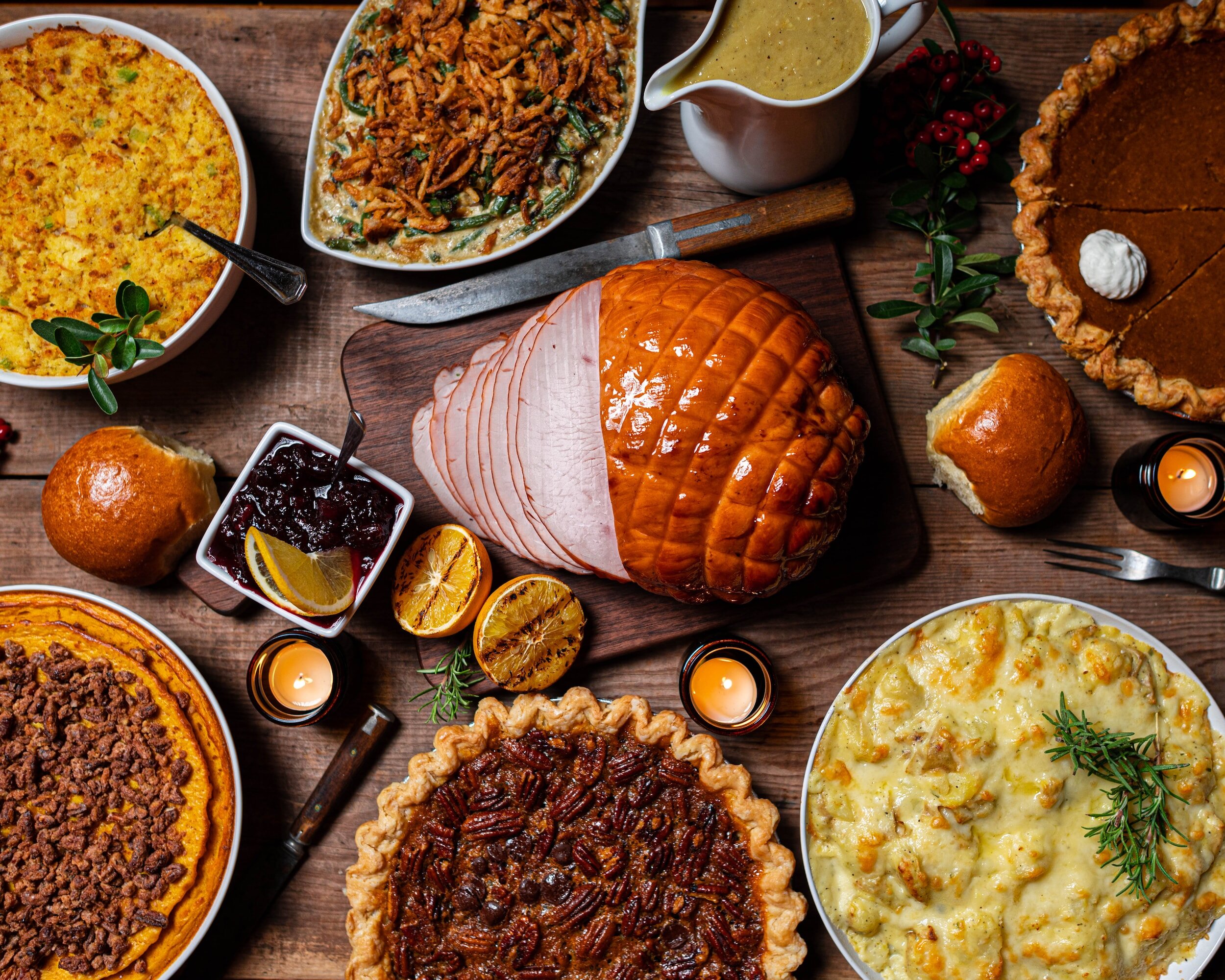
In this post, 5 Strategies for a healthy holiday season, Levels Health provides guidance for successful eating around the holidays (advice that could be applied all year). Central to their five strategies is the willingness to put yourself and your goals first. Holiday dinners or meals out with friends are hard because of the unspoken expectation to indulge or else be seen as a pain in the ass (a criticism I know well).
Being the odd one who doesn’t want cake, fried food, or a drink (almost two years now), almost always conjures up ridicule (no matter how small) and feelings of disappointment for not partaking in the feast.
But as this post points out first, the best strategy is “Do you, for you” (advice that’s easier said than done). As humans we have an innate desire to please others, often at the expense of our self. The pressure to pick at hors d'oeuvres, eat seconds, and then sit around watching the game, are all real, and making “Doing you, for you” really difficult.
But it doesn’t have to be that way. Holidays and meals with friends and loved ones can be fun and indulgent, without neglecting your goals.
[You can read the 5 strategies and advice posted by Levels here]
While reading this article I reflected on the top 5 things I follow to stay on track. Here’s my take:
Set intentions often and early. This applies both to the food I’m going to eat and the amount of time I need for exercise each day. Setting intentions ahead of time greatly reduces the chances I’m going to cave to pressure, and it deals a preemptive strike to the inevitable disappointment everyone feels when they realize I’m out.
Don’t go back for seconds. On these occasions, the biggest factor is always how much I eat, not what I eat. One plate with a taste of everything is plenty.
Space out the time between dinner and dessert. After dinner, get up from the table, walk around, or play a game with the kids.
Bookend big dinners with balanced and nourishing meals. It has a double benefit. One, I’ve already addressed a big part of the days nutrition, and two, I don’t go into dinner with big eyes. It keeps me satiated, but still leaves room for tasty carbs.
Go no carb or low carb the day or two following a big meal. The damage is never done at one meal, it’s done over many meals. This strategy helps to rein me in and mitigate the damage.
Bonus: Exercise. I couldn’t finish this post without addressing it. But after 25 years this isn’t a strategy for me, it’s a part of me. But even I can let the guilt of missing time with family impede my gym time. Remember, that the 20 - 60 minutes spent moving will benefit everyone, and it’s too short for anyone to really miss you.
I hope you enjoy the holidays and enjoy some delicious food. I know I’m looking forward to it.
Cheers.

Taking Control of Your Health
Click here: OneSource Health, December 24, 2023
My Favorite: Tim Ferriss and Dr. Andrew Huberman - The Foundations of Physical and Mental Performance
“Know thyself. Use the body to control the mind.” - Andrew Huberman, Ph.D.
In this episode Andrew Huberman is clear, by taking control of our bodies, we have the ability to turn off stress and take charge of our health. And while their nearly 3 hour conversation touched on a large number of topics, I found the information I learned about fear and anxiety, resetting your circadian clock, and ways to optimize testosterone to be the most interesting and actionable. This was a fascinating conversation that I thoroughly enjoyed. Check it out for yourself, and read key takeaways by clicking below.
A Good Book: Black Dog Escape, by William Bach
“The ancient Egyptians believed that when you die, the Gods ask you two questions before they let you into the next world: Did you find joy in life? Did you help someone else find joy in life?”
A few Saturdays ago my girlfriend and I were exploring the Western Slope of Colorado and popped into a local coffee shop. On my way to the bathroom an event being setup grabbed my attention. When I got out I saw that it was a fundraiser and a book signing. I hesitated for a minute, and then walked over.
A Good Podcast: Full Body Preventive Health Care with Andrew Lacy of Prenuvo, How I Built This With Guy Raz
I’d heard of Prenuvo, a company that offers full body MRI scans to detect potential diseases in the body before they become symptomatic, on a podcast a few years ago. They popped back into my conscious recently when I came across this article, How Much Would You Pay For Peace of Mind?, detailing patient complaints of inaccurate reporting, false positives, and an overall feeling of anxiety due to the uncertainty of their scan. So when I saw this episode with Prenuvo co-founder Andrew Lacy, I tuned in to hear what he might have to say in defense.
Good Advice: 5 Strategies for a healthy holiday season, Levels Health
In this post, 5 Strategies for a healthy holiday season, Levels Health provides guidance for successful eating around the holidays (advice that could be applied all year). Central to their five strategies is the willingness to put yourself and your goals first. Holiday dinners or meals out with friends are hard because of the unspoken expectation to indulge or else be seen as a pain in the ass (a criticism I know well).
Challenge Yourself: Four (4) Push Up Variations
Performing different variations of a movement is a good way to achieve progress without worrying about the weight. Check out these four moves for your next workout or the next time your bored.
1 Full Body Workout, 1 Kettlebell
This circuit can be completed in less than 10 minutes, and only requires 1 kettlebell. Give it a try when your time on time, or complete multiple rounds for a more intense workout.
A Beefy Egg Scramble
Check out my one of my favorite meals from the week, and many more by clicking here. Buon Appetito!
There’s a Perfect Weight For Every Exercise
Nailing the perfect weight for your exercise can be fun and engaging
There’s a perfect weight that pushes you to think about and maintain perfect form, and there’s a weight that pushes you just beyond that point and breaks down your form. And finding that weight is really important.
It’s something I’ve noticed a lot recently, I think in part because I’ve been doing more movements that require a lot of total body engagement. Since some of the moves are new to me, I’ve been intentionally underestimating the weight I start with, so I don’t blow my form before I learn the exercise.
But as I progress the weight, I’ve noticed that when I’m really dialed in, there’s a weight that focuses me and pulls it all together. It happened over the last two weeks as I’ve been working on landmine rotations (kettlebell alternative shown here).
Last week I started with 10 lbs for 20 repetitions (10 per side), which I incorrectly assumed was a light enough place to start. But it was too much, and so on the subsequent two sets I used used just the bar. But that too didn’t feel great and I felt my form suffer throughout the whole ciruit.
So, this week I modified two things.
One, for the first set I backed off the weight and started with just the bar.
Two, I reduced the reps from 20 total (10 per side) to 10 total (5 clean rotations per side).
The difference in the two approaches was profound (at least to me). Starting too heavy with too many reps in week 1 forced me to regress (from 10 lbs to 0 lbs). But in week 2, by making the adjustments above, I was able to make progress (from 0 lbs to 10 lbs).
Even more interesting to me was that 10 lbs on my third set in week 2 hit that form and focus sweet spot, whereas the same weight the week before took away from the movement.
It’s these little things about training and exercise that fascinate me and keep me interested. Consistency is key and I’ve found consistency through making myself aware of even the smallest changes. Cheers.

A Good Podcast: Prenuvo co-founder Andrew Lacy
The future of preventative medicine through whole body MRI imagine
How I Built This With, Guy Raz: Full body preventive health care with Andrew Lacy of Prenuvo
I’d heard of Prenuvo, a company that offers full body MRI scans to detect potential diseases in the body before they become symptomatic, on a podcast a few years ago. They popped back into my conscious recently when I came across this article, How Much Would You Pay For Peace of Mind?, detailing patient complaints of inaccurate reporting, false positives, and an overall feeling of anxiety due to the uncertainty of their scan. So when I saw this episode with Prenuvo co-founder Andrew Lacy, I tuned in to hear what he might have to say in defense.
Prenuvo currently operates 9 locations, 8 in the U.S., and 1 in Canada, with 11 more in the pipeline (they’re coming to Denver in August 2024). For $3,000 and 1 hour of your time you can get a full body scan that can detect things like early signs of cancer, liver disease, aneurysms, and even multiple sclerosis. The preventative medicine industry is now a $250 billion per year market that’s growing, and Prenuvo seems well-positioned to take advantage.
But with change and new technology comes criticism and fear.
Many doctors are sounding the alarm stating that the false positives (16% rate of occurrence) created by scans such as these leave people with anxiety and could result in unnecessary and expensive treatments or surgeries (i.e. removing a benign tumor).
But Andrew Lacy doesn’t see it that way. With 32% of scans revealing a legit abnormality according to a meta-analysis, Andrew see the pros largely outweighing the cons. The difference he says is in their custom software and hardware, specifically designed for fast and efficient whole body scans. He believes that we should be looking at the body as the sum of its parts, not its individual parts (like generic MRIs do). By scanning the whole body they’re able to make connections, like telling you about your heart by looking at your brain.
Change is hard, especially when it has the potential to disrupt a whole industry. As preventative medicine continues its march to eclipse sick medicine, these dinosaur healthcare companies have taken notice, and are doing their best to sow doubt in the minds of would be patients and doctors. The dollars they stand to lose are enormous. Just as one example, ever year we spend $100 billion on late stage cancer drugs. Meanwhile to scan the whole population of the United States every 2 years would only cost $60 billion according to Andrew. Pretty compelling.
There are real concerns, like the potential for false positives, and complaints of poor service and inaccurate reporting (the severity of which increases drastically when it comes to your health). But if there’s one thing that Andrew Lacey is right about, it’s that a whole body approach to your health is essential.
This was another great episode of How I Built This With, Guy Raz.

A Beefy Egg Scramble!
One egg. Meatloaf. Roasted peppers (garlic and onion). Boiled beets. Avocado. Sautéed red onion.

One egg. Meatloaf. Roasted peppers (garlic and onion). Boiled beets. Avocado. Sautéed red onion.
Egg Scramble. Chop 1 beef patty or 1 meatloaf square into bite size pieces and add it to a bowl with one egg (I only had one, I would’ve preferred two), a handful of chopped roasted peppers, 1.5 beets chopped into bite size pieces, 1/4 avocado sliced. In a pan heated to medium, add 1 tbsp of olive oil and 1 slice of chopped red onion. Allow to cook for 5 minutes and then add the contents of the egg bowl mixture. Cook 3 - 5 minutes before flipping to cook for another 3 - 5.
Your Bowl: Add the scramble from the pan into a bowl. Top with a generous amount of red wine vinegar and 2 pinches of sea salt, or any hot sauce or other topping you’d enjoy.
Buon Appetito!!
Cooking Instructions:
The Meat. Bring a pan large enough to fit the meat to med-high heat, add a tbsp of olive oil. Use 1 lbs of 100% grass fed and finished or pasture raised ground beef. In a mixing bowl add the ground beef, 6 pinches of salt, 6 pinches of black pepper, 2 tbsp mustard, 2 tbsp Primal Buffalo Sauce, 1 egg (beat it before adding it), and 1/4 cup panko bread crumbs. Mix it all together.
Make 4 equal size meatballs using your hands. Add each meatball to the pan individually and flatten until each resembles a hamburger. Cook for 4-5 minutes undisturbed and then flip for another 4-5.
Or, make this Meatloaf and use 1 square for this dish.
Roasted Peppers. Bring a pan to medium-high heat. Chop 1 slice of onion, 2 cloves of garlic and 1 jalapeño pepper. Add to the pan with 1 tbsp olive oil and two pinches of salt. Cut out the core of three peppers (red, yellow and orange) and slice into 1/8 inch strips. Toss in a bowl with 1 tbsp olive oil and 2 pinches of salt. Add to the pan once the onion, garlic, jalapeño combination starts to give off an aroma. Cook for 15 - 20 minutes depending on how you like your peppers, flipping every 5 minutes.
Boiled Beets. Buy 3-4 loose organic beets. Remove the skin. Cut them into quarters (1/8s if they’re large). Place in a pot, add water so covered by 1-2 inches of water. Add two pinches of salt. 1 tbsp of red wine vinegar. Bring to a boil then reduce to a simmer for 60 minutes. Make sure you can easily pierce them with a fork before removing from water.
Remove them from water but keep the water you boiled them in. This water now contains all the nutrients that escaped the beets during the process. Put it in a jar in the fridge and enjoy it as a slightly sweet cold drink later in the day.

A Good Book: Black Dog Escape
An enjoyable and insightful read
“The ancient Egyptians believed that when you die, the Gods ask you two questions before they let you into the next world: Did you find joy in life? Did you help someone else find joy in life?”
A few Saturdays ago my girlfriend and I were exploring the Western Slope of Colorado and popped into a local coffee shop. On my way to the bathroom an event being setup in the back grabbed my attention. When I got out I saw that it was a fundraiser and a book signing. I hesitated for a minute, and then walked over.
It was a local fundraiser for veterans. The book signing was for Black Dog Escape, written by former Navy SEAL, William Bach. He was selling his book and donating the proceeds to the cause. We struck up a conversation with him and his wife and ended up chatting for a while. It turns out we had a lot of common interests. Before leaving I bought a signed copy from him.
Black Dog Escape is about a former Navy SEAL fighting the demons of war and trying to make a new life for himself after retiring from combat. The main character, Jack, gives all the outward impressions of a normal guy. He owns a local book shop, likes to go crabbing, and is a regular in town. But on the inside he’s tormented by what he’s seen and done in war.
As Jack is searching for answers to heal his trauma, an adventure and love story begins to unfold around him. But the Black Dog won’t relent and keeps nipping at his heels.
While the story is told from a veterans point of view, I found that there was a lot that related to the every day lives of non-combat citizens as well. We all have something that tugs at our happiness, that can bring us into a dark place.
As Plato says and WL Bach quotes midway through the book, "Be kind, for everyone you meet is fighting a hard battle."
For Jack, it’s his trauma from the war, and for the rest of us it could be childhood trauma, a devastating loss, or a bad breakup.
I chose to read Black Dog Escape this week to take a break from all the self-improvement and health related books I’ve been immersed in this year. Turns out I didn’t get much of a break from learning, but at least the lessons here were taught through a well written and entertaining story. I pulled out a lot of wisdom that I’ll definitely be remembering throughout my life.
When I walked over to that fundraiser table I was nervous about getting pulled into a commitment (financially or otherwise) that I wouldn’t be able to say no to, and for that reason I almost walked right by. But I fought that urge and I’m glad I did. Because I got to meet a really impressive couple, and I got a great book out of it. The uncomfortable thing can be rewarding.
Enjoy.