

Spaghetti and Meatballs
Try this veggie packed take on spaghetti and meatballs

Spaghetti, meatballs, beets, broccoli, mushrooms, avocado, red onion
This dish has a lot going on. I wanted pasta, but I also wanted to balance the carbohydrates to limit my glucose spike, so I added a bunch of fiber and fat to the dish. It worked. My glucose remained steady. Try this dish.
Spaghetti. Follow instructions on your package. We used Rao’s. A good choice because it only contains two ingredients: durum semolina flour and water. Cook time is 11 minutes if choosing this pasta.
Meatballs. Bring a pan large enough to fit the meat to med-high heat, add a tbsp of olive oil. Use 1 lbs of 100% grass fed and finished or pasture raised ground beef. In a mixing bowl add the ground beef, 6 pinches of salt, 6 pinches of black pepper, 2 tbsp mustard, 2 tbsp Primal Buffalo Sauce, 1 egg (beat it before adding it), and 1/4 cup panko bread crumbs. Mix it all together.
Make 4 equal size meatballs using your hands. Add each meatball to the pan individually and flatten until each resembles a hamburger. Cook for 4-5 minutes undisturbed and then flip for another 4-5.
Or, use this recipe.
Beets. Buy 3-4 loose organic beets. Remove the skin. Cut them into quarters (1/8s if they’re large). Place in a pot, add water so covered by 1-2 inches of water. Add two pinches of salt. 1 tbsp of red wine vinegar. Bring to a boil then reduce to a simmer for 60 minutes.
Broccoli.Chop two broccoli crowns into bite size pieces. Bring a pot of water to boil. Add broccoli and let cook for 3 - 5 minutes (taste test before removing from water). Once strained, add the broccoli back to the pan, add two pinches of salt and a tbsp of grass-fed butter, and mix.
Mushrooms. Organic baby bellas are good. Bring a pan to medium-high heat. Add a tbsp of olive oil. Slice the mushrooms, and add them to the preheated pan. Leave undisturbed for 5 minutes, then toss and let sit for another five.
Assemble. Add a handful of pasta. One beef patty or beef square chopped into bite size pieces. One and a half beets, chopped. Handful of broccoli. Handful of mushrooms. 1/4 sliced avocado. 1/2 slice of chopped red onion. Top with red wine vinegar, 1 tbsp of olive oil, and 2 - 3 pinches of sea salt!
Buon Appetito!!

Meat and Purple Potatoes
Ground beef patty, purple sweet potato, and veggies

Ground beef patty, with purple sweet potato, mushroom, zucchini and broccoli.
Ground Beef Patty. Bring a pan large enough to fit the meat to med-high heat, add a tbsp of olive oil. Use 1 lbs of 100% grass fed and finished or pasture raised ground beef. In a mixing bowl add the ground beef, 6 pinches of salt, 6 pinches of black pepper, 2 tbsp mustard, 2 tbsp Primal Buffalo Sauce, 1 egg (beat it before adding it), and 1/4 cup panko bread crumbs. Mix it all together.
Make 4 equal size meatballs using your hands. Add each meatball to the pan individually and flatten until each resembles a hamburger. Cook for 4-5 minutes undisturbed and then flip for another 4-5.
Sweet Potato. Place a purple sweet potato in a microwaveable dish. Cover it in a wet paper towel. Add a 1/2 inch of water to the dish. Microwave for 8-10 minutes (or until done). Peel the potato and cut it up into small pieces. Mix in a bowl with two pinches of salt and a tbsp of ghee.
Mushrooms. Organic baby bellas are good. Bring a pan to medium-high heat. Add a tbsp of olive oil. Slice the mushrooms, and add them to the preheated pan. Leave undisturbed for 5 minutes, then toss and let sit for another five.
Zucchini. Bring a pan to medium heat. Chop one slice of yellow onion and two cloves of garlic. Add to the pan with 1/2 tbsp of olive oil and two pinches of salt. Chop a zucchini in half down the middle. Then chop the halves in half length wise. Then cut into bite size (1 inch) pieces. Toss in a bowl with 1 tbsp olive oil and two pinches of salt. Once the garlic and onion are fragrant, add the zucchini to the pan. Add a splash of water and cover. Let cook for 3-5 minutes. Uncover and flip, then cover again and let cook for an additional 3-5 minutes (until done).
Broccoli. Chop two broccoli crowns into bite size pieces. Bring a pot of water to boil. Add broccoli and let cook for 3 - 5 minutes (taste test before removing from water). Once strained, add the broccoli back to the pan, add two pinches of salt and a tbsp of grass-fed butter, and mix.
Assemble. Add 1/2 a sweet potato to the bowl. Add 1/2 a handful of each the mushrooms, zucchini and broccoli. Cut one ground beef patty into quarters and add that. Top with red wine vinegar, Ume plum vinegar and 2 - 3 pinches of sea salt.
Buon Appetito!!

Blueberry Pancake Breakfast
Healthy, quick and delicious pancake breakfast

Birthday pancakes.
Pancake mix. We used Birch Benders Paleo pancake mix. Follow the instructions on the back (1 cup mix to 3/4 cup water), add an egg (it adds a nice fluffiness to it), 6 pinches of chia seeds, and 6 handfuls of blueberries, and mix. Bring a pan to medium heat, and add 1 tbsp of grass-fed and finished butter. Add two ladles worth of mix to the pan and cook for 3 - 5 minutes, flip and allow the other side to cook for an additional 3 - 5 minutes. Repeat with all of the mix.
Assemble. Add 2 - 3 pancakes to your plate. Butter your pancakes with ghee. Add a pinch of chopped walnuts. Add a pinch of cocoa nibs. And a handful of raspberries. Drizzle with maple syrup! And indulge!
Buon Appetito!

My Meditation
Unconventional forms of meditation that work (for me)
I have five forms of meditation that I currently use in my practice. Although if you ask a purist (or my girlfriend) they would likely not consider them meditation at. But they work for me, so, who cares.
A mantra. Sitting cross legged on the floor (with or without back support) I breath and repeat to myself: in through the nose, fill up your lungs, out through your mouth, feel it on the lips. In through the nose, fill up your lungs, out through your mouth, feel it on the lips. I repeat this mantra as many times as necessary or until a 10 minutes timer goes off.
Reading early in the morning. I’ve found that nothing centers my day like reading for an hour or finishing a chapter in the morning. Sitting down with a book is the first thing I do after getting the morning’s routines (bathroom, coffee, walk the dog) out of the way. I try to do this every morning.
Sauna. Sitting cross legged quiet in a sauna puts me into a trance like no other. I like to sit with my thoughts (not meditation I know) or repeat the mantra from above and do some clearing of my mind.
Sensory deprivation tank. This isn’t so much a method of meditation but an easy way I find to get into a deep state of calm. I might repeat the mantra above, or I might go through my thoughts trying to bring each one to closure.
Thinking in complete sentences. This is one I stole from a Tim Ferriss Show episode, although I can’t recall the episode. Tim was speaking about a friend who told him he meditates by thinking in full sentences. When I heard this it didn’t make much sense right away. But as I began to practice, I realized how often I cut off my own sentences in my mind, and jumped to the next one. This practice has been one of my favorites and has helped me communicate, read, write, think and focus better.
These are my practices and they wouldn’t all (if any) be considered conventional, or formal, meditation, but this is what works for me. Two weeks ago I started working with Sam Harris’ Waking Up App which teaches you how to meditate, plus provides additional mindfulness tools. For a week straight (the free trial period) I woke up with the Waking Up app (😃) and properly meditated for 10 minutes (probably my third or fourth attempt at formal meditation). In that week I learned a lot, and is actually how I developed the mantra above. But I wasn’t ready for the full course, and so I let the trial expire. But I learned something to take into my practices. Which is kind of the point.
The point is your practice (whether it be exercise, reading, writing) needs to work for you. The goal is to find what you like and will engage with, which will require trying different methods and other people’s practices. Then taking the pieces that work for you, and leaving what doesn’t. And incorporating those pieces into your practice, until they no longer serve you.
Don’t worry if it’s not conventional, or if it’s something that no one else does. Practices are highly individualized and change. Your goal is to work on you and that will only happen if you find your path.

Seeking Happiness, Fighting Muscle Loss, and more
Click here: OneSource Health, December 17, 2023
“It’s your road and yours alone,” wrote the Sufi poet Rumi. “Others may walk it with you, but no one can walk it for you.” (excerpt from Strength to Strength)
A Week of Happiness with Arthur Brooks, Ph.D.
Last week Peter Attia, MD drew me into an episode of The Drive with a title: The Science of Happiness. The podcast guest, Arthur Brooks, Ph.D., was new to me, but I enjoyed their conversation so much that I decided to read one of Dr. Brooks’ books, From Strength to Strength: Finding Success, Happiness and Deep Purpose in the Second Half of Life.
Now contrary to what it may seem like, I actually wasn’t looking for advice on how to be happy and succesful in the second half of my life. I chose this book because it was the most reviewed of the 6 he’s written. And it’s a good thing I did, because as it turns out, according to Dr. Brooks, the sun has already started to set on the first half of my life.
A Good Podcast: Sarcopenia - Strategies To Maintain Muscle Mass As We Age
Nothing motivates the gym rat in me like knowing that 7 years ago I started losing muscle. Sarcopenia, the loss of muscle mass as we age, begins at around age 30. Yikes! In this short 30 minute episode EC Synkowski provides tips and tricks to slow down the process.
Read key takeaways from the episode here…
A Good Article: Reassessing The Relationship Between Alcohol Intake and Cardiovascular Disease Risk
Alcohol is a drug that continues to fascinate me. With all of the rules, regulations and laws surrounding most other drugs, alcohol, despite it’s long list of harmful side effects, remains abundantly available and endlessly promoted across all media. In this article Peter Attia, M.D. discusses the increased risk of cardiac disease (the #1 cause of death in this U.S.) from even low levels of alcohol consumption.
Try These Workouts
5 Exercises. 5 Minutes. 1 Kettlebell.
Cook this Week:

A Week of Happiness with Arthur Brooks, Ph.D.
Getting to know the science of happiness with author, professor and social scientist, Arthur Brooks, Ph.D.
Last week Peter Attia, MD drew me into an episode of The Drive with a title: The Science of Happiness. The podcast guest, Arthur Brooks, Ph.D., was new to me, but I enjoyed their conversation so much that I decided to read one of Dr. Brooks’ books, From Strength to Strength: Finding Success, Happiness and Deep Purpose in the Second Half of Life.
Now contrary to what it may seem like, I actually wasn’t looking for advice on how to be happy and succesful in the second half of my life. I chose this book because it was the most reviewed of the 6 he’s written. And it’s a good thing I did, because as it turns out, according to Dr. Brooks, the sun has already started to set on the first half of my life.
Arthur Brooks starts the clock on the second half of life when fluid intelligence reaches its peak, and begins to decline, which occurs around the same time that crystallized intelligence begins to eclipse fluid intelligence in its abundance. Fluid intelligence, the ability to reason, and think flexibly, peaks on average 20 years after career inception and begins declining between the ages of thirty-five and fifty. Conversely, crystallized intelligence, the ability to use a stock of knowledge, and share accumulated information, continues to increase well past your 60s and remains steady late into life.

It’s hard to admit, but if the science is right, then my days of high performance problem solving are behind me. Which actually correlates to the exact way I’ve been feeling. My inclination lately has been more towards sharing, and away from solving.
But the former high performer in me had to ask the question: Does fluid intelligence really peak at a certain age, or is the onset of the “decline” a choice (whether consciously or not). Or is it just the age, on average, where you’ve earned enough, worked enough, and problem solved enough to want to begin your descent. I know I felt it after 10 years. I couldn’t imagine 15 or 20. It certainly seems plausible. Research however has shown that there is a correlation between declining fluid intelligence, cortical thickness and regional volume in the brain. Sounds like a chicken or egg situation to me.
Knowing that you’re past your prime is only half the work. The other half involves embracing it. He’s found that many people get caught up in the success and acclaim they find earlier in life, and for those people stuck looking back, it’s more difficult to move forward. Which is the problem with all of change. It’s scary to embrace what’s unfamiliar.
It doesn’t even have to be something as big as a mid-life realization that your peak years are behind you. It could be a new job. Moving to a new city. Or starting a new hobby. It could be finally committing to taking your website serious and expressing yourself. Scary stuff!
So how do you do it? Figure out what makes you happy and and devoid yourself of everything that doesn’t service it. Or as Simon Sinek puts it:
“To unlock your true potential and happiness, you need to articulate their deep purpose in life and shed the activities that are not in service of that purpose.”
First, Dr. Brooks says, get to “know your tendency, because once you know your tendency you manage your habits.” Practice metacognition, defined as developing an awareness of one’s thoughts and processes and an understanding of the patterns behind them, to maximize your ability to think, learn and evaluate.
A good place to start is this short personality test on his website, which will tell you if you’re one of four personality types: a cheerleader, poet, mad scientist or judge. My girlfriend and I took the test and were frightened, but not surprised, to find we’re both mad scientists (Yikes!).
Then once know your tendency, focus on achieving the three macros to happiness; enjoyment, satisfaction and meaning, not the three macros of nutrition; carbohydrates, protein and fat (and limit your opinions, the number one source of misery according to Dr. Brooks). Simply put, indulge in the things that fill you up, and separate from all the things that don’t.
Next, Make A To Don’t List. Instead of worrying about what you want to add to your life that you think will bring you joy, “Write down the things you do out of habit or obligation,” he says, “even though they lower your spirits.” And then, avoid them.
Over the years I’ve acquired a similar technique that has helped me focus on what fills me up and avoid what doesn’t. I learned it from a guest (who’s name I can’t recall) on the Tim Ferriss Show. When faced with a yes or no question I ask myself, “is it yes because I want to, or is it yes because I should?” When it’s the latter, my answer is invariably a no (exceptions do apply). It does require practice to be able to discern the difference between the two, but based on a study of one, I’ve found that strict adherence to this rule results in a 10x better life.
The point Dr.s Brooks makes throughout the book, podcast and article are the same. Achieve happiness by getting to know yourself and eliminating what’s not serving your purpose.
I’m a mad scientist. Is that as bad as it sounds? It depends on my mood. In short, my deep emotion produces feelings of exhilaration, drives my work ethic, and makes me deeply curious, but it also leads to unnecessary misery and volatile mood swings at times, which can exhaust friends, family, myself, and my loved one. (She’s hanging on).
To give my tendency a name is new to me, but the resulting emotions and actions are not. Over the last few years I’ve become all too aware of my thoughts, processes and habits, and, as a result, I’ve implemented a number of practices aimed at maintaining homeostasis between the ups and downs. But before I ever knew that, all my efforts to mitigate my tendency were futile.
When I was a kid G.I. Joe’s were very popular. My brother and I used to play with them all the time. They had a saying that I repeat to myself almost daily.
“Now you know, and knowing is half the battle. G.I. Joe!”
Now you know. The other half is up to you.
This is a great book, podcast, and article with Arthur Brooks, Ph.D., and a short video on happiness. Enjoy one. Enjoy all.
Book: From Strength to Strength: Finding Success, Happiness and Deep Purpose in the Second Half of Life, Arthur Brooks, Ph.D.
Podcast: The Science of Happiness, with Arthur Brooks, Ph.D.
Article: Make A To-Don’t List, Arthur Brooks, Ph.D.
Video: What makes a good life? Lessons from the longest study on happiness. (also worth watching)

Cooking Rules
A simple guide to getting the most of out cooking
Rules to develop a sustainable and healthy practice of cooking.
Keep it simple. There are only two ingredients you need to cook any dish you want:
Something to cook your food in (i.e. olive oil, avocado oil, grassfed and finished butter), and salt.
If you want, pepper. But it doesn’t even need it.
Make the most of your time in the kitchen. If you have to be in the kitchen, make the most of it. Put something in the oven. Something in a pan. Something in a pot.
Almost any non-root vegetable can be cooked on a stovetop, on medium - high heat (depending on your stoves settings), in 10 minutes. This includes mushrooms, peppers, zucchini, broccoli and brussel sprouts.
Almost any root vegetable can be cooked in the oven in 20 minutes at 425 degrees. This includes carrots and beets.
Almost any lean meat (chicken thigh, chicken breast, steak, ground beef, fish) can be cooked in 20 minutes or less in the oven at 425 degrees. This will of course depend on thickness of the cut.
Use your hand to measure for your plate:
Shoot for two handfuls of veggies, one palm size piece of lean protein (chicken, beef, fish), and one thumbs length of fat (4 almonds, 1/8 of an avocado), with every meal.
Go heavy on vinegar and light on olive oil (any oil) when dressing your food:
Red wine vinegar, white wine vinegar and apple cider vinegar can be used on anything in almost any amounts.
Fig and balsamic vinegars are hiring in sugar and shouldn’t be used as freely.
Oil is high in fat and calories, which can both sneak up on you if you’re not careful.
Garnish generously with salt. If you’re eating whole foods then you’re not getting any salt from your food. You need to add it.

A Good Podcast: Preventing Sarcopenia with EC Synkowski
Tips to slow the process of muscle loss as we age
Listen Here: The Consistency Project: Strategies To Maintain Muscle Mass As We Age
Nothing motivates the gym rat in me like knowing that 7 years ago I started losing muscle. Sarcopenia, the loss of muscle mass as we age, begins at around age 30. Yikes!
In this short 30 minute episode EC Synkowski provides tips and tricks to slow down the process.
Some key takeaways from this episode, On The Fight Against Sarcopenia:
Sarcopenia begins at age 30 at a rate of .3% to .8% loss per year
After age 50 it increases to 1 - 5 % per year
Note: you can put on muscle after age 30 (especially if you’re new to exercise)
Exercise helps to prevent Sarcopenia
EC Synkowski’s #1 rule of exercise - “All exercise is better than none”
Work on resistance training 1 - 2x per week, and cardio (both short duration, i.e. HIIT, and long duration, i.e. swim or cycle) 3 - 4x per week
Get consistent, make the workout challenging, and don’t overcomplicate it worrying about the correct set rep system!
Nutrition to slow Sarcopenia
Focus on the #800gramchallenge (this has been a life changer for me)
Consume a minimum of .7 grams of protein per pound of bodyweight
Use creatine which can aid in the fight against Sarcopenia
I first got introduced to EC Synkowski in the book Built to Move, which introduced me to the 800 gram challenge, and I’ve been following her ever since as a subscriber to her weekly newsletter, where she discusses nutrition and health related topics. If you want a little primer to see what she’ all about, check out this 5 minute Ted Talk she gave five years ago, where she explains her simplistic and effective views on health and nutrition. Enjoy!
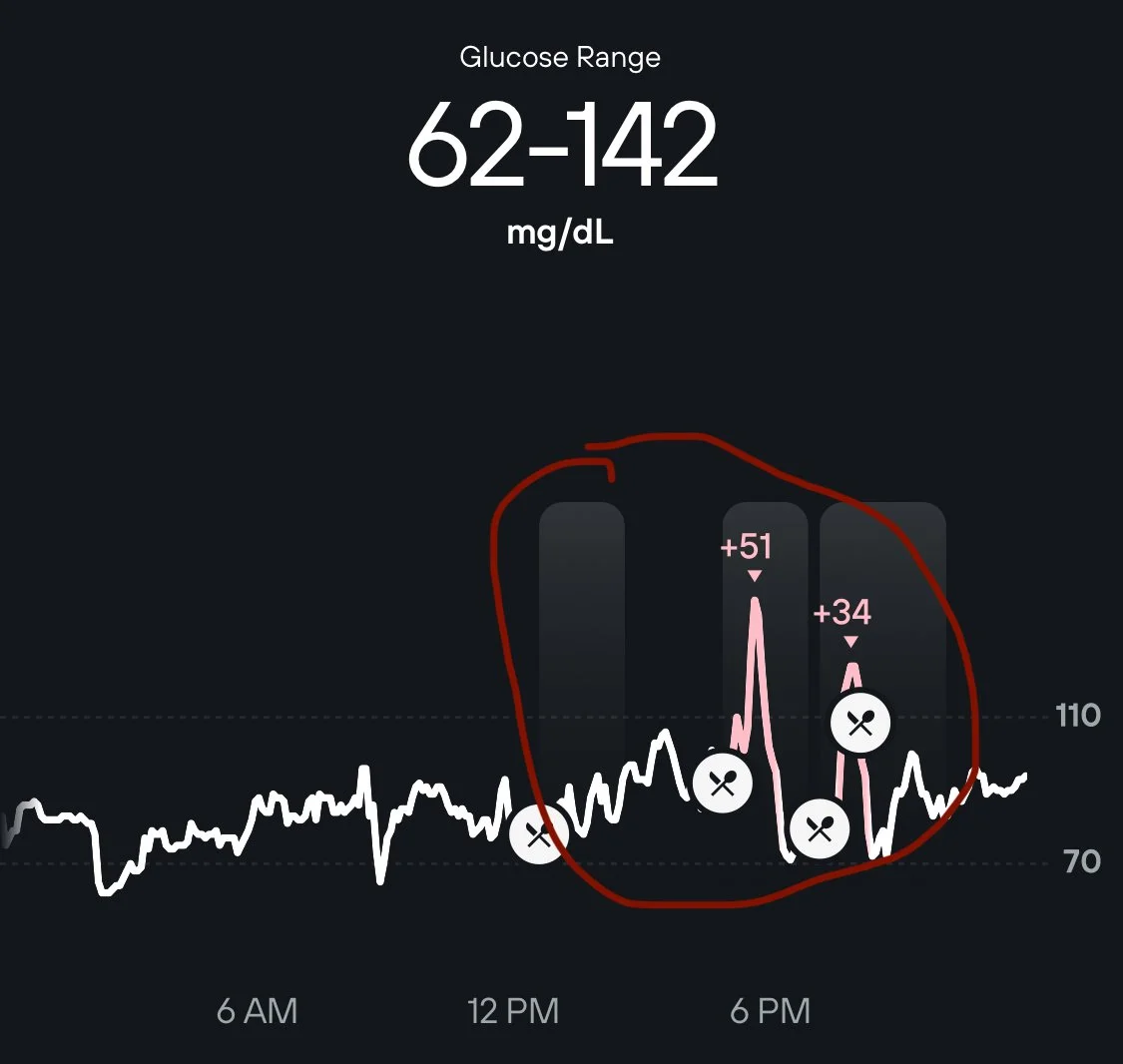
Glucose Monitoring Update
Glucose spikes and crashes and what’s causing them.
It’s now been just over a week of wearing a continuous glucose monitor (CGM) and I remain fascinated by what I’m seeing. In the past few days I’ve had a few incidents that are worth sharing.
Cappuccino Crash
On Sunday morning I woke up and put in 60 minutes on my assault bike (majority low intensity, with 10 high intensity intervals mixed in). I didn’t eat after and instead grabbed a handful of blueberries and raspberries and we ran out the door to run errands.
We sat down at a coffee shop around 1 pm. My girlfriend had hot chocolate and I had an oat milk cappuccino, and then we took our dog to the park to run around. The ground was fresh with good packing snow and so we proceeded to run around like little kids, throwing snow balls, and tackling one another to the ground. But about halfway through our fun, I started to feel really woozy and nauseous. I figured it just had something to do with not eating yet, but I mostly dismissed it.
On the way home we stopped at Walgreens. While I waiting in line to check out I pulled out my phone and opened my Levels app. This is what I saw.
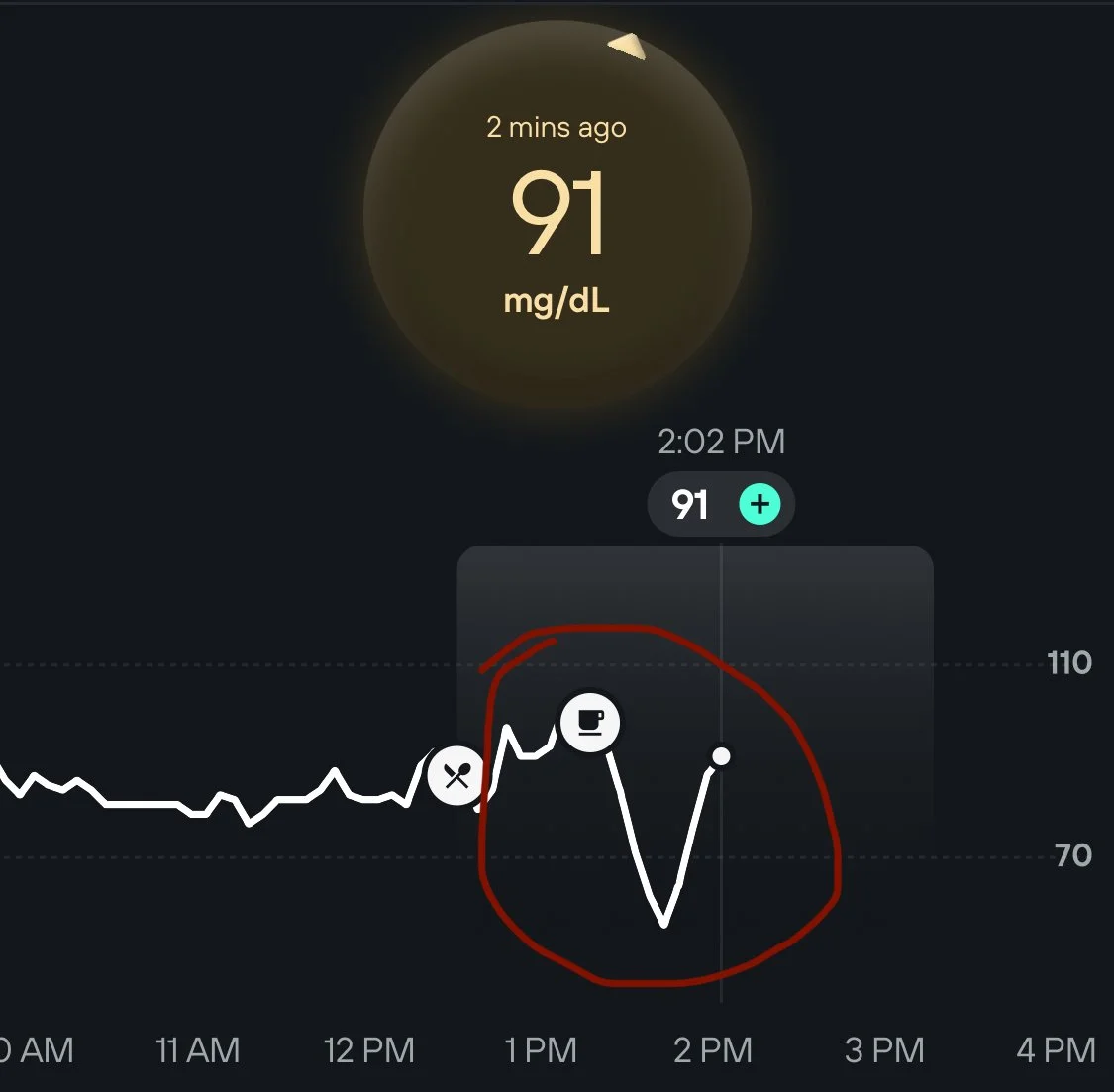
I was amazed. A 30 point crash was no doubt the reason I felt sick. The culprit? Not eating, combined with having oat milk, which I later learned is the worst alternative milk option for blood sugar, in my coffee. I was disappointed to learn that because oat milk is so delicious. But I thought it was cool to see the data correlate in real time to how I was feeling physically. How wild!
Chocolate Peanut Butter RX Bar
The second incident (later in that same day) was more of an experiment. RX Bars are my go to when I’m hungry and in a pinch. Not only are they absolutely delicious, but I’ve always appreciated the minimal ingredients (typically 5 or less) as well as the balance offered by it macro nutrient ratios.
The bar I ate this day, Peanut Butter Chocolate contains: egg whites, peanuts, dates, chocolate, cocoa, natural flavors and sea salt (yum). It macro nutrients profile is:
Fat: 10 grams
Carbs: 22 grams
Fiber: 4 grams (almost 1/5 of the carbs, an ideal ratio)
Protein: 12 gram
So I was excited to see what this bar did to my glucose and if I could continue to enjoy them or if I needed to look for an alternative.

Over the 1.5 hours that followed, my glucose levels rose, albeit gradually, and managed to stay just under the upper 110 mg/dl threshold set by Levels. After the slow rise, my glucose subsequently descended at an equally steady pace before returning to baseline.
This reaffirmed to me that this is a balanced bar, that I can continue to eat without concern.
Two Bad Spikes
After a couple of my most stabile glucose days, Wednesday turned out to be a bad one.
It started good with a 7 am agility session. But, like Sunday, I didn’t end up eating my first meal until the early afternoon, setting me up for disaster later in the day. All morning I chose coffee over food because I didn’t want to break my work flow. Which was obviously the wrong choice.
The first spike (+51 points, yikes!) was caused by a “snack”; dark chocolate espresso beans, Mary’s Gone Crackers, and one Jojos chocolate square. It seemed harmless at the time, but in retrospect it was a lot of sugar and carbs and no nutrients to aid in their digestion. I was hungry, and didn’t want to pull myself away to make something nutritious, and my body paid a price as a result (second mistake of the day).
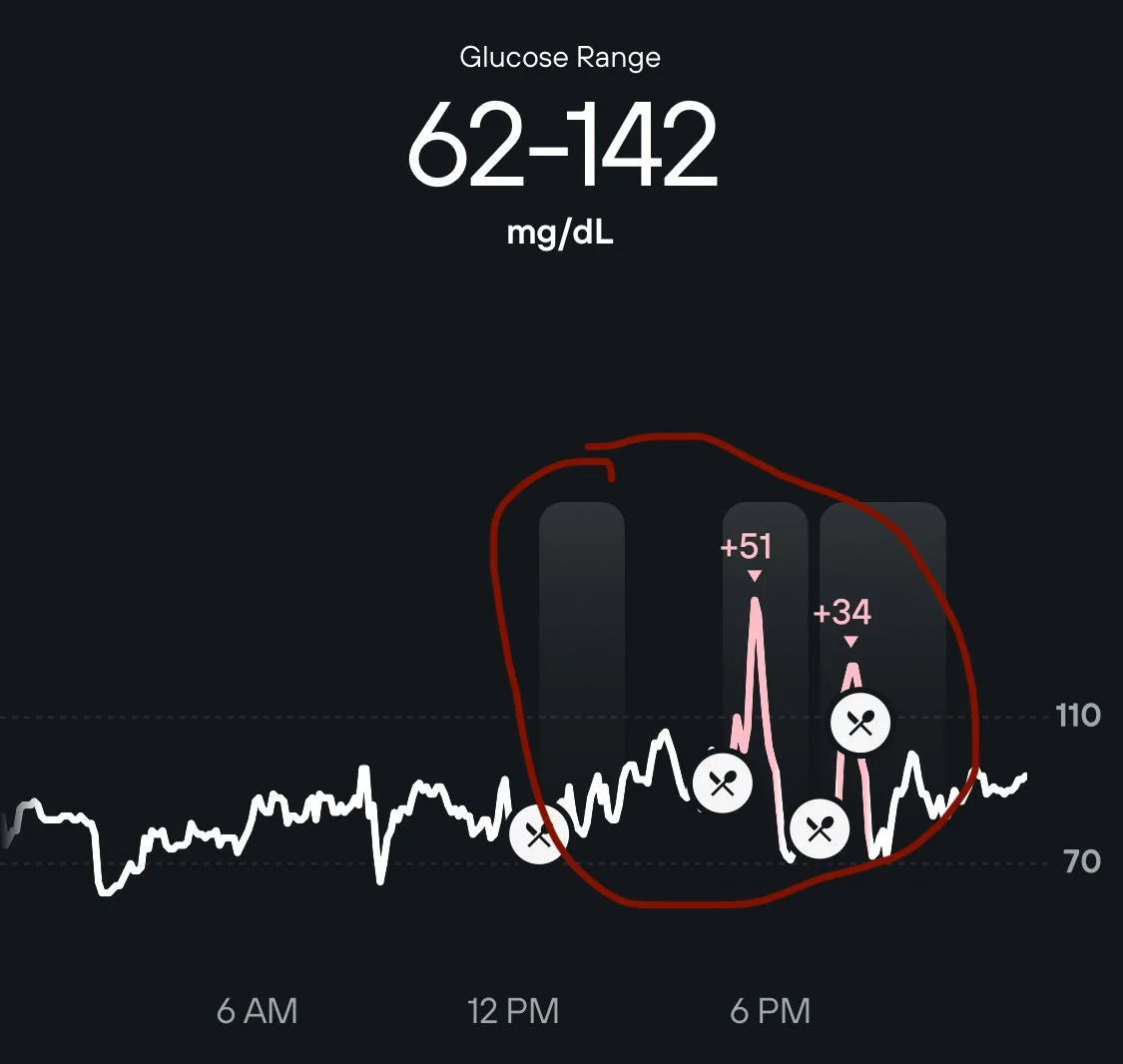
The second spike (+34 points) came at dinner. By the time I came up to eat at 7 pm I was feeling ravenous. So I did what any ravenous person does. I made a huge bowl of food (third mistake). Pasta, zucchini, mushrooms, tomato, avocado, tofu, chicken and onion. And then followed it up with another bowl 1 hour later. Arugula salad with sardines, onions, blueberries and more mushrooms and zucchini.
The spike is significant, but it also comes on the heels of crashing from my snack a few hours earlier. So I’m giving myself a little bit of a break. I think the pasta and vegetable dish outlined above was fairly balanced, and I think had I eaten it alone, without the earlier snack, that the results would have been different. Regardless, all of my poor eating choices set me up for a day of yo-yoing glucose.
The longer I wear the CGM the more fascinated I become by the data. As I’ve mentioned before, it scares me to think about all the spikes and crashes that are happening internally, while externally I mostly feel nothing. The body is constantly working overtime and we really don’t give it enough credit for all it does. We run around abusing it, hoping it doesn’t crap out on us. And when it does, we wonder why.

Be Specific
Being Specific Can Improve Procrastination
Details matter.
I’ve found that when I’m very specific about my objectives, the more likely I aim to accomplish them. Here’s a recent example.
I’ve had finalizing my itinerary for my trip to Switzerland on my list of things to work on for over 2 weeks and I haven’t touched it. It’s an enormous under taking in comparison to say building a workout, or writing up a meal idea. It involves research, looking back through photos and apps to piece together our trip and write about it. So instead of working on it, I’ve just kicked it to the side for about 2 weeks and just stared at my to do list: Switzerland Itinerary.
Today I decided I was actually going to work on it. I had enough of putting it off and I wanted to work on something different. I’d been putting a lot of work into everything but the itinerary, so I figured it would be a nice change of pace.
I started working on it as planned. I tried to get everything I had written up already organized. I had started a Scrivener file on it, and I had a bunch of notes stored in my phone, so I began by consolidating everything into the Scrivener file (something I always seem to do).
I created tabs for each leg of the trip (13 in total). Then I started pulling the information I had from my phone into its respective leg. Luzern details into the Luzern folder. Via Alpina: Stage 8 notes into the Via Alpina: Stage 8 folder. And so on.
After that, I went in, starting with Luzern (the first stop on our trip) and organized the notes.
Destination: Luzern
Days/Nights: 3
Restaurants:
Where We Stayed:
So on and so on.
Then I stopped, because I had this realization. Maybe if I had been more specific on my to do list I would have actually done some work on it.
To Do: Consolidate all of the trip notes into Scrivener and organize the details based on a set format.
How much more manageable does that sound versus, Switzerland Itinerary. That’s a big project. Whereas the former is a clearly defined plan. Something that sounds doable.
It was just one of those ah ha moments. Like wow I get it.
Anyway, I need to get back to consolidate all of the trip notes into Scrivener and organize the details based on a set format.
Thanks for listening.

Sockeye and Eggs
A low carb, high protein, good fat breakfast!

Sockeye and Eggs, with mushrooms, avocado, red onion and beets. With homemade sauce.
Salmon. Preheat the oven to 425. Lightly coat both sides of the salmon filet (or filets if cooking multiple) with olive oil. Place the filet skin up on a baking sheet lined with aluminum foil. Add a pinch of salt (or two) to each filet and black pepper. Cook for 8 minutes (longer if desired).

Beets. Buy 3-4 loose organic beets. Remove the skin. Cut them into quarters (1/8s if they’re large). Place in a pot, add water so covered by 1-2 inches of water. Add two pinches of salt. 1 tbsp of red wine vinegar. Bring to a boil then reduce to a simmer for 60 minutes.
Mushrooms. We like organic baby bellas. Bring a pan to medium-high heat. Add a tbsp of olive oil. Slice the mushrooms into quarters, toss lightly with olive oil and salt, and add them to the preheated pan. Leave undisturbed for 5 minutes, then toss and let sit for another five.
Egg Scramble. In a bowl mix 1 large egg, 1/4 sliced avocado, 1 slice of chopped red onion, 1 sliced beet and a handful of mushrooms.

Add to a pan heated to medium heat. Allow to cook fully and then flip to cook the other side.

Homemade Sauce. 1 tbsp Primal Buffalo sauce, 1 tbsp olive oil, 1/2 tbsp red wine vinegar, 1/2 tbsp fig balsamic vinegar, 2 pinches of sea salt.

Assemble. Add 1 salmon filet to a bowl. Layer the egg scramble on top. Drizzle homemade sauce over the whole bowl and enjoy!
Buon Appetito!

Meatloaf (ish) Dish
Quick, easy, delicious meatloaf(ish)

Ground beef meatloaf(ish) recipe
Prepare the meat. Use 1 lb of 100% grass fed and finished or pasture raised ground beef. In a mixing bowl add the ground beef, 6 pinches of salt, 6 pinches of black pepper, 2 tbsp mustard, 2 tbsp Primal Buffalo Sauce, 1 egg (beat it before adding it), and 1/4 cup panko bread crumbs. Mix it all together.

Prepare to cook. Preheat the oven to 425 degrees. Coat the bottom of a 8 x 8 pyrex with olive oil. Ball the ground beef mixture into one big ball in your hands, and then place it in the middle of the pyrex. Flatten it out so it’s even throughout and fills in all the corners and edges of the pyrex.
Chop up 1 slice of onion and 2 cloves of garlic. Add that to the top of the beef and sprinkle with 2 pinches of sea salt and a generous amount of cracked fresh pepper.
Cook for 20 minutes.

Finishing up. After cooking for 20 minutes, move the pyrex to the top rack and turn on the boiler and allow to cook for an additional 1 - 2 minutes (try not to let the garlic and onion burn like I did. It happens fast).
Remove after 1 - 2 minutes and cut into 4 equal portions to make preparing meals in the future easy (each one will be approximately 1/4 lb of beef).
Place in a glass container to store and drizzle the remnants from the pyrex over the top!
Buon Appetito!!


The Real Reason To Warm Up
The warm up is a time of self assessment
Warm Up = Self Assessment
Warming up has been given the wrong name, and created confusion as a result. Because the point of the warm up is not actually to warm up. The point is to take the time before your workout to check in with yourself and see what you’re going to be capable of that day.
People don’t get hurt because they didn’t warm up (temperature wise), they get hurt because they didn’t take the time to listen to their body and assess what’s going on (which can also lead to burn out). And that’s why it is so important not to skip it.
Start slow and easy.
Take 5 minutes to foam roll and investigate what’s sore.
Take 5 minutes to stretch and lengthen your body. Where is your range of motion limited?
Take 5 minutes for some dynamic movements. Identify what is sore, limited and tired.
Take the first 1 - 2 sets of your workout to assess more before really pushing it.
Each one of these will change daily, so it’s important to reassess daily.
There’s another benefit to the warm up as well. It acts to ground us before a workout. By doing the one thing we all want to skip, it forces us to slow down and enter the workout with a level head that’s ready to go.
During your next warm up, listen to your body. Is today a day to push it? Or is today just about getting through the motions? Two very different days, but both are necessary. The warm up is where you can figure that out.

Lentils and Chicken
Green and red lentils, chicken thighs, and onion!

Green and red lentils, chicken thighs, onion, sea salt and olive oil!
Lentils. I have a bulk mix of red and green lentils. Depending on what you buy, the cooking time will vary. Check the packaging. These instructions are based on my mix.
Rinse 1 cup of mixed lentils. Add 3 cups of water or vegetable brother to a pot. Add the lentils. Bring to a boil, then reduce to a simmer and cover. Cook for 30 - 40 minutes, covered. Taste for tenderness before removing from heat.
Strain the lentils and return them to the pot.
Chicken Thighs. Buy a pack of organic free range chicken thighs (pasture raised is best if you can get it). Preheat the oven to 425. Put the chicken thighs into a Pyrex. Coat them lightly in enough olive oil so they don’t stick to the dish. Add a pinch of salt to each one (each side), black pepper, onion powder, garlic powder and a touch of cayenne pepper. Add a little water to the dish. Leave them right side up. Cook at 425 for 20 minutes.
Assemble. Add 1 - 1.25 lattles of lentils to a bowl. Chop up 1 - 2 chicken thighs into bite size pieces. Chop 1 slice of onion. Add everything to the bowl. Drizzle with 1 tbsp of olive oil and two pinches of sea salt.
Buon Appetito!
A Fascinating Doctor, Fixing Food, and Glucose Spikes
Click here: OneSource Health, December 10, 2023
"I hope whatever you're doing, / you're stopping now and then / and / not doing it at all." - How To Change Your Mind, Michael Pollan
A Good Podcast: The Drive with Tom Catena, M.D.
“I think maybe the modus operandi of my life is always looking for, what’s the opposite of greener pastures? Browner pastures (laughs)”
That’s a quote from guest Tom Catena, M.D., the only physician working in the Nubah Mountains in Sudan, where a civil war has raged for over a decade, devastating the community, injuring thousands and taking countless lives. If it sounds like this episode is going to be a depressing one, it’s far from it. On the contrary it’s quite up-lifting.
A Good Book - Food Fix: How to Save Our Health, Our Economy, Our Communities, and Our Planet--One Bite at a Time, by Mark Hyman, M.D.
This book, first read in 2020, marks the beginning of my interest to better understand the impacts that the food system and food policies have on our health. Prior to reading this book (and subsequently The Omnivores Dilemma), I never considered how things like subsidizing grain farmers and the prevalence of food deserts (amongst many other factors) contributed to the growing health epidemic. Food Fix is a good primer for anyone interested in learning more about these topics and how the system is designed (intentionally or not) to keep people sick.
A Good Article: Six Factors That Affect Glucose Besides Food
Last week I started wearing a continuous glucose monitor (CGM) for the first time in my life. I had been thinking about it for over a year and was finally pushed over the edge by this article by Peter Attia, MD. I’m less than a week into wearing it and I’ve been fascinated at the variations in my glucose. Since I’ve been immersing myself in the data, I found this article interesting. The two most surprising non-food items to me? Sunlight exposure and environmental toxins (yikes).
Workout this Week: Try This Workout
5 exercises. 5 minutes. 1 kettlebell.
Progression I of a 4 part progression series.
Cook this Week: Wild Sockeye Salmon with Purple Sweet Potato, Mushrooms and Sliced Avocado

Early Glucose Monitor Results
A quick check in on my glucose results
On Wednesday of this week I started wearing a continuous glucose monitor (CGM) for the first time in my life. More than a year ago I started to toy with the idea of wearing one for experimental purposes. I wanted to see how different foods might affect me, and I also wanted to see what (if any) behaviors I would change as a result.
But I kept putting it off until I read this article by Peter Attia, M.D. advocating for wearing one to take better control of your health. So I ordered one from Levels, a company I’ve been following for over a year. As far I can tell, they’ve been one of the pioneers in the space of at home CGMs.
The package of 3 CGMs came about a week after I placed my order. They came in a nice box, with alcohol swabs to clean your arm before applying the CGM, as well as Levels branded stickers to go over the CGM and hold it in place.
My experience got off to a rough start. I applied the CGM to the wrong spot on the back of my arm (right on my tricep). Based on the instructions it’s where I thought it was supposed to go, but I immediately experienced pain and discomfort. I thought the pain would go away. But after nearly 3 days I decided to remove it and put on the second one.
This time I applied it correctly, placing in on the outer part of my arm in the space between my shoulder muscle and tricep muscle (pictured here). Now I forget it’s even there.

After the initial mess up, I’ve been amazed to see what foods impact me the most. The two most surprising, on opposite ends of the spectrum, are purple sweet potato and lentils.
Eating 1/2 of a purple sweet potato mixed with 1 tbsp of ghee, with 1/4 pound of ground beef, brussel sprouts, walnuts and pumpkin seeds, spiked my glucose 52 points.

On the contrary, a 1/2 a cup of cooked lentils, 2 chicken thighs, onion, olive oil, salt and peppers, actually lowered my glucose levels by 10 points before it rebounded (the 30 point spike is from a sauna session, which is expected).

So what gives? Because 1/2 a purple sweet potato actually contains less carbs (17 grams) than 1/2 a cup of cooked lentils (20 grams). The difference, is in their protein and fiber.
A 1/2 a purple sweet potato contains 1.5 grams of fiber and 2 grams of protein, while a 1/2 a cup of cooked lentils contains 8 grams of fiber and 9 grams of protein.
All that fiber and protein in the lentils is helping for your body to absorb the carbs slowly. The ratio of 8 grams of fiber to 20 grams of carbs is actually 2x the ratio you want (a minimum 1 to 4 ratio is the target).
1/2 Sweet Potato 1/2 Cup Lentils
Carbohydrates 17 grams 20 grams
Fiber 1.5 grams 8 grams
Fiber/Carbs Ratio 1/8 2/5
Protein 2 grams 9 grams
What’s scared me is after eating each of these meals, I felt the same. I didn’t feel like anything was going on inside of me that potentially was harmful. They both felt like balanced meals. But obviously I was wrong.
The next time I eat sweet potato (because I will continue to have it), I’m going to make sure I add enough fiber, protein and healthy fat to offset the sweet potatoes nutrient deficiencies.
I can’t wait to see what else I learn.

Chicken Peppers and Onions
Chicken, broccoli, peppers and onions deliciousness

Chicken, broccoli, peppers and onions, zucchini and garlic, avocado and red onion
Baked Chicken Thighs. Buy a pack of organic free range chicken thighs (pasture raised is best if you can get it). Preheat the oven to 425. Put the chicken thighs into a Pyrex. Coat them lightly in enough olive oil so they don’t stick to the dish. Add a pinch of salt to each one (each side), black pepper, onion powder, garlic powder and a touch of cayenne pepper. Add a little water to the dish. Leave them right side up. Cook at 425 for 20 minutes.
Broccoli. Chop two broccoli crowns into bite size pieces. Bring a pot of water to boil. Add broccoli and let cook for 3 - 5 minutes (taste test before removing from water). Once strained, add the broccoli back to the pan, add two pinches of salt and a tbsp of grass-fed butter, and mix.
Peppers and Onions. Bring a pan to medium-high heat. Chop 1 slice of onion, 2 cloves of garlic and 1 jalapeño pepper. Add to the pan with 1 tbsp olive oil and two pinches of salt. Cut out the core of three peppers (red, yellow and orange) and slice into 1/8 inch strips. Toss in a bowl with 1 tbsp olive oil and 2 pinches of salt. Add to the pan once the onion, garlic, jalapeño combination starts to give off an aroma. Cook for 15 - 20 minutes depending on how you like your peppers, flipping every 5 minutes.
Sautéed Zucchini. Bring a pan to medium heat. Chop one slice of yellow onion and two cloves of garlic. Add to the pan with 1/2 tbsp of olive oil and two pinches of salt. Chop a zucchini in half down the middle. Then chop the halves in half length wise. Then cut into bite size (1 inch) pieces. Toss in a bowl with 1 tbsp olive oil and two pinches of salt. Once the garlic and onion are fragrant, add the zucchini to the pan. Add a splash of water and cover. Let cook for 3-5 minutes. Uncover and flip, then cover again and let cook for an additional 3-5 minutes (until done).
Assemble. Chop up 1 - 2 chicken thighs into bite size pieces and add them to your bowl. Add a handful of broccoli, a handful of peppers and onion, and a handful of zucchini. Slice a 1/4 of an avocado, and chop a 1/2 a slice of red onion, mix together. Dress all ingredients with red wine vinegar and fig balsamic vinegar to taste, and two - three pinches of sea salt.
Buon Appetito!!

Beef Beets Bowl (BBB)
Beef, beets, zucchini, peppers, garlic and onions
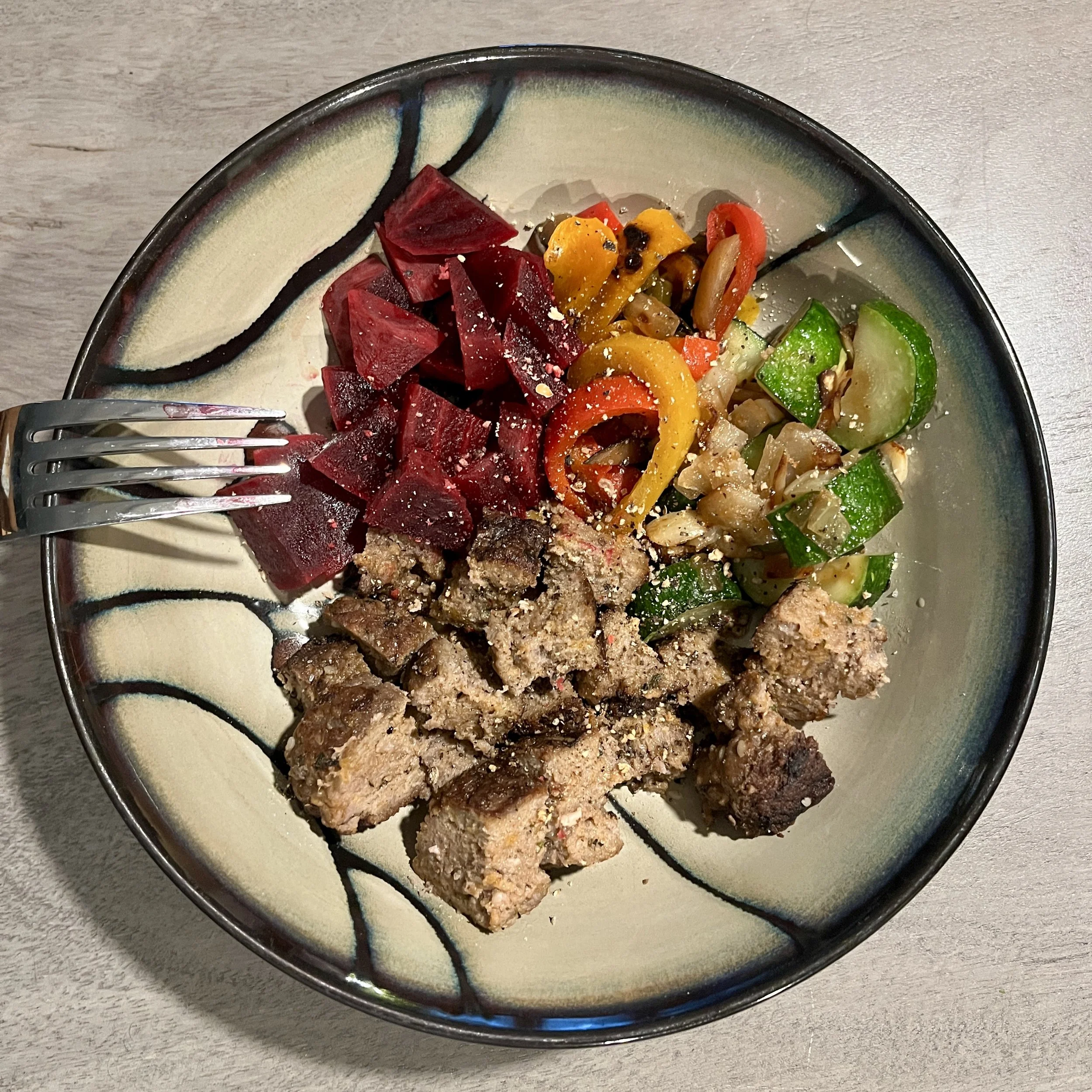
Ground beef, boiled beets and sautéed zucchini, peppers, garlic and onions
Ground Beef. Bring a pan large enough to fit the meat to med-high heat, add a tbsp of olive oil. Use 1 lbs of 100% grass fed and finished or pasture raised ground beef. In a mixing bowl add the ground beef, 6 pinches of salt, 6 pinches of black pepper, 2 tbsp mustard, 2 tbsp Primal Buffalo Sauce, 1 egg (beat it before adding it), and 1/4 cup panko bread crumbs. Mix it all together.
Make 4 equal size meatballs using your hands. Add each meatball to the pan individually and flatten until each resembles a hamburger. Cook for 4-5 minutes undisturbed and then flip for another 4-5.
Beets. Buy 3-4 loose organic beets. Remove the skin. Cut them into quarters (1/8s if they’re large). Place in a pot, add water so covered by 1-2 inches of water. Add two pinches of salt. 1 tbsp of red wine vinegar. Bring to a boil then reduce to a simmer for 60 minutes.
Peppers. Bring a pan to medium-high heat. Chop 1 slice of onion, 2 cloves of garlic and 1 jalapeno pepper. Add to the pan with 1 tbsp olive oil and two pinches of salt. Cut out the core of three peppers (red, yellow and orange) and slice into 1/8 inch strips. Toss in a bowl with 1 tbsp olive oil and 2 pinches of salt. Add to the pan once the onion, garlic, jalapeno combination starts to give off an aroma. Cook for 15 - 20 minutes depending on how you like your peppers, flipping every 5 minutes.
Zucchini. Bring a pan to medium heat. Chop one slice of yellow onion and two cloves of garlic. Add to the pan with 1/2 tbsp of olive oil and two pinches of salt. Chop a zucchini in half down the middle. Then chop the halves in half length wise. Then cut into bite size (1 inch) pieces. Toss in a bowl with 1 tbsp olive oil and two pinches of salt. Once the garlic and onion are fragrant, add the zucchini to the pan. Add a splash of water and cover. Let cook for 3-5 minutes. Uncover and flip, then cover again and let cook for an additional 3-5 minutes (until done).
Assemble. Chop one ground beef patty into bite size pieces and add it to the dish. Add two quarters of beets chopped into bite size pieces. Add a handful of zucchini. Handful of peppers and onions. Top the dish with two pinches of salt and Ume plum vinegar on the beef.
Buen Appetito!!

High Protein and Fiber Bowl!
Chicken thighs and veggie tofu bowl!

Chicken thighs and veggie tofu bowl!
Chicken thighs. Buy a pack of organic free range chicken thighs (pasture raised is best if you can get it). Preheat the oven to 425. Put the chicken thighs into a Pyrex. Coat them lightly in enough olive oil so they don’t stick to the dish. Add a pinch of salt to each one (each side), black pepper, onion powder, garlic powder and a touch of cayenne pepper. Add a little water to the dish. Leave them right side up. Cook at 425 for 20 minutes.
Broccoli. Chop two broccoli crowns into bite size pieces. Bring a pot of water to boil. Add broccoli and let cook for 3 - 5 minutes (taste test before removing from water). Once strained, add the broccoli back to the pan, add two pinches of salt and a tbsp of grass-fed butter, and mix.
Mushrooms. Organic baby bellas are good. Bring a pan to medium-high heat. Add a tbsp of olive oil. Slice the mushrooms, and add them to the preheated pan. Leave undisturbed for 5 minutes, then toss and let sit for another five.
Assemble: Chop one chicken thigh into bite size pieces add it to the bowl and drizzle with Ume plume vinegar. Add a handful of broccoli and a handful of mushrooms, drizzle with red wine vinegar. Slice up a 1/4 of an avocado, a slice of tofu and a slice of onion, add it to the bowl and drizzle with soy sauce. Sprinkle two pinches of sea salt to the whole dish.
Buon Appetito!
Get Up Earlier
A simple solution to the morning rush that stuck for me
Something simple that stuck
There was a period in my mid 20s when I was working long hours and struggling to get my workouts in. By the time I got home from work it was dinner time, and my workouts began to suffer. So I decided to start going to the gym before work, which worked for a while, until I encountered a different problem.
My morning was now rushed, and was adding more stress to already stressful work days.
I was getting up at 5:45 am and rushing to be at the gym at 6 am. Giving myself 2 hours to train, shower, change and be at my desk by 8 am. But it wasn’t working, and I really wasn’t enjoying it.
I was telling this to a friend and he made a very simple and obvious suggestion.
“Why don’t you get up earlier?”
“Why don’t I get up earlier?” Holy shit. You’re right.
Why was I waiting until 5:45 to get up and get out the door? I was embarrassed at how obvious a solution this was and why I hadn’t thought of it. The next day, I changed my routine.
I started waking up at 5 am. With the same goal of being at the gym by 6 am. But now I had a full hour to myself to have my coffee, go to the bathroom, and get my bag, breakfast and lunch ready for the day. The 45 minutes of sleep lost had a negligible impact, and, if anything, the benefits of an extra 45 minutes to get ready in the morning far outweighed the negative effects of sleeping less. Moreover, after a few weeks of getting up earlier, I started going to bed earlier, gaining back my lost sleep.
I feel stupid for even sharing that the idea of getting up earlier was not something I had thought of, and was actually a novel idea to me, but the truth is, it was. I had programmed myself to sleep right up until the point when I needed to get up, and that programming made me miss the simple solution that was right in front of me. “Get up, and give yourself extra time.”
It’s little things like this that I remind myself of constantly to try and figure out what else I might be missing if I just looked through a different lens.