
A Word on Optimization
The pursuit of optimization is as futile as pursuing perfection.
At what point does the cost of pursuing optimization begin to outweigh the benefits? At what point do we consider optimization achieved?
There’s such a push to try and optimize every aspect of our lives. Whole industries have been built on it. Careers made on it. But no one can really tell you where the curve starts to level off, and your efforts become futile, or even start to erode the progress you’ve made. But I have to believe that a life focused on optimization misses the point of life.
It’s my opinion that if you exercise regularly, 3 - 5 times per week, and you eat a good diet, one that is rich in fruits, vegetables, lean meats and proteins, and devoid of added sugars and artificial ingredients (nothing processed) then you are at least 90 percent of the way there. If you’re sleeping well, which you likely are because you’re exercising and eating right, you’re even closer. Working a job you love, closer still. Maintaining close relationships with loved ones. You’re nearly at 100 percent.
So how much more of a role could vitamins play? Supplements? Hot and cold therapy? High intensity training? How much more is it going to add to your life? How many days, weeks, years will it add? How much better are you going to feel? One percent better? Two percent better? I take vitamins, supplements, and do different “health” modalities, and the difference between when I do them or not is negligible.
I’ve heard countless people say “when I stopped eating sugar I felt amazing.” “When I stopped eating bread, pasta, and processed food I felt amazing.” “Stopping drinking was the best thing I ever did.” “When I started exercising I felt amazing.” Whether that was walking, hiking, running, yoga, or strength training was irrelevant. And that’s been my experience as well.
But I’ve never heard anyone say “When I started taking my vitamins, I started to feel amazing.” “When I started waking up to view morning sunlight is when everything changed.” “Creatine changed my life.” It’s just not something I’ve ever heard.
Conversely, if you’re not eating right and exercising, then there is nothing you could ever do to feel amazing. No vitamins, supplements, medication, contrast therapy, or any other life hack that people and companies promote will give you that feeling that exercise and diet provides. And anything that does provide that benefit only lasts a short time and then wears off.
So I guess there’s two things I think about.
The first is personal. Why am I spending so much time and money on this dream of being “optimized” when I’m already as close to the pin as I can get. It’s like that old Jim Gaffigan joke. He goes to the gym, sees a bunch of really in shape people and say, “What are you doing here? You’re done.”
Second is societal. If careers and industry were built on getting people to eat right and exercise, instead of focusing on a small percentage of the population that are “optimizing,” how much better off would we be? I know it doesn’t work like that. Doing good was never the intention of capitalism, and the former is way harder than the latter. It’s way easier to say “take this pill,” then it is to educate people and give them resources to improve themselves. But it’s still the thing I think about and wonder.
We’re focused on optimizing a few while the masses could use a hand with the basics.
What’s the point?
Shifting mindsets to find the real reason for everything.
That’s the question I have been asking myself a lot lately when things aren’t going as anticipated.
Take a recent ski trip for example. It’s coming to the end of the ski season in Colorado, so my fiance and I planned a trip to the mountains. The goal was to get there early and ski from first to last chair. But that’s not how it went.
We got a late start. We got into a fight the night before (over what I can’t even remember), and it ruined our night and pushed out bedtime back a couple of hours. And we both slept horribly, so we woke up late.
We didn’t get on the road until about 10 am (first chair is 9 am and we live, without traffic, 90 minutes from the mountain). We hit traffic almost immediately, and ended up at a dead stop for 45 minutes. Fortunately after we got moving again it was clear sailing. However, we it wasn’t until around 1 pm that we put in our first run.
To make a bad situation worse, it was spring break, so the mountain was packed, and lift lines were very long. It was 20 - 30 minutes between each run. By last chair at 4 pm we had put in no more than 5 runs. Not a very productive day. Not the day we had planned.
But what was the actual point of our trip? While the original intention was to get in one last full day of skiing before the season ended, wasn’t there another secondary reason that we planned this trip? An underlying reason for everything we do together. That’s what I started asking myself as we sat in traffic after leaving our house.
The point was as much about spending time together doing something fun, as it was about skiing. And once I began to see our day in that light, all of the stress of our fight the night before, the late start, traffic, and busy chair lifts started to roll off. It no longer mattered how much skiing we got in or what time we got to the mountain. What mattered was that we had the day to ourselves. We had the day together.
Perspective is such a powerful thing! It can literally turn what would normally have been a disappointing and stressful day into a great day together, despite none of my previous expectations being met. I think there’s always a view that we can take to make any situation better. It is not always easy to see, but I’ve been trying more and more to find that perspective shifting why. And the more I search for it, the easier it becomes to see.
Another Reason for Universal Healthcare
Arbitrary denials, and delay in medication, should not be controlled by health insurers like UnitedHealth Group.
And just like that UnitedHealth Group reduced the work required for patients to receive their medication. It’s as if there was no real reason for anyone to jump through these hoops to begin with. It’s as if all the requirements for reauthorizations were made up. As if they were only in place to make it difficult for people to receive their medication and deny or delay peoples prescriptions and save UnitedHealth Group money.
It seems that way, because it is.
Once you see the truth you can’t unsee it, and that’s how I feel here. After learning about universal healthcare systems in other developed countries around the world my views of healthcare in this country have totally changed. Perhaps the most eye-opening fact I learned was that in developed nations with universal healthcare insurers, whether they are private or public, are not allowed to deny or delay claims. I can’t help but see this situation through that lens.
The problem is that UHG, a for profit health insurer, is allowed to implement their own set of made up requirements that do nothing but make it more difficult for patients to receive medical services and medication. And the arbitrary nature of these requirements is confirmed by the fact that, after receiving some “pressure,” at a moments notice they can change those requirements. So much so that they anticipate a 25 percent reduction in paper work associated with reauthorizations for the 80 drugs they selected.
When you see that you have to ask the question: If they can so easily and quickly eliminate those requirements, then why were they there in the first place? And, what other “requirements” could just as easily and quickly be eliminated? How could insurance make it easier for doctors and patients to receive the care they need and are entitled to instead of making it more difficult?
It’s a big game to them. The prize is money. The consequence is suffering.
I know because I saw it firsthand after the company I worked for was acquired by UnitedHealth Group. The focus was never on patient outcomes or the level of care patients received. Not when it got in the way of profits. UHG executives didn’t fly in for meetings to discuss how patients were doing. They flew in to ask: why we weren’t making more money, how could we make more money, and when we would make more money.
I was never a proponent of universal healthcare, especially when I was working. It took me a long time to come around to it. Reading The Healing of America was the last piece for me. I realized I wasn’t a proponent of it because I didn’t understand it and because I had succumbed to the propaganda that opposed to. TR Reid’s book gave me the information I needed to understand how it could work, and why it was so important.
Healthcare is not something to mess around with, that suits in a board room should be pontificating on. Healthcare should be easily obtainable, accessible, and affordable for everyone. And people who actually study medicine should be making the decisions. Decisions shouldn’t be made based on their impact on a stock price.
From my time working under UnitedHealth Group I still own some shares of their stock. When their CEO was murdered, the stock took a dive. When the DOJ opened up an investigation into improper billing of Medicare it dove further, and it hasn’t recovered. I told my brother I’m stuck between a rock and a hard place.
“On the one hand, my stock is down 30 percent. On the other hand, UHG is finally getting what it deserves, and even though it hurts my wallet, I’m happy that they’re facing a reckoning.”
Ignoring the root cause in healthcare
Obesity and bariatric surgery as the example
Every book or long form podcast contains at least one gem of information, new perspective, or piece of context that shines new light on an old topic. That’s the opening sentence from my last post: War Good. Trump Bad. But the theme continued when listening to another Joe Rogan podcast (I’m on a Rogan roll). This one was with Chris Williamson.
They were discussing a wide range of topics when Chris dropped this piece of knowledge on me. He said that patients who undergo bariatric surgery have higher rates of suicide post surgery. The reason, he explained, was because obese patients get that way by using food as a coping mechanism for whatever trauma they are trying to deal with. No different than the way an alcoholic drinks, or a drug addict drugs. They are all dealing with the same thing, unaddressed trauma, their substance of choice just differs.
But when patients come out of bariatric surgery, and the size of their stomachs have been greatly reduced, they can no longer eat enough to sedate those depressed or anxious feelings. They can’t eat themselves into a “food coma” and feel ok. So, they turn to self harm. And it turns out, it’s true.
It’s another one of those things that after hearing makes so much sense, but not something I ever thought about before. Bariatric surgery is addressing the symptom of the disease. It’s addressing the weight gain, not the reason the patient gained so much weight in the first place. But the root cause of why they got that way is ignored.
I feel sad when I hear things like this. Because people turn to doctors, hospitals, and clinicians to help them with whatever ailments they face. And it’s the job of the practitioner to figure out what’s really going on, but most of the time they don’t. An obese patient needs to lose weight to save their life and improve their quality of life, but excess weight is not the underlying issue.
And while there are probably bariatric surgeons out there who address the whole problem, or try to by referring their patients to psychotherapy in addition to surgery, most physicians probably don’t. I worked in the system long enough to know how most physicians operate. And it’s not totally their fault.
Incentives are woefully mis-aligned. Surgery makes money, so hospitals and surgeons are incentivized to perform surgery. Spending time with a patient and coaching them to lose weight is not a money maker in the short term, so very few physicians put any real effort into it.
It’s just another example of the failure of our healthcare system. It’s just another example of how we don’t address the root cause of issues in this country. We just try to cover them up or cut them out. Meanwhile the issue continues to lurk in the darkness waiting to rear its ugly head again.
A system that works for everybody is very badly needed in this country. A total realignment of healthcare’s incentive structures is very badly needed. So many people are suffering and not getting the help they need. Imagine if we had a system that actually worked for everyone.
War good. Trump bad.
Sums up what the media wants you to believe
Every book or long form podcast contains at least one gem of information, new perspective, or piece of context that shines new light on an old topic. I was listening to Daryl Cooper on Joe Rogan. Daryl said, amongst many other insightful things, the reason that the youth so adamantly opposed the Vietnam war and protested against it, was because the war had the potential to directly impact their lives should they be drafted.
It was not simply a battle of ideology.
I heard that and a light bulb went off. The anti-war protests were not about saving Vietnamese lives. A group of people who in a far away land who most people had never even interacted with before in their life. It was about saving their own lives. Perhaps there was an anti-war undertone, but it was not the main motivation.
Suddenly a number of things made sense to me. Like why the U.S. government has been increasingly using military “contractors” in wars and foreign occupations. Why the military prefers unmanned drone strikes over ground invasions. It’s not because they are concerned with the loss of life, saving American soldiers. They’ve learned that when American’s are faced with the possibility of having to fight their unjust wars, it leads to unrest and protests.
Why more people aren’t outraged by the two war’s we’ve been funding over the past two years. We’re not directly impacted. Or at least we think we’re not, because we’re told we’re not.
There’s been an interesting parallel going on ever since Donald Trump’s inauguration, and the implementation of his drastic policy changes. In two months I’ve heard more complaints about Donald Trump and his policies than I heard in all four years of Biden’s presidency. This is despite the fact that under Biden’s leadership two wars broke that continue to threaten the safety and security of all those involved, and millions of people around the world as each conflict escalates.
Between Ukraine and Gaza it’s likely that at least a million people have perished. Millions more Ukrainians and Gazans have been displaced. Over $200 billion of U.S. tax payer money has been sent overseas to aid in the devastation. And yet over the course of 4 years I never once heard any unsolicited complaints about Joe Biden and his leadership. Not once.
But now I hear it about Donald Trump regularly. The cashier at the grocery store. People I volunteer with. Friends I grew up with. And everyone in between.
There’s two reasons for this. One, coverage in the media. Two, how media frames all of Trump’s policy changes. Every move he makes is covered relentlessly, and every move he makes is positioned as a threat to Americans. Tariffs. DOGE. The Department of Education. And some of it might be, although I have my doubts.
But contrast that to how the war in Ukraine and conflict in Gaza are being covered. In Ukraine we are funding a necessary war to fend off the evil Russian Empire and Vladimir Putin. In Gaza we are continuing to fight the war on terror. If we don’t fight these wars, then our freedoms, sovereignty, and safety will be in jeopardy!
Increasingly people don’t know what they believe. They are told what to believe, adopt it as their own and regurgitate it. But one thing is true. People are selfish. They care about what affects them and what’s good for them. And so as long as the media continues to tug at this string, the people will continue to support war and fear Trump.
Crazy.
ETFs vs Individual Stocks
A stark example of the difference between an ETF and individual stock during a period of volatility
I was looking at my portfolio yesterday and I realized that right now it provides the clearest example of the benefits of owning a total market ETF, like VTI, although there are many, versus owning individual stocks.
VTI, is the example since it’s the one I own, is comprised of over 3,500 different equities, which makes periods of volatility, like the one we’re experiencing right now, a little easier to stomach.
My Vanguard ETF is only 8% off its 52 week highs, while the rest of my portfolio is 16 - 19% of their highs, exception made for Tesla which is nearly 50% lower.

True for me that the majority of my money is concentrated into VTI, so even a 8% drop off is felt pretty hard in the wallet. But still it’s better than 16%, or 50% in the case of Tesla, had I continued to maintain large dollar amounts in those positions.
That’s the benefit. That when the market corrects, and certain equities, Tesla, or industries, tech, drag the market down, the diversity of an ETF will help soften the blow. If you are a risk averse person, that’s the reason, one of the reasons, to focus on segmental or total market ETFs. It takes the guess work out of stock picking, and it also makes the lows easier to tolerate.
The other reason as far I’m concerned to own only ETFs, or to have ETFs make up a majority of your portfolio, is because it creates less of a headache. Instead of managing and following 10 individual stocks, or 20+ like I used to, you can narrow your focus to just a few and maintain a better understanding of what’s happening in the market as a result. You just have less to track, and unless investing is your full time gig, then when it comes to equities, it’s been my experience that less is certainly more.
But it is true there is a flip side. While VTI, or any broad market ETF, might not plummet as sharply as an individual stock might, it also isn’t going to increase as drastically either. My VTI holdings show a 53% gain over the lifetime I’ve owned it, while some of my individual stocks show 100%+, and unicorns like Tesla stands at 1,380%, and has been the gift that keeps on giving.
But those aren’t gains that are easy to come by or easy to predict. I’ve been very fortunate with my timing of the market. The large chunk of my investment into the market started in 2019. Depending on which index you view, Dow, S&P, or Nasdaq, the gains over the last 5 years have either been just under 100% or in excess of 125%. A lot of luck. You can’t time the market.
Whatever your appetite is for investing, I think anyone that is not in the market is missing out on the opportunity to make “free” money (taxes will be due when you eventually sell). So I don’t view being in the market or not as a choice. It’s a must for anyone who wants their money to grow.
Having said that, you do have a choice when deciding how to invest. If you don’t think you’re a person who can handle volatility, than an ETF is the route for you. If you’re someone who is going to dedicate time each day to monitoring the market and have an appetite for risk, then individual stocks might be for you. And if you’re somewhere in the middle, then consider a mix of both (like me right now).
But with the market returning on average 8-9% per year (including the low valleys and high peaks), not being involved is not an option. All the richest people in the world own stocks, and all the richest people in the world control the world, and therefore the market. They have a vested interest in making sure it goes up and to the right. You might as well jump on board.
The Reality
Lessons from the mobile food market with We Don’t Waste
There’s basically four jobs you can do when you volunteer with We Don’t Waste (not including setting up and breaking down the market, which everyone works together on).
You can work the check in table. That is verifying that the participants have a reservation, and checking them in to the system so we can keep track of how many families we’ve served (an average market serves 400 families, 2,000 - 3,000 people).
You can work the food tables where customers shop, making sure that the tables are stocked, and that customers take the right amount of each item (every item has a limit to ensure that all participants have the opportunity to shop the item).
You can work the market entrance and assign families that need a shopping cart to a volunteer working a cart. Lastly, you can volunteer to work a shopping cart, which involves following a person or family through the market, helping load their items into the cart, pulling the cart for them, and then following them to their car or house (when its close) and unloading the items for them.
Carts is the job I most prefer.
I prefer it for two reasons. One, it is the most active and physically demanding of all the jobs. It requires 2.5 hours of constant moving, walking, and occasional lifting.
Second, I love it because it gives me the opportunity to interact with the people who come to our markets, and it allows me to get to know a little bit about them.
The demographics of the people who come to our markets is diverse. Young and old. Singles and families. Citizens and immigrants. Housed and unhoused. And everything in between. The question I ask most people is “where are you from.”
A young man with his baby girl from Afghanistan, in America attending college.
A very young girl rom Spain, shopping for her whole family who presumably couldn’t make it to the market because they had to work.
A mother and grandmother from Ethiopia.
A young girl born in Colorado, but whose parents immigrated from Kenya.
A young man no older than me with a baby girl who told me he walked from Venezuela with his wife (his daughter he priorly exclaimed was born in Colorado). It took them 2 months, and they had to cross the dreaded Darién Gap.
An elderly overweight woman from Colorado with health complications.
A family from Panama.
A 37 year old man from Vietnam, who’s lived in America for 10 years.
A lady from El Salvador who’s been in America for 30 years, in Colorado for 20 of them.
A young unhoused couple and their dog, from Colorado, living out of their car.
A Native American Man and his wife.
Two friends, a male and female, the woman carrying her beautiful 7 month old baby girl, who came to America from Egypt 2 years ago.
An elderly woman from Colorado shopping for herself, her 18 yr old grandson, his 17 year old girlfriend, and their infant. All of whom live with her.
A handful of families from various parts of Mexico.
A young American woman with 5 kids, 3 of whom are special needs.
These are the people we serve. These are the people whose lives we make a little bit easier by providing them with free food and baby supplies (WeeCycle partners at all We Don’t Waste Markets to provide free diapers, formula, and occasional extras such as winter coats, blankets, toys, and books for children). These are the people who we make feel a little bit more welcomed, by being kind and offering our help to them.
And in turn they are kind, generous, and grateful whenever they are at our markets.
These are the people I get to know just a little bit whenever I work a shift. And these are the people that remind me that no matter where you come from in the world, or what your hardship is, that all you want is to be fed, cared for, and welcomed into society.
And these are the people that remind me that every effort by the news, politicians, and lobbying groups, to make us think otherwise, is absolute horse shit.
U.S. and Russia Collaborate to Save Astronauts
Another reason not to believe the propaganda
I guess this is where it all falls apart for me. A Russian astronaut was sent to help rescue two NASA astronauts stuck aboard the ISS. Here on earth we must believe that Russia bad. But in space, we’re able to cooperate and coordinate with Russia to help bring people home, potentially saving lives.
How could there be such disconnect? How could we be fighting Russia and the Soviet Union for decades, but behind closed doors be collaborating so seamlessly for huge, high risk, missions?
It’s the same way I felt after learning that the U.S. was supported China financially and militaristically during WWII as it tried to ward off Imperial Japan. My whole life the message has been clear: China bad. But within the last 100 years the U.S. had helped China fend off an invading force. China was an ally.
It’s the same way I feel recalling that the Soviet Union helped the U.S. win WWII. But somehow we’re still fighting the Cold War.
And what all of this makes me realize is that nothing is what it seems. That if the world leaders really wanted peace and stability, then they could negotiate it. It is a reminder that we, the people who are subject to the endless rhetoric and propaganda and destruction as a result, all are really a lot closer than we’re led to believe.
It’s a reminder for what the world could look like if only these people in charge were once and for all put in their place. That during a time when the U.S. and Russia are at war that we could collaborate on such an important mission speaks volumes.
Remember these events the next time someone tells you Russia bad, China bad, Middle East bad, Everyone bad. Remember that there are people on the ground in all of those countries willing to put their life at risk to save yours.
People’s Opinions Are Not Their Own
But they believe they are
Most people don’t even realize that when it coms to politics and world events, that is to say things to which they are not intimately involved with, that they don’t actually have an opinion. That the thing or idea they espouse to believe is just a regurgitation of what they have been told.
How else do you explain people supporting foreign wars that kill millions of innocent people that they have never met and have never threatened them, fought in a place they have never been to?
How else do you explain why people would so easily agree to shut down their businesses, stay locked inside for months, and allow loved ones to die alone in hospitals, nursing homes, and clinics?
Would it really be the opinion of the average person that this was all ok had the ideas not been shoved down their throat?
The same goes for the love and hatred of certain political figures. How do you explain why so many people hold Barack Obama, Hillary Clinton, and Joe Biden, in such high regard, despite the fact that they have participated in genocide, overthrowing foreign governments, and the relentless bombing of foreign countries.
People hate Russia, China, and Iran, and yet most of these same people have never been to any of these countries (most of them probably don’t even hold a U.S. passport). Most of them have Russian friends, Chinese friends, Persian friends, or have met people from these countries and have never had more than a disagreement with them, and yet they believe, because they’ve been told, that these countries and the people that populate them are bad.
They view these countries as evil and cheer on any talk about destroying them. Whether it is by financial and economic ruin, or through physical aggression. They view it as just and reasonable. And they believe it is an opinion they have formed. It never occurs to them that these countries might just be filled with people similar to the ones they have known in their own lives.
It’s similar to a conversation Jen and I were having during our recent trip to Guatemala. When we told friends and family we were going to Guatemala, many of them said things like “Be careful.” “There’s a lot of crime there.” Which is the same reaction we got when we went to Mexico a year earlier.
We realized that only the people that have never visited these countries say things like “be careful,” “I wouldn’t go there,“ “couldn’t you go somewhere else.” While the people who have been to these places say things like “you’re going to love it.” “Have such a great time!” The former have formed their opinions based on what they see in the media and what they are told. The latter have formed their opinions based on real life experience. Going to a place. Seeing it with their own eyes. Meeting the people.
I don’t really understand what it is about the human psyche that makes people want to stick their neck out for a belief with absolute certainty without actually having firsthand knowledge of it. I don’t understand how people don’t hesitate and question what they are being told, and look back to their real life experiences for the answers.
It feels like the whole world is suffering from amnesia, forgetting how many times in their lives they’ve been lied to, and how many times something they believed to be so absolutely true turned out to be so absolutely false.
It’s so frustrating to live in an age of information surrounded by people who are uninformed and unconscious, and yet hell bent on making “their” opinions heard. People who just accept what they are told, and then repeat it as if it’s facts they’ve uncovered. It’s an insane world to live in.
Guatemala: Acatenango and Antigua
A recent trip to Guatemala City, Acatenango, and Antigua
Guatemala
We arrived late to La Aurora International Airport in Guatemala City. So rather than making the 90 minute(ish) trip to Antigua, we opted to stay in Guatemala City for the night, and spend the next day exploring the capital.
We stayed at Courtyard Guatemala City because of its proximity to the airport. About a 10 minute Uber ride (as an aside, Uber is an affordable, accessible, and reliable form of transportation in Guatemala). For a night or two in Guatemala City this hotel does the trick.
We didn’t get to the hotel until 9 pm, so we decided to eat at the restaurant there. The food was perfectly fine for a late night, last minute, meal. If we had more time we would’ve walked to Pecorino Italian Restaurant. Although we didn’t get to eat here, the reviews on Google are mostly positive.
The next morning we explored Guatemala City. We took a short walk to Plaza Espana and then took an Uber to the Historic District and walked through the massive underground central market. You can find anything you could ever want or need here. Cooked food, raw meat, produce, textiles, souvenirs, and more. Had we not just eaten breakfast I would have loved to try some of the food here. It all looked and smelled fantastic.

We did some more walking and found Amor Cafe. My fiancé got a smoothie she loved and I had my first real Guatemalan coffee. A delicious americano. I definitely recommend checking them out if you’re looking for a spot for food or coffee.
After our coffee and smoothie we headed back to the hotel. We needed to start our drive to Antigua where we had our pre-hike meeting at Ox Expeditions headquarters that evening (our chosen guide company to take us up Acatenango).

Before leaving Guatemala City we grabbed tacos from this little spot, Café Portalito, which I randomly stumbled upon, right around the corner from our hotel. The couple running the café were extremely kind and accommodating. My fiancé wanted tacos vegetales and they happily made them for her even though they weren’t on the menu. Our tacos were great. Our first authentic meal.
We took an Uber from Guatemala City to Antigua. There was a bit of traffic and the drive took just over 90 minutes. Pretty typical. But not a bad trip at all. There are no restrictions on exhaust in Guatemala, like most South American cities, and this route seems to be the main thoroughfare, so try to keep the windows up and the AC on. Otherwise expect some fumes, and maybe wear a mask. The Uber cost around $40.
For our one night before the hike we stayed at Casa Santa Rosa Boutique Hotel. We had a beautiful, spacious, historic room, with a short balcony that opened up to the courtyard (room number 1). We moved hotels after our hike, but in hindsight we could have easily stayed here for the remainder of our trip. The hotel is beautiful and is in one of the quieter corners of the city. Our two friends we were traveling with stayed here for a few nights and enjoyed their stay.

That evening we went to our pre-hike meeting (more about the hike below). After the meeting we ate dinner at Laurel Bistro. It wasn’t my favorite meal. In fact it was tied for my least favorite of our trip. The food was just pretty bland and unimaginative. Especially when compared to the food options available in Antigua. I wouldn’t recommend going.
After dinner we went back to our hotel to pack our gear for our hike of Acatenango the next morning, and went to bed early.
Hiking Acatenango
All of the pictures make it look like the trail is overcrowded. It gave me hesitation when booking it. I couldn’t imagine how it could be enjoyable with so many people hiking at once. Turns out, it was better than expected, and well worth it. It’s like that Yogi Berra saying, “Nobody goes there anymore. It’s too crowded.”

But it’s not overcrowded. We started as a group of 30, and there were a lot of other groups going up. But it seemed like there were a number of different paths and stopping points on the way up, so it never felt too packed.
We chose Ox Expeditions because all the travel blogs we read listed them as being in the top 3 of guide groups. Also, they showed availability when we first looked online, while other companies looked to be fully booked (turns out that might not have been true). Regardless, we are so happy we went with them. We had an awesome trip. There’s nothing more I could have asked for from them.
How it Works
After going through all of the necessary online booking and signing of waivers, it is recommended that you show up to the pre-hike meeting the day before the hike begins. And I would agree. The meeting takes place at the Ox Expeditions headquarters which is within walking distance of any accommodation within Antigua. The meeting is at 4:45 pm, and runs about 1 hour.
During the meeting Ox will collect the remaining amount due for the tour in cash, as well as collect an ID from each person in the group to be held as collateral for returning any rental gear (rental gear is free, and even if you don’t think you’re going to rent anything they still require an ID, so bring one to the meeting). After that the lead guide, in our case Miguel, will go through a power point presentation that gives all the participants all the required information about the hike and what to expect.
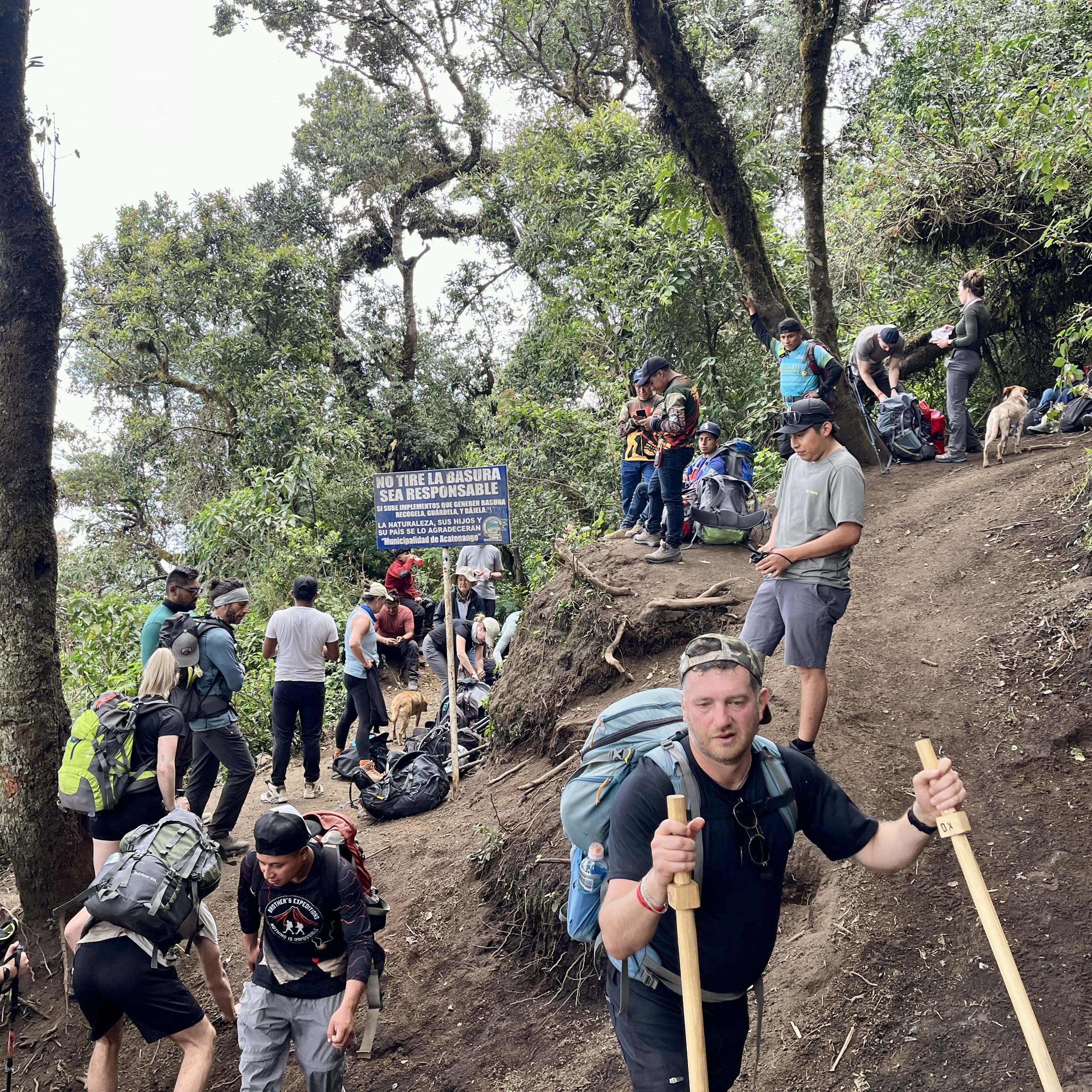
Things like what size backpack to bring. They recommend a 50L backpack, which at first I thought was unnecessary, but quickly realized why it was needed (especially if you’re not using a porter and carrying all of your own stuff). You will need 4 - 5 L of water (there is no water sources on the mountain). You will want to bring some of your favorite snacks. Things like trail mix, protein/energy bars (I love RX Bars), maybe a piece of fruit or two. You will also need to pack warm weather clothes. We hiked in March and it was warm and sunny, but at night it gets cold, and you’re going to want layers.
Lastly, you’ll need to pack your lunch and dinner (provided by Ox Expeditions but you must carry it), as well as community food (something that I hadn’t realize beforehand). Lunch was a stromboli like sandwich. Dinner was a Tupperware of pasta that they mixed with what tasted like homemade sauce with vegetables. For the community food I had a bottle of wine in my bag. Some people had bagels or banana bread. Others had a jar of peanut butter, nutella, or jam for breakfast.
Additionally, only about a mile into day one of the hike 7 people dropped out of the trip and turned back. But we still had to carry up their community food. I ended up adding cheese and coffee to my pack to help out. My bag at this point was by no means full, but I’m glad I had the extra space.
During the meeting they will also go over what clothes to pack (see below), conditions on the trail, how long you’ll be hiking for, what time to meet in the morning and where, details on hiking to Fuego, details on the sunrise summit, how often you’ll break, and a lot more information. Definitely attend this meeting if you’re able to. A few people in our group got in too late to attend and did just fine. So don’t fret if you can’t make it.
Clothes and layers
I hiked up in Danner trail boots. Knee high, thin smart wool socks. Prana hiking pants. A dri-fit t-shirt. A long sleeve base layer. Hat, light buff (for nose and mouth coverage from the dust) and sunglasses. Some people were in shorts and t-shirts which was perfectly doable given our weather conditions, but I always prefer long sleeves and pants on sunny days to protect against the sun.

In my pack I had base layer pants, fleece, puffy jacket, rain jacket, warm hat, warm gloves, and an extra pair of socks that I changed into for the night and to sleep. And I’m happy I had all of it. Once the sun went down it got quite chilly. Even with the fire we had going I still had on all of my layers minus the rain jacket and gloves. Luckily we didn’t end up needing our rain jacket. I did wear my gloves for some of the early morning summit to Acatenango. But once the sun came up it was plenty warm and I didn’t need them.
Here’s a good site for very accurate weather information: https://www.mountain-forecast.com/peaks/Acatenango/forecasts/3976
Food and Water
I mentioned some of the food I brought above. But I ended up bringing too much. The sandwich they gave us was dense and filling, and there was a lot of pasta for dinner. They also put out banana bread and hot chocolate before dinner. I brought 2 apples, 2 bananas, ~6 protein/energy bars, trail mix, and 2 bags of plantain chips. I could have done with half of it and been fine.
Breakfast was a beautiful assortment of bagels, English muffins, avocado, peanut butter, Nutella, jams, coffee. I was happy I had the banana for my breakfast.

I brought up 5 L of water and I drank all of it. One piece of advice: make sure you hydrate the morning of your hike before you begin. My water bottle was in my bag which went on top of the bus that takes you to the trailhead. So from about 7 am, when we left Ox Expeditions offices, to around 9:30 am, when we got to the trailhead, I barely drank anything other than coffee at Rainbow Cafe (where Ox Expeditions had arranged for free breakfast for everyone before the restaurant opened). Eggs, beans, tortillas, and plantains. It was quite good, but I didn’t have any water.
So I killed 1 liter of water immediately at the beginning of the hike. Electrolyte packets are also a nice thing to have.
The Hike
Day 1 was challenging. I didn’t use a porter, but a lot of people did (it cost Q200 for one way). But if you’re not using one, expect to carry 30 - 40 lbs. Day 1 took around 5 hours to go just under 5 miles, gaining close to 4,000 ft. Not an easy feet. But it is totally DOABLE. Our guides gave us breaks for water, a snack, and to re-group every 30 minutes or so. Don’t give up. Keep going.
And if you want to use a porter, do it. Not only will it help you get to the top, but it also helps the local economy by giving someone a job for the day. You pay the porters directly, and if no one uses them, they don’t have work. Don’t be ashamed to use one.
The trail is dusty, loose, and tricky at parts, but nothing too technical. While we did have some people in our group turn back early on, we also had a couple of people who were older, ~60s, and without hiking experience, who made it up.
Sunset Hike to Fuego

A little less than half of our group did the additional sunset hike to Fuego. At the time it was not erupting and so I think many people decided it wasn’t worth it. But the people who went anyway were happy they did. The people who decided to stay back, myself included, and hang out at camp and shoot the shit around the fire, were equally as happy with their decision. The campsite overlooking Fuego is a beautiful place to spend the evening after a long day of hiking. I don’t think you can go wrong either way.
Having said that, if you think hiking to Fuego is going to impact your ability to summit the next morning, then I would say skip Fuego and do the sunrise summit of Acatenango.
Where We Slept

Ox Expeditions has 5 person cabins for anyone who books ahead of time. For people who show up the day before or day of to book sleep in tents. We got lucky and only had 4 people in our cabin. There’s sleeping bags and really cushiony sleeping pads with a small built on pillow. One thing we forgot was a sleeping bag liner. It is mandatory to sleep in one presumably to help keep the sleeping bags clean. If you have your own you can bring it, and if not they can let you borrow one.
Acatenango Sunrise Summit
We woke up at 4 am, and we were hiking by 4:30 am. There is no time for breakfast, coffee, or really a proper bathroom break. So plan accordingly. It’s just about getting up and going. But it is totally worth it, and not nearly as difficult as I had anticipated. I went up with 1 L of water and barely drank any of it. I also didn’t eat anything until I got back down. But some people did. Maybe bring a light snack.


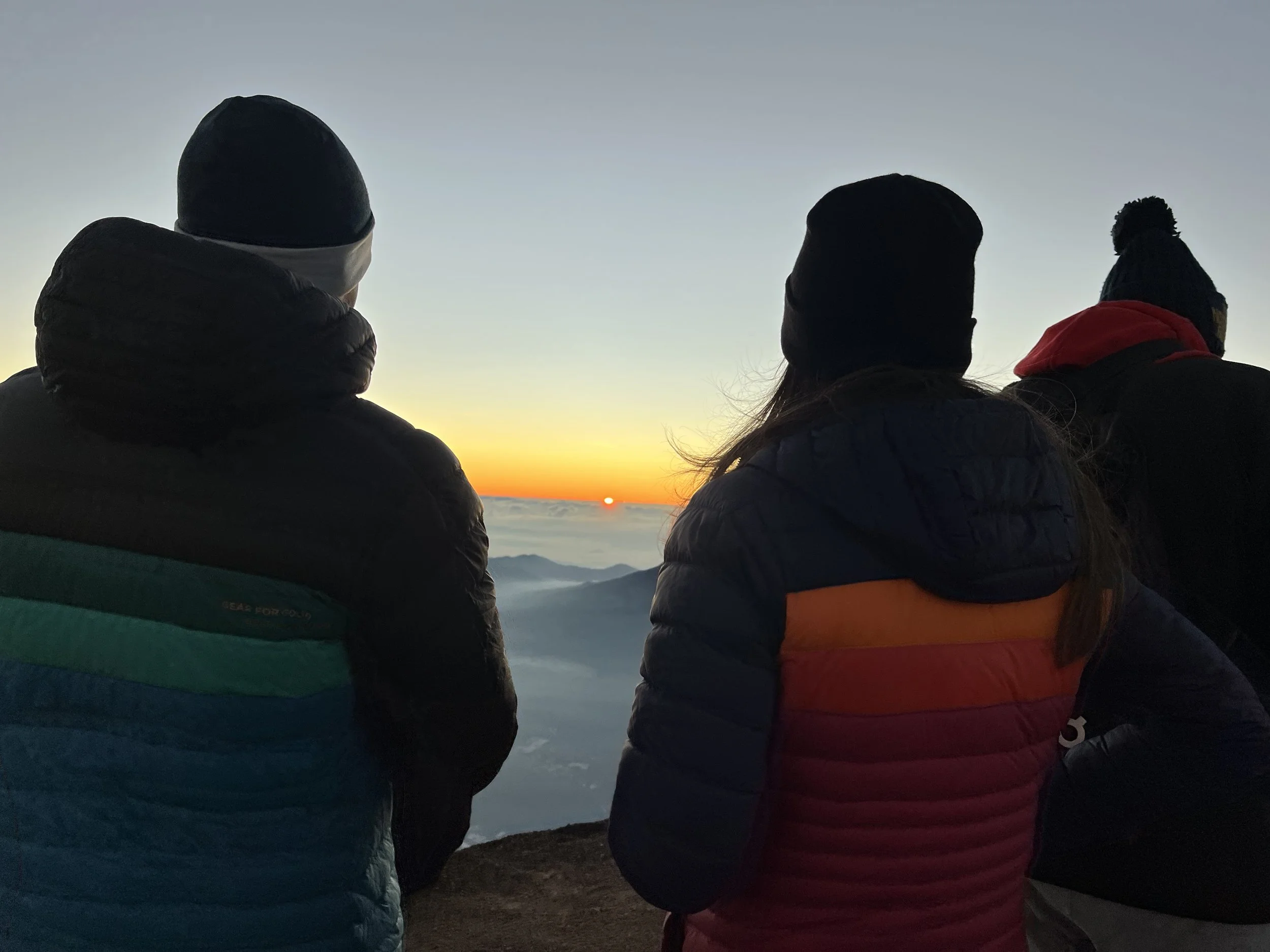

Most of the trail on the way up is very loose sediment. I’m talking sinking a few inches in with each step (a little like snow shoeing). Especially on the way down. Expect to be “skiing” through the dirt.
The summit is about 1 mile each way (depending where you camp is on the mountain). In total the summit was about a 3 hour event. 90 minutes up, hanging out for 30 minutes or so, and around 60 minutes or less on the way down. Once you get back to camp it’s time to back up your cabin (or tent) and eat some breakfast before heading back down.
The Way Down
Getting down Acatenango was challenging at times. There are some very steep and slippery spots. But if you have hiking poles, which I definitely recommend having (you can rent them from Ox), you will be ok. The way down took under 3 hours. We ran the last mile or so because it was easier than sliding through the dirt.
Once you’re back down you’ll wait for the bus to take you back to Antigua.
Overall Thoughts on Acatenango
It was an amazing experience that far surpassed my expectations. I’ve been to different places around the world to hike and summit mountains, and this experience was up there with the best of them. It is challenging, but I think if you have some experience, and a real desire to get to the top, you can make it. And I can say that Ox was very accommodating and supportive in trying to get everyone to the top.
Antigua
Our two friends we were traveling with stayed in Antigua for a couple of nights after the hike before going to Lake Atitlan. If you’ve been researching things to do in Guatemala, surely Lake Atitlan has shown up. It is the one place that every local we met said we should visit. Still, my fiancé and I chose not to.
Depending on where you’re staying around the lake (there are a number of different small towns to choose from), it’s a 2.5 - 3 hour trip there from Antigua (drive + boat ride). My fiancé and I just didn’t feel like making that journey. We wanted to relax and explore every corner, café, restaurant, and ruin we possibly could in Antigua. Our friend’s pictures from Lake Atitlan looked amazing. But still, we’re happy we spent 5 nights after the hike in Antigua. We got to really know the city and try a lot of local places. We’ll visit Lake Atitlan on our next trip.
For our time after the hike we stayed at El Convento. A small boutique hotel in the northeast corner of the city. As the name suggests it’s an old convent, like a lot of hotels in Antigua are, that was converted into a hotel. Our room, room 13, was a beautiful king suite. We booked this room for the outdoor soaking tub, but never actually got to use it. For one, we were out too much (we walked ~10 miles per day). Two, we couldn’t figure out how to fill it. Three, the one time we did ask the hotel to come and prepare it, as a sign posted above the tub suggests you do, they never showed up. Luckily the bathroom has a beautiful bath tub and so we just used that. It worked out just fine. Point is: maybe you don’t need the room with the soaking tub. All the rooms were beautiful.
We loved this hotel. My fiancé didn’t want to leave. We’re planning on getting married in Antigua next year and she wants to stay there again. It’s just a beautiful, comfortable, well decorated, and historic place to spend your nights. The breakfast wasn’t great, but with so many places to eat breakfast in Antigua I didn’t quite care. Even if it was good, I would’ve still wanted to go out and explore. And explore the food and coffee scene we did!
Restaurants/Cafés
It seems like there is a cool or historic restaurant or café around every corner of Antigua. We spent 5 nights in Antigua and every day we found a new place we wanted to go to. We left Antigua with over 40 places saved on our maps. We did our best to get to as many of them as possible, but we still missed some. But we’re planning on getting to them when we get married there next year.
Thursday - Day 1
Breakfast - Courtyard Guatemala City - Buffet style. Typical hotel breakfast.
Coffee Break - Amor Cafe: We loved it here. Located near the historic district we enjoyed talking to the owner, as well as an Americano and a delicious green smoothie.
Lunch - Café Portalito: A great little spot around the corner from the Courtyard Guatemala City. The food was great, the owners were friendly and accommodating.
Dinner - Laurel Bistro: Not my favorite meal. It was just very basic in a city filled with flavors. Skip it.
Friday - Day 2

Pre-hike breakfast at Rainbow Café
Breakfast - Rainbow Cafe (with Ox Expeditions): Solid spot. Good coffee, and desayunos tipicos.
Lunch - Hiking
Dinner - Hiking

Jalapeño and Banana Chicken at Sobremesa
Saturday - Day 3
Breakfast - Hiking
Lunch - Café Boheme: We can hear straight from Ox Expeditions offices after returning from the hike. We all go something different, and everyone enjoys their meals. We would have come back if there weren’t so many good options in this city.
Coffee Break - Bru’d: Ok coffee. I got a cortado and was pretty underwhelmed by it. I never came back despite passing it multiple times during my stay. Skip it.
Dinner - Sobremesa: Good food. Kind of an Italian and Guatemalan fusion. I had an interesting dish called Jalapeño Chicken. If you want something that’s not exactly Guatemalan, give this place a try.
Sunday - Day 4

Empanadas at Chermol
Breakfast - El Covento Hotel Breakfast: Breakfast at our hotel was completely mediocre. We ate here twice (first morning, last morning) because it was convenient and included, but it was pretty disappointing. They do give you a choice of oatmeal or yogurt, a choice of an egg dish, and a choice of a juice, plus coffee. A good amount of food/drink for breakfast, it just wasn’t very good.
Lunch - Chermol Empanadas: One of the best Jason y queso empanadas I’ve ever had. Our friends ended up eating 6 empanadas here. I would have had more if we weren’t planning on going to get street food after.
Lunch - Parque La Merced Street Food: In Parque La Merced is a food and shopping market. During the week there are not many vendors, but on the weekend it is filled. I highly recommend getting some food here. We go tacos and tostadas, and came back here a few times to eat.
Dinner - 27 Adentro: This restaurant is rated 4.9 out of 5 on Google. A friend we were with was skeptical about the rating until we actually ate there. We shared an avocado salad, shrimp ceviche, and their shredded beef tostadas. I had the Chicken Pepian. The best chicken dish I’ve ever had in my life.
Monday - Day 5

Tacos from a vendor at Parque La Merced
Breakfast - Café Sol: The service here was rather slow, but the food was extremely delicious. I wanted to come back here but we just ran out of time. My fiance and I split oat pancakes which were insane. And we each got a smoothie. Our friends had egg dishes that they really enjoyed. Just be patient with the service.
Lunch - Y Tu Piña Tambien: This was one of our favorite meals. The food was awesome, I got the typical egg, plantain, beans, and tortilla dish. But the restaurant itself is worth going into because everything from the seats, tables, doors, and door frames, are all antiques and just gorgeous. We also experienced great service.
Coffee break - Del Otro Lado: This was a random stop for a coffee and I really enjoyed my Americano (cafe negro) from here. They also sell packaged foods, chocolates, and other things of that nature. They try to promote local. Definitely stop in here.
Dinner - Ta’Cool Taco Shop: We ended up at Tacool after not being able to get into Por Que No (see below). We were really hungry and just settled on this restaurant that we had seen busy ever since arriving in Antigua. We split 8 tacos (you have to order 4 of the same type) and nachos. The food really wasn’t bad, neither was the price. It just didn’t feel like the authentic taco experience we were looking for. Good spot if you’re in a pinch.
Tuesday - Day 6

Cocoa Bowl at Amanecer Juice Bar
Breakfast - Amanecer Juice Bar: Unbelievably delicious smoothies and smoothie bowls. The presentation of the smoothie bowls is also remarkable. We ended up coming back here the next day for lunch, and I got the same thing. It was that good. A small little spot. Totally worth the bit of wait for them to freshly prepare your food.
Lunch - Parque La Merced Street Food
Coffee Break - A Ver Quien Soy Cafe: A nice cafe negro doble. Cool little spot a little bit off the beaten path. I really enjoyed my coffee here.
Dinner - ¿Por Que No?: One of our favorite meals. Not just because of the food but also because of the decoration and ambience of the restaurant itself. It’s a very small place (probably less than 10 tables) and fills up quickly. The dishes are unique, the kitchen is small, and everything feels like it’s cooked with love. Definitely go here. The suggest making a reservation which you can do from their social media page.
Wednesday - Day 7

The Duck Muffin from Caoba Farms
Breakfast - Caoba Farms: A small organic farm just outside of the city. From El Convento Hotel where we stayed it was an easy 20 minute walk. They have a farm, a full restaurant, and a great little store with a lot of unique and local products. I bought coffee and freshly made chocolate they were making in the back room. At the restaurant I had duck muffin. A duck sausage patty with an over easy egg, cheese, pickles, on a homemade brioche bun. My fiance had eggs Benedict and said it was the best hollandaise sauce she’s ever tasted. It comes with a bright side salad fresh from their garden.
Lunch - Amanecer Juice Bar
Lunch - Cactus Antigua: After the juice bar we were still a little peckish so we split 4 tacos here. I don’t recommend. They were fine, but they were just very cheesy and very saucy, and therefore very heavy.
Coffee Break - Café Condensa: Decent cafe negro double in the main square.
Dinner - 27 Adentro: The food here was so good that we had to come back for our last dinner. I got the beef stew the second time, but I wish I got the chicken pepian again, because as good as the beef stew was, the chicken was just next level.
Other places of note:
Fat Cat Coffee: Really good coffee. A very familiar cafe experience.
Fernando’s Kaffee: A great little spot off the beaten path.
Café La Parada: Cheaper coffee right near the food market. I really liked my cafe negro here and brought my fiance and friends later in the day. They didn’t like it as much as me. 🤷♀️
Overall Opinion of Guatemala
We loved our time in Guatemala, and specifically in Antigua. We found the food and coffee to be delicious, the people to be insanely friendly and helpful, the prices perfectly reasonable, and the whole city to just be magical. So much so that we will be back next year to get married. Don’t miss the chance to experience this historic and majestic city surrounded by volcanos, and filled with culture.
Unraveling Universal Healthcare II
One more reason why we would all benefit from universal healthcare
When I was working one of the main reasons people said insurance companies didn’t focus on preventative care was because they were unlikely to benefit from it. That by the time a person was at the age when they would develop a preventable disease, they would be covered by a different insurance carrier, and that carrier would be the one benefitting. Because most people get their health insurance through their job, whenever they switch employers, they also switch insurance. It turns out this happens on average every 6 or so years.
I understood the logic then as I do now, but I have never agreed with it. My view was always if all the insurance carriers provided preventative care, then it wouldn’t matter which patients they were covering. Everyone in the pool, in theory, would be equal. But obviously getting every insurer to agree and comply with this idea would be a gargantuan task, and one that no one wants to take on. It is though one of the reasons that Accountable Care Organizations were born, as well as incentives for achieving certain quality metrics. Unfortunately it hasn’t been enough to change the trajectory of health in America.
But I never thought of it as a reason for universal healthcare. Not until I read TR Reid’s The Healing of America. Because under universal healthcare, and more specifically a single payer system, the government has all of the incentive in the world to keep people from getting sick. The more disease they prevent, the less money they have to spend on treating those preventable diseases, the more money that’s in the system to treat other people with acute and non-preventable illnesses.
TR Reid makes this argument in chapter 11, An Apple a Day, and it was the first time I ever realized that it could help solve this problem.
“In a nation with a unified health system that covers everybody - which is to say, all the industrialized democracies of the world except the USA - it clearly benefits both the population and the system to invest in public health. But in a fragmented, multifaceted-system nation like the United States, the economic incentive for preventative care are dissipated.”
In this excerpt from the book he calls U.S. healthcare a “system.” But in a previous chapter he more accurately defines it.
“American healthcare is not really a system at all. It’s a market. In a market, people with money can buy what they want, and many people are left out. So we thought, no, we don’t want market-driven healthcare. We want a real system, something that covers everybody and doesn’t depend on how much money you have.”
He’s quoting a Taiwanese businessman who helped set up the universal healthcare system in Taiwan in the 90s. When thinking about what they wanted their system to look like, they first turned to the US, but then realized it wasn’t a model to copy.
Healthcare as a market, as a commodity, is also not something that I ever put together even though it should have been obvious to me. The rich get good healthcare, the poor don’t. It’s not something I was ever ok with, but it’s something that I dismissed as just the way it was. The same way I thought the ability for insurers to decide which claims to deny was normal. That is until I read this book and my eyes were opened. That is until he framed healthcare as a commodity in the U.S. and it clicked for me.
Our country is so focused on making money. Everything we do as a nation is based on this. And that’s ok. That’s a good thing in most cases. Economic incentives, the ability to create a better life for yourself and your family is one of the reasons that Americas is viewed so favorably around the word. I meet people all the time in my travels who dream of coming to America, working hard, and having a better life. I meet people who have immigrated here and are so happy they have the opportunity to improve their situation. And I don’t think we should ever change that.
But I think it’s time that we grow up as a nation. That we realize as a nation that we have more than enough resources to give everyone that lives here a comfortable and secure basic level of living. That certain things like healthcare, food, shelter, and clean water, are not commodities that should be distributed based on income.
And I think providing a real healthcare system for everyone, and turning our public health efforts towards helping prevent disease, is a great place to start. And I think that while healthcare could be step number one, revamping the market around food and turning it too into a system that benefits everyone, is a very close number two.
Easy Peasy Eggy Breakfast
A simple fried egg with cheese and avocado. Easy and delicious.
For awhile I had been off the egg game. Years ago I did a food intolerance test and they told me I was allergic to eggs. Specifically the egg white! So, I got it in my head that I shouldn’t eat them. Since that time I’ve heard of how inaccurate those tests can be and since I loveeee eggs, I’ve been incorporating them back into my diet. Everything in moderation right?
My favorite way to eat an egg is pan fried over easy so the yolk runs out all over the dish.
I’ve also recently been indulging in my cheese cravings.
Easy Peasy Eggsy Breakfast
Two eggs fried over easy in butter
Melted sharp cheddar cheese
Slice avocado
Sriracha sauce

Unraveling Universal Healthcare, and a Good Place to Start
One aspect we can all agree on for healthcare in America
I started reading TR Reid’s The Healing of America in which he analyzes the main components of universal healthcare systems in developed countries around the world, and then compares them to each other, and to the U.S.’s system.
I’ve gotten as far as France, Germany, Japan, and the UK. Each one is slightly different in whether insurance is private or government funded. How much citizens have to pay (if anything at all). How much providers, physicians and hospitals make. How they maintain patient records (France maintains all patient records on a card similar to a credit card. When you visit the doctor or a hospital they simply swipe your card and all of your information pops up, and the provider can update your chart. Imagine never having to complete a new patient intake form again!).
There are a lot of small differences.
But the one thing thus far that is universal to them all is that no insurance, whether it’s private or government run, can deny a claim. If a physician, hospital, or provider, submits a claim for a procedure, test, or medication, insurance must approve it, pay it, and the patient must get the service.
The one slight caveat to this is in the UK, where a government run organization called the National Institute for Health and Clinical Excellence, NICE for short, conducts research and studies to decide what gets approved. The difference though between NICE and insurers in America is that NICE publicizes its decisions. While private insurers in the U.S. make their decisions in private.
Another difference is that NICE only has a set amount of money to fund healthcare for the whole country, so they need to be strategic. But denying a service doesn’t result in extra profits in the UK like it does in the U.S. Rather, rationing some services, like experimental treatments, means that someone else can receive the care they need.
It’s been shocking to learn because it is so contrary to the way we provide healthcare in America.
In America the insurance carrier decides what procedures, tests, and medications are approved. Not the doctor. In America, the clinic’s office staff frequently has to fight with the insurer to get approval and payment. They have to go through a lengthy appeals process, and very often the doctors themselves have to take time out of their day to get on the phone with the insurer!
It’s so engrained in us that I had a hard time accepting it. My American brain, programmed from spending 10 years working in the American healthcare system, kept saying “That doesn’t make sense. Of course they should be able to deny claims.”
I told my brother, who’s an operating room nurse manager in the largest hospital network in the northeast, about it, and he too was confused. His response was, “wow, really?”
Corollary to that thought, my next one was, “Their claims, testing, and procedures, must be through the roof. And costs as a result.”
But that’s not really the case. It is true that in most of those countries utilization rates are higher when compared to the U.S., but still the overall cost of healthcare is cheaper. One of the main ways they manage that is by having a drastically lower fee schedule when compared to the U.S.
A $200+ office consult in America might cost $20-$30, while a $1,500 MRI might be $105.
And the evidence actually says the inability to deny claims makes it cheaper by putting less strain on the system. Providers in those countries aren’t required to employ additional administrative staff to bill claims, file appeals, and fight denied claims. A huge expense, and huge time suck. I know because it’s one of the main responsibilities I had at my company.
Which made me think, “Why do we allow insurers to deny claims here?”
The answer. It’s just what we do.
I was talking to a gentleman at the airport who works for Firestone Agriculture as a farm consultant. He was a big heavy set Texas man with a handle bar mustache.
I asked him what he does in his role. He said he tries to save farmers money by implementing more efficient practices. He said the main thing he does was advise them on what tire pressure to maintain on their tractors. The correct pressure can save 1 percent on annual fuel bill of $250,000. That’s $2,500. A lot of money for farmers who typically run at a loss.
But he said despite telling them that, he often meets resistance. They don’t want to check their tire pressure and most farmers keep their tires at around 24 psi. The correct pressure is 12 psi.
When he asks farmers why they chose 24 psi, they respond by saying, “Because that’s why I’ve always done.”
It seems to me that we have a long road ahead if we’re ever going to get to a real universal healthcare system in this country. But maybe a smart approach is to start tackling it piece by piece.
It seems like, especially given recent events around healthcare and its executives, that a good place to start might be outlawing the practice of denying claims. If we can’t yet wrap our heads around universal coverage, maybe we can accept that anyone with coverage needs to be covered.
Why CVS and Senators Lie
Despite what they say, no one is interested in your health
I saw a CVS Health commercial today. It was a promotion patting themselves on the back for eliminating tobacco products from their stores 10 years ago. Bravo.
The problem though, is that’s not the only addictive carcinogen they sell. Alcohol and ultra processed foods that are laced with chemicals and added sugar, line their shelves and are just as deadly and addictive as cigarettes. This self-congratulating as a show of their “commitment to health” is so nefarious.
It reminds me of this clip where Senator Chris Murphy is standing in front of the closed USAID building with a group of people in protest. He says:
“The people get to decide how we defend the United States of America. The people get to decide how their tax payer money gets spent. Elon Musk does not get to decide”
Do we though? I don’t recall deciding, or agreeing for that matter, to send my tax dollars to fund a war and a genocide. There are many other places I and my fellow Americans would rather spend their money.
But that’s what these companies and politicians do. They tell you what you want to hear while omitting the truth. They play to our emotions. CVS is making us feel like, “Wow, the was a bold move. They must be really committed to health.” While ignoring all of the other harmful products they sell in their stores.
Murray is getting us angry at “Elon Musk who isn’t elected and doesn’t get to decide where our tax dollars go!” Leaving out the part that he and his colleagues decide, not us or Elon Musk, and their decisions are increasingly less aligned with the will of the people.
I just finished reading The Tipping Point, by Malcolm Gladwell. Here’s an excerpt that stuck out on the topic.
“Teenage smoking is one of the great, baffling phenomena of modern life… To address that problem, then, we’ve restricted and policed cigarette advertising, so its a lot harder for tobacco companies to lie. We’ve raised the price of cigarettes and enforced the law against selling tobacco to minors, to try to make it much harder for teens to buy cigarettes. And we’ve run extensive public health campaigns on television and radio and in magazines to try and educate teens about the dangers of smoking.”
If we can do it for cigarettes. If we could demonize them, restrict them, and tax them, then why can’t we do it for alcohol and ultra processed poisonous foods that we know are killing us? Why can’t we make it just as difficult to drink or eat your way into an early death as we did for smoking?
If Chris Murphy and his colleagues can stand outside of the USAID building in protest, surely they can stand outside of Coca-Cola, McDonalds, Wendy’s, Starbucks, Kelloggs, Kraft, Pepsi, and voice their concern over the increasing amounts of processed foods in American’s diets, the deleterious impact they hav on our health, and demand change!
He might say something like, “Big Food, Big Ag, and Big Beverage don’t get to decide what food we grow, how we grow it, and what ends up on our shelves, the people get to decide!”
But of course he would never do that.
Murray is no more interested in doing something so “controversial” as restricting alcohol or processed foods as he is telling us the truth about where our taxes go and who decides. It could mean career suicide. It would mean having integrity, doing what’s right, telling the truth, and helping the people you were elected to serve, even when it might cost you.
CVS doesn’t want you to know that there are other things in their stores that are just as dangerous as cigarettes. They just want you to think they care, and to think about them when you think about your health. They’re just looking for another way to convince you to walk through their doors, instead of Walgreens. Even though they all sell the same poison.
The only thing they are really interested in is filling your prescription(s) and having you buy something addictive to keep you coming back for more. Nobody is looking out for your health. It’s on you to do it for yourself.
Electrolytes are trending, but they are just sugar delivery systems
Don’t fall for the hype.
I think it’s criminal the way companies load a product with sugar and then promote it as a health supplement. That’s been the new trend with electrolyte powders. The claim is that they’ll balance your nutrient level. The truth is that they are just another way to deliver sugar and get people addicted to their product.
One of the leading electrolyte brands is Liquid IV. My friends in Los Angeles all used them. I’ve heard Joe Rogan promote them. But for whatever reason I was never inclined to try them. I was in REI a few weeks ago and thought about buying a packet. Luckily I checked the ingredients list and nutrition facts first.
Liquid IV contains 11 grams of added sugar.
In my hotel room this past week was free samples of Mortal Hydration. Their tagline is “Formulated to Fight Death.” Sounds critical. In one packet is 8 grams of added sugar. The first ingredient is organic cane sugar, the last ingredient is Stevia (just in case the sugar didn’t hook you). They recommend mixing this packet with 22 oz of water.
The other night my fiancé and I went to the Backcountry Film festival. I took a free sample of DripDrop Electrolytes. Their label states it was formulated using Oral Rehydration Solutions Science (ORS Science), and developed by a doctor. Science, doctor, it must be good for you. One packet contains 7 grams of added sugar. They recommend mixing it in 8 oz of water.
DripDrop goes on to say that the doctor made it for people in developing countries to fight dehydration. They claims that there’s a special formula that helps accelerate hydration. But here’s the thing. If you live in a developing country where dehydration and lack of calories are real threats to life, then Liquid IV, DripDrop, and Mortal Hydration could all make a difference. That is a good use case for them.
However, if you live in the developed world, or a country like the U.S.A., where it’s very likely that you’re already consuming too many calories and sugar, then the last thing you need is an extra shot of sugar and calories in liquid form. There are very few people suffering from dehydration in America. Especially anyone who can afford packets of electrolyte powder.
Don’t get me wrong, sodium, magnesium, and potassium are critical to optimizing performance and health. But you don’t need them delivered on a sugar train. And the people who need the sugar are people who are exercising enough to burn that sugar. Endurance athletes, CrossFitters. If you’re training for an hour a day or less, then a packet of sugar and calories is the last thing you want.
Buy an electrolyte mix without sugar, without artificial sweeteners and flavor. That’s what will turn a good thing into a bad habit.
DripDrop contains 35 calories, Mortal Hydration 40 calories, and Liquid IV has 50 calories per serving.
I did an intense one hour workout the other day. I burned 220 calories. That means 10 minutes of work burned 40 calories. That might not seem like a terrible tradeoff, but the only way to lose weight is to be in a calorie deficit. And most of us are already in caloric surpluses. Why make the work harder?
But the problem isn’t just the unnecessary calories and sugar. Chances are if you drink sugar water you’re going to crave sweets and sugars throughout other times in your day. It’s an addictive substance. That’s why it’s in so many ultra-processed foods and drinks.
If you think you need electrolytes, choose the versions with no sugar and no artificial sweeteners. That means it will have to be unflavored. Or do what I do and buy the main ingredients in bulk from BulkNutrition.com and mix your own. I used 1/8 of a tsp of the magnesium malate, 1/8 tsp of potassium chloride, and 1/4 tsp of table salt per 32 oz of water. I might mix a couple of those a days depending on how active I am. LMNT also makes a good unflavored version.
But don’t fall for the hype and just ASSUME that it’s good for you because everyone is talking about electrolyte or because a doctor is promoting it. Always check the nutrition facts and ingredient list. If it has added sugar, put it back. You don’t need it.
Which Egg Do You Want To Eat?
The answer should be obvious

Left: Store brand “free range” and Right: Vital Farms organic pasture raised
The eggs I typically buy are Vital Farms brand, organic and pasture raised. If the store has regeneratively raised then I’ll go for those, but right now most stores don’t carry them. My sense is that for that extra $1 - $2 per carton, people aren’t buying them. There is more education to do on the benefits of regenerative farming.
But with the egg shortage recently due to the bird flu, Vital Farms eggs have not been on the shelves. In some grocery stores, they haven’t had eggs at all. So when I saw eggs on a recent food shopping trip, I decided to grab a dozen.
The best and most expensive eggs available were store brand “free range” eggs for $4.99 per dozen. Vital Farms organic pasture raised by comparison can be $10, regenerative eggs are even more.
So I didn’t have any grand expectations for the eggs I bought. I know how most chickens are raised in this country. I know that cage free, free range, non-GMO, no antibiotics, is really all horse shit when compared to a chicken that is actually raised on pasture. But I was shocked when I cracked these two eggs next to each other.
I was preparing to make chicken cutlets and I had one Vital Farm egg left, so I used it along with the new dozen I bought. The difference in color almost made me throw the egg away. I couldn’t believe how dead the egg on the left looked in comparison to the egg on the right.
The egg on the right looks like it’s full of life and nutrients. Thick and creamy. While the egg on the left looks like it came from a chicken who struggled to survive.
Most food we eat doesn’t have such a contrast when put side by side. Meats, vegetables, and fruits, have a better appearance when raised regeneratively or organically, when compared to conventionally raised. They have a better taste too. But out of the box (out of the shell), I don’t think the juxtaposition is nearly as drastic this.
When I see the difference in these yolks it is no wonder to me that bird flu spreads so quickly and easily through the factory chicken farms that house hundreds of thousands of birds all crammed on top of each other, living in their own filth and excrements. These birds are clearly very unhealthy and their immune systems are therefore incapable of fighting off a virus. The same way that many people with co-morbidities were unable to fight off COVID in this country.
And it’s not wonder. If most people are eating eggs that look like the one on the left, or worse, then how could we expect to be healthy. If what were putting into our bodies is dead, then how could we expect to live.
The first key to turning around our health is putting healthy food in front of us. And that happens when we force the food system to change, and start growing food that serves us and not the corporations that own the system.
To achieve success, visualize success
I learned the hard way what a bad rehearsal can do
Chase Hughes spoke about rehearsing before a big fight, or a big event in your life, whatever it might be. He spoke about the importance of visualizing everything. Of seeing it through to the end, visualizing success, and then doing it over. Repeating it again, and again, and again, in your mind. Visualizing and anticipating, so that when you do step into the ring, the office, onto the stage to give a presentation, you are prepared for whatever comes your way. And the more you rehearse, the higher your chances are of succeeding.
It’s something that Charles Duhigg also spoke about in The Power of Habit. He used Michael Phelps as the example.
Michael Phelps had a very specific routine that he followed every day during training. This was intentional. So that when we woke up on race day, he was able to get right to action without having to think. There was not hesitation. Part of his routine during training was visualizing his race. His launch off the board. His stroke. His breathing. His turn. Visualizing each piece of the race.
He become such a master of visualizing his races, that during one race when his goggles started filling with water, preventing him from being able to see, he didn’t panic. He knew exactly what to do. He had visualized this race so many times beforehand, that he didn’t need his sight. It was already programmed in him, and he won, despite not being able to see.
That’s the power of rehearsing.
But I think perhaps the more important thing that Chase Hughes said was that every time you envision your event, race, fight, or presentation, and that vision is filed with fear, anxiety, things going wrong, and insecurities, that also counts as a rehearsal. A bad rehearsal, but a rehearsal nonetheless. And each time you rehearse in this way, you engrain the opposite outcome in your brain. You begin to engrain failure, because that’s what you see.
It was a very interesting perspective because it is true, and I had never thought about it that way before. It would be the equivalent of repeating the wrong lines or the wrong scene while rehearsing for a movie, or play. If that were to happen, chances are the performance would be shitty.
It’s also interesting to me, because that is what I did in preparing for my trip to the cabin a couple of weeks ago. I thought about all the things that could go wrong. I thought about all the things that were making me nervous. I had planned on going out a week earlier to run reconnaissance and see what the trail was like. Get an idea of how difficult it might be. Even knowing about the parking situation, and permitting. But I never did it.
I went in blind, suppressing my fear and anxieties, instead of acknowledging them. So, it should be no surprise that when disaster struck, when I feel in a snow well and was stuck chest deep (aka, my goggles filled with water), I immediately decided to turn back. I had never visualized successfully getting to the cabin. I didn’t know what to expect. I hadn’t planned. So it didn’t take much to throw me off.
Don’t that negative rehearsal a place in your mind. Shut it down. It doesn’t serve you. Worrying and giving yourself anxiety over something you have to do or want to do, is not going to help you be prepared. It’s just going to hamper performance.
Instead take the time to visualize success, from beginning to the end. Anticipate where things might go wrong, what questions might be asked, and then figure out the answers. Step out into the field before your trip, or onto the stage before your presentation. See what it feels like. Get comfortable in the uncomfortable environment.
Take the time to go through the motions. Stay positive and smile. Give yourself the best chance to succeed by visualizing yourself on the other side of success.
The path to health is littered with temptation
Vigilance and focus are required
In this world, if you want to be healthy, then you need to follow a game plan. You need to have some rules. You need to have parameters set up that you’re going to stay within.
You need to have some tricks to help you stay on the path. You need all of those things to help you build healthy habits. And once you’ve developed healthy habits, it will make sticking to your plan, maintaining your goal, easier.
But it will still require work. Because we live in an unhealthy environment. We do not live in an environment that promotes health. We live in one that advances the opposite.
So it’s on you to be proactive and vigilant. The temptations are all around us. The temptations are intentionally the most affordable, and the most accessible. So, if you’re not being vigilant, it’s very easy to get sucked into the system and slip up.
The food system is set up in such a way to keep us just alive enough to keep us coming back for more. But the food system in no way supports making us thrive.
The food is grown in a toxic and lifeless environment. It’s then mixed with toxic chemicals. Addictive substances are added. And sold everywhere.
Achieving health in today’s society requires hyper vigilance and hyper focus. It’s the only way.
Tuna Salad and Brussels
When I’m craving something creamy and salty, this homemade tuna salad does it every time
My fiancé left some tuna in the fridge. Not enough to make a meal, to I opened a new can and mixed them together. I figured it was a good way to make the most of leftovers and add some extra protein to my meal.
I’ve also been back into eating nice salads for lunch. We’ve been getting these great greens from our local supermarket. Gotham Greens, a Brooklyn based company, grows all of their greens in greenhouses. The specific variety we’ve been buying, Rocky Mountain Crunch, is grown in Colorado. And since we like to support anything local, we’ve been buying this.
A nice little lunch filled with protein, fiber, clean carbs, and healthy fat.
Tuna Salad
Canned albacore tuna
Organic mayo
Dijon mustard
Soy sauce
Salt
Tomatoes
Green Salad
Rocky Mountain Crunch
Cherry tomatoes
Opal apple
Organic red kidney beans
Raw chipped yellow onion
Avocado
Ground flax
Olive oil, red wine vinegar, apple cider vinegar
Salt and pepper
Sauteed crispy brussels
Brussels, stemmed and halved
Cooked on medium-high heat with olive oil and salt
Uncovered for 5 minutes, covered for 5 minutes (or until tender enough to pierce with a fork)

Disconnect and Make Better Decisions
Manipulation is subtle but always in your face.
I recently realized how easy it is to be manipulated. What all of the advertising, marketing, and celebrity sponsorships is all about. Because for the first time in my life, I was the unknowing victim.
I love the UFC. I think it’s the greatest American sport. I also love Dana White. He is a sports marketing genius. There is no one, in my opinion, better than him at promotion. He’s no bullshit, and I enjoy the brand of entertainment he’s created.
I don’t love Donald Trump. I don’t hate him like most people, half the country, do. But then again, it takes a lot to make me hate you. It takes an equal amount to make me like you. But I’d say I’m at best neutral on him, in that I don’t think he’s any better or any worse than any of the other options. I didn’t want him to be president the first time he won, or the second time. But I also didn’t want Hillary Clinton or Joe Biden to be president. Maybe I’m just tough to please.
But the first time I saw Donald Trump sitting ringside at the UFC chatting it up with Dana White I immediately thought, “Maybe he’s not so bad. Maybe I got it all wrong.” I quickly became aware of what was happening and snapped myself out of it. But, it happened. For a moment, I was convinced he was an ok guy, and not a word had been spoken.
But that hasn’t happened with Mark Zuckerberg, who has become as frequent a sight at UFC events. The more I see him sitting ringside, the less and less I like him. But I digress.
But it’s an amazing thing really, to be influenced just by association with something or someone you like. And it’s scary because that’s happening to us all day.
It’s part of what Chase Hughes spoke about on the Joe Rogan Experience. The openness and suggestibility of certain people, and how easy it is to manipulate them as a result. It’s what he’s built his whole career on. It’s part of what I’m reading about in The Tipping Point, by Malcolm Gladwell.
In The Tipping Point, Malcolm Gladwell points to a study that showed how Peter Jennings’ facial expressions alone when discussing Ronald Reagan were enough to sway his viewers to vote for Reagan in far greater numbers than viewers of CBS or NBC. Despite all three stations producing programming that was unfavorable to Reagan. According to the study, Peter Jennings’ face lit up when talking about Ronald Regan versus Walter Mondale.
When participants were asked to score his facial expressions on a scale of 0 - 21, with the lowest being “extremely negative” and the highest being “extremely positive,” he scored 13.38 for Mondale, and 17.44 for Reagan. The other anchors, Tom Brokaw and Dan Rather, scored fairly evenly for both candidates (~11.00).
The result? On average viewers of Peter Jennings voted for Ronald Reagan 70 - 75 percent of the time, compared to 50 - 60 percent of the time for viewers of CBS or NBC. We are way more susceptible to manipulation than we think.
If facial expressions are enough to unknowingly tilt someone’s decision, then what would we estimate the impact of social media, the 24 hour news cycle, and reporting that focuses on biases and curated narratives instead of facts? How much could that be influencing our choices and opinions? All day screens are hurling suggestions at us, trying to convince us to take a certain side, and meanwhile we think that we’re voting for Reagan because he’s the better candidate.
I see it as an advantage that I don’t have social media and I don’t watch the news. Everything that’s important in the world still makes it in front of me anyway, but only 1 percent of what isn’t important does. I see the elimination of social media and news as being as advantageous as eliminating processed foods, drugs, alcohol, toxic relationships, or an unfulfilling job. As advantageous as sleeping 8 hours per night.
If you’re looking for a path out of the rabbit hole, disconnect from the noise, and pay attention to see if you start making different, better, decisions. Decisions that benefit you, not someone else.
I can guarantee you will.