
Misc Thoughts on Macros, Diet, Exercise and the Blue Zones
Trying to explain why my skepticism of health, life, and longevity hacks is growing.
Instead of thinking about everyday, think about your diet in terms of the week. This way if you mess up one meal in a day, you don’t beat yourself up for it. Instead you can tell yourself that you’ll make it up by staying consistent with your next meal and the one after that.
We put too much emphasis on getting every macro right that the whole project becomes overwhelming and we crash. Not every meal needs to be the exact right ratios or types of food. It’s more important that in the long term you’re successful. One wrong meal doesn’t have to spell disaster.
The same is true of exercise. We don’t need every workout to be our best. We just need to keep moving. The accumulation of movement over time is what spells change. If you’re emptying the tank at every workout, or getting so sore that it makes the next day too painful to workout, then you’re setting yourself back. Long term gains requires a lot of consistent hours.
I’m starting to fade on the idea that we need as much protein as some nutritionists and longevity experts say we do. The skepticism comes from watching and learning about people in the Blue Zones, the areas of the world where people live the longest, most active and fulfilled lives in the world.
In these parts of the world, it’s not uncommon for people to live past the age of 100, and being active into your 90’s is the norm. In all of these distinct cultures there are a number of things they do that they have in common. Like keeping close relationships and emphasizing community. Like maintaining a vegetable garden as the source of most of their food. And being active throughout their whole lives.
There’s also a lot of things they don’t do. They don’t work jobs they hate. They don’t do high intensity aerobic exercise. They don’t eat processed food. And they don’t obsess over the nutrients and macros they’re putting into their body. Protein included.
Their diets consist of a modest amount of proteins from a wide array of sources. Beans, legumes, dairy, plants, eggs, and some meat and fish.
If we want to explain part of the obesity epidemic I think we need to look at the way protein is forced on us. Eating too much protein while being inactive will lead to weight gain and other possible health issues. Because unused protein is stored as fat, and a lot of times in places you don’t want it, like the liver.
If you are a bodybuilder, a high level athlete, or extremely active, then you are the exception. But considering that 60 percent of the adult population doesn’t get the recommended amount of daily exercise (20 minutes of moderate intensity aerobic exercise per day, 2 strength training sessions per week), than the overconsumption of protein is surely part of the issue.
The second thing I think the protein messaging does it cause overeating. Not only are we programmed to reach for protein at every meal, we’re also told hitting your daily protein goals (anywhere from 0.7 - 1.5 grams per lb of bodyweight) is hard to do in one day. Hm, I wonder why? Because it’s too much protein.
But in a subconscious effort to hit our goals we reach for calories hoping it gets us closer to the target.
During stretches when I’m really dialed into my training and my diet I can sense the difference from day to day of what my body is asking for. On days when I train hard, I can’t get enough protein and carbs. But on my rest days, it’s mainly carbs and a normal amount of protein (70 - 90 grams).
There’s a lot that’s influencing the changes we’re seeing in our health. None bigger than our outside environment, the one we cannot control. Things like the type of food that populates 90 percent of grocery stores, and the relentless marketing and messaging that’s everywhere.
Don’t worry about the nutrients and macros you’re getting. Instead focus on eating real food and spending 70 - 80 percent of your day on your feet. I think that just those two changes can offer dramatic results.

Why supporting local is difficult but necessary.
It might cost a little more time and money, but shopping local is the best.
Two recent examples.
Spell Books - “Because a good book puts a Spell on you!”
My girlfriend and I were in downtown Littleton recently when we stumbled upon Spell Books, a small locally owned bookstore. We are both avid readers and when it comes to buying a book, we both prefer the in-store experience over the online one. So, it’s exciting for us when we find a local bookstore.
I went in looking for Greg McKeown’s second book, Effortless. I read his first book, Essentialism, back in 2019 when I first left my job and began overhauling my whole way of life. Essentialism completely shifted my perspective of productivity and allocation of time, and got me to start focusing on what was essential and eliminating what wasn’t. It had a big impact on me and I was hoping Effortless would be the same.
Unfortunately, they didn’t have it in stock, but the owner offered to order it for me. She said it would arrive in 5 - 7 days.
Almost three weeks went by, and I still hadn’t heard from them. So, Jen decided to call and find out what was going on. I assumed it came in and they just forgot to notify me or had misplaced my contact information which I had written on a sticky note.
But it turns out that they didn’t forget, the book just hadn’t come in yet. Effortless was on back order from the distributor and they didn’t know when it was coming in. She offered to cancel my order so I could buy it somewhere else. On Amazon it would have been at my doorstep in a matter of days or maybe hours. I decided to continue to wait.
Last week I got an email from Spell Books notifying me that the book had come in. When we went in to pick it up it was sitting there waiting for me with the same sticky note I had written my contact information on almost four weeks prior.
Overall, choosing to buy my book locally cost time waiting and driving to the store, and probably 10 percent on the purchase price, but it was worth it.
Chicken and the Egg
I’ve been getting my chickens and eggs from a local farm. They pasture raise hogs and poultry, treat their animals humanely, and use high quality, diverse, and organic feed when needed to supplement their diet. All characteristics of small farms that you won’t see in grocery store bought meat.
When I order, I have two options. For $5 they’ll deliver my order to a locally owned retail store that’s a 30-minute drive from my home, or for $10 they deliver it to my door. Orders are placed bi-weekly. If you miss the order deadline then you wait (although they’ll make every effort to squeeze an order in), or, conceivably, you could drive the 2.5 hours (one-way) to the farm.
A couple of weeks ago I placed an order for 3 whole chickens, 1 dozen eggs and 1 package of bacon (it was on sale 😀) and paid the $10 to have it all delivered to my house. I ordered on a Sunday with a Tuesday delivery date.
Tuesday morning, I got an email letting me know that the delivery driver wasn’t available to make deliveries, so my order would be delayed to the following week. At the time I had been in the habit of slow-cooking a whole chicken every week, and I had timed my cooking schedule to align with this delivery. So, when it didn’t come I drove 5 minutes to the grocery store and picked out the best organic free range bird I could find, knowing that it was mostly lies and I’d be eating an inferior and sickly bird. But I didn’t want to wait.
The next Tuesday rolled in and with it came a huge snow storm. I knew immediately more delivery delays would be in my future. I got an email from the farm that morning informing me that the winter storm had shut down the roads out of the mountains and they wouldn’t be able to deliver.
On Thursday my order was delivered to my doorstep.
The Impact.
Since local shops and farms have been pushed out by big box retail and mega farms, it’s made buying local inaccessible and expensive when compared to the big boys. The big box stores have swallowed up all the convenient locations, and their large purchasing power has driven down their cost of goods (which allows them to undercut small business owners) and allowed them to stockpile inventory, while local shops struggle with back orders.
Our neighbor told us that when she first moved into her home more than 20 years ago, she was surrounded by ranches on every corner. Now, those same corners are occupied by a gas station, a Costco, and a parking lot. She said when Costco was first built, she was so mad that she boycotted them for 2 years. But she eventually caved when she got a coupon in the mail. She’s been shopping there ever since.
The book experience came a couple of weeks on the heels of a similar one my buddy and I had when we went into a local gaming shop looking for two board games. We were told the games were on back order from his distributor. Two days later Amazon delivered the games to my buddy’s doorstep.
Mega farms jam hundreds of thousands (sometimes millions) of animals into factories to reduce the cost of raising meat. Pasture raised chickens (like the ones I’ve been ordering) cost 100 percent more per pound to raise than a factory farmed chicken you’ll find in the grocery store ($3-$4 per pound versus $8-$11). If we can agree that pasture raising animals is the right way, then what kind of conditions must the factory farmed chickens who are half the price be living in?
In the last 20 years the only contribution to society by big business is cheap, low quality, and fast. That’s the business model for Amazon, Walmart, Costco, McDonalds, Starbucks that has allowed them to accumulate insane amounts of wealth (collectively worth almost $3 trn) and power and control nearly every market.
But cheap, low quality, and fast is the reason that our health and local economies continue to decline at a rapid rate.
Whenever a Costco opens where a ranch used to be. Whenever an Amazon warehouse stocks books to the ceiling. When McDonalds and Starbucks open in your neighborhood selling fake food and artificially sweetened beverages, it is a sign of societal decline. The long term impact of these stores is what we’re seeing play out all over the country. Millions of people suffering from chronic disease and mental health issues that are the results of poison in our food and low paying and unfulfilling jobs.
Not everyone I understand has the time, capacity, resources, or accessibility to choose local over big business. But, for those amongst us who do, then we really need to do a better job of spending our dollars appropriately.
Mid-term elections are every two years. Presidential elections every four. But everyday we can vote with our dollars. And the more we can re-direct dollars into our local economies, the more accessible and affordable we will make it for everyone.
Let us practice patience and be willing to spend a little more money to support our local farmer, grower, baker, and shop owner.

Intuition
Our intuition has been hijacked
I’ve had this belief for a while now that the comforts of modern society are disrupting our ability to listen to or even hear our intuition. And it’s for that reason that we are both sick and divided. Let me explain.
Food I think is the easiest one to understand. Food today we know is not the food we ate 100 hundred or more years ago. Maybe not even 50 years ago. And most of it isn’t even really food.
The food that many of us consume today is engineered to be extremely tasty (I won’t say delicious), palatable (easy to eat), and therefore addictive (you want to keep coming back for more). And our body doesn’t know how to handle that.
So even if we’re not hungry, we want to eat. Even if we’re trying not to have sweets, we reach for the candy. Our intuition is saying we don’t want it, but it’s been engineered so perfectly that it disrupts what our gut is telling us.
And it’s not just what food we put in our body that determines what and how much we’re going to eat. It’s the advertisements that we see all around us. It’s the grocery store filled with these manufactured foods.
When we walk into the grocery store we might know what we’re going in for, but the second we see the shelves lined with treats that all changes. All of a sudden what we need (our intuition) gets hijacked by what we want.
Social media is another easy example to understand. How many times do you open your Instagram when you’ve told yourself that you’re not going to? I know that happened to me all the time until I deleted my account for a period of time.
How often are you scrolling through your feed while thinking “what am I looking at?” Again, that used to always happen to me too.
Developers have figured out how to override that voice in your head. They’ve figured out the formula, much like the food companies, that tricks your brain into coming back for more when you know you shouldn’t. It’s the same feedback loop that drugs play off of.
This is true of the 24 hour news cycle. It’s true of streaming platforms like Netflix, Hulu, and Prime.
So for many of us the majority of our daily interactions with food and technology are getting between us and our intuition and the result is we’re out of touch with what we want and are therefore unknowingly being conformed to what they want.
That’s why when you talk to someone face to face or on the phone the conversation is a much different one than the one you have online. You can tap into what you want and most people want the same thing.
It’s the reason why when you eat real food you don’t over indulge. Your body is able to signal to you and say “hey, we’re good.”
I think for most of human civilization people have been able to listen to their intuition and now there is so much noise and poison in our environment that we’re having a tough time tapping in. If we can eliminate the noise and limit the poison I think we’ll all see a big change in our health and more people come together.

Time Restricted Eating as a Tool and Bird Flu
Click here: OneSource Health, April 14, 2024
“If there is no solution there is no problem.”
Metabolical
Photo by Pushpak Dsilva on Unsplash
A few weeks ago, I shared my thoughts on time-restricted eating (“TRE”). In that newsletter I stated that while I used to practice TRE regularly, I stopped when I learned that fasting can negatively impact testosterone levels in healthy males. Well, the last two weeks have made a liar of me.
Over the last two weeks I’ve been staying up later than usual. On top of that I’ve also been snacking on sweet treats like brownies, ice cream, and my favorite of all, medjool dates stuffed with peanut butter. If you know me well and are shocked, you can blame it on The Great British Baking Show. It’s the reason I don’t want to go to bed and it’s convinced me to eat more sweets.
I’ve been rationalizing it by telling myself if they’re homemade (like the brownies) or made locally (like the ice cream), than I’m good. 🤷♂️
Regardless, as a result I’ve been waking up without an appetite and feeling like my GI tract needs a break before having breakfast. So, to counter my late night eating I’ve gone back to TRE.
Whenever people ask me about various diets, whether they’re vegan/vegetarian, keto/low carb, or fasting/TRE, I try to advise using them more like tools than diets. In the long run, none of those diets (IMO) are sustainable. But in the short term, they can have huge benefits. And that’s what incorporating TRE for me right now is doing.
I know that this recent habit of staying up late and indulging in sweets won’t last, but while it does, I’m going to enjoy it. But I’m also going to counter the effects of it as best as I can. And right now that means fasting through the morning and getting a workout in before eating.
As an example, today I took a 1 hour kickboxing at 11 am and ate my first meal at 1 pm.
There’s going to be certain times when your lifestyle easily lends to staying balanced and on track with your health and fitness goals. And there’s going to be other times when it won’t. It’s in those latter times that you want to implore the tools you’ve learned to ride out whatever it is that’s getting in the way of your routine.
We have 5 seasons left of The Great British Baking Show. Eight episodes per season, 1 - 1.5 episodes each night, means I can expect to continue my morning fasts for about another month.
Cheers to your practice.
James.
Avian Flu in the News
Avian flu or “bird flu” was in the news again last week. If you’re anything like me, you probably read the headline, thought something along the lines of “that’s scary,” and kept it moving. At least that’s what I’ve always done in the past, but recently I’ve been trying to educate myself more on what it means.
One of the benefits of knowing your farmer is you get access to their wealth of knowledge. This week when I decided I wanted to learn more about bird flu and write about it, I emailed Aila Holley, owner of Sisu Farms where I buy my meat from, to find out what she had to say on the topic.
Perhaps the most important thing I learned was that the number of birds lost during each outbreak does not actually represent the number of birds that were infected. Rather it represents the number of chickens that came in contact with an infected bird.
“The number of birds that were' affected' [by] avian flu is really very artificial,” Aila said. “It’s not actually birds that died of the virus but rather the birds in close proximity to those that died. The way the USDA handled compensation to producers, was they would be paid for any birds that had to be ‘depopulated’ due to being housed with birds that died and tested positive. So, in reality we don’t actually know how deadly the virus is because it was not allowed to run its natural course. When producers had a bird test positive for the flu, in most cases they would kill all the birds in that barn, sometimes to the count of 100’s of thousands.”
So, when Cal-Maine Foods, the largest egg producer in the country, recently reported the “culling” of almost 2 million chickens at one of their Texas facilities, we don’t actually know how many were infected nor how many actually died from the virus.
With that said, we can assume that due to the environment that factory raised chickens are forced to live in “without sunshine, fresh air, soil and grass,” and fed commodity grown grains, they really wouldn’t stand a chance. They lack access to all the resources needed to build a robust immune system, one of the reasons why antibiotics have become so prevalent in factory “farming.”
Roughly 80 percent of all antibiotics worldwide are given to factory raised animals.
As Aila put it, a robust and resilient immune system “is one of the key differences in animals raised like that vs pasture-based producers” like her.
Aila and many other pasture-based producers, like Will Harris of White Oak Pastures and Joel Salatin of Polyface Farms, agree that the virus should be allowed to run its course to take out the weak birds and breed the survivors. But that’s not something the government is intent on doing.
Instead, they’re worried about containing the problem, not solving it. Which is why the health of the birds, is left out of the conversation.
This is the fifth outbreak since 1924 and in the 100 years since chicken factories have only grown larger and more crowded. Government’s only intervention has been to require the killing of all birds in proximity to an infected one. During the 2005 outbreak “experts” also suggested that all animals, including the ones raised on pasture, should be sent indoors. A virus fighting strategy we’ve all recently had the pleasure of experiencing.
It’s also the first time in history that a virus that causes high mortality in birds was detected in cows.
The 2 million chickens slaughtered by Cal-Maine Foods only represents 3.6 percent of their total flock. Doing the math, that means they have over 50 million birds under their care. That’s a number that scared me and should scare you too.
But once I learned how big these factories are, the numbers started to make sense. In the two most recent outbreaks combined, in 2005 and 2022, nearly 200 million chickens were exterminated worldwide. 200 million chickens could feed a lot of people.
How could one company possibly care for that many lives without compromising their health and welfare? They can’t. Raising healthy animals cuts into profit margins and would require a total revamp of their systems. They’re not concerned with the health of the animal we eat, which means that they are not concerned with our health either.
The CEO of Tyson isn’t eating Tyson chicken. And the CEO of Kelloggs isn’t feeding his children cereal for dinner (even though he’s suggesting you should).
What’s the alternative? By my count there are three.
Find, Befriend, or Become a Backyard Chicken Farmer
My mom is a backyard chicken farmer. She has around 30 egg laying chickens (hens) and one rooster that keeps the order. She feeds her chickens the highest quality feed she can find, filled with appropriate amounts of quality protein and nutrients vital for egg production. In the summer she gives them special treats like frozen watermelon and strawberries. She also hangs heads of cabbage and ears of corn for the chickens to peck at and enjoy.
Recently she’s even been supplementing their food with oregano and red pepper flakes to help their digestive tract (they don’t feel the heat from the pepper, but the last dozen eggs she sent me were a little too spicy… just joking).
Their coop receives an abundant amount of sunshine and fresh air, is cleaned regularly so they aren’t walking around in their own waste, and the chickens have regular human interactions.
Find a Local Farm like Sisu Farms (search on: eatwild.com)
Sisu Farms is a family-owned farm 2 hours outside of Denver, CO. They pasture raise all their meat, which includes chickens, turkeys, cattle, and hogs (best bacon I’ve ever tasted).
I asked Aila, how they raise their birds.
“We raise our laying hens in flocks of 400-500,” she said, “and our meat birds in batches of 200-400 and then when they are on pasture each 10x12 pen has 75-100 birds in it. Turkeys are in flocks of 75-100.”
The mobile pen, which is mainly there for protection, has no floor, so the chickens can eat, peck, and scratch the ground beneath them.
“We only raise meat chickens and turkeys in the summer months when they can be on pasture. Egg hens are out when weather allows and then in deep bedding hoop-houses in the winter months.”
When egg hens are inside for the winter months, they’re given an organic and diverse array of feed to supplement their diet.
Order from a Large Farm Pasture Based Farm
White Oak Pastures, in Bluffton, Georgia, is a large-scale production farm, but they still pasture raise all of their meat (of which they have 7 or more varieties). It’s not just how they raise their animals, it’s also about how they slaughter them. This is an excerpt from Will Harris’ book, A Bold Return to Giving a Damn.
“Unlike the industrial system’s slaughterhouses, the biggest of which kill four hundred head of cattle per hour, ours handles thirty head of cattle per day, four days a week. On the fifth day, a much smaller number of hogs, or sheep and goats, move through. Our poultry plant can do about a thousand chickens a day, compared to a quarter of a million in an industrial facility.”
I know that access to local food is limited, and sometimes we have no choice. But if we do have a choice, choosing local has repercussions that reverberate through the food system and our communities. And the best way to increase accessibility is to demand it with our dollars.
Where we buy our food from matters. It matters to the animals, farmers, communities, planet, and most important of all, to our health.
Source(s):
Largest U.S. egg producer detects bird flu at Texas plant
Risk of Avian Flu Could Send Poultry Indoors
Will's Wisdom: Avian Influenza & Dairy Cattle
Cal-Maine Foods, Inc. Reports Positive Test Result for Avian Influenza at Texas Facility
Stop using antibiotics in healthy animals to prevent the spread of antibiotic resistance

Breakfast: Salmon Egg Scramble, Lentils, Local Mushrooms
Locally sourced mushrooms and an egg scramble make for a delicious and filling breakfast
I finally got more than 6 hours of sleep last night and I woke up extra hungry as a result. So I put together this heavy, hearty bowl.
I got my hands on some locally grown shiitake mushrooms from a small market that opened recently near my house, Littleton Meats. They’d been sitting in my refrigerator for a couple of days so decided to cook them this morning.
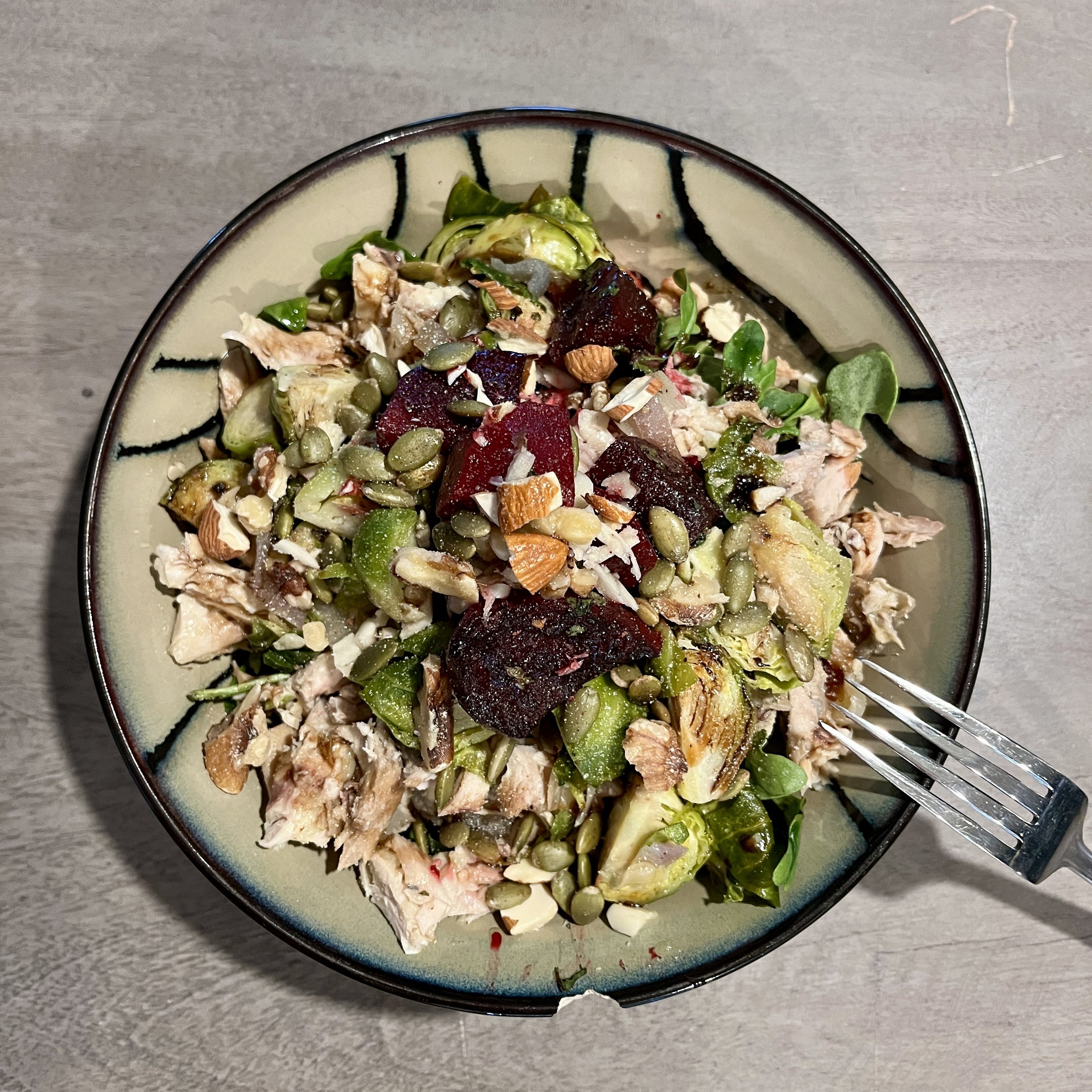
My bowl consists of, by layer: lentils, tofu, broccoli, and mushrooms, with a salmon, egg, and avocado scramble on top. I finished the dish with chopped raw garlic, olive oil, red wine vinegar, and fig balsamic vinegar.
I’ll probably be full until dinner.


My Workout Got Stale So I Changed it Up
With kickboxing, handstands, and HIIT
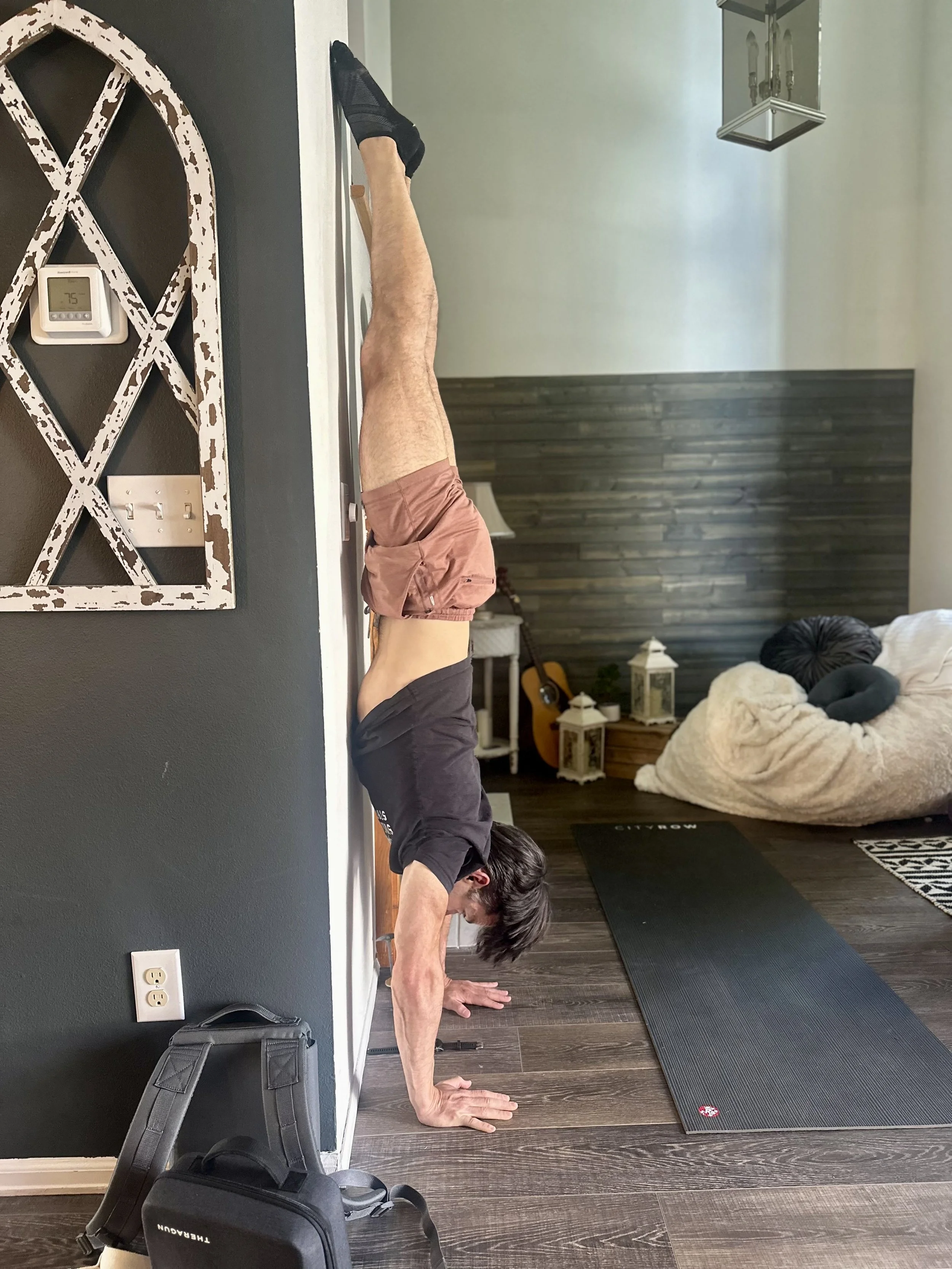
In the past three weeks I’ve thrown myself into the fire in an effort to change up my fitness game. Just straight strength training was getting boring so I started looking for new training modalities. I had a few in mind that I had been thinking about for months and never acted on. So over the last few weeks as my motivation to go to the gym wained, and I found myself just going through the motions of a workout, I finally decided to change things up. And this week in particular I found myself in 3 very different forms of exercise.
Handstand and mobility
Hight Intensity Interval Training (HIIT)
Kickboxing
The handstand class was at a place called ApeCo Movement School. As the name suggests the studio focuses on getting back to your primal roots by focusing on movement through all planes of motion. Classes focus on things like mobility, light acrobatics, and fun things like handstands. They also emphasize building relationships and community. Each class you’re paired up with at least one other person and you help guide each other through the movements. It’s a funky class with a style that’s way out of my comfort zone.
Take this week’s warm up as an example to help explain. The whole class started by laying on the floor. We pretended the floor was covered in paint and we had to twist, turn, and roll our bodies around to make sure that every inch of us was covered in paint.
The HIIT class (called Stations) was at a new gym that opened by me called The EPOC Experience. EPOC, I found out, refers to excess-post exercise oxygen consumption, which is the measurable increase in oxygen consumption and metabolism that happens after a high intensity workout. The class consists of 5 circuits, 2 - 4 exercises per, aimed at jacking up your heart rate (think sprinting on the treadmill for 60 seconds followed by 5 burpees, repeated for 9 minutes). It’s been a long time since I’ve sustained such a high intensity effort for 60 minutes, and this class kicked my ass.
The kickboxing class was at mixed martial arts school called Easton MMA. They teach kickboxing, Muay Thai, and Brazilian Jiu Jitsu. Entry level people like me can start in kickboxing before moving to more advanced modalities. It’s been years since I’ve hit a bag and it felt so good to unload for an hour. If you’ve never really punched, kicked, kneed, and elbowed a punching bag before, don’t waste anymore time. Find a gym and do it. There is no better way to relieve tension and stress. There is also no better way to build confidence.
So, what’s the point?
I’m always amazed by the nuances of movement whenever I try something new, or revisit something old. Each modality requires something slightly different of your mind and body if you want to be successful. Sometimes the hard part is what you expect it to be, like at the HIIT class at EPOC. I knew walking into that class that I’d been ignoring my cardio for over a year and that this class was going to kick my ass, so I just put my head down and powered through.
But at ApeCo the hard part for me isn’t the physical and mental demands of the handstand exercises (although for sure they are not easy), it’s getting comfortable allowing my body to move freely through space while in the presence of people I don’t know, all without letting my thoughts interrupt and stop me. And at Easton I walked in wondering how I’d fare on the bag in a 60 minute kickboxing class having not hit a bag for over 5 years. But it turns out that wasn’t the difficult part. The challenge was ignoring the rug burn on my knee from glancing blows on the bag and the blister on my foot that developed early in class from pivoting and driving through punches.
I’ve been able to sustain my fitness practice for over 20 years because I’m always looking for something new to jump into when my routine gets stale and never giving into that voice that says “don’t do it.” I look for what’s going to challenge me physically, force me to learn, and make me uncomfortable. Because those are the things that keep interest. And each one of these classes check all of those boxes.
If it doesn’t challenge you it doesn’t change you.
I know that right now my cardio is not where it needs to be if I want to leave HIIT class feeling anything but dead. That if I want to excel at the movement school I need to get over my fear of being uncomfortable moving in unorthodox patterns. And that if I keep kickboxing my toes and knees will form callouses to protect me. I know that while I’m struggling right now, that all of those things will only happen if I just keep going.
I also know that I’ll be able to take pieces of what I learn from each class and incorporate them into my routine going forward, and that the endurance, callouses, and body awareness I develop will serve my practice for years to come.
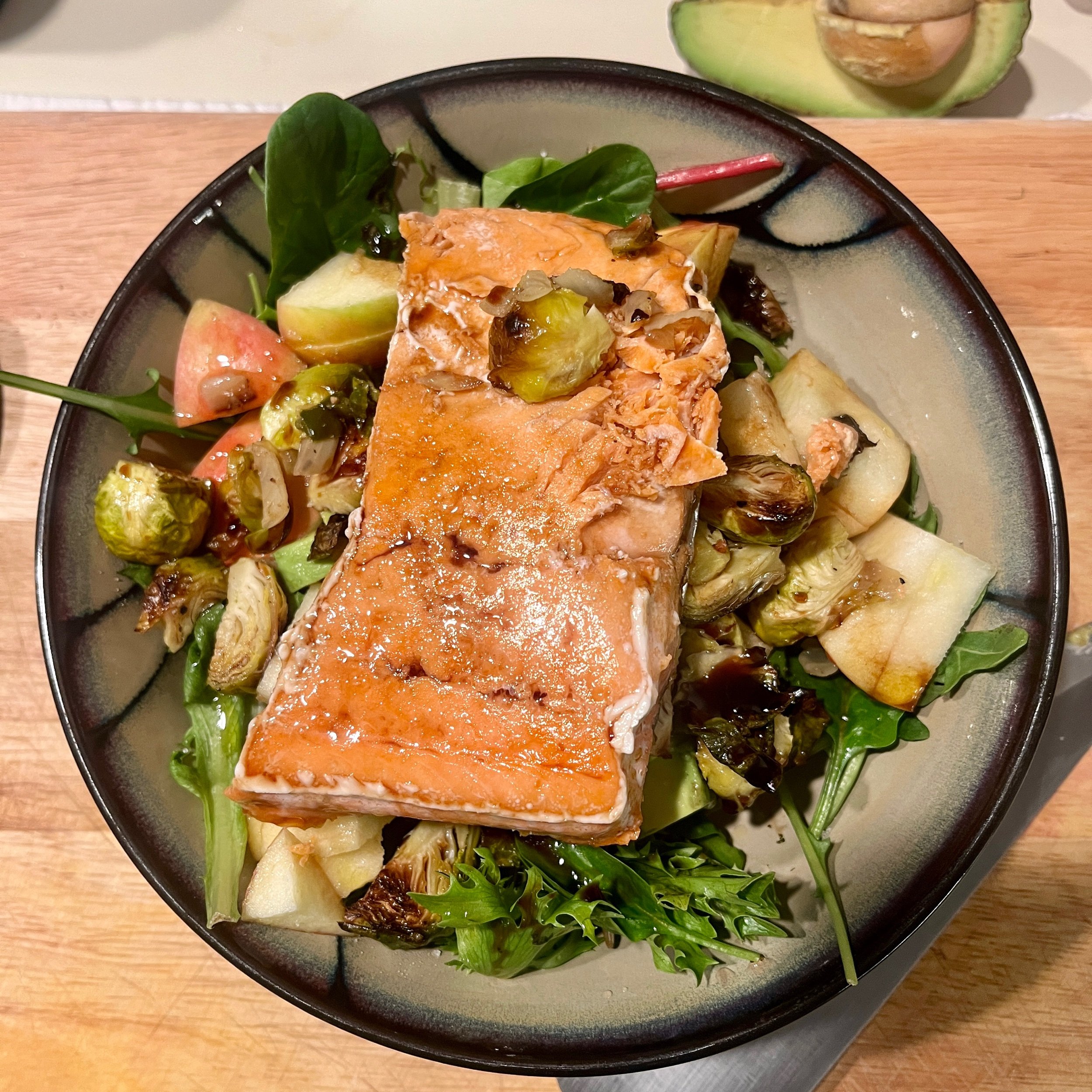
Salmon Breakfast Salad
A different way to enjoy breakfast
Unfortunately breakfast has become associated with foods loaded with simple carbohydrates and sugar. But it doesn’t have to be. Once you breakaway from the addiction they cause there’s no reason why breakfast can’t be healthy, savory, and delicious.

2 handfuls of greens
1/2 chopped apple
1/4 sliced avocado
1 handful of roasted brussels sprouts
1 6 oz filet of baked wild salmon
Finished with olive oil, fig balsamic vinegar, red wine vinegar, and sea salt
It's Groundhog Day When it Comes to Health Studies
Click here: OneSource Health, April 7, 2024
“But teach the children, and someday they’ll vote - with their dollars, with their ballots, and with their forks.”
Robert H Lustig, MD, MSL
A Good Book and Two Studies
Every week the media writes about a new study that tells us what we already know. This week the Washington Post provided two such examples. One about the increased risk of developing dementia and another about the benefits of the ketogenic diet on mental health (both discussed below).
It gets pretty exhausting seeing the same information published each week as if it’s ground breaking. And it’s maddening that despite everything we now know, or in the case of the ketogenic diet have known since the early 1900s, nothing changes in the one place that matters. Government.
Fake food is the most widely abused drug in the world and it’s completely unregulated. Walk into any store and buy as many hohos or Doritos as you want, or Super Size your Big Mac, fries, and soda at McDonalds. Contrast that to the last time you tried to buy some weed (assuming you have 👀), where they’ll check your ID, then make you wait in a holding pen to be escorted to the back, then check your ID again before making you point out what you want from behind the counter.
And that is not a comment on personal choice. It’s confirmation of how backwards our country has become. The thing that we know is killing us remains abundant, accessible, unregulated, AND subsidized by the government, while the thing that opens our mind, gets us in touch with ourselves, and has proven healing benefits remains highly taxed, regulated, expensive, and inaccessible to most.
Cheers to your practice.
James
Photo by Khalid Boutchich on Unsplash
“It’s not what’s in the food, it’s what’s been done to the food that matters.”
I just finished Metabolical, in which Robert Lustig, MD, MSL offers this straightforward advice: feed the gut, protect the liver. It reminds me of Michael Pollan’s equally simple advice: Eat food. Not too much. Mostly plants.
How do you feed your gut and protect your liver? Eat Real Food that’s high in fiber (food for your gut aka a prebiotic) and low in sugar (excess sugar in your diet ends up as stored fat in your liver which can lead to non-alcoholic fatty liver disease or even cancer).
88 percent of people are believed to be metabolically ill. Your metabolic health is a reflection of how well your mitochondria function, which is impacted by everything you put into your body as well as outside factors such as air pollution (as we’ll see in the dementia study below).
But the greatest impact right now is by far our food. Specifically ultra-processed fake food. So how do you know the difference between real food and fake food? Dr. Lustig provides this great breakdown to help distinguish between the two.
“Processed food is defined by seven engineering criteria:
mass produced
consistent batch to batch
consistent country to country
uses specialized ingredients from specialized companies
consists of pre-frozen macronutrients
must stay emulsified so that the fat and water do not later out
must have a long shelf life or freezer life”
Of the seven characteristics, numbers 2 and 3, consistent from batch to batch and country to country, stuck out to me the most. I think because when you realize the extent to which the ingredients must be manipulated to achieve that level of consistency, to produce millions of copies that are shelf stable enough to ship all around the world, the reality of how unnatural a process it is starts to set in.
Source(s):
Recommend reading with Food Fix, The Omnivores Dilemma, and Animal, Vegetable, Junk
A Dementia Study Confirms the Obvious
The study concluded that alcohol, air pollution, diabetes, sleep, weight, smoking, and blood pressure all play a role in the risk of developing dementia. The same factors that influence every other disease.
And while diet is given little mention throughout the article referenced, it is well documented that a diet rich in ultra-processed food and sugar plays an important role. Dr. Lustig frames it like this in Metabolical:
“Given the $290 billion annual cost of dementia in the US and that there've been 146 failed trials, it's almost laughable that we keep trying to develop a drug… New research shows that sugar consumption is associated with the development of Alzheimer's disease. It appears that fructose alters mitochondrial function in the brain, reducing energy generation, which puts the identified neuronal proteins amyloid and tau at risk for clump-ing, forming the classic neurofibrillary tangles of Alzheimer's. A processed food eating pattern has been shown to be predictive of future Alzheimer's disease, although no one has yet demonstrated that switching to Real Food lessens one's risk.”
Switching to Real Food has not yet been studied because there’s nothing to gain by demonstrating this truth. It’s a lot harder to make money selling broccoli than it is drugs. We know the answer’s but somehow we’re still looking for a solution.
Source(s):
Study finds 3 big risk factors for dementia
“High-fat keto diet may help people with serious mental illness”
Fun fact about the ketogenic diet, it was actually developed in the early 1900s by a physician looking to treat seizures in people suffering from epilepsy. The physician was looking for a way to mimic the known mental benefits of fasting, one of which was treating seizures, in a way that was sustainable long term. You can only fast for so long before you starve.
Since then it’s been used by intelligent and independently thinking psychiatrists like Chris Palmer, MD who discusses it in more detail in this podcast episode. He’s been treating his patient’s depression, anxiety, and schizophrenia for years with a strict ketogenic diet and it’s been life changing for his patients. They’ve been able to get off their drugs and experience relief that psychiatric drugs never gave them.
So the results of the clinical trial discussed in the Washington Post article shouldn’t be surprising to anyone who has been paying attention.
If you’ve ever fasted or been strictly keto, then you’ve likely felt these benefits. Mental clarity and, oddly enough because you aren’t eating, an increase in energy are chief among them. I’ve experimented with the ketogenic before for extended periods of time (3 - 24 months), and the results have always been the same for me. Huge benefits short term. Unsustainable long term.
Still, I think that keto is a good tool to keep in your toolbox. It can help you achieve short-term goals, and it’s a good way to reel yourself back in after going off the rails (like say after the holidays, or after a vacation). However, I’m convinced more and more each day that eating a Real Food balanced diet and focusing on intuitive eating (trying to dial into what your body is telling you you need) remain the best path towards a healthy and happy life.
The problem is that when you live in an environment abound with fake food and catchy marketing it’s very easy to slip into bad habits. Use diet techniques like keto, vegan, paleo, fasting, and others to reset your path.
Source(s):
High-fat keto diet may help people with serious mental illness
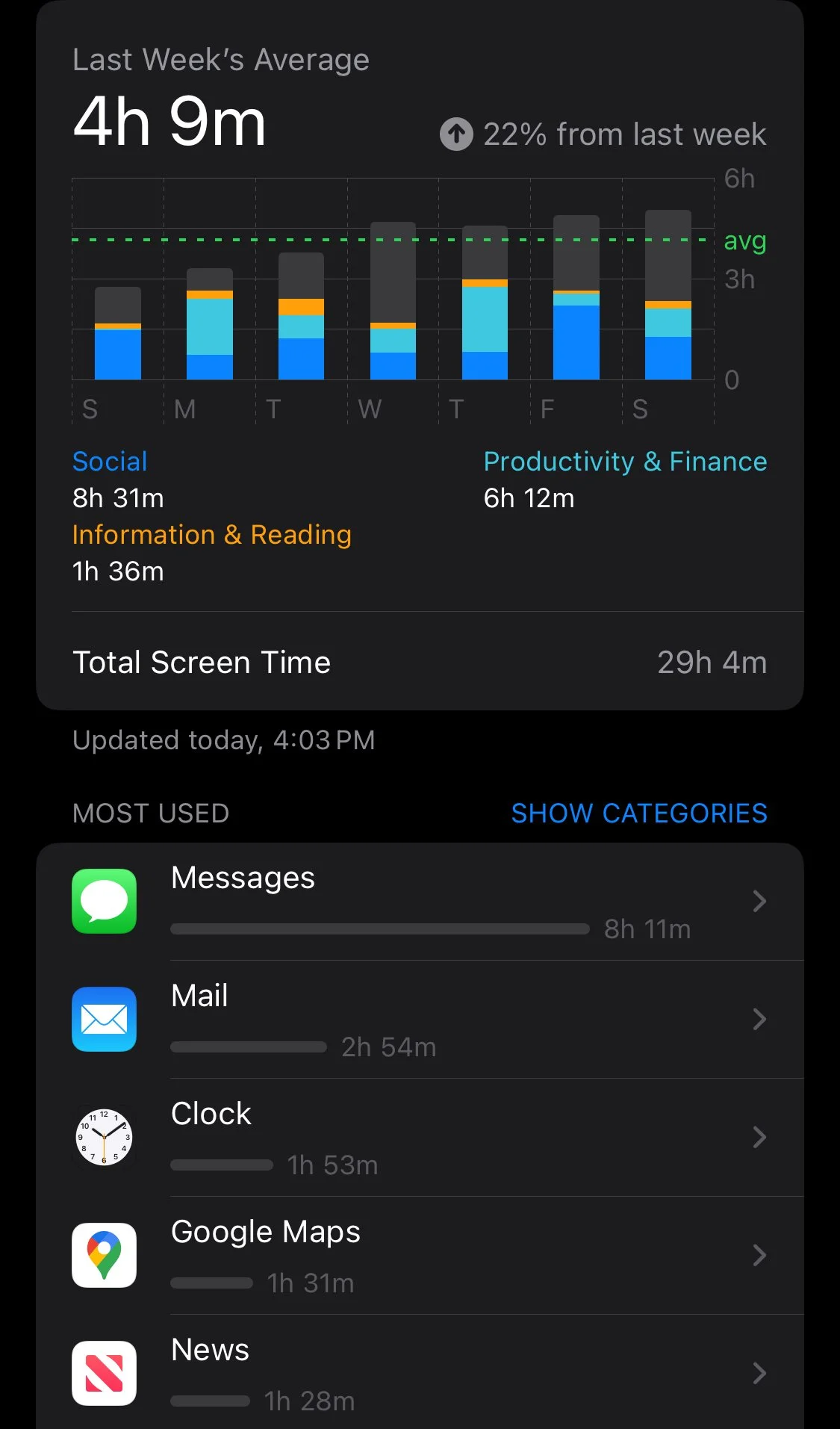
Cell Phone Usage and Social Media
It’s not your phone you’re trying to avoid, it’s using your phone to benefit you.
I don’t use my phone less since I stopped using all social media (with the exception of LinkedIn), I just use it for what I think is more productive means. Like the way it was originally intended to before greedy corporations sunk their teeth into it.
Last week I used my phone for an average of 4 hours and 9 minutes per day. That is a long time. I think the average person uses their phone for 5 - 6 hours per day, so I’m not far off. But, my top five most used apps last week, which is representative of most weeks, were:
Messages: 8 hours total, 1 hour 10 minutes per day
Mail: 3 hours total, 24 minutes per day
Clock: 2 hours total, 16 minutes per day (I’m always cooking so I’m always timing something)
Maps: 90 minutes total, 13 minutes per day
News: 90 minutes total, 13 minutes per day

My next five were Zoom (I had 3 video calls last week, which is 3 more than I’ve had in the last five years, so this one is an anomaly), Brave (my web browser), Notes, Spotify, Password Keeper.
I still touch my phone as much as I did before, but the difference is that by not having social media on my phone, I have to look for other things to do. And I try to make those other things productive. Like reading an article I saved. Organizing and cleaning up my inbox. Or writing something down that was on my mind.
And I think that’s maybe where people struggle. They think they’re trying to avoid their cell phones and when that doesn’t work they think they’ve failed. But really you’re trying to use your phone to be productive and having social media on your phone makes it really difficult.
It’s like keeping cookies in the house and telling yourself you’re not going to eat them. Has that ever worked? I know it doesn’t work in my house.

Breakfast: Turkey Chili
A different way to hit the craving for turkey chili
I got my hands on local ground turkey recently from Littleton Meats, and in keeping with my theme of cooking in the crock pot, I thought it’d be nice to make a turkey chili.
But all the recipes I found called for a long ingredient list, most of which I didn’t have, and a long cook time, time I also didn’t have. So I did the next best thing.
I cooked the ground turkey in a pan and then added it to vegetable soup I made a couple of days earlier. I also added some brussels sprouts cooked the night before.
Yes, this isn’t chili, but it’s the next best thing and it’s hits the same spots. In some ways I think it’s better. I have three different ingredients, soup, turkey, brussels, that I can mix and match with anything else in my kitchen.
I realized this morning that it’s not really meal prep we’re after. It’s food prep to be used to create different meals.

A Visit from Family, Time Restricted Eating, and Blood Glucose
Click here: OneSource Health, March 31, 2024
“What makes it great is the personal. How you see the world that’s different from how everyone else sees the world. Thats why you’re an artist. That’s your purpose in sharing your work with the world.”
Rick Rubin
Table of Contents
The Mike’s in the Spaulding Bowl at Copper Mountain
Last weekend my brother and his friend came to visit Jen and I in Colorado and do some skiing. I planned on sending out a newsletter last Sunday, but we were having so much fun that I couldn’t even think about pulling out my computer. Instead I spent my weekend trying to keep up with these guys as they skied non-stop from first chair Friday to last chair Sunday.
In my brother’s own words, “we were like little kids, exploring the mountain looking for fun places to play, and being excited at every turn.”
I also thought that if I was going to practice what I preached (i.e. work life balance, focusing on relationships, and disconnecting), that I should just enjoy the time with my brother, friends, and loved ones in the mountains. I’m glad I did.
There is nothing like the healing power of nature and family.
This is the 19th newsletter. When I started this project in November, I promised myself that I’d push through for at least a year. And that’s what I intend on doing, only it’ll be with a slightly different approach and on a different platform going forward.
I appreciate everyone’s support up until this point. If you wish to continue following me, I’ll be sending out information on how to do that once I get organized in the next 1 - 2 weeks. There is no obligation to sign up. I know the content is not for everyone.
With that said, this week I just have two short pieces to share that I found interesting on the topic of differing views and medias role in shaping perspective.
Thanks again.
Cheers to your practice.
James
There’ always two ways to interpret a study
If you saw a headline last week that went something like, Time-restricted eating linked to 91 per cent higher risk of cardiovascular death, then you should also read Peter Attia, MD’s article Does time-restricted eating increase the risk of cardiovascular death?.
For anyone that doesn’t know, time restricted eating (TRE) is a popular diet technique used by people to lose weight and improve their health (or so they thought). The study looked specifically at the most common TRE approach, 16:8 (fasting for 16 hours, eating for 8).
But, as Attia points out, the study, cited by the BBC and various other media sources, is riddled with flaws. Most glaring of which was the discrepancy in the size of the study groups (414 vs 11,831 participants), and the prevalence of pre-existing conditions (i.e diabetes, dyslipidemia, cardiovascular disease), higher body mass index (BMI), and greater likelihood to be a smoker in the TRE group.
While the BBC acknowledges that the study has not been peer reviewed, scrutinized for credibility and reliability, it didn’t stop them from using the study’s click-bait conclusion as their headline, and never clarifying inconsistencies in the methodology of the study. They only care about eyeballs.
I’ve used TRE a lot in the last decade of my life because it gave me mental clarity and made me feel better physically. I only stopped this past summer when I learned that TRE in healthy males can lower testosterone levels. Other than that all the data I’ve ever seen has been positive.
Regardless, I think the answer lies somewhere in the middle. I think too much of anything, including being too rigid (i.e. demanding your body to eat within a set window) must have negative consequences. I know I’ve found that to be the case in my own life. Whether it be relationships, work, exercise, or diet, moderation and balance always prove to be the better approach. I haven’t mastered it yet, but I try to get closer every day.
But don’t take my word for it. Read both articles. Give TRE a try, if you never have, and see what kind of results you experience.
Two Takes on Glucose and Blood Sugar Spikes
Continuous glucose monitors (CGMs) have been all the rage for a couple of years now. Everyone, including the healthy, are wearing them trying to gain insight into their health. I wore one for 3 weeks in the beginning of this year.
But there are opposing views when it comes to their effectiveness. This article by the Wall Street Journal, Is Glucose the New Gluten? Inside the Blood-Sugar Health Craze, provides a positive view based on anecdotal evidence.
While EC Synkowski, drawing conclusions from a meta-analysis that reviewed CGMs ability to predict cardiovascular disease, noted in her newsletter that wearing a CGM won’t improve weight or “optimize health” (she goes into more detail in this podcast episode from 2019).
Based on my own experience, I’d have to again land somewhere in the middle. Wearing a CGM made me more mindful of my food choices. The more I saw how certain foods impacted my body the more conscious I became. The most fascinating insight I had was learning how much poor sleep quality and quantity negatively influenced my body’s ability to regulate glucose.
I think anything that provides insight into the inner functioning of your body, and how it reacts to various inputs, is a good thing. Whether that’s a blood test, sleep tracker, or wearing a CGM. All the information helps paint a picture of your health.
Big changes don’t occur overnight, rather they are the result of many small changes over a lifetime. So, if a CGM can be the catalyst for one change amongst many, then it is beneficial.

Breakfast: Vegetable Soup and Eggs Over Easy
Hearty vegetable soup and eggs over easy make a delicious way to start a day
I love having a nice vegetable soup in the refrigerator to use as the base for any dish. This morning I decided to use it for breakfast.
I pumped up the soup with a handful of boiled broccoli, chopped red onion, and spiced pumpkin seeds (which added a nice texture to every bite).
For protein, and to make it feel more like “breakfast,” I added two pasture raised eggs from Sisu Farms cooked over easy. The runny yolk brought an additional layer of flavor to the dish.
I finished the bowl with salt, fig balsamic vinegar, and olive oil that was imported from Palestine and being sold at a local store called The Local (it’s also where I was able to pick up 2 whole pasture raised chickens from Sisu Farms).
This warm tasty dish was the perfect way to start my day.


Crock Pot Chicken and Lentils
Check out this hearty and healthy bowl filled with all the nourishment your body needs.
1.5 handfuls of Crock Pot Chicken chopped up
1 ladle of cooked green lentils, mixed with chopped white onion, 1 tbsp of olive oil and 2 pinches of sea salt
Cooking Instructions. Add 3 cups of water or vegetable brother to a pot. Add 1 cup of green lentils. Bring to a boil, then reduce to a simmer and cover. Cook for 45 minutes, covered. Taste for tenderness before removing from heat. Strain the lentils and return them to the pot.
1 handful of spicy brussels sprouts
1 handful of sautéed crimini mushrooms
Cooking Instructions. Bring a pan to medium-high heat. Add a tbsp of olive oil. Slice an 8 oz package of mushrooms into quarters (baby bellas or crimini), toss lightly with 2 tbsp of olive oil and 2 pinches of sea salt and add them to the preheated pan. Add a few splashes of water to create steam and cover. Leave undisturbed for 5 minutes, then toss, cover again, and let sit for another 3 - 5 minutes.
Notes on Health, Wasted Food, and Communication
Click here: OneSource Health, March 17, 2024
“I am a kind of flawed mirror, by no means wise or actualized, but willing to be in the endless discomfort of asking ‘Is this life?’”
Boyd Varty, The Lion Trackers Guide to Life
Three Articles and a Book I Like
A Different Perspective on Health
When I think about health, I like to think back to what our ancestors did. It’s highly unlikely that they thought about “getting in shape,” working out, lifting weights, or going for a run (unless being chased). But they were most certainly active most days, for most of the day. I imagine they were always outside getting sweaty or fighting the cold.
When it came to food, processed food wasn’t invented yet (yes, processed food is an invention), so they ate whole foods, meats, veggies, nuts, and berries. But they also indulged in foods rich in “simple carbohydrates,” sugar, and butter. Breads, pastas, and pastry are a historical part of every culture. But the difference is that they knew where their food came from, and what ingredients were in it. It was either made in their home, or by someone they knew.
There’s a growing movement to know where your food comes from. To know your farmer. But it’s not just the farmer. You should know your baker, your pasta maker, and your confectioner. If you know who’s growing or making your food, you’re way more likely to know what’s in it, and what’s not (i.e. preservatives, gums, artificial ingredients). Because when food is fresh and local, there isn’t much it needs to be good.
And for most of us, I don’t know if it’s much more complicated than that. If you can get outside every day to move and get to know the people or places that your food is coming from, health will take care of itself.
Cheers to your practice.
James.
Food Waste is Wasted Food
When I hear the term “food waste” I envision moldy produce, rotten meat, and food scraps. Even though I know that’s not what they are referring to, I can’t help but have that vision. But when I think of wasted food, I picture discarded leftovers, perfectly good produce left to rot, or food thats thrown out for being “past” it’s best by date.
For companies like We Don’t Waste, whose mission is to rescue food wasste and provide it to people suffering from food/nutrition insecurity, it means pallets full of ripe organic produce like carrots, potatoes, shallots, and broccoli. It means frozen pork shoulders and ground beef. Trays of fried chicken, mashed potatoes, biscuits, and mac n cheese. And it means loaves of fresh bread and pastries. This is “food waste” which is not at all what many of us picture.
Which is why we need to start calling it by its proper name. Wasted food.
Food gets wasted at every stage of its life cycle. Production (16.8 percent), processing (14.7 percent), and grocery stores/restaurants (20.2 percent) account for the fair share. But most of good food gets wasted at home. A staggering 48.2 percent of the 80 million tons of wasted food occurs at home! That’s an insane number, but it means we have the power to impact change, if we can shift our mindset.
When it comes to waste, the root cause is always the same. Cost and abundance. When a resource is cheap and readily available, the more likely we are to take it for granted. We can “afford” to throw out leftovers. We can “afford” to let those vegetables turn and wilt. Because we can get more. Reducing food waste comes down to a shift in mindset.
Here’s two strategies that I use to cut down on my wasted food:
How much food are you buying? We have an inclination as humans to buy food before we even need it. Only two bananas left? Better buy another bunch. We cooked all the broccoli? Let’s buy a couple of more crowns.
Don’t be afraid to run out of your favorite foods. If we’re lucky enough to be able to waste food, we also have easy access to buy more. So, running to the store is always an option. Also, letting your favorite foods run out is a good way to vary your diet and force yourself to try something new.
Ask yourself, what would I do if I had limited access to food? Would I just throw out those leftovers, or would I repurpose them? Would I toss out that last bit of food from my plate, or store it as a snack for later?
I know I’ve encountered this mindset during the pandemic or when I’ve been out backpacking (there’s only so much food you can bring with you). In those scenarios, when food is scarce, we take better care of it. We need to adopt that mindset to our everyday lives.
Why it matters: Landfills produce 1/3 of all human-driven methane and wasted food accounts for 58 percent of it. 44 million people suffer from food insecurity creating stress, poor food choices, poor health, and reduced productivity, creating a drain on our economy and the healthcare system. But with 40 percent of food going to waste it’s an unnecessary chain of events that people need not face. If we can figure out how to get more of this food into the hands of the people who need it and keep it out of the landfill, we’ll kill two birds with one stone and do a lot of good!
Sources:
A Bulk of Food Waste Happens at Home. Here’s How to Cut Your Footprint.
The Staggering Scale of Food Waste, Explained.
Understanding Your Health Markers
I think it’s normal to question what somebody tells you. Not because people are dishonest. But because people get shit wrong all the time. So why would you accept one person’s opinion, even if they are an “expert?” It’s the main reason I liked this article.
In this post by Levels Health they provide insights into the importance and optimal ranges of 12 different health metrics as told by eight highly credentialed MDs and PhDs. The advisors agree in principle that metabolic health, how well your mitochondria perform in response to the stress of living and eating, is the key to being healthy, and metabolic dysfunction, caused by an ineffective healthcare system and an environment filled with fake foods, leads to chronic disease.
But each one of them has a slightly different opinion on what is optimal when it comes to the health markers, why they’re important, and how to interpret them. I decided to take my most recent blood work and see how my results compared to their advice and see if I could learn anything new.
My main takeaway: Heart disease is the leading cause of death in America, which makes understanding these metrics of extreme importance. I also have a family history of heart disease, so it’s always my main concern. While my LDL-C and Total Cholesterol are above the optimal range, my HDL and triglycerides are in a healthy range. Most reassuring to me is that my Triglycerides-to-HDL ratio, the one marker that all the advisors on this panel agree is the best predictor of heart disease, is well within optimal ranges.
When I had my blood panel run in January and learned that my LDL and Total Cholesterol had climbed, I made several changes to my diet and lifestyle. I reduced my red meat intake from daily to 1 - 2 x per month, and began incorporating more soy, green tea, and legumes into my diet (recommendations from InsideTracker). While I don’t believe that red meat causes heart disease, my cholesterol levels have been rising ever since I reintroduced red meat into my diet a few years ago. So, I figured it’s better safe than sorry.
I’ve also focused on getting a high volume of quality sleep (inadequate sleep interferes with your body’s ability to clear cholesterol), and better stress management. Both of which have been greatly improved by reducing the amount of caffeine I consume each day. Recently I’ve also introduced high-intensity aerobic exercise into my routine that should improve my cardiorespiratory fitness, VO2 Max (I’ll be publishing a post about it this week).
Whether or not these changes will be enough to make an impact remains to be seen, but I plan on having my bloods run again in April to find out.
Why it matters: We’re living in an age of endless information, where everyone is an “expert,” and the amount of contradictory information is endless. This post gives you a range of voices to listen to, while providing clear information to take with you to your next doctor’s appointment. One of the experts, Robert Lustig, MD recently published a book Metabolical, which I’m about 1/3 of the way through. He tackles the healthcare industry head on. I’d recommend it to anyone interested in learning about metabolic health and the effects of processed foods.
Sources:
The ultimate guide to understanding your cholesterol panel and metabolic blood tests
The Reason to Exercise and Why You Don’t
Last week I shared a couple of articles about being evolutionarily prone to opposing exercise. The theory is that the human brain evolved to favor rest so that energy could be stored for finding food or fending off predators. But while food is abundantly available (to most of us), and we are the apex predator, our brains still haven’t figured out that over-eating and being sedentary is the new threat. But I wanted to add an addendum to that post.
Part of the untold reason that over 70 percent of Americans fail to get the recommended dose of weekly exercise (120 - 150 minutes of aerobic exercise and two weight training sessions) is because they don’t know how to. And who likes doing things that they are bad at? Mostly no one.
The reason we don’t do most of the things we dream of, is because we don’t know how to, which makes it uncomfortable and challenging. Take bouldering as an example, a sport I’ve dreamt of getting into for 3 years now. I would love to be out bouldering, but aside from practicing at a climbing gym, I’ve didn’t grow up doing it, I’ve never been taught, and therefore it seems like a big undertaking.
I need the right climbing shoes. I need to know where to go. Where to park. I think I need a bouldering mat. Some chalk. A climbing partner for safety? What do I do once I’m out there? Try the same boulder, or try a bunch?
But the difference between bouldering and exercise (i.e. running, weight training) is that there’s an inherit assumption that we all “know” how to do the latter. But we don’t, and therefore don’t see any progress, assume we don’t like it, and stop. But it’s not true. You were never given the tool. You never got to explore what you like or were given the opportunity to learn. And that’s the truth.
Why it matterss: Exercise has been shown to improve nearly every health outcome (even Parkinson’s disease), and reduce the risks of cardiovascular disease, stroke, cancer, and diabetes. Exercise also plays a vital role in reducing anxiety and eliminating depression. Resistance training improves balance and flexibility (key to aging), strengthens bones and joints, and reduces age related muscle loss (sarcopenia).
In short, if you’re interested in your health, exercise is a good place to start. And as the article points out, and as I alluded to above, it doesn’t have to be complicated. “Even everyday tasks like moving one’s body weight in and out of chairs, climbing stairs, or carrying heavy groceries and full laundry baskets count.” (check out: How to Make Your Life Harder to Live Longer for other recommendations)
Everyone deserves to feel their best. Forget about the disease fighting benefits and all the complicated reasons and ways that people want to convince you to exercise. The main and only reason is because you want to feel your best and exercise will help you get there. And the health results will follow in time.
Sources:
What lifting weights does to your body—and your mind
Your Brain is Built to Avoid Exercise - here’s why
Your Brain Doesn’t Want You to Exercise
Learn How to Communicate with Charles Duhigg
Some books teach you something new. Others offer a reminder of what you already know. And some do both. That was the case for Supercommunicators, by Charles Duhigg. We all know the importance of good communication, yet very few of us are ever taught how good communication is facilitated. As George Bernard Shaw said, “The single biggest problem with communication is the illusion it has taken place.”
Charles Duhigg is the author of The Power of Habit, a book I reference and recommend often as it profoundly changed my understanding of habits, their formation, and how to change them. In Supercommunicators, he takes on our inability to communicate with one another, highlights the key to good communication, the ability to connect, and emphasizes that a successful conversation starts with knowing what kind of conversation we’re having. In short, do we want to be helped, hugged, or heard?
Why it matters: I’ve found that most ill will is the result of misunderstandings, which is the result of miscommunication. We’re never really taught how to communicate, the way we’re never really taught how to run, but we’re expected to just know how to do both. When we get hurt running we automatically think running is bad, instead of questioning our gait. The same goes for communication. So often we think we know what kind of conversation we had, when we have no idea. Knowing how to communicate is especially important in today’s world of social media where things like verbal cues, which are paramount to good communication, are completely lacking. This book will provide basic tools and fundamentals to have better conversations and achieve more.
Sources:
Supercommunicators: How to Unlock the Secret Language of Connection, by Charles Duhigg
The Power of Habit: Why We Do What We Do in Life and in Business, by Charles Duhigg
Five Articles Worth Reading This Week
Click here: OneSource Health, March 10, 2024
“The single biggest problem with communication is the illusion it has taken place.”
Five Articles to Consider This Week
I think the single biggest struggle we face when trying to do something to better ourselves like exercise and clean up our diet is the idea that in doing so, we’re giving something up. When we choose to exercise, we’re giving up time to decompress after a long day of work. When we choose to clean up our diet we’re missing out on that tasty cheeseburger and fries. When we choose to get adequate amounts of sleep, we experience FOMO thinking about all the fun that everyone else is having.
But we never give enough credit to how much we are gaining from those actions. This is in part because we live in a society based on consumption. It is the job of major corporations to make us feel like we’re missing out if we’re not participating because that’s what keeps their pockets fat and happy. But as the articles below make abundantly clear, there is plenty to gain from avoiding what corporate has to offer.
Parkinson’s and Exercise
Add Parkinson’s to the list of diseases that exercise has been shown to improve. Parkinson’s is a progressive neurodegenerative disease that effects dopamine producing neurons in the brain which impacts both motor and non-motor skills, and mood. Historically treatments for Parkinson’s have focused on dopamine supplementation which only masks the symptoms and is not a sustainable solution long term. Exercise, by contrast, has been shown to not only slow the deterioration of the dopamine neurons but even to reverse it in some cases. The type of exercise required is moderate-high intensity aerobic exercise, like HIIT, performed 3 or more times per week. Weight training may also have benefits, but it has not been studied.
Why it matters: Exercise is the one supplement that has been shown to improve nearly every disease across the board. Adding a degenerative and debilitating disease such as Parkinson’s to the list is further evidence of just how powerful exercise can be. If it can help treat Parkinson’s, what can it do for a healthy brain and body?
Read here: Aerobic exercise for Parkinson’s disease
Read here: Yale study shows HIIT can reverse nerve damage caused by Parkinson’s
9 charts that show US factory farming is even bigger than you realize
Factory farms, not farming, is contaminating the water we drink, polluting the air we breathe and causing an increased rate of climate change, as well as causing the inhumane treatment of billions of animals each year. Like so many other industries in recent years (i.e. healthcare, retail, housing, banking), large scale factory farms have benefited from consolidation, absorbing there would be competitors into their business, and concentrating too much of where our food comes from into the hands of a few. A few key takeaways:
¾ of chickens raised for meat live on farms that house 500,000 or more chickens.
Egg producers are sometimes housed with millions of other hens in one place, increasing the likelihood of disease and making the transmission of bird flu even more likely.
2/3 of dairy cows live on farms with 100,000 or more cows.
1/3 of U.S. River miles have been contaminated by farm run off consisting of waste from high concentrations of animal manure.
40 percent of corn grown in the U.S. is used for ethanol (it takes 100 acres of corn to produce the same amount of energy as 1 acre of solar).
Why it matters: Relying on a shrinking number of growing farms to supply our food means, in addition to the harm to the planet and animals it causes, our food system is losing it’s resilience. During times of disaster (i.e. COVID) or disease (i.e. bird flu) the potential for our food supply to be disrupted is greatly increased. Small local farmers by contrast offer sustainability across communities.
Read here: 9 charts that show US factory farming is even bigger than you realize
The Science Behind Ozempic Was Wrong
It turns out that they don’t know how the new class of weight-loss drugs that millions of people are taking actually works. They just know that they do. Initially they thought the drug reduced appetite by mimicking the GLP-1 hormone produced naturally in your gut. It’s now believed that the high concentrations and extended half-life (how long it takes for the hormone to be absorbed by your body) of the manufactured GLP-1 drug allows it to cross the blood brain barrier and penetrate deep into the brain.
Here’ a direct quote from the article that should make you feel better: “The latest drugs succeeded not because we fully understood the hormone, they’re based on but because we got lucky. And drug development, for all the careful research required, does sometimes come down to luck.”
Why it matters: It’s just the latest example of pharmaceutical companies chasing profits over safe treatments. The expected utilization of Ozempic and Wegovy has been enough to make Novo Nordisk, the company that manufactures both drugs, more valuable than the country, Denmark, it’s based out of. It makes you wonder what all those clinical trials are for.
Read here: The Science Behind Ozempic Was Wrong
CEO of Kellogg’s Say Eat Cereal For Dinner
The CEO of Kellogg’s took to TV this past week to tell Americans, particularly those struggling to put food on their tables, that they should eat cereal for dinner. The backlash was quick as many people pointed out that it’s very unlikely that the CEO making close to $5 mln per year is feeding his children cereal for dinner. He of course also missed the fact that cereal (as the next article points out) is not food.
Why it matters: This is the second time I’ve read about the CEO of a major food corporation telling people to eat processed foods. It continues to amaze me how people in positions of power are allowed to lie and omit facts on TV or in print without any real repercussions. The idea that while 44 million Americans face food insecurity, and millions more face nutrition insecurity, the CEO of Kellogg would make a statement such as this one tells you where we are in society.
Read here: Kellogg CEO under fire for suggesting cereal as a money-saving dinner
Read here: Let them eat Flakes: Kellogg’s CEO says poor families should consider ‘cereal for dinner’
Ultra-Processed Foods Linked to 32 Health Problems
An umbrella review of 45 distinct pooled meta-analysis that included 10 million people concluded that consumption of ultra-processed foods (UPFs) increases the risk of death and disease. The studies included the impact of increased exposure to UPFs such as cereal, ready to eat meals, protein bars, and soda. Heart disease, cancer, metabolic disease, respiratory illness, obesity, and diabetes were among the diseases with increased prevalence. Rates of anxiety and depression also increased dramatically. The researchers concluded “It is now time for UN agencies, with member states, to develop and implement a framework convention on ultra-processed foods analogous to the framework on tobacco.”
Why it matters: We’ve been told for too long that ‘calories in and calories’ out is all that matters. This review proves that the type of calorie is key. Ultra-processed foods are stripped of their nutrients and fiber and contain toxic ingredients that are banned in other countries. Up until now this has mostly been ignored by the “experts.” Perhaps now they will take it seriously and work to introduce legislation to make the food we eat be more like food.
Read here: Ultra-processed food linked to 32 harmful effects to health, review finds
Cheers to your practice.
James.
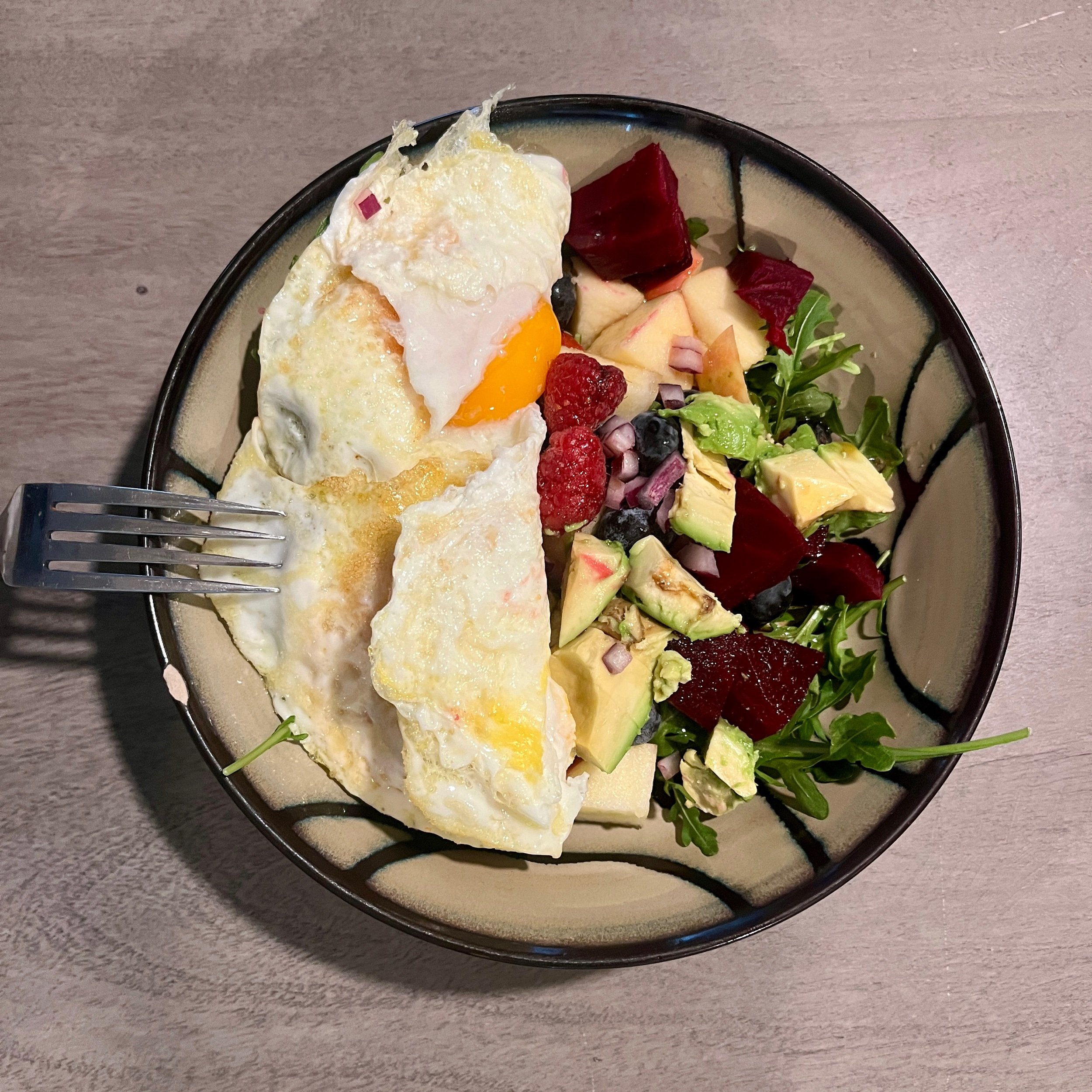
Meals & Recipes: Egg & Fruit Salad
Over easy egg salad, fruits and veggies!

I love throwing a couple of runny eggs on top of a salad. The yolk makes the whole dish so creamy. Check out this salad for a light meal.
Assemble the salad:
1 handful of wild arugula
1 handful of blueberries
1 handful of raspberries
1/3 sliced avocado
1 chopped beet
Chopped raw red onion
2 eggs over easy (leave the yolk runny to help dress the salad)
Dressing, in a small dish mix:
1 tbsp olive oil
1/2 tbsp fig balsamic vinegar
1/2 tbsp red wine vinegar
1 pinch of sea salt
Dash of garlic powder
Mix well and then drizzle over your bowl before adding the egg. Break the egg yolk and mix to enjoy!
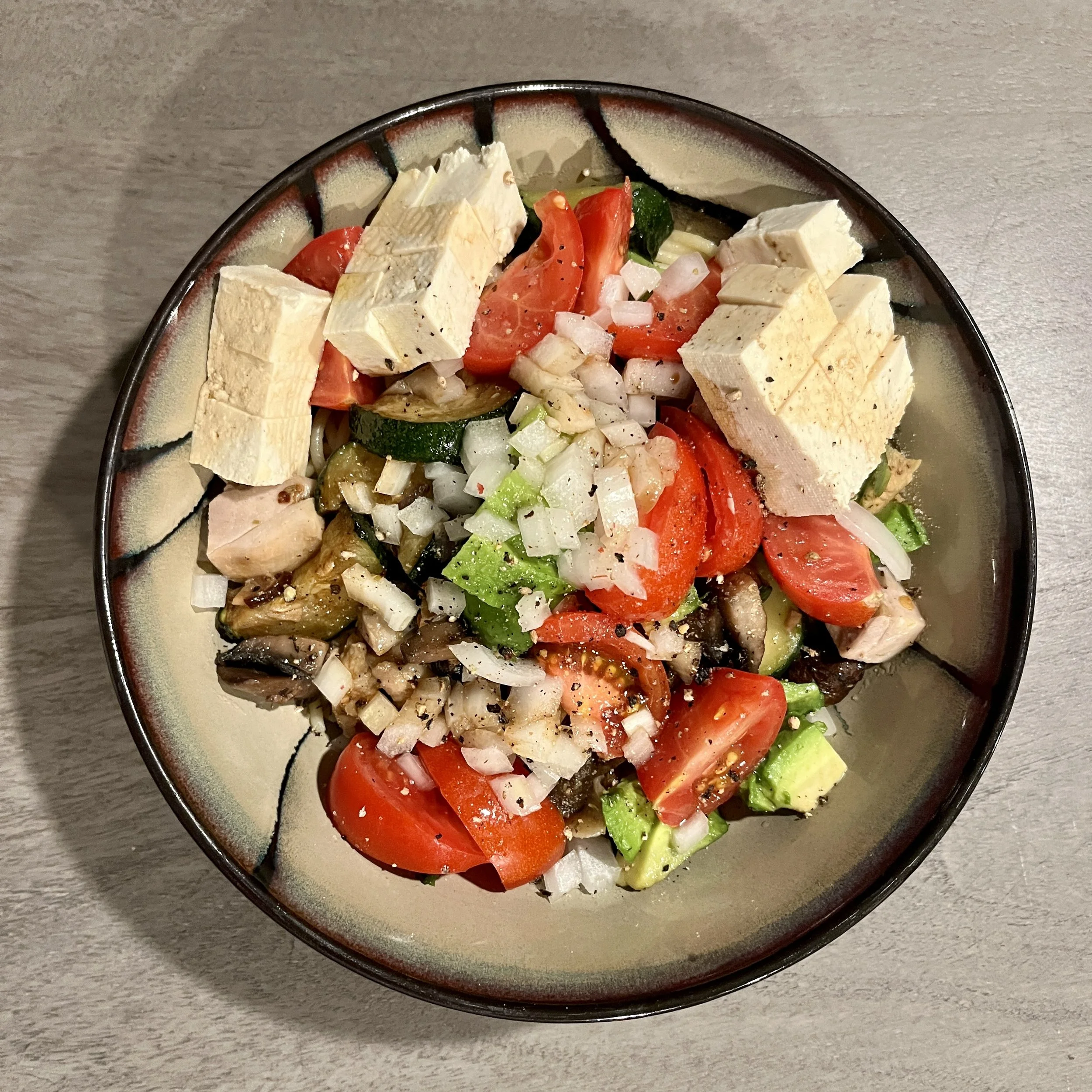
Dinner: Veggie Covered Spaghetti
Pasta, chicken thigh, zucchini, mushroom, tomato, avocado, onion, and tofu.

Pasta, chicken thigh, zucchini, mushroom, tomato, avocado, onion, and tofu.
This is an admittedly glutaneous dish. By the time I ate dinner it had been hours and I had only eaten breakfast. So I tried to make up for lost time with this enormous bowl of food! Enjoy.
Your Bowl. Add a handful of spaghetti, 1 chicken thigh chopped into bite size pieces, 1 handful of zucchini, 1 handful of mushrooms, 1 small sliced tomato, 1/4 sliced avocado, 1 slice chopped onion, 1 slice of tofu chopped into cubes. Top the tofu with soy sauce. Coat the rest of the dish with red wine vinegar, fig balsamic vinegar, 2 tbsp of olive oil, 2 - 3 pinches of sea salt and fresh cracked pepper!
Burying the pasta forces you to eat the vegetables (fiber) and chicken (protein) first which helps to slow the digestion of the processed carbohydrates from the pasta.
Buon Appetito!
Cooking Instructions:
Spaghetti. Follow instructions on your package. We used Rao’s. A good choice because it only contains two ingredients: durum semolina flour and water. Bring a pot of water to boil. Add the pasta. Cook time is 11 minutes if choosing Rao’s pasta. Strain. Pour back into the pot and add 1 - 2 tbsp of olive oil (to prevent pasta from sticking), 1 - 2 pinches of salt and stir.
Chicken Thighs. Use organic free range chicken thighs (pasture raised is best if you can get it). Preheat the oven to 425. Put the chicken thighs into a Pyrex. Coat them lightly in enough olive oil so they don’t stick to the dish. Add a pinch of salt to each one (each side), black pepper, onion powder, garlic powder and a touch of cayenne pepper. Add a little water to the dish. Leave them right side up. Cook at 425 for 20 minutes.
Zucchini. Bring a pan to medium heat. Chop one slice of yellow onion and two cloves of garlic. Add to the pan with 1/2 tbsp of olive oil and two pinches of salt. Chop a zucchini in half down the middle. Then chop the halves in half length wise. Then cut into bite size (1 inch) pieces. Toss in a bowl with 1 tbsp olive oil and two pinches of salt. Once the garlic and onion are fragrant, add the zucchini to the pan. Add a splash of water and cover. Let cook for 3-5 minutes. Uncover and flip, then cover again and let cook for an additional 3-5 minutes (until done).
Mushrooms. We like organic baby bellas. Bring a pan to medium-high heat. Add a tbsp of olive oil. Slice the mushrooms into quarters, toss lightly with olive oil (1 - 2 tbsp) and salt (2 - 3 pinches, and add them to the preheated pan. Add a few splashes of water and cover. Leave undisturbed for 5 minutes, then toss and let sit for another 3 - 5 minutes.
Meat Raised Right, and Finding Excuses to Exercise
Click here: OneSource Health, March 3, 2024
“When motivation fails you, discipline and routine will save you.”
Tim Kennedy
Sisu Farms Show and Tell
For the past few weeks, I’ve been ordering chicken and eggs from Sisu Farms. They’re a local farm located about 2 hours outside of Denver run by a native Colorado family. I found them on eatwild.com. All their meat is pasture raised and fed only organic non-GMO grains. Pictured above are 3 whole chickens, a dozen eggs, and a package of bacon (it was on sale and I couldn’t resist). My largest order to date.
The chicken is more expensive than what you’d get in the store, but that’s because they’re two different chickens. An industrial raised chicken might be as cheap as $3.50 per lb, while an industrial raised organic chicken will be closer to $5 per lb. Pasture raised organic chickens, like the ones shown here from Sisu Farms, are closer to $9 per lb or more. Yes, almost double the price.
So, what’s the difference?
Industrial raised chickens live their entire lives indoors, never seeing sunlight or feeling a breeze. They’re fed cheap commodity grains grown with pesticides, herbicides, and fungicides. Their feed is laced with antibiotics meant to ward off infections caused by weak immune systems from the inhumane way they’re forced to live. Antibiotics also accelerate their growth to otherwise abnormal levels, making some chickens so heavy their legs can’t even support their weight. And with no room to move they’re forced to live “knee” deep in their own waste.
Industrial raised chickens
“Free range” chickens have access to the outdoors for 51 percent of their life, but that says nothing of how much time that they actually do spend outside the coop or what the quality of that outdoor environment is. “Cage free” hens can move “freely” within their hen house, assuming they have the space to do so amongst the thousands of other chickens. And an “organic” industrially raised chicken is given organic feed, but it’s typically of low quality and no variety.
Pigs being transported to slaughter
It’s for all these reasons that industrial farmers are able to produce birds, and other animals such as hogs and cattle, so cheaply. But this method of raising animals has other more costly downstream effects. Mainly to our health in the form of antibiotic resistant strains of infection and chronic diseases, and to the environment in the form of natural disasters such as wildfires, hurricanes, and rising water levels. The cost to remedy our health epidemic and the growing number of disasters is borne by us and is in the trillions of dollars. When you include those costs, it becomes clear what the cheaper option is.
In stark contrast to this method of farming lies Sisu Farms and a growing number of other farmers around the country who are raising their animals the right way. Sisu raises their chickens and hogs out on pasture, allowing them to exhibit natural instincts to peck, scratch, and root. Creating a healthier and more resilient animal.
The recent bird flu outbreak in 2022 in which over 50 million chickens, most of which were on large scale commercial farms, had to be slaughtered to try and contain the spread of the virus is the perfect example. The flu spread through these chickens like wildfire because of the artificial and inhumane way in which they were raised. As a result, the USDA had to reimburse farmers more than $140 million dollars for the lost fowl. Funded by taxpayers.
So, the question isn’t “why are pasture raised chickens so expensive,” its “why are commodity chickens so damn cheap!” And, moreover, “what is the true cost to society of raising chickens in an industrialized manner?”
I don’t like thinking I’m paying double for meat when I don’t have to, but it’s become abundantly clear to me that I have to. If I want to stay healthy, consume humanely raised animals, and contribute to healing the planet, then I don’t have a choice. I must be willing to put my dollars behind my beliefs.
One way I’ve tried to offset the cost is by buying and cooking whole chickens. Organic chicken ranges in price from $7 per lb for chicken thighs, up to $10 per lb for chicken breasts. So if you’re used to buying individual cuts, then you’re already paying close to the same price as you would for an organic pasture raised chicken. But with a whole chicken you’ll get more meat, tasty skin, a carcass for delicious bone broth, and organs (if you or your dog are into that).
For those of us with a choice it’s not a question but a matter of fact. Anyone that can afford to, must. And the more of us that do, the more accessible and affordable raising food the right way will become. Think of every dollar you spend as a vote. I’ve been using my dollars to vote for local food and businesses as much as I can, because it’s been my experience that those are the people that care.
Check out eatwild.com to find a farm that will deliver near you.
Science Says We Don’t Want to Exercise.
Two articles slid into my feed recently that piqued my interest. Both were detailing the science behind why we don’t want to exercise. The theory goes something like this. While humans developed a large capacity for physical activity, born out of our need to hunt and gather food, our brains also evolved to favor the conservation of energy.
From an evolutionary perspective this made sense. Save your energy (calories) for finding food and fighting off predators. But we no longer must search for food, and the only real predators we face are ourselves. Since food is easily accessible and abundant (for most) we no longer burn calories hunting and gathering, and we end up doing too much conserving.
According to the Centers for Disease Control and Prevention over 70 percent of people fail to get the recommended 150 minutes (about 20 minutes per day) of moderate-intensity aerobic exercise and two resistance training sessions per week prescribed by the U.S. Department of Health and Human Services. Various surveys suggest that the reasons why so many people are missing the mark isn’t exclusive to our evolutionary tendency towards rest.
At least 50 percent of people report having a chronic condition that prevents them from exercising. Others report lacking the confidence to step into a gym and workout. And for a lot of people, it’s simply a matter of avoiding what they view as an unpleasant and uncomfortable act with uncertain rewards.
I can’t disagree. I’ve been walking into gyms for over 20 years and despite what it seems, it never gets easier. The habit I’ve developed makes it harder to skip a day (see quote above), but it doesn’t make it easier. Most days I still dread walking through those gym doors or driving to a trailhead.
But one of the things that has kept me coming back is the feeling I always leave with. A sense of accomplishment and a clear mind. In all my years of exercise there’s never been a workout I’ve regretted. So, in order to stay consistent and keep those good feelings coming, I’ve developed a number of techniques and mental tricks to keep showing up.
Think About Your Ideal Self
Self-discrepancy theory describes three selves we all possess.
Actual self - your current state
Ideal self - what you want to be
Ought self - the self that does all the stuff required to become your ideal self
I wrote a post recently titled Who Are You Becoming? that speaks to this theory (although I hadn’t heard of it at the time). Essentially, think about the person you want to become and then match your daily actions to those that would be required to become that person. If you want to feel better and exercise, then talk to your ought self and get a workout in. We become our ideal self through the accumulation of small actions each day.
Think About the Reward
Both articles cite “uncertain rewards” as a reason people avoid working out. But I think it’s a misunderstanding of what rewards to expect. Physical rewards might take time to appear, but the mental benefits are always immediate as exercise is the most effective mood booster on the market, the result of a handful of hormones that are released when you exert yourself physically. In addition, a good workout serves as a distraction from stress and anxiety in your normal life, providing you with a muchneeded break and reset. So, think about what a good workout is going to do for your mood.
Break It Down
The hardest part of a workout is (like most of life) showing up for it. When we think about a workout, all we focus on is the 45 - 60 minutes of getting our ass kicked, ending up in a pool of our own sweat. Instead, focus on each step on the way to that workout. When I’m struggling to get out the door, I have a conversation with myself. “Well, just change into your gym clothes, then see how you feel. Ok good, now get your bag ready. Great. How about filling up your water.” I have this conversation to distract myself from the workout I’m dreading and to inch my way out the door.
Lie To Yourself And Commit To A Shorter Workout
This was particularly useful when I was training for triathlons. I would convince myself to get out for my run or bike sessions by lying. I’d commit to half the prescribed miles and then agree to reassess. Nine out of 10 times I’d complete the whole workout. It was just a matter of getting going.
Now that I’m strength training the conversation sounds different, but the intent is the same. Some days all I commit to is a stretch and foam roll session, or 20 minutes in the sauna, or 10 minutes on the treadmill. But once I’m in the gym and the blood starts pumping, I find the motivation to get my workout done.
Be Realistic About The Commitment
An hour at the gym, on your Peloton bike, or out hiking, sounds like a long and dreadful time! But it’s only one hour or 6 percent of your day. It’s one episode of your favorite show. It’s one meeting at work. It’s a chance to do something for yourself that will make you feel good the rest of the day.
Know That You’re Not Alone In Feeling Out Of Place
I’ve been working out in gyms for 20+ years, and I still feel uncomfortable whenever I’m in a new setting. It happened to me recently after moving to Colorado (read New Gym Jitters). So, know that you’re not alone. And while avid gym goers seem intimidating, I’m here to tell you that they are anything but. They are some of the nicest people I’ve ever met. Also, and this is important, most avid gym goers (me included) are too self-absorbed to care about what you’re doing.
Try Something New
After a few years of endurance racing, I’ve finally gotten back into strength training (my first love). But after a year of consistently hitting the weights, I’ve been feeling burnt out and lacking motivation. So this past week I tried something new. I took a movement class where we did things like bear crawl forwards, backwards, and sideways. We played a game of “catch,” and we practiced moves like cartwheels, the crab, and (my favorite) the slippery pickle. It was a blast and it provided enough of a shakeup in my routine to get me excited to exercise.
Physical Activity Doesn’t Have To Be Formal
Spend time in your garden if you have one. Spend time in the kitchen cooking, whether that’s big meal preps or preparing individual meals. Clean up and organize your house. Volunteer in your community. Anything to get moving.
The science says we don’t want to exercise but every study in the world comes to the same conclusion. That exercise is by and large the best way to improve your physical and mental health. We don’t have to forage for food anymore or hunt big game, what a relief. Instead use that energy to do something fun and active!
Cheers to your practice.
James.

How I Limit My Phone Usage
Putting down your phone is hard. But with these tactics it might be possible to at least limit it’s usage.
I, like most people, struggle with being on my phone too much, and I’m always looking for ways to limit my usage. We carry our phones everywhere, and even when we do decide to put them down, we’re inevitably prompted to pick them back up the second a new message, call, email, or social media notification comes through. Each time this happens, it brings us right back into the throws of phone addiction. Phones have eliminated boredom.
On average Americans check their phones anywhere from 150 to 350 times per day (depending on the survey). That equates to once every 5 - 10 minutes. There is nothing else in this world that garners that much attention from us. And when we touch our phones, we usually end up on it longer than we intended. We spend nearly 1/3 of our time awake, or 4 - 5 hours, each day staring at our phones.
What’s worse is what we do when we’re on them. Scrolling through social media, checking our email, shopping, and gaming are all top reasons people report using their phones for. The number one reason though is to call or text friends and family. And while keeping in touch feels like a legitimate reason to be on your phone, more and more research shows that always being connected is not a good thing. Always being connected negatively affects our mental health and well-being. Anxiety and rates of depression have soared since the advent of the smartphone.
But I think there is a stigma around trying to convince people to get off their phone. People feel, with good reason, that you’re trying to control their behavior and prevent them from doing something that they “enjoy.” But I think that thought process needs to be re-framed. It’s less about what’s being taken away and more about what’s being given back.
A smartphone is like a bag of M&M’s or a cylinder of Pringles (once you pop you can’t stop). The more junk processed food you consume the less likely you are to consume nutritious food that fuels your body. The same holds true with your phone. The more time you spend staring at social media, or scrolling through emails, or playing games, the less likely you are to immerse yourself in activities that are going to benefit your life. Most notably, thinking.
Thinking is a vital but lost art. We need time to think to figure out what we want from our day, our lives, our jobs, our relationships. And we need time to think to figure out how to make it all happen. But that’s almost impossible to do when you’re being distracted by your phone. It doesn’t matter if you’re “just responding to a friend” or watching a video. It is all pulling you away from deciding your goals, figuring out how to accomplish them, and executing.
Phones also rob you of being present and staying connected in the real world. Smartphones create a forcefield around you that blocks out your environment and the people in it. I’m sure you’ve experienced trying to talk to someone who is immersed in their phone only to get no response or a muted one. Or you’ve been walking across the street and realized you haven’t looked up to check for traffic (I know I have).
It’s for all these reasons that I’ve worked hard over the last few years to limit my phone usage. For me it’s simple. When I limit time on my phone, I’m more productive, happier, and my day goes my smoother. In addition, when I do finally pick my phone up, I’m excited to respond to whatever communications I missed.
But putting down your phone is not easy (they are in fact designed to be addictive in the same way a slot machine is), and it doesn’t come down to willpower. Like so many things, diet being a good example, your ability to succeed in limiting your phone comes down to setting up strict parameters, and then following them as closely as possible. In the same way that it’s a lot easier to not snack on Pringles or M&M’s if they aren’t in your pantry, giving yourself reasons to avoid your phone will make it harder to pick up and easier to put down.
Recognizing all of this, I’ve setup several informal rules that I try to comply with every day. I’m not 100 compliant, but these rules have helped me to separate myself from my phone and be more productive when I do pick it up. After all, a smartphone is a wonderful piece of technology if used for good.
Here are my rules and the tactics that I try to follow to make my days better and more productive.
No phones while eating. When I use my phone during a meal it takes away from my enjoyment of eating, and the person(s) I’m eating with. If I’m alone, I’ll either write (pen and paper) or read whatever is around. Recently I’ve been studying a postcard of Native Indian Tribe names we picked up on a road trip. It’s light enough to still let my mind wander, while keeping me from feeling completely bored. Reading nutrition labels is another fun past-time of mine.
Unsubscribe from emails that are no longer serving me. If I head for the delete button before the read button, then I need to unsubscribe. Marketing/spam emails are the obvious culprits, but I also regularly unsubscribe from emails I willingly signed up for. Sometimes they aren’t what I was expecting, or I’ve grown tired of the content. If I regain interest for some reason I can always resubscribe. But strict adherence to this rule saves me a lot of otherwise wasted time.
During the day my phone stays on vibrate. At night I put it on do not disturb and airplane mode. I don’t want to be woken up by my phone, and I don’t the first thing I see when I wake up to be unread messages. All too often those texts contain something that will ruin my morning. I check my phone after my morning routine is complete.
When I put my phone down, I lay it face down. If a notification does come through, I’m not tempted by the brightly lit LED screen to pick it up.
I intentionally leave my phone behind. In the car when I’m at the park with my dog (don’t rob me). At home when I go out to dinner. In my locker when I’m in the sauna. I do it because otherwise I’d be tempted to pick it up.
“I wanted to stop being on top of things, and start getting to the bottom of things.” This is a great quote I heard recently, and I think applies perfectly to social media usage. We think we’re staying on top of things but really, we’re getting nowhere. By deleting my Twitter and FaceBook, and no longer using Instagram, I’ve reduced the reasons to pick my phone up, and made more time to dive into things that actually interest me. I’ve also eliminated social media induced anxiety from my life.
Remember, not every message needs an immediate response. Not immediately acknowledging a message, email, or phone call is not the same as ignoring someone. Most times these actions are actually interrupting me and what I’m doing, which causes me to be distracted, lose focus, and lose productivity. So instead of answering right away, I finish my task, whether that’s folding laundry or reading a chapter, and then answer.
Re-direct why I picked my phone up. When the above fails and I pick up my phone and go to do something “unproductive” (i.e. refresh my email, check the stock market), I give myself a choice. Put the phone down or do something productive (i.e. read that newsletter or article you’ve been putting off). In this way I can at least make the most of my time.
It’s possible to limit your screen time. Try some of these tactics the next time you’re trying to manage your phone usage and let me know if they work for you.
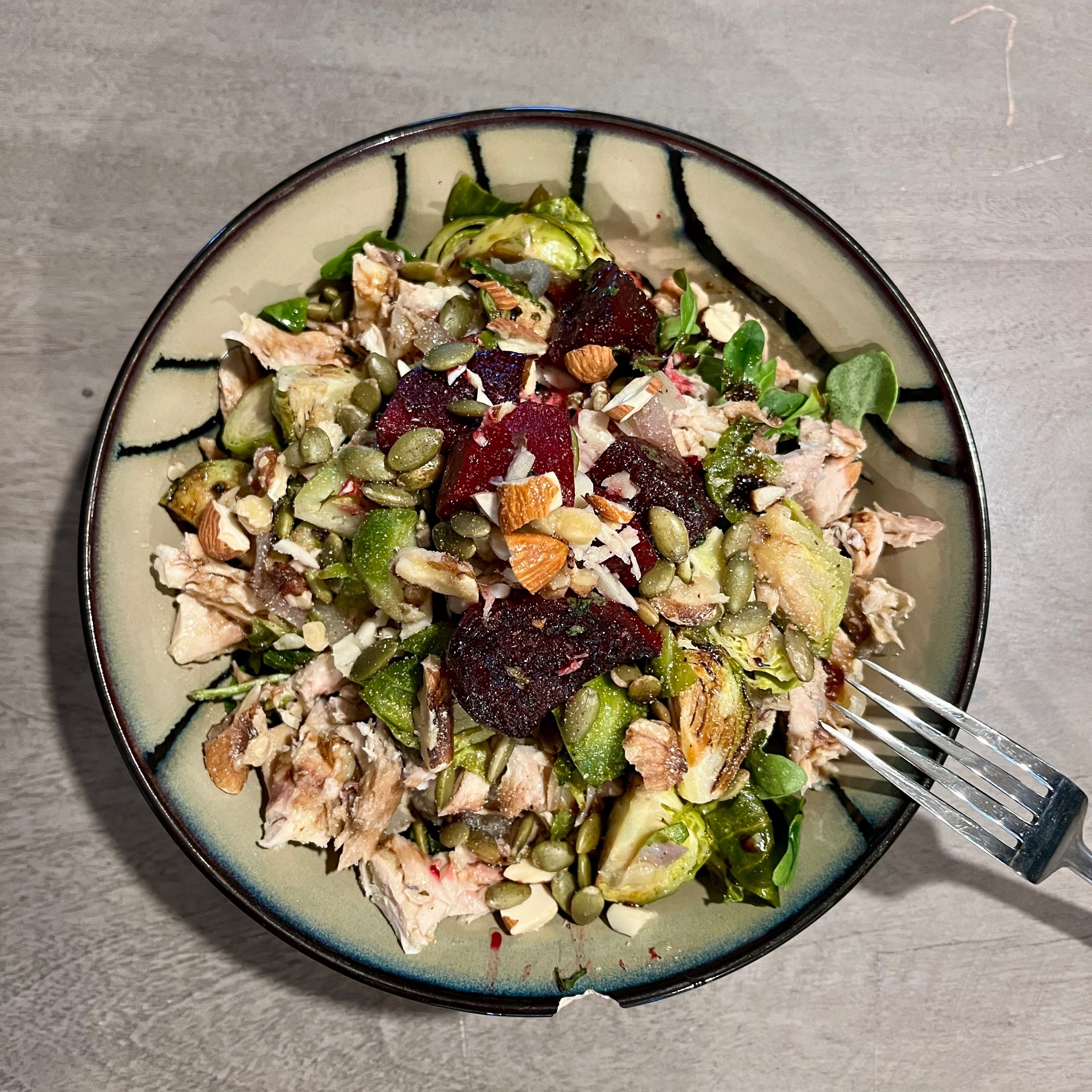
Lunch: Chicken, beet, and brussels salad
A big lunch to replenish after the gym
After discovering how easy and delicious it is to cook with the crock pot (check out this crock pot chicken recipe) we’ve been looking for more ways to use it. This morning Jennifer thought “why not cook the beets in it.”
So that’s what we did. She found this simple recipe. I only had 4 beets so I pared the amounts down a bit. I also think I cut the beets smaller than I was supposed to, so I cooked them on low for a little over 4 hours instead of 6. But they came out sooo good.
They finished cooking right when I got back from the gym, so I tossed them with some dry parsley and then made this bomb salad with them. Check it out.
1.5 handfuls of chicken
1 handful of roasted brussels
1 handful of crock pot beets
Chopped walnuts and almonds, and a dash of pumpkin seeds
Finished with olive oil, fig balsamic, red wine vinegar, chopped raw garlic, salt, onion powder
Such a treat!