

Being Inexperienced Is Not The Same As Being Bad
Over the last few years consistency has been the main driver of my improvement. Skiing is the most recent example.
“We are what we repeatedly do. Excellence, then, is not an act but a habit.”
I went skiing last week and realized for the first time that I’m getting better. More importantly that I really enjoy it. It was only a few years ago that I told my friends I was done with the sport. I had become fed up with the whole process and my lack of ability, and decided it just wasn’t for me.
Getting to the mountain. Waiting for rentals. Getting fitted for rentals. Buying a lift ticket. Spending the day in the cold. All of it had worn on me and I didn’t want to do it anymore. I didn’t see the fun that everyone else did, and I thought there were better ways I could spend my winters.
But at the end of October, I moved to Colorado and pressured by my girlfriend, bought an Ikon Pass for the season, and everything is different now.
I live 90 minutes away from world class mountains and each week we’ve made it a point to ski at least once. Five minutes away from my house is a ski shop where I pick my rentals up the night before and return them the morning after. I’ve got a gear bag with my ski pants, jacket, gloves, helmet, goggles, and energy bar that’s always standing ready to be simply thrown into the car.
I’ve figured out the perfect layers to wear that keeps me from getting cold, but also doesn’t let me get too hot. Incentivized by my season pass I’ve already been to the mountains seven times this season, which is close to the number of times I’ve skied in total in the last 10 years.
Getting to the mountain is a breeze. I know where to park. I know what shuttle to take. And I know what lift to take up and what runs to come down to get to the runs I want. And yes, my actual ability to ski has drastically improved.
What I realized is that this whole time it wasn’t that skiing wasn’t for me, or that I was bad at skiing, it was that growing up on Long Island, and living in Los Angeles for the last few years skiing just wasn’t that accessible and it prevented me from being consistent. And not being consistent meant I didn’t have the experience to get better.
The first time I ever skied was in high school, and for many years after that we only skied local hills, I can’t call them mountains. In college I skied in Aspen a handful of times, which changed my idea of what real skiing is, but up until now I still only skied less than once a year.
I just never had the opportunity to put in the required reps to improve. But now that I do, it’s changed everything. Stay consistent with the skills you want to get better at. It’s a guaranteed way to improve.
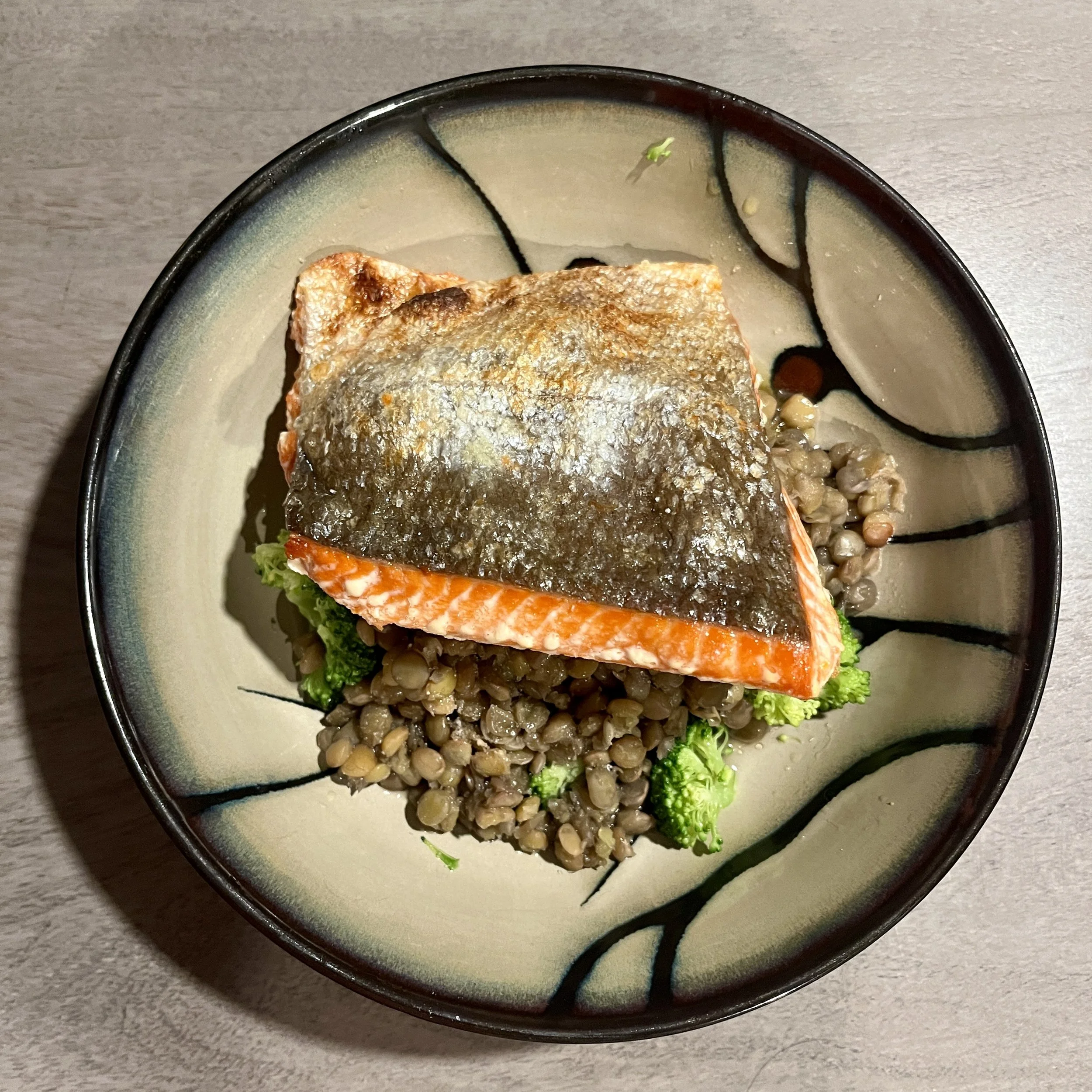
Meals & Recipes: Crispy Salmon, Lentils & Broccoli
This is a full bodied and nourishing meal. Great for dinner or breakfast.

This is a full bodied and nourishing meal. Great for dinner.
The Dish:
1 - 1.5 ladles of green lentils. 1 handful of boiled broccoli. 1 filet of wild salmon. Finish with olive oil and salt to taste.
Cooking Instructions:
Salmon. Start with wild salmon (click here to learn why). I’ve been enjoying frozen wild sockeye salmon from Whole Foods or Sprouts (grocers closest to me), or fresh wild Sockeye from Trader Joes. Preheat the oven to 425. Lightly coat both sides of the salmon filets with olive oil. Place the filet skin up on a baking sheet lined with aluminum foil. Add a pinch of salt (or two) to each filet and black pepper. Cook for 8 - 10 minutes (depending on thickness of the fish).
Turn off the oven and turn on the broiler. Place the baking sheet of salmon on the top row and allow the skin to crisp for 60 - 90 seconds (don’t take your eye off of it, it burns quick!)
Green Lentils. Add 3 cups of water or vegetable brother to a pot. Add 1 cup of green lentils. Bring to a boil, then reduce to a simmer and cover. Cook for 45 minutes, covered. Taste for tenderness before removing from heat. Strain the lentils and return them to the pot.
Broccoli. Chop two broccoli crowns into bite size pieces. Bring a pot of water to boil. Add broccoli and let cook for 3 - 5 minutes. Once strained, add the broccoli back to the pot, add 2 pinches of salt and a tbsp of ghee, butter or olive oil and mix.

Try This Move: Supine Extensions
This exercise feels really good (like your flossing your shoulder joints) and also builds strength
Supine Resistance Band Extension
I used a 15 - 35 lb band. If you don't have a resistance band, just follow the move without it.
Grab the band at shoulder width. Lie face down, gaze 10 inches out in front of you, and extend your arms out past your head. Pull your hands apart until you feel resistance (the wider the more resistance you'll feel).
Retract your shoulder blades and arms, keep your elbows high, maintain the tension, and pull the band down towards your shoulders.
Holding a tight grip, from your glutes to your hands, is essential to keep your wrists and hands from caving in.
Keep your tail bone tucked, glutes tight, core engaged.
3 sets x 10 reps

Quick Marinated Salmon
A quick and tasty way to enjoy wild salmon
I love to cook but I’m not good at pre-preparing foods, or doing things like marinating meat or fish overnight. But cooking with the same spices was getting a little dull. So I decided to do a “quick marinate” with my salmon. I’m using frozen wild sockeye salmon I bought at Whole Foods and defrosted in the refrigerator overnight. It’s not the greatest but I’m hoping it’s better than the farmed alternative I learned about reading The New Fish.
After the filets have defrosted, pat them really dry, even squeeze them, with a paper towel to get out and off all the excess moisture. Since they were frozen there is bound to bee a lot.
Once dry, add them to a bowl. Then add:
2 pinches of sea salt
1 tsp of garlic powder
1 tsp of onion powder
1 tsp of Cracked black pepper
1 tsp of chili powder
1 tbsp of olive oil
1 - 2 tbsp of soy sauce

Mix everything together in the bowl with your hands. Leave the filet meat side down to absorb the flavors for 5 - 10 minutes.
Heat the oven to 425. Place the filets on a cooking tray skin side up, and cook for 7 minutes.
Remove from the oven, and turn the broiler on. Once the broiler heats up (I wait 60 seconds) add the salmon back under the broiler and allow the skin to crisp for 60-90 seconds (watch it closely so it doesn’t burn).
Remove and enjoy!


The Next Generation, Following Intuition
Click here: OneSource Health, January 28, 2024
“A false sense of permanence can cause a person to put off the things they truly want to do”
I had two inspiring conversations this week that gave me hope for the future. On Monday Jen and I spoke to Ryan Slabaugh, founder of ThinkRegeneration, a non-profit that’s helping advance the regenerative agriculture movement forward. They’re doing this in a few different ways.
One way is by securing capital for farmers who want to transition away from conventional agriculture (i.e. growing methods that use harmful chemicals and inhumane animal practices), or who’ve already made the change and need funding to expand or upgrade their operations. Access to capital has been cited as one of the biggest challenges farmers face, so anything to help in this regard, like securing government grants, is welcomed.
Another key tactic is hosting regenerative agriculture programs that bring like-minded people together. In a recent newsletter they announced a program being held in Colorado later this year. Colorado is my new home, so I replied to the email with excitement about the prospect of attending. Ryan in turn extended an invitation to connect via zoom.
As my luck would have it, the program being offered will focus on expanding Food Is Medicine, a program launched in 2023 by the Biden administration that grants states permission to use Medicare and Medicaid funds to provide beneficiaries with nutritious food. The program recognizes the important relationship that exists between food and health. Two areas with the potential to heal a lot of what ails us.
According to Ryan there are ~20 states taking advantage of the program. FreshRX, based out of Tulsa, OK, is one company that’s leading the way. They provide food, cooking classes, and nutritional programs to beneficiaries with Type 2 Diabetes. Patients enroll for 12 months and on average have experienced a 2.2% reduction in A1c levels and a 13-point reduction in blood pressure. Pretty remarkable results.
The goal of the ThinkRegeneration event is to find ways to make a program like this available to everyone. It’s been reported that 50 percent of the adult population is diabetic or pre-diabetic making the success of programs like this extremely important. It’s so exciting to be a part of supporting this initiative.
The second conversation was on a ski lift with an eighteen-year-old college student from St. Louis. He’s majoring in business, and minoring in outdoor management. But his dream is to take over the 500 acres of pasture his family owns and turn it into a regenerative farm. He told me one of his school mates is in a similar position. His family owns over a thousand acres in Montana, and once he inherits it he also plans to flip off the conventional switch.
Hearing him talk about their future plans gave me so much hope and filled me with excitement. We’ve been led to believe that the generations coming up behind us are not interested in taking over and putting in the work, but this conversation gave me insight into what’s really happening.
Everyone is waking up and the movement is gaining steam. Things need to change, and doing what’s right is starting to take precedent over chasing money. It’s only a matter of time until the movement becomes the standard.
Cheers.
James
An easy way to get involved: Tell Congress: Prioritize TEFAP and SNAP in the next farm bill
This Week’s Posts
The Comfort Crisis Reveals the Importance of Intuition
They say that the key to life is being happy. But what exactly does that entail? Ask 1,000 people and you might get 1,000 different answers. It’s been my belief recently that happiness boils down to the ability to listen to and follow your intuition. But it’s occurred to me, and Michael Easter points out, that we now live in a society where our natural instincts are muted by all the “comforts” around us. Read more here…
Ruck Plate Series: Workout 4
The Ruck plate’s unique one foot rectangular shape lends itself to a lot of different movements. The morning after I got mine I put together this four workout progression series. This is workout 4, the most challenging of the series. Get the workout here. And check out the first three workouts: Workout 1, Workout 2, Workout 3.
Homemade Veggie Stock and Soup
I’ve been keeping all of my food scraps in a plastic bag in the freezer. I hate throwing away food so when I learned this technique of making vegetable stock out of scraps I went all in. This was my second time trying it which is always better than the first because I got to try things I missed the first time to make it better. Read more here…

The Comfort Crisis Reveals the Importance of Intuition
We can follow our intuition to better health, wealth, and happiness.
They say that the key to life is being happy. But what exactly does that entail? Ask 1,000 people and you might get 1,000 different answers. It’s been my belief recently that happiness boils down to the ability to listen to and follow your intuition. But it’s occurred to me, and Michael Easter points out, that we now live in a society where our natural instincts are muted by all the “comforts” around us.
These “comforts” exist in many forms, but the most prevalent and detrimental are by far ultra-processed foods, unlimited entertainment on our phones, TVs, and laptops, and climate-controlled homes, cars and office buildings which invoke a sedentary life. As he points out, these modern luxuries have only existed for “around .03 percent of the time we’ve walked the earth.” But regardless of the infinitesimal amount of time they’ve been around, their level of toxicity has been enough to wreak havoc on our lives and our health.
Seventy percent of the adult population is overweight or obese. Over 40 million Americans have mobility issues. Fourteen out of 15 adults have poor cardio-metabolic health. And, the one that kills me, 1 out of 4 children are obese and/or pre-diabetic, and are now suffering from diseases such as non-alcoholic fatty liver disease and colon cancer.
And the problems aren’t just physical. In the last two decades overdose deaths have increased 300%. In the last few years alone drug overdoses amongst 10 - 19 years old have nearly doubled, dragging life expectancy down to its lowest levels in decades, and crippling what should be the next generation of thinkers and innovators. The problem, as I see it, is that modern comforts has evolved in a way that blunts our intuition, which in turn leads us to make poor choices that run counter to our needs.
Our lives are filled with fake products and devices that interfere with our innate ability to seek out what we need. Fake foods cloud our brain and stop it from signaling to our body what fuel we need, causing us instead to eat more calorically dense manufactured foods that are devoid of nutrition and filled with sugar and chemicals. Social media makes us crave attention and acceptance from fake relationships and in turn ignore real ones. Binging TV shows, movies, and videos rob us of our inclination to be creative and curious and impedes on our ability to discover our path and achieve fulfillment. The list goes on and on.
It’s no coincidence that the happiest and healthiest people around the world are the ones who live the simplest and sometimes most challenging lives. Whether it’s the people of Okinawa highlighted in Ikigai or all of the communities studied in Live to 100, “The Blue Zones,” there’s a common thread they share. Embracing a life that brings them back to their natural inclinations, and stripping themselves of the desires and toxins that modern society promotes under the guise of “better.”
Living life in this way lends itself to call on your intuition, to listen to your gut, to follow your heart. The modern comforts of life can be enthralling, and they can provide enhancement, but they’re robbing far too many of us of our ability to heed the call. The Comfort Crisis provides a great framework for anyone who is looking to reclaim their life.
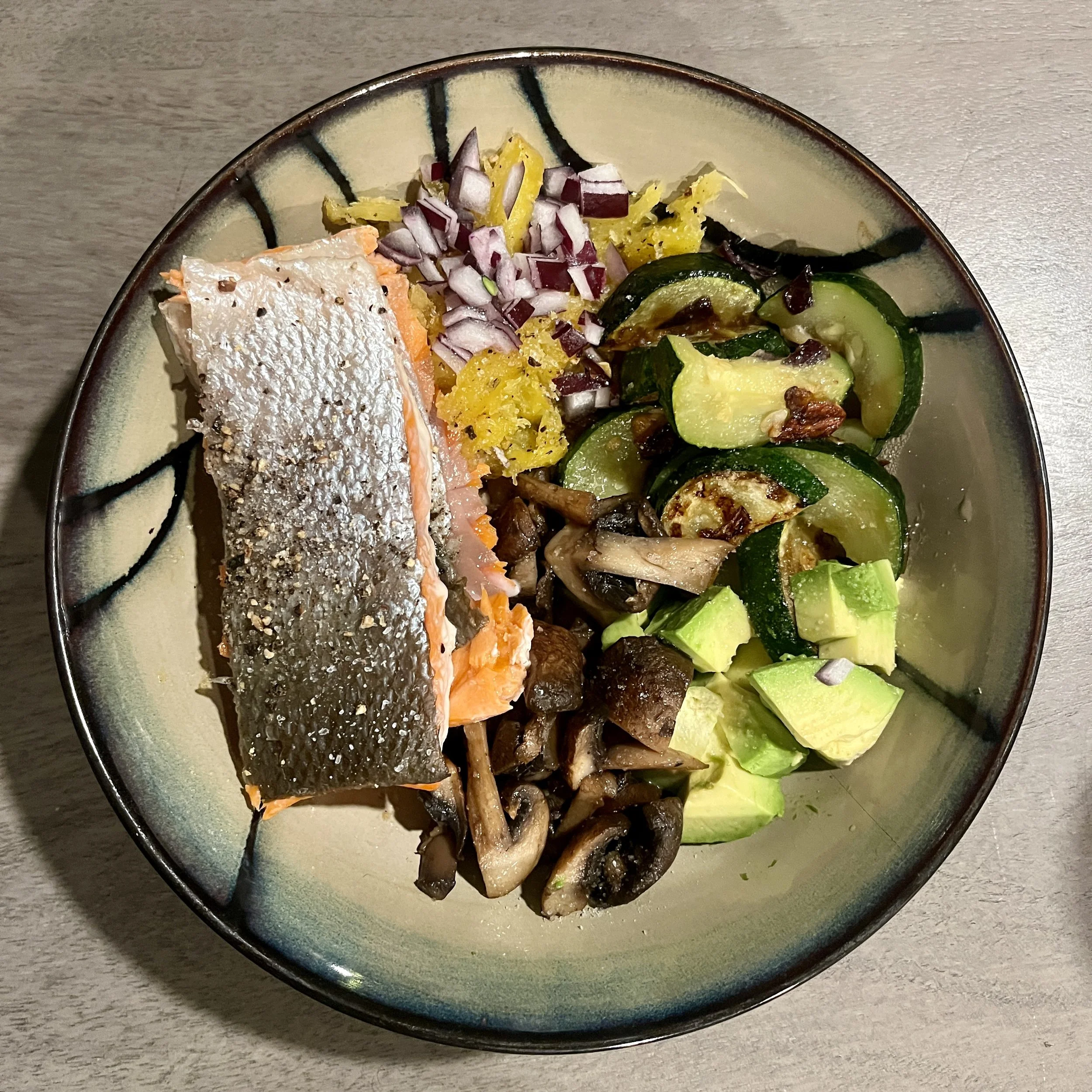
Meals & Recipes: Delicata Squash, Wild Salmon & Veggies
Wild salmon, winter squash (red onion, ghee, salt and pepper), zucchini (garlic and onion), mushrooms, avocado.

Wild salmon, winter squash (red onion, ghee, salt and pepper mixed in), zucchini (garlic and onion sautéed), mushrooms, avocado.
Your Bowl. Add 1 filet of salmon cut in half. Add 1 handful of zucchini, mushrooms, and 1/4 sliced avocado. Add 1/4 winter squash mixed with chopped red onion, 1 tbsp of ghee, 2 pinches of sea salt and 1 pinch of pepper. Drizzle zucchini, mushrooms, avocado and salmon with red wine vinegar and 2 pinches of sea salt.
Buon Appetito!!
Cooking Instructions:
Wild Salmon. Start with wild salmon. I’ve been enjoying frozen wild sockeye salmon from Whole Foods or Sprouts (grocers closest to me), or fresh wild Sockeye from Trader Joes. Preheat the oven to 425. Lightly coat both sides of the salmon filet (or filets if cooking multiple) with olive oil. Place the filet skin up on a baking sheet lined with aluminum foil. Add a pinch of salt (or two) to each filet and black pepper. Cook for 8 - 10 minutes (depending on thickness of the fish).
Winter Squash. Preheat the oven to 350 degrees. Slice squash in half length wise. Use a spoon to scoop out the seeds (save and clean seeds if you’d like to roast them later). Scoop out the stringy meat inside. Coat the entire squash in olive oil and sprinkle salt inside. Place on baking sheet with the skin up. Bake for 20 minutes at 350 or until tender (easily pierced with a fork).
Zucchini. Bring a pan to medium heat. Chop one slice of yellow onion and two cloves of garlic. Add to the pan with 1/2 tbsp of olive oil and two pinches of salt. Chop a zucchini in half down the middle. Then chop the halves in half length wise. Then cut into bite size (1 inch) pieces. Toss in a bowl with 1 tbsp olive oil and two pinches of salt. Once the garlic and onion are fragrant, add the zucchini to the pan. Add a splash of water and cover. Let cook for 3-5 minutes. Uncover and flip, then cover again and let cook for an additional 3-5 minutes (until done).
Mushrooms. We like organic baby bellas. Bring a pan to medium-high heat. Add a tbsp of olive oil. Slice the mushrooms into quarters, toss lightly with olive oil (1 - 2 tbsp) and salt (2 - 3 pinches, and add them to the preheated pan. Add a few splashes of water and cover. Leave undisturbed for 5 minutes, then toss and let sit for another 3 - 5 minutes.
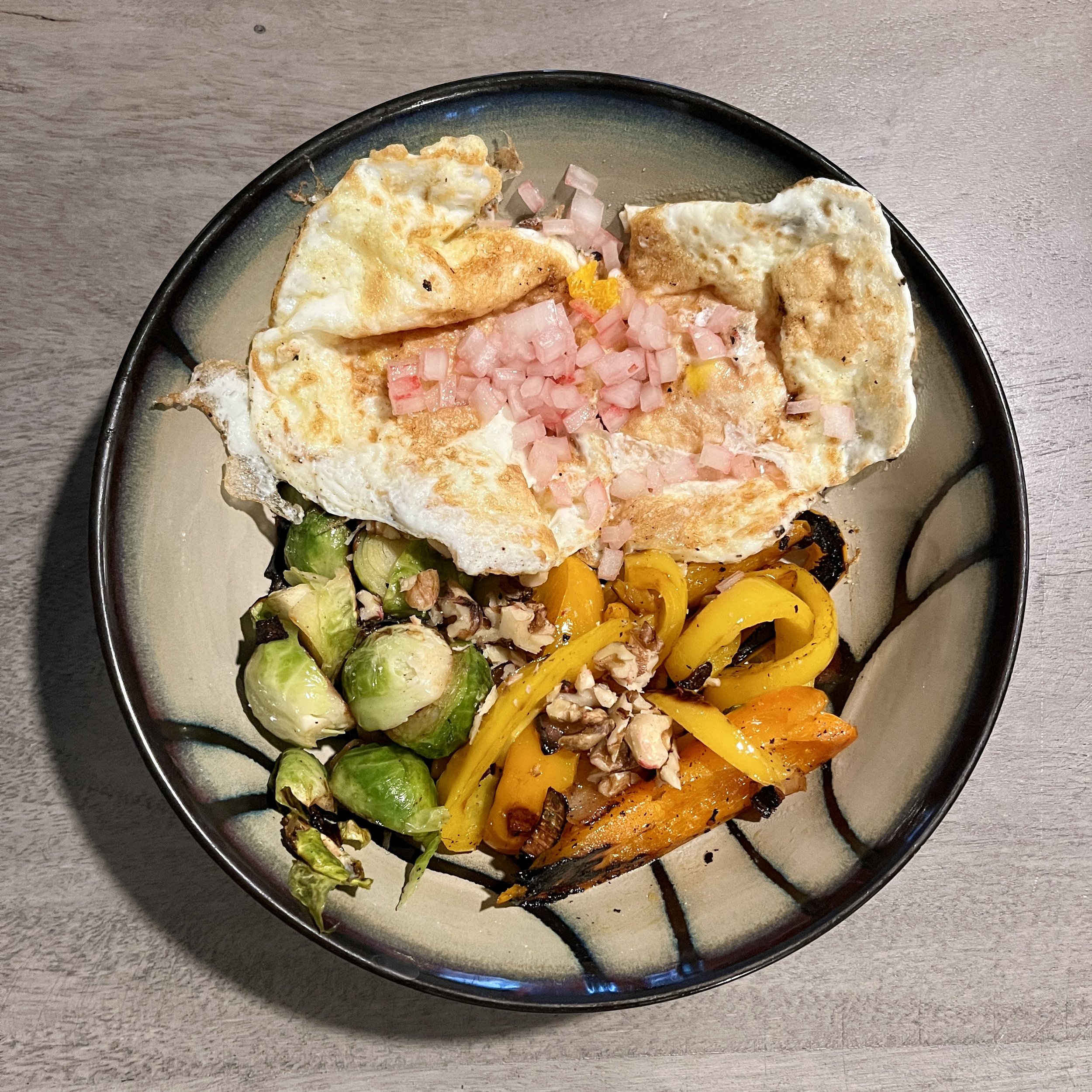
Meals & Recipes: Eggs, Peppers & Brussels
Eggs over easy, with brussel sprouts, peppers (garlic and onion), chopped walnuts, diced onion and a splash of red wine vinegar and salt.

Eggs over easy, with brussel sprouts, peppers (garlic and onion), chopped walnuts, diced onion and a splash of red wine vinegar and salt.
Your Bowl. Add a handful of brussel sprouts. A handful of peppers, garlic and onion. Two eggs cooked over easy, topped with chopped yellow onion, red wine vinegar and 2 pinches of sea salt. Add chopped walnuts to garnish.
Boun Appetito!!
Cooking Instructions:
Eggs Over Easy. Bring a pan to medium heat. Add 1 tbsp of olive oil, butter or ghee. Add 1 pinch of sea salt. Crack two pasture raised eggs into the pan. Add 1 pinch of sea salt to each egg. Allow to cook for 3 - 5 minutes before flipping and allowing to cook for another 2 - 3 minutes, leaving the yolk good and runny!
Brussel Sprouts (garlic, onion, poblano). Cut the stems off and quarter or halve them (if bigger). Dice half a poblano chile. Chop one slice of onion. Toss with olive oil and salt first. Chop two gloves of garlic. Add onion and garlic to a pan with olive oil, set to medium heat. Once the onions and garlic start cooking, add the Brussels and poblano. Add a splash of water to the pan and cover. Let cook for 5 minutes. Toss and cover for another 5.
Peppers, Garlic and Onions. Bring a pan to medium-high heat. Chop 1 slice of onion, 2 cloves of garlic and 1 jalapeño pepper. Add to the pan with 1 tbsp olive oil and two pinches of salt. Cut out the core of three peppers (red, yellow and orange) and slice into 1/8 inch strips. Toss in a bowl with 1 tbsp olive oil and 2 pinches of salt. Add to the pan once the onion, garlic, jalapeño combination starts to give off an aroma. Cook for 15 - 20 minutes depending on how you like your peppers, flipping every 5 minutes.
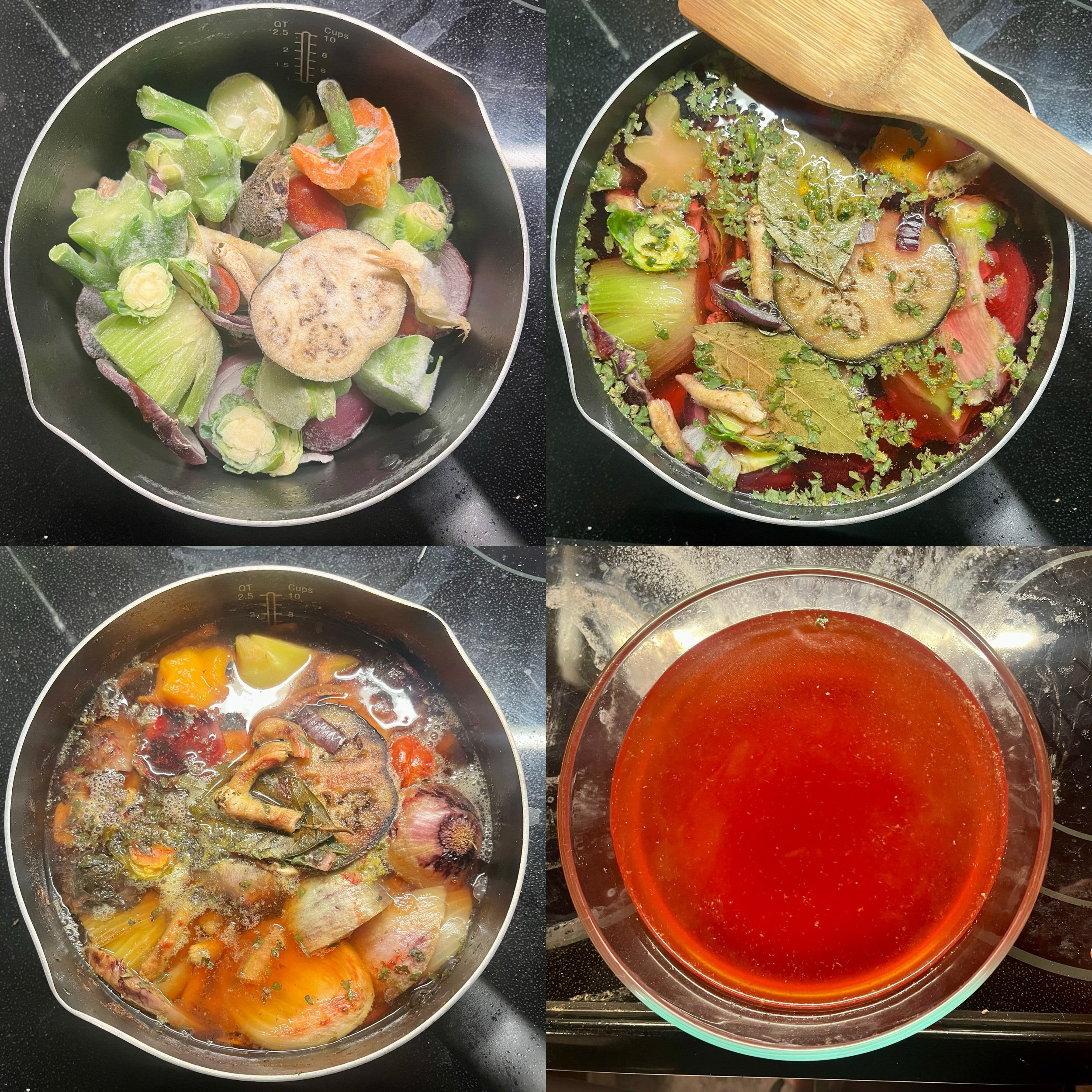
Homemade Veggie Stock and Soup
Making veggie stock from your food scraps is a great way to reduce waste and create a robust broth
I’ve been keeping all of my food scraps in a plastic bag in the freezer. I hate throwing away food so when I learned this technique of making vegetable stock out of scraps I went all in. This was my second time trying it which is always better than the first because I got to try things I missed the first time to make it better.
It was also exciting because this time I had new scraps. Peppers, eggplant, and my favorite, beets to add to the flavors! The recipe is so simple.

The biggest pot I have in my rental house holds only 10 cups of water. So I unloaded 1/2 of a gallon size ziplock worth of frozen scraps into the pot, and then covered them with water until the liquid hit the 10 cups level.

Then I added 2 bay leaves, 2 tsp of dry parsley, 3 - 4 pinches of sea salt, 1 tsp of turmeric, and 1 tsp of ginger root. Brought it all to a boil, and then brought the heat down to a simmer.

I didn’t time it, but once the liquid came down to about 8 cups, 2 cups evaporated off, I drained the pot. I probably could’ve let it go a bit longer, the originally recipe says once the liquid has reduced to half take it off, but we only have one pot and someone needed to make pasta. The stock (to the left) came out looking medicinal, and it tastes that way too. In a good way. It’s just so rich and full of abundance.
The next logical step of course was to make soup. I started it the same way I have been.
2 chopped carrots
2 slices of chopped red onion
3 cloves of sliced garlic
2/3 chopped celery stalk (I typically use 1/2 but it was going bad and needed to be cooked)
After sauteeing those ingredientns in a pot for 5 minutes with 2 tbsp of olive oil and 3 pinches of sea salt, I added the veggie stock from above and topped it off with water. I also added:
3 bay leaves
2 tsp of dry parsley
1/2 purple sweet potato (the only vegetable I had available, plus we’ve been wanting to add potato to the mix)
1 handful of Bob’s Red Mill Soup Mix
I brought all of that to a boil, then let it simmer. After 20 minutes I added 1/2 cup of white cannelloni beans to the pot and let it all simmer for another 25 minutes.

Having soup in the refrigerator has been a nice way to add some variety into my day. Recently I’ve been loving pouring a ladle of soup over some wild cod I pan fried (seen in the dish below). The flakey white fish and broth mesh so well together. It creates such a warming dish that fills you up. Give it a try.


Try This Move: Weighted Push Up
Adding weight to the classic push up is a great way to work your chest, shoulders, triceps and core
Classic push up w/ a Ruck Sack
In this video I'm using 30 lbs.
Start in a plank position, hands just past shoulder width, in-line with your chest. Tuck your tail bone, squeeze your glutes. Rotate your elbows back and in.
Descend to the ground, stopping a fists width off the ground. Keep your tailbone tucked, glutes tight, core engaged as you drive your hands through the floor back to the starting position.
If you've never done a push up with weight, then take extra precaution to make your form pristine before adding weight.
3 sets x 10 reps

Meals & Recipes: Beet, Squash & Salmon
Sockeye salmon, boiled beets, and roasted delicata squash (mixed with ghee, salt, onion and pepper).

Sockeye salmon. Boiled beets. And delicata squash (mixed with ghee, salt, onion and pepper).
Your Bowl. Add 1 salmon filet and drizzle with soy sauce. A handful of boiled beets (usually 3 - 4 quarters) chopped into bite size pieces. Add 1/4 delicata squash chopped, and mashed with 1 tbsp of ghee, 2 pinches of sea salt, 1 slice of chopped onion, and 2 pinches of pepper. Drizzle the beets and squash with red wine vinegar and salt.
Buon Appetito!!
Cooking Instructions:
Wild Salmon. Start with wild salmon. I’ve been enjoying frozen wild sockeye salmon from Whole Foods or Sprouts (grocers closest to me), or fresh wild Sockeye from Trader Joes. Preheat the oven to 425. Lightly coat both sides of the salmon filet (or filets if cooking multiple) with olive oil. Place the filet skin up on a baking sheet lined with aluminum foil. Add a pinch of salt (or two) to each filet and black pepper. Cook for 8 - 10 minutes (depending on thickness of the fish).
Boiled Beets. Buy 3-4 loose organic beets. Remove the skin. Cut them into quarters (1/8s if they’re large). Place in a pot, add water so covered by 1-2 inches of water. Add two pinches of salt. 1 tbsp of red wine vinegar. Bring to a boil then reduce to a simmer for 60 minutes. Make sure you can easily pierce them with a fork before removing from water.
Delicata Squash. Preheat the oven to 350 degrees. Slice squash in half length wise. Use a spoon to scoop out the seeds (save and clean seeds if you’d like to roast them later). Scoop out the stringy meat inside. Coat the entire squash in olive oil and sprinkle salt inside. Place on baking sheet with the skin up. Bake for 20 minutes at 350 or until tender (easily pierced with a fork).
The Future of Health and Food Is Here
Click here: OneSource Health, January 21, 2024
“Life is not only a pleasure but a kind of eccentric privilege” - G. K. Chesterton
I had two major epiphanies this week. The first one came while I was listening to Joe Rogan and Brigham Buhler’s conversation for the third time. A few people in my immediate circle recommended I listen to it. But I didn’t grasp the importance of the episode until my third time through.
In this episode Brigham Buhler, founder of Ways2Well, dive’s into the failings of the U.S. healthcare system. Despite spending more than $4 trillion on healthcare each year, two times more than other countries of comparable wealth, disease prevalence continues to increase and life expectancy continues to decline to it’s lowest level in years.
As he describes it, “what you’re seeing is a symptom of a disease… and its spread throughout all of the government, and that disease is private industry and its influence on the federal government and the decisions they make.”
The private industry he’s referring to is the one created by intermediaries such as insurers, pharmacy’s, and pharmacy benefit managers (PBMs). They’ve figured out that it’s a lot more valuable to treat, rather than prevent disease.
To quote Brigham, “If [the insurer] can monetize your diabetes, why would [the insurer] cure or prevent your diabetes?” And that’s exactly what they’ve done.
These intermediaries now receive 45%, almost $2 trn, of the annual healthcare spend in the United States. This enormous wealth is shared by a little more than a handful of companies that control the industry, and therefore control the treatments they make available to us, the patients.
In recent years they’ve been using their capital to narrow our options even further by creating “vertically integrated networks.” It’s a model of healthcare that promises to reduce costs and improve patient outcomes by bringing all of your healthcare needs under one “roof.” According to The Economist, “between 2013 and August 2023 the nine health-care giants spent around $325 bn on over 130 mergers and acquisitions.”
But the model hasn’t lived up to it’s promise. In fact the exact opposite has occurred. Patient health has declined while costs have increased. “Many studies have found that after hospitals acquire physician practices, prices increase but quality of care does not.”
I can verify this all because I lived it. My former company was acquired by Optum, a subsidiary of United Health Group (UHG), the largest insurer in the country. We were one of many acquisitions by UHG in the last 10 years who now control 70,000 physicians across the country. Their obsession with profits over patient outcomes made it unbearable to work for them, and was one of the main reasons I left in 2018.
But listening to this conversation also gave me hope for the future of healthcare or The Age of Scientific Wellness, a recent book that describes the future of health in great detail. Like the vision shared by Brigham, the book envisions the future as one that is personalized, predictive, and preventative.
By focusing on comprehensive testing (i.e. blood, genetic, gut biome), analysis of data from wearables (i.e. tracking sleep, glucose levels), and alternative modality treatments (i.e. stem cells, red light therapy, optimization of sleep and hormones) they believe they can prevent or slow the onset of early disease.
“The difference between somebody dying at the average human life expectancy, and making it to be a centenarian, the only difference is the onset of chronic disease” Brigham says.
It occurred to me that there is a real movement happening, and it’s being led by guys like Brigham and Ways2Well, Peter Attia and his company Early Medical, as well as companies such as Parsley Health, InsideTracker, LevelsHealth, Prenuvo, Function Health, and many more.
This movement to replace “sickcare” coincides with the movement to transform the food system through a new age of agriculture. Commonly referred to as “The Future of Food.” These two movements have the potential to solve a lot of what ails our society. And they both need as much support as possible if they’re going to have any chance of succeeding.
Which brings me back to my first epiphany. That I need to support these movements and the companies and people who are driving the change. So everything I do going forward will be with an eye towards supporting these efforts.
My second epiphany occurred to me while I was in the sauna. It dawned on me that I needed to stop hiding behind the content of other people; the books, podcast’s, and articles I enjoy. They’ve played a pivotal role in teaching and inspiring my beliefs, and will continue to do so. But I’m going to use my knowledge and experience to highlight what I see, rather than summarizing what I’m consuming.
If you know me then this idea of a renewed focus on healthcare and food might seem obvious, but it’s just never been as clear to me as it is right now, and the work I’ve been doing on this newsletter has helped me to realize it. So with that said, I want to thank you all for receiving week 10 of the newsletter, and providing me with the feedback and support you all have!
Cheers.
James
If you want to help in a small way, consider signing onto this petition: Tell the EPA to keep this toxic pesticide out of our food
This Week’s Posts
5 Names to Follow in Health and Fitness
I’ve written a little bit before about some things to keep in mind when you seek advice from influencers and public figures. I watched this TED Talk with EC Synkowski recently. She opens the talk with this quote that put it all into perspective for me.
“As to methods there may be a million and then some, but principles are few. The man who grasps principles can successfully select his own methods.” - Ralph Emerson.
It made me realize that the people I was most interested in following all had a common thread. Beyond teaching their own methods, they preached and taught fundamentals. And it occurred to me that the biggest problem with 9 / 10 influencers we find online is that they preach their methods as gospel.
Ruck Plate Series: Workout 3
My girlfriend gifted me a Ruck Plate Carrier and 30 lb Ruck plate for our two year anniversary.
The Ruck Plate Carrier is a game changer. But the bigger surprise is the Ruck plate itself. It’s unique one foot rectangular shape lends itself to a lot of different movements. The morning after I got it I put together this workout series.
Meal Prep: Salmon, Brussels, and Vegetable Soup
I’ve been doing a lot of my cooking in the morning. I find it therapeutic to start the day that way. My routine recently has been wake up between 5 - 6 am, make coffee, read for 60 - 90 minutes, then walk and feed my dog. Most days I start cooking by 8 - 9 am. This Wednesday I went into the kitchen to make breakfast and before I knew it I had salmon, brussels sprouts, and vegetable soup all going at once.
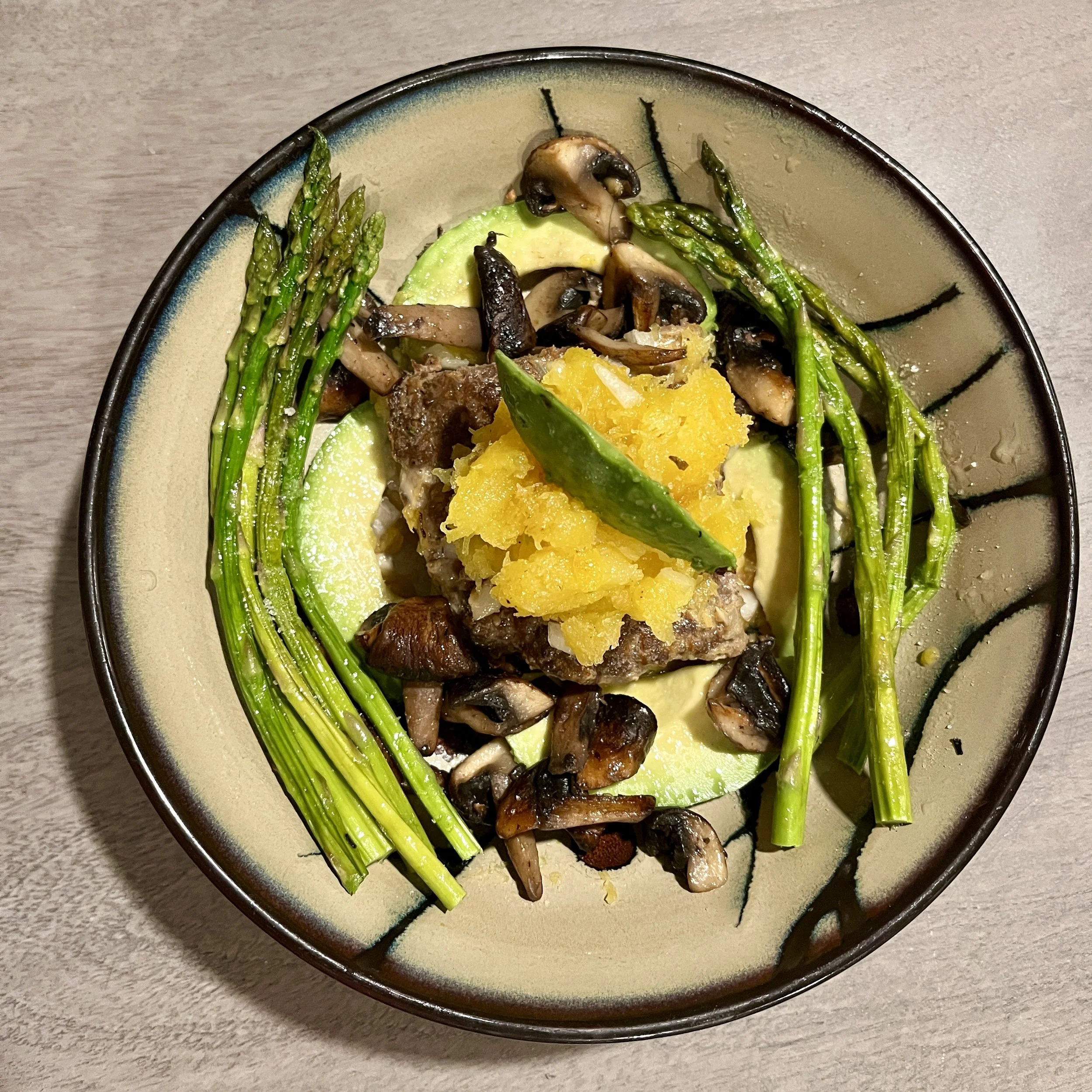
Meals & Recipes: Meatloaf, Mushrooms, Asparagus and Squash
Meatloaf square, with delicata squash (ghee onion and salt), mushrooms, avocado and asparagus. Topped with red wine vinegar.

Meatloaf square, with delicata squash (ghee onion and salt), mushrooms, avocado and asparagus. Topped with red wine vinegar.
Your Bowl. Add one square of meatloaf. Slice 1/4 avocado and line around the meatloaf. Add a handful of mushrooms. Add a handful of asparagus. Top the meatloaf with 1/4 delicata squash mashed and mixed with 1 tbsp of ghee, 1 slice of chopped yellow onion and 2 pinches of sea salt. Drizzle with red wine vinegar, add 2 pinches of sea salt.
Buon Appetito!!
Cooking Instructions:
Meatloaf. Prepare the meat. Use 1 lb of 100% grass fed and finished or pasture raised ground beef. In a mixing bowl add the ground beef, 6 pinches of salt, 6 pinches of black pepper, 2 tbsp mustard, 2 tbsp Primal Buffalo Sauce, 1 egg (beat it before adding it), and 1/4 cup panko bread crumbs. Mix it all together.
Prepare to cook. Preheat the oven to 425 degrees. Coat the bottom of a 8 x 8 pyrex with olive oil. Ball the ground beef mixture into one big ball in your hands, and then place it in the middle of the pyrex. Flatten it out so it’s even throughout and fills in all the corners and edges of the pyrex.
Chop up 1 slice of onion and 2 cloves of garlic. Add that to the top of the beef and sprinkle with 2 pinches of sea salt and a generous amount of cracked fresh pepper.
Cook for 20 minutes.
Finishing up. After cooking for 20 minutes, move the pyrex to the top rack and turn on the boiler and allow to cook for an additional 1 - 2 minutes (try not to let the garlic and onion burn like I did. It happens fast).
Remove after 1 - 2 minutes and cut into 4 equal portions to make preparing meals in the future easy (each one will be approximately 1/4 lb of beef).
Place in a glass container to store and drizzle the remnants from the pyrex over the top!
Delicata Squash. Preheat the oven to 350 degrees. Slice squash in half length wise. Use a spoon to scoop out the seeds (save and clean seeds if you’d like to roast them later). Scoop out the stringy meat inside. Coat the entire squash in olive oil and sprinkle salt inside. Place on baking sheet with the skin up. Bake for 20 minutes at 350 or until tender (easily pierced with a fork).
Mushrooms. We like organic baby bellas. Bring a pan to medium-high heat. Add a tbsp of olive oil. Slice the mushrooms into quarters, toss lightly with olive oil (1 - 2 tbsp) and salt (2 - 3 pinches, and add them to the preheated pan. Add a few splashes of water and cover. Leave undisturbed for 5 minutes, then toss and let sit for another 3 - 5 minutes.
Asparagus. Cut the base of the stems off. Line the asparagus on a cookie sheet lightly covered in olive oil and salt. Cook for 8 - 10 minutes if you’re cooking at 425, 12 minutes if cooking at 350. Thick asparagus will take longer. We always buy thin bunches. You’re looking for bright green color, with some snap.

Meal Prep Wednesday
Meal prep salmon, vegetable soup, and brussels to start the day
I’ve been doing a lot of my cooking in the morning. I find it therapeutic to start the day that way. My routine recently has been wake up between 5 - 6 am, make coffee, read for 60 - 90 minutes, then walk and feed my dog. Most days I start cooking by 8 - 9 am. This Wednesday I went into the kitchen to make breakfast and before I knew it I had salmon, brussels sprouts, and vegetable soup all going at once.
Wild Sockeye Salmon
Ever since reading The New Fish, which confirmed all of the rumors I’d heard about the poor health of farmed fish and it’s harmful impact on the environment, I’ve been avoiding farmed fish. But finding wild caught fish in Colorado has thus far been a challenge, so I’ve been opting instead for flash frozen wild cod or salmon sold at the grocery store. The quality is fine, but I do hate that it’s wrapped in plastic. I guess nothing is perfect.

I defrosted two 6 oz filets and marinated them in 1 tbsp of olive oil, a generous tbsp of soy sauce, and sprinkled them with 2 pinches of sea salt, chili powder, onion powder, and garlic powder. I let them sit and marinate as I prepared the rest of the food I was cooking.
After marinating for 10 - 15 minutes I put the filets face down, skin up, on a baking sheet, and cooked them for 9 minutes at 350 degrees. I finished them under the broiler for 90 seconds to crisp the skin. The flavor and texture it gives it makes all the difference.
Vegetable Soup with Homemade Bone Broth
Christmas day was the first time I ever made a whole chicken in the crock pot. I’ve made one every week since. It’s just so easy and delicious. The meat falls right off the bone. In previous weeks I had been discarding the chicken bones and carcass, but listening to EC Synkowski talk about collagen supplementation put the idea in my head that I should make my own collagen supplement. Bone broth.
I also HATE FOOD WASTE. I LOVE the idea of using as much of every animal, vegetable, and fruit you can. So this past week I made my first bone broth in the instant pot. It was so easy. I’ve also been on a soup kick. So with fresh bone broth in the refrigerator I decided to use it to make soup.

For this soup I went with: chopped carrots, celery, red onion, garlic, salt and olive oil, which I cooked for 5 minutes in a pot. Then I added 2 cups of bone broth, 2 cups of water, a handful of sliced white and baby bella mushrooms, sliced tomato, bay leaves, parsley, 1 handful of Bob’s Red Mill Soup Mix, brought it all to a boil, then let it simmer for 20 minutes. Finally I added 1 cup of kidney beans and let everything cook for another 25.
The soup at first came out a little bland, but my girlfriend reminded me that I needed to add salt since we didn’t use store bought broth which contains sodium. Once she added salt we both agreed it was the best batch of soup thus far.
Brussels Sprouts
Brussels are my favorite vegetable. They’re really healthy, they can be cooked lightly or crisped, baked, boiled, or sautéed, and they hold onto a lot of flavor. It’s a rare occasion when there aren’t cooked brussels in my refrigerator. How I cook them varies just slightly every time.

Today, after cutting off the stems and quartering them, I added them to a mixing bowl with 2 tbsp of olive oil, 2 pinches of sea salt, onion powder, and 2 slices of red onion cut in half. I tossed all the ingredients together until all of the brussels were evenly coated. Then I spread them evenly on a baking sheet to cook for 25 minutes at 350 degrees.
I usually cook everything, brussels included, at 425, but I cooked them a little slower to see what difference it made. It turns out, not that much. But they were delicious.
Reducing Waste
I really hate wasting food and materials in the kitchen. I try as much as possible to re-purpose ingredients, and re-use plastic bags, tin foil, parchment paper, whenever I can.
I cooked the salmon on tin foil that had been used prior to make roasted brussels sprouts. Tin foil gets tossed away so easily when it really has 2 - 3 good uses out of a single sheet. I was able to use the chicken carcass and bones to make a delicious broth for my soup. I’ve also been keeping my vegetable scraps in a bag in the freezer and using them to make homemade vegetable broth. It’s a trick my mom saw online and sent me.
It’s all part of my commitment to limit waste and re-use. These are small actions, but right now it’s the best I can do. I look forward to the day when we have a garden for compost, and when we can use our coffee grinds to grow mushrooms.
This was my meal prep Wednesday. For the next few days I’ll be all stocked up. All I have to do is open a container and grab a ladle of soup, a handful of brussels, and a filet of salmon, and breakfast, lunch, or dinner is served. It’s about 2 hours of work, but it makes eating healthy a lot easier. Plus, I love being in the kitchen and seeing my refrigerator stocked.


Meals & Recipes: Winter Squash & Chicken
Delicata squash, roasted peppers, mushrooms, avocado, red onion and chicken.

Your Bowl. Scoop out the cooked inside of 1/4 of the squash, chop it up, and mix with a handful of chopped roasted peppers, a handful of sautéed mushrooms, 1/4 sliced avocado, one slice of chopped red onion, 3 pinches of sea salt and 1 - 2 tbsp of ghee. Line the rim of the bowl with 1/2 chicken breast chopped into bite size pieces. Use the homemade sauce for dipping.
Buon Appetito!!
Cooking Instructions:
Chicken Breast. Buy organic free range chicken breast (pasture raised is best if you can get it). Preheat the oven to 425. Put the chicken breast into a Pyrex. Rub them down in olive oil. Rub them down with salt, pepper, onion powder, garlic powder and a touch of cayenne pepper. Add a little water to the dish. Cook at 425 for 25 - 35 minutes depending on the thickness of the breast.
Delicata Squash. Preheat the oven to 350 degrees. Slice squash in half length wise. Use a spoon to scoop out the seeds (save and clean seeds if you’d like to roast them later). Scoop out the stringy meat inside. Coat the entire squash in olive oil and sprinkle salt inside. Place on baking sheet with the skin up. Bake for 20 minutes at 350 or until tender (easily pierced with a fork).
Peppers, Garlic, Onion. Bring a pan to medium-high heat. Chop 1 slice of onion, 2 cloves of garlic and 1 jalapeño pepper. Add to the pan with 1 tbsp olive oil and two pinches of salt. Cut out the core of three peppers (red, yellow and orange) and slice into 1/8 inch strips. Toss in a bowl with 1 tbsp olive oil and 2 pinches of salt. Add to the pan once the onion, garlic, jalapeño combination starts to give off an aroma. Cook for 15 - 20 minutes depending on how you like your peppers, flipping every 5 minutes.
Sautéed Mushrooms. We like organic baby bellas. Bring a pan to medium-high heat. Add a tbsp of olive oil. Slice the mushrooms into quarters, toss lightly with olive oil (1 - 2 tbsp) and salt (2 - 3 pinches, and add them to the preheated pan. Add a few splashes of water and cover. Leave undisturbed for 5 minutes, then toss and let sit for another 3 - 5 minutes.
Homemade Sauce. 1 tbsp Primal Buffalo sauce, 1 tbsp olive oil, 1/2 tbsp red wine vinegar, 1/2 tbsp fig balsamic vinegar, 2 pinches of sea salt.

Try This Move: Split Stance Row
An effective way to target your back and work your core and posterior chain at the same time
Split Stance Kettlebell Row
Step one leg back and slightly out, with your foot angled at 45 degrees. Keep your front foot straight and knee straight, knee bent at a 120 degree angle.
Tuck your tail bone, hinge forward, and grab the kettlebell with a tight grip. Lift your chest away from the ground back into the split stance.
Press your opposite arm straight out and make a fist. Start the movement by activating your shoulder, rear deltoid and then lats. Let those muscles guide the weight up towards you hip. Lower and repeat.
Lower the weight back down while keeping those muscles engaged.
3 sets x 10 reps per arm

5 Names to Follow In Health and Fitness
Here is a list of 5 teachers (one company) that I’ve been following in the health and wellness space.
I’ve written a little bit before about some things to keep in mind when you seek advice from influencers and public figures. I watched this TED Talk with EC Synkowski recently. She opens the talk with this quote that put it all into perspective for me.
“As to methods there may be a million and then some, but principles are few. The man who grasps principles can successfully select his own methods.” - Ralph Emerson.
It made me realize that the people I was most interested in following all had a common thread. Beyond teaching their own methods, they preached and taught fundamentals. And it occurred to me that the biggest problem with 9 / 10 influencers we find online is that they preach their methods as gospel.
But as I’ve pointed out before, there’s no guarantee that what works for someone else will work for you. In fact, it’s highly unlikely it will for an endless number of reasons (goals, experience, access) that I won’t get into here.
But if you can grasp the principles, then you can start to figure out your methods.
With that in mind I thought it would be helpful to share the short list of instructors and teachers that I’ve been following and learning a lot from.
Ben Bruno is a personal trainer who’s clientele includes professional athletes and actors/actresses. But he is in no way a Hollywood trainer. He trains all of his clients out of his garage which is no bigger than a living room. The exercises and workouts he shares are mostly variations of the same core movements. He believes that proper training really comes down to mastering the same basic exercises. A few months ago he put out two workouts, both of which I’ve purchased and used multiple times. They are really thorough, and unique. I’ve incorporated a lot of what I learned from him into my normal routine. This podcast episode is a great way to get to know him a little bit better.
EC Synkowski - As far as nutritionists go, I usually gloss over anytime I read or listen to what they have to say. Most nutritionists, like most experts, get caught up in the weeds and in proving their worth by making things complex. EC Synkowski is the opposite. Her mission is to make nutrition as simple as possible. She preaches achieving maximum results through a proper, healthy, and balanced diet. She also provides actionable ways on how to achieve that. Her #800 gram challenge is one such method, which I first discovered in the book Built to Move. Applying the 800 gram challenge to my life has been a game changer for me. Her weekly newsletter and podcast are also great resources to learn more about nutrition, supplementation, exercise, sleep and more.
Beth Lewis is a movement specialist. She is constantly sharing unique ways to move your body and stay fit. She’s a big believer in building strength and proper technique from the ground up. And for her a lot of that starts with foot strength. She also puts on a lot of online classes that will teach you how to move or stretch, and other non-conventional ways of increasing strength and mobility. To get a glimpse into what she believes, check out this great podcast episode with Peter Attia, MD.
Meghan Callaway is no frills. She teaches unique ways to strengthen your overall body, with a lot of focus on core and glute strength, as well as hip mobility. She is always sharing exercises I’ve never seen before and could’ve never dreamt up in my life. Her work is great because most exercises can be done at home with a resistance band, the couch, or a kettlebell. I’ve incorporated a lot of her exercises into my workouts. She’s also published a handful of detailed workouts programs, such as how to perform the perfect pull-up. Her content is real and I really enjoy seeing her work. She also shares a weekly newsletter packed with the exercises she’s working on.
Levels Health - Not a person, but a company. I’ve found their newsletter and blog to be very valuable. Their content is direct, actionable, and informative. It’s the reason I chose them when doing my continuous glucose monitor experiment. Everything they publish is well researched and well written. Metabolic health has become a big thing recently and as far as I can see they are leading this revolution in how we think about our health.
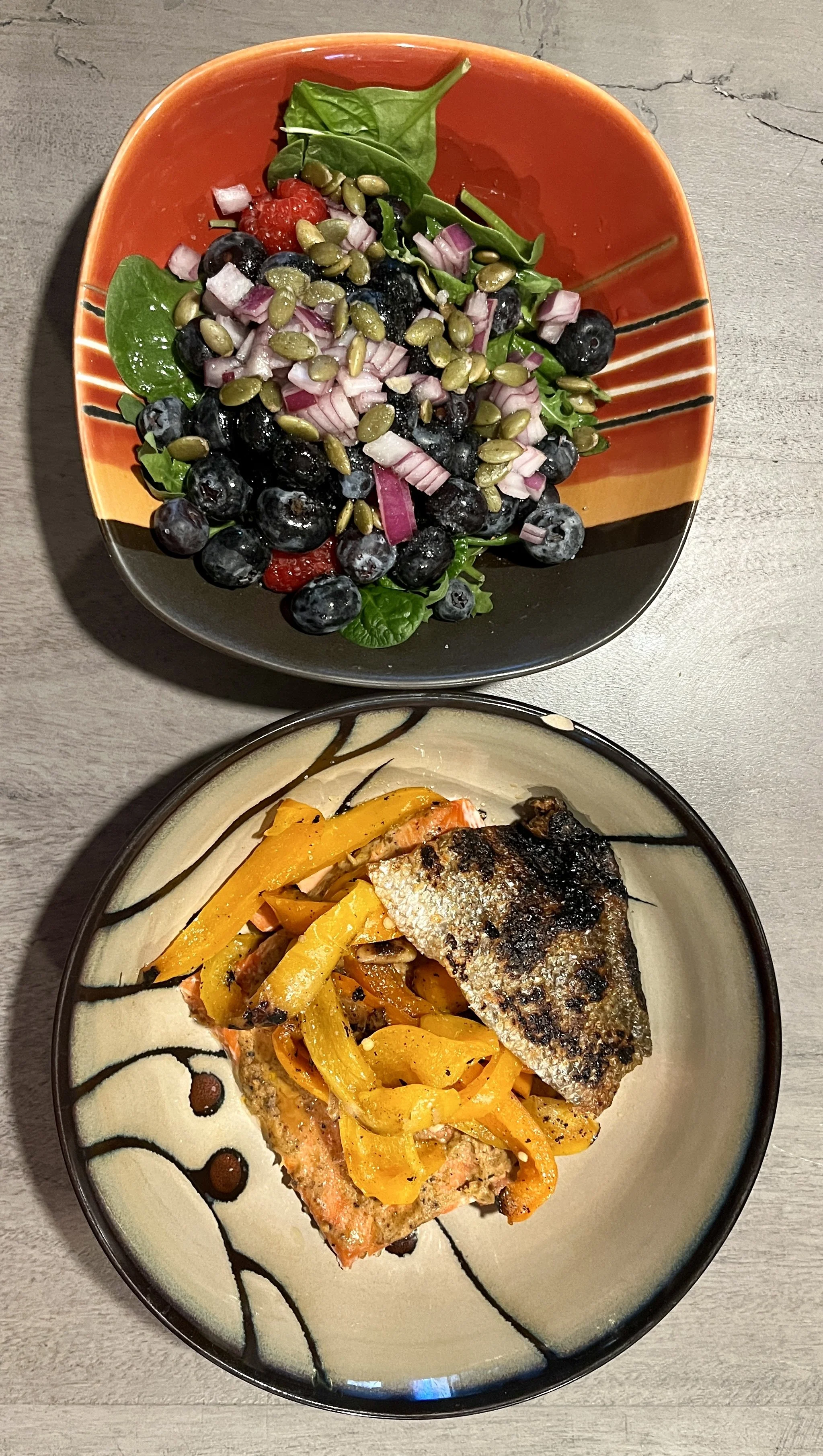
Meals & Recipes: Crispy Salmon Skin & a Side Fruit Salad
Wild sockeye salmon, with roasted bell peppers, and crisped (burnt) salmon skin, and a side salad.

Wild sockeye salmon, with roasted bell peppers, and crisped (burnt) salmon skin, and a side salad.
Wild Sockeye Salmon. Start with wild salmon. I’ve been enjoying frozen wild sockeye salmon from Whole Foods or Sprouts (grocers closest to me), or fresh wild Sockeye from Trader Joes. Preheat the oven to 425. Lightly coat a baking sheet with olive oil and a few pinches of salt. Place the salmon skin side down. In a bowl mix 1 tbsp of: honey dijon mustard, Primal buffalo sauce, Sweet Baby Rayss Hot Sauce, and stone & ground mustard. Sprinkle 1 pinch of: salt, black pepper, onion powder, and 1 garlic powder on the filet side. Spread mustard evenly throughout the filet. Cook for 8 - 10 minutes.
Salmon Skin. Remove the salmon skin after baking. Bring a pan to high heat. Add the salmon skin, make sure it’s laying flat. Flip every few minutes until crisp and it doesn’t bend when you pick it up.
Peppers, Garlic and Onion. Bring a pan to medium-high heat. Chop 1 slice of onion, 2 cloves of garlic and 1 jalapeño pepper. Add to the pan with 1 tbsp olive oil and two pinches of salt. Cut out the core of three peppers (red, yellow and orange) and slice into 1/8 inch strips. Toss in a bowl with 1 tbsp olive oil and 2 pinches of salt. Add to the pan once the onion, garlic, jalapeño combination starts to give off an aroma. Cook for 15 - 20 minutes depending on how you like your peppers, flipping every 5 minutes.
Assemble. Add a filet of salmon. Add a handful of pepper. Add salmon skin. Drizzle lightly with olive oil over the whole dish. Sprinkle with 2 pinches of sea salt.
Side Salad. Add a handful of arugula. Two handfuls of blueberries. One handful of raspberries. Half a handful of pepitas. One slice of chopped red onion. Drizzle with olive oil, red wine vinegar and two - three pinches of sea salt.
Buon Appetito!!

Podcast Review: Peter Attia w/ Michael Easter
Takeaways from Peter Attia and Michael Easter’s conversation about his new book Scarcity Brain and the research that went into writing it.
Michael Easter is an investigative journalist, author or The Comfort Crisis and a new book Scarcity Brain, discussed in this episode. Michael Easter makes the point that most of our behaviors as humans are based off what he calls “the scarcity loop,” which consists of three components.
Opportunity - you have an opportunity to get something of value
Unpredictable rewards - you don’t know when and how much, but you know something is coming
Quick repeatability - The faster a human or any animal can repeat a behavior the more likely they are to repeat that behavior
And it’s this evolutionary scarcity loop that food manufacturers, casinos, drugs, retailers, and social media take advantage of to keep us eating, gambling, inebriated, shopping and scrolling.
The episode dives into each one in further detail, but I’d like to focus on their discussion of food and diet as I believe it is the most relevant and important.
Food wasn’t always easy to come by, and when food was scarce, we had a necessity to store excess food for energy. But you also had to expel energy to get energy. Now, more than 10,000 items line grocery store shelves, which created an environment where over-nourishment now causes 4x more disease worldwide than under-nourishment. Simply put, the more options we have, the more we will eat. A behavior that has been termed the “buffet effect.”
The result is a population that consumes 60 - 70% of their calories from ultra-processed foods (i.e. fast food, potato chips, cereal), and where 70% of adults are overweight or obese. This trend towards consuming more and more processed food began in the 1970s with the invention of the “snack.” Food manufacturers discovered what Michael Easter refers to as the Three V’s of Snacking that would ensure a snack sells.
Value - it must be affordable (cheap)
Variety - the more flavors the better
Velocity - it must be fast to eat ensuring over consumption
The environment created by Big Food is at the root of our disease epidemic. Food that is designed to be extremely palatable, cheap (we spend 8% of our income on food today compared to 40% historically), non-perishable, and calorically dense has resulted in the dramatic rise in metabolic disease, which causes chronic illnesses such as obesity, diabetes, and heart disease.
A study discussed in the episode verifies this claim. The purpose of the study was to determine the impact of ultra-processed food on weight gain. A group of participants were kept in a tightly controlled environment for one month and fed a diet of ultra-processed foods for two weeks, followed by a diet of minimally processed food for two weeks.
The result showed that on the ultra-processed food diet participants ate on average 500 calories more per day, and gained 2 lbs. When they were on the minimally processed food diet they lost 2 lbs.
The lead researcher Kevin D. Hall Ph.D. concluded, “This is the first study to demonstrate causality — that ultra-processed foods cause people to eat too many calories and gain weight."
So what do we do in a world filled with cheap processed food? Michael Easter visited a group of hunter gatherers, the Tsimane, in Bolivia who do not suffer from heart disease, or any other diseases of the modern world, to find out.
He found that they’re diet consisted of fish, meat, rice, plantains, vegetables, and fruit. They consumed every type of macro, but never fried or overcooked their food, and always ate in moderationn. The one thing they didn’t consume, was ultra-processed foods. He broke it down as follows.
Eat foods that are ingredients, not food that contain ingredients (i.e. fruits, vegetables, lean protein).
Eat your food plain. Even adding something as innocuous as salt makes food taste better and can cause over-eating.
Eat slowly. The quicker you eat the more likely you are to over-eat.
Eat a balanced diet with a little bit of everything.
He also noted that they did not eat a ton of vegetables, about the equivalent of one Sweet Green salads worth of vegetables a day.
This was a great episode and I encourage you to listen to it in length to hear many more valuable insights. I have The Comfort Crisis in the queue to read next and report back on.
Cheers.
The "Complexity" of Our Food System and Health
Click here: OneSource Health, January 14, 2024
“The deal we made with our planet, its creatures, and our rural workforces, all so we could enjoy a slightly cheaper hamburger, might just be the worst deal that was ever made.” - Will Harris
Last week I shared an article titled Colon cancer is rising in young Americans. It’s not clear why. and my commentary that healthcare is invested in the technique of sowing doubt. This week the Wall Street Journal provided further evidence of my claim with the headline: Cancer Is Striking More Young People, and Doctors Are Alarmed and Baffled.
Even if doctors, researchers and experts remain baffled, I’m not. It’s evidently clear that the rise in disease is directly related to the rise of industrialized food.
Just take this example from A Bold Return to Giving a Damn, this week’s book, discussing the toxins that cattle are treated with.
“What’s the weed situation out here… is it more weedy than I want… If affirmative, I’d get out the herbicide. Next… Is there an infestation of fall army worms? If yes, spray some Pyrethroid to take them out. Search… for leaf spot mold. Better get the fungicide. Test the soil for nutrients, then add nitrogen, phosphorus, and potassium. Now look over the cattle for bottle jaw… some of them might need a dewormer. And if there are over two hundred flies per head, the books says to spray insecticide on them, so I’d do that too.”
Or this example from The Botany of Desire.
“I asked Forsyth [a potato farmer] to walk me through a season’s regimen... Typically it begins early in the spring… potato farmers douse their fields before planting with a chemical toxic enough to kill every trace of microbial life in the soil. Next… herbicide to “clean” his field of all weeds. Then… a systemic insecticide is applied to the soil. This will be absorbed by the young seedlings and kill any insect that eats their leaves... When the potato seedlings are six inches tall, a second herbicide is sprayed to control weeds.”
Both the cattle and the potatoes in each of the examples will end up in fast food chains and grocery stores around the country, and ultimately in the stomachs of millions of Americans.
Or read this week’s article discussing 7 food additives that are banned in other countries for causing diseases such as cancer and nerve damage, but remain legal in the U.S.
So when doctors and researchers say they’re baffled, I’m baffled that they’re baffled. But the twisted part is that they’re not baffled. They’ve just decided to trade lives for profits.
And all of these chemicals and additives don’t even account for the impact that ultra-processed foods (UPFs) has on our health. As Michael Easter points out in this weeks podcast, in a tightly controlled one month study, participants fed a UPF diet ate on average 500 more calories per day than when they were fed a minimally processed diet. Extrapolate that over a full year and the math to obesity and disease becomes clear.
So here in lies the problem. We have a population that is getting sicker by the day. We know why, but politicians and corporate greed keep telling us “they’re not sure why.” Pharmaceutical companies keep developing and marketing treatments and medicines, meanwhile the prevalence of disease continues to rise.
Instead its up to us as consumers to spend our money in places where health, quality food, the welfare of animals and the land is the priority. The best way to do that is by buying local, from farmers and growers in your area. Here is a list of resources from A Bold Return to Giving a Damn where you can search for locally sourced food in your area.
But if you can’t do that, you can at least keep your dollars from going to the likes of fast food chains and food manufacturers which rely on cheap corn, soy, beef, and grains grown with toxic chemicals. You can opt for cooking food from whole foods produce and humanely raised meats. Every dollar shifted away from Big Food, Ag, Drinks, and Healthcare is a dollar shifted in the direction we need to go.
This Week’s Posts:
Three Easy Ways I Improved My Nutrition
Kidney Bean and Mushroom Soup Recipe
A Book, Podcast, and Article Worth Sharing
A Bold Return to Giving a Damn: One Farm, Six Generations, and the Future of Food, By Will Harris III
In 2020 the pandemic revealed cracks in our food system and I became interested in learning more about it. In 2021 I leaned in a little more and worked part-time on a farm near Los Angeles. Through my reading and experience I became a believer that fixing the food system was a path to fixing most (if not all) the ailments we face as a nation. November 2022 I listened to Will Harris on the Joe Rogan Experience and the episode provided even more fuel and I started manifesting a trip to visit his farm, White Oak Pastures, to learn more.
Order the book here… and Read my takeaways here…
Peter Attia The Drive with Michael Easter, Author of The Comfort Crisis and Scarcity Brain
Michael Easter is an investigative journalist, author or The Comfort Crisis and a new book Scarcity Brain, discussed in this episode. Michael Easter makes the point that most of our behaviors as humans are based off what he calls “the scarcity loop,” which consists of three components.
Opportunity - you have an opportunity to get something of value
Unpredictable rewards - you don’t know when and how much, but you know something is coming
Quick repeatability - The faster a human or any animal can repeat a behavior the more likely they are to repeat that behavior
And it’s this evolutionary scarcity loop that food manufacturers, casinos, drugs, retailers, and social media take advantage of to keep us eating, gambling, inebriated, shopping and scrolling.
Listen to the episode here… and Read my takeaways here…
7 Additives in our Processed Food That Are Banned Outside the U.S.
The reasons why we face a catastrophic health epidemic in this country are many and complex. But if we can’t get this right, having an FDA with a backbone to stand up against Big Food and ban ingredients KNOWN to cause cancer, neurological problems, and metabolic disease (the main culprit of obesity and diabetes), then what chance do we have?
Credit to California, the first state to pass a law that will ban 4 of these additives from being used in food sold in California. But even they fell short. The law, which passed in 2023, doesn’t go into effect until 2027, giving companies time to "revise their recipes to avoid these harmful chemicals," said Governor Gavin Newsom. Said another way, “corporate profits are more important than your health.”
Our politicians are constantly faced with the decision: do I support the public that supports me, or the companies that line my pockets? And without fail, they choose the latter. We deserve so much better.
Read the article: 7 Additives in Our Processed Food That Are Bannee Outside the U.S.