

Cooking Rules
A simple guide to getting the most of out cooking
Rules to develop a sustainable and healthy practice of cooking.
Keep it simple. There are only two ingredients you need to cook any dish you want:
Something to cook your food in (i.e. olive oil, avocado oil, grassfed and finished butter), and salt.
If you want, pepper. But it doesn’t even need it.
Make the most of your time in the kitchen. If you have to be in the kitchen, make the most of it. Put something in the oven. Something in a pan. Something in a pot.
Almost any non-root vegetable can be cooked on a stovetop, on medium - high heat (depending on your stoves settings), in 10 minutes. This includes mushrooms, peppers, zucchini, broccoli and brussel sprouts.
Almost any root vegetable can be cooked in the oven in 20 minutes at 425 degrees. This includes carrots and beets.
Almost any lean meat (chicken thigh, chicken breast, steak, ground beef, fish) can be cooked in 20 minutes or less in the oven at 425 degrees. This will of course depend on thickness of the cut.
Use your hand to measure for your plate:
Shoot for two handfuls of veggies, one palm size piece of lean protein (chicken, beef, fish), and one thumbs length of fat (4 almonds, 1/8 of an avocado), with every meal.
Go heavy on vinegar and light on olive oil (any oil) when dressing your food:
Red wine vinegar, white wine vinegar and apple cider vinegar can be used on anything in almost any amounts.
Fig and balsamic vinegars are hiring in sugar and shouldn’t be used as freely.
Oil is high in fat and calories, which can both sneak up on you if you’re not careful.
Garnish generously with salt. If you’re eating whole foods then you’re not getting any salt from your food. You need to add it.

A Good Podcast: Preventing Sarcopenia with EC Synkowski
Tips to slow the process of muscle loss as we age
Listen Here: The Consistency Project: Strategies To Maintain Muscle Mass As We Age
Nothing motivates the gym rat in me like knowing that 7 years ago I started losing muscle. Sarcopenia, the loss of muscle mass as we age, begins at around age 30. Yikes!
In this short 30 minute episode EC Synkowski provides tips and tricks to slow down the process.
Some key takeaways from this episode, On The Fight Against Sarcopenia:
Sarcopenia begins at age 30 at a rate of .3% to .8% loss per year
After age 50 it increases to 1 - 5 % per year
Note: you can put on muscle after age 30 (especially if you’re new to exercise)
Exercise helps to prevent Sarcopenia
EC Synkowski’s #1 rule of exercise - “All exercise is better than none”
Work on resistance training 1 - 2x per week, and cardio (both short duration, i.e. HIIT, and long duration, i.e. swim or cycle) 3 - 4x per week
Get consistent, make the workout challenging, and don’t overcomplicate it worrying about the correct set rep system!
Nutrition to slow Sarcopenia
Focus on the #800gramchallenge (this has been a life changer for me)
Consume a minimum of .7 grams of protein per pound of bodyweight
Use creatine which can aid in the fight against Sarcopenia
I first got introduced to EC Synkowski in the book Built to Move, which introduced me to the 800 gram challenge, and I’ve been following her ever since as a subscriber to her weekly newsletter, where she discusses nutrition and health related topics. If you want a little primer to see what she’ all about, check out this 5 minute Ted Talk she gave five years ago, where she explains her simplistic and effective views on health and nutrition. Enjoy!
Glucose Monitoring Update
Glucose spikes and crashes and what’s causing them.
It’s now been just over a week of wearing a continuous glucose monitor (CGM) and I remain fascinated by what I’m seeing. In the past few days I’ve had a few incidents that are worth sharing.
Cappuccino Crash
On Sunday morning I woke up and put in 60 minutes on my assault bike (majority low intensity, with 10 high intensity intervals mixed in). I didn’t eat after and instead grabbed a handful of blueberries and raspberries and we ran out the door to run errands.
We sat down at a coffee shop around 1 pm. My girlfriend had hot chocolate and I had an oat milk cappuccino, and then we took our dog to the park to run around. The ground was fresh with good packing snow and so we proceeded to run around like little kids, throwing snow balls, and tackling one another to the ground. But about halfway through our fun, I started to feel really woozy and nauseous. I figured it just had something to do with not eating yet, but I mostly dismissed it.
On the way home we stopped at Walgreens. While I waiting in line to check out I pulled out my phone and opened my Levels app. This is what I saw.
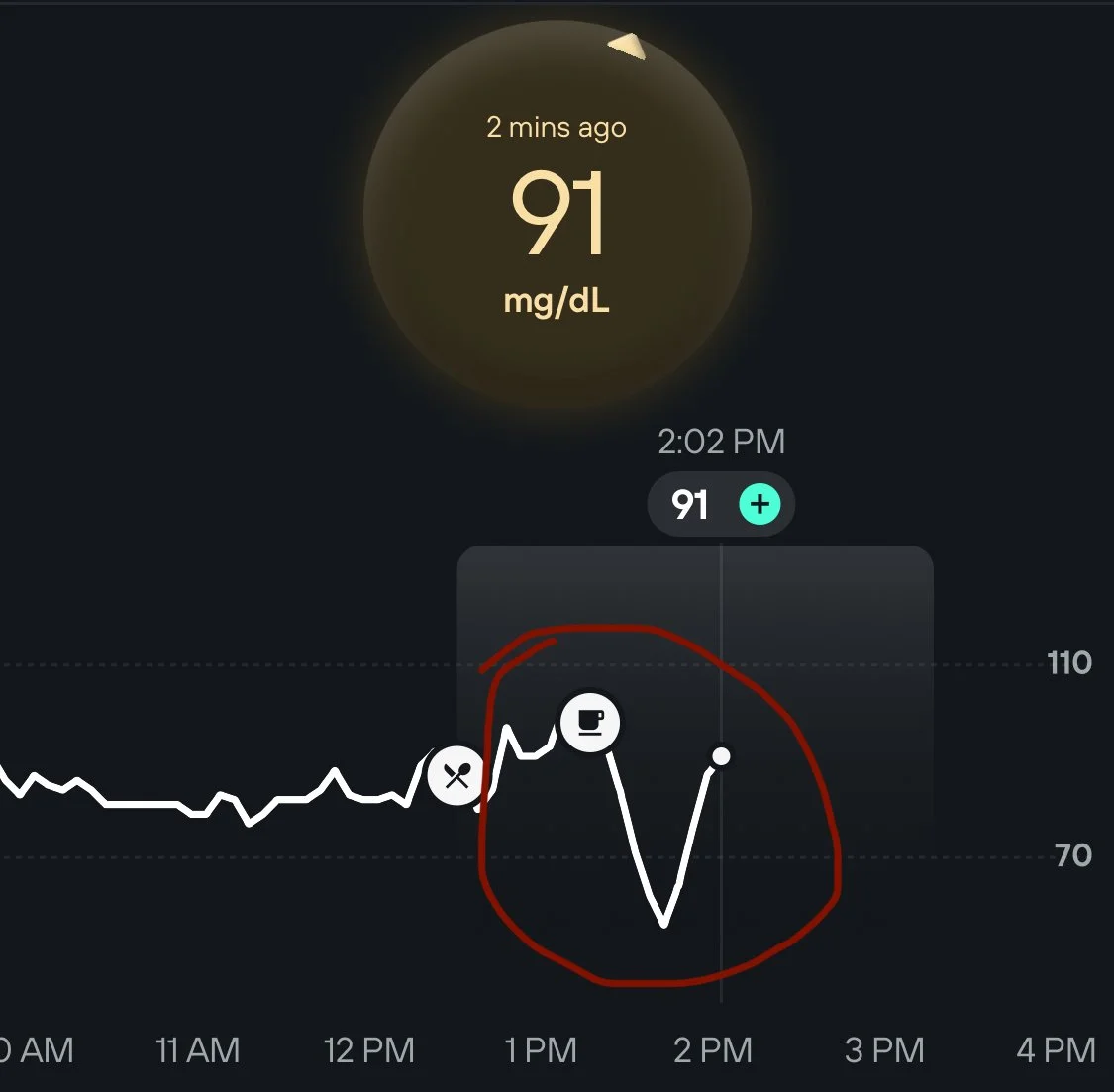
I was amazed. A 30 point crash was no doubt the reason I felt sick. The culprit? Not eating, combined with having oat milk, which I later learned is the worst alternative milk option for blood sugar, in my coffee. I was disappointed to learn that because oat milk is so delicious. But I thought it was cool to see the data correlate in real time to how I was feeling physically. How wild!
Chocolate Peanut Butter RX Bar
The second incident (later in that same day) was more of an experiment. RX Bars are my go to when I’m hungry and in a pinch. Not only are they absolutely delicious, but I’ve always appreciated the minimal ingredients (typically 5 or less) as well as the balance offered by it macro nutrient ratios.
The bar I ate this day, Peanut Butter Chocolate contains: egg whites, peanuts, dates, chocolate, cocoa, natural flavors and sea salt (yum). It macro nutrients profile is:
Fat: 10 grams
Carbs: 22 grams
Fiber: 4 grams (almost 1/5 of the carbs, an ideal ratio)
Protein: 12 gram
So I was excited to see what this bar did to my glucose and if I could continue to enjoy them or if I needed to look for an alternative.

Over the 1.5 hours that followed, my glucose levels rose, albeit gradually, and managed to stay just under the upper 110 mg/dl threshold set by Levels. After the slow rise, my glucose subsequently descended at an equally steady pace before returning to baseline.
This reaffirmed to me that this is a balanced bar, that I can continue to eat without concern.
Two Bad Spikes
After a couple of my most stabile glucose days, Wednesday turned out to be a bad one.
It started good with a 7 am agility session. But, like Sunday, I didn’t end up eating my first meal until the early afternoon, setting me up for disaster later in the day. All morning I chose coffee over food because I didn’t want to break my work flow. Which was obviously the wrong choice.
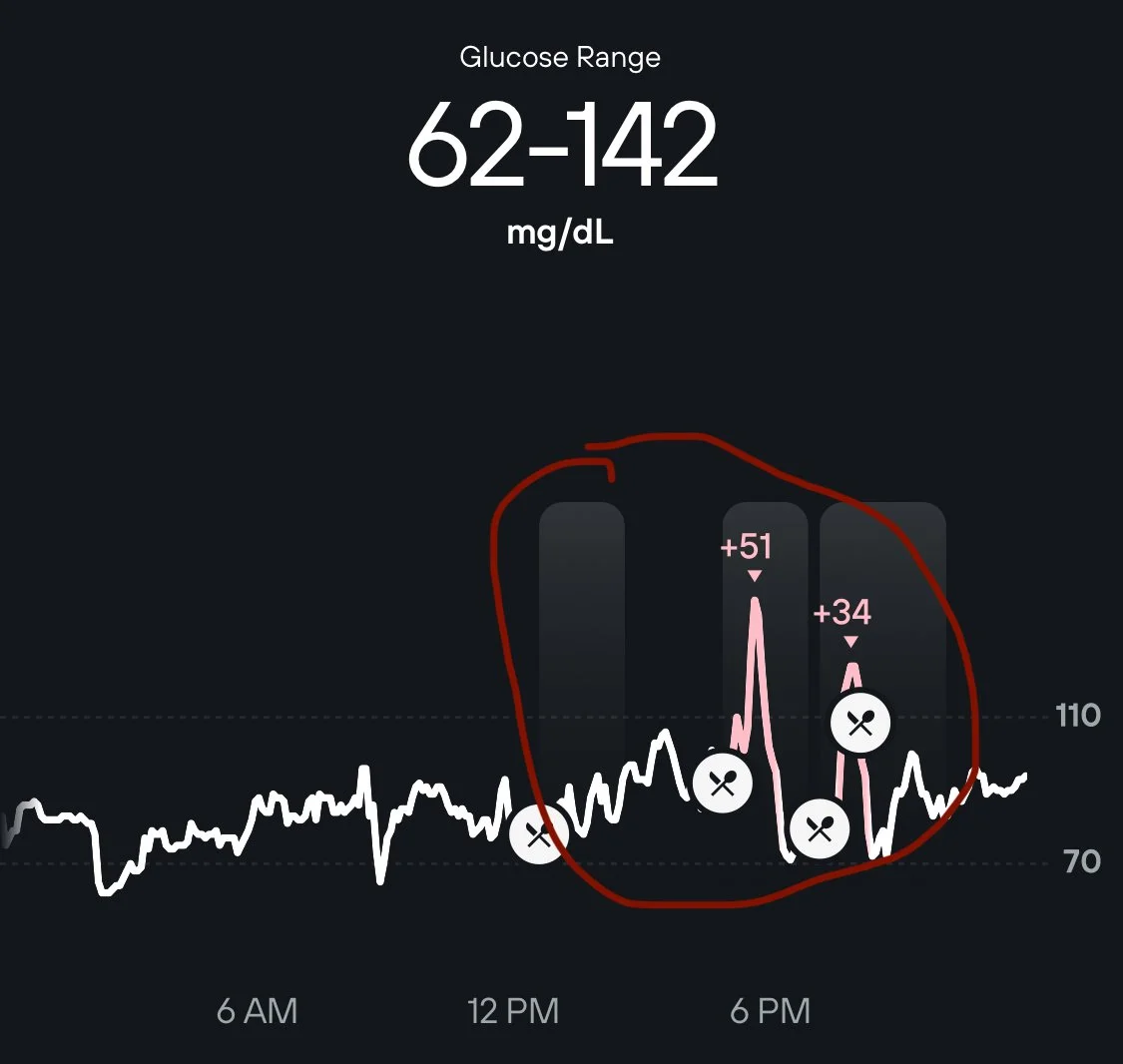
The first spike (+51 points, yikes!) was caused by a “snack”; dark chocolate espresso beans, Mary’s Gone Crackers, and one Jojos chocolate square. It seemed harmless at the time, but in retrospect it was a lot of sugar and carbs and no nutrients to aid in their digestion. I was hungry, and didn’t want to pull myself away to make something nutritious, and my body paid a price as a result (second mistake of the day).
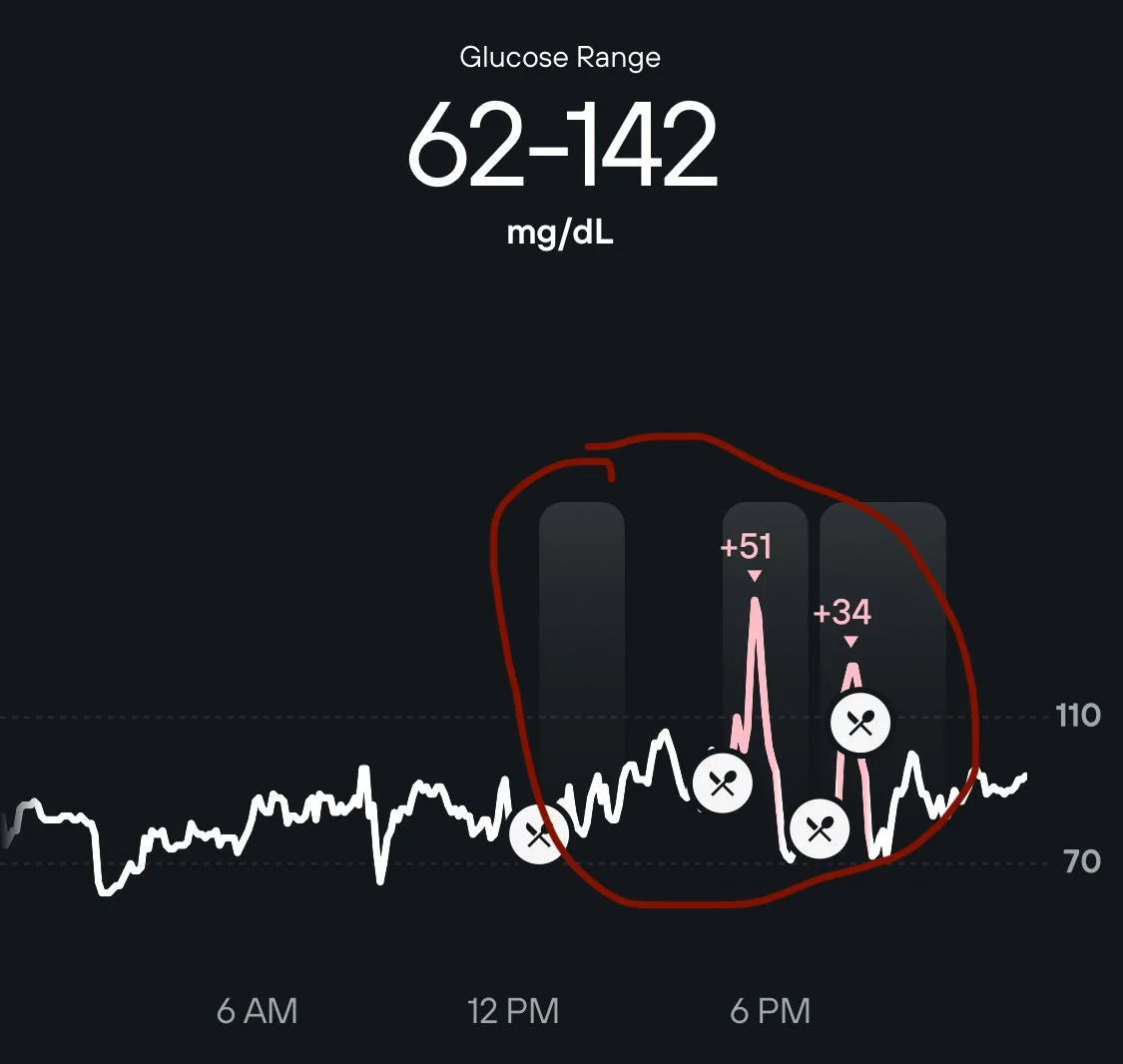
The second spike (+34 points) came at dinner. By the time I came up to eat at 7 pm I was feeling ravenous. So I did what any ravenous person does. I made a huge bowl of food (third mistake). Pasta, zucchini, mushrooms, tomato, avocado, tofu, chicken and onion. And then followed it up with another bowl 1 hour later. Arugula salad with sardines, onions, blueberries and more mushrooms and zucchini.
The spike is significant, but it also comes on the heels of crashing from my snack a few hours earlier. So I’m giving myself a little bit of a break. I think the pasta and vegetable dish outlined above was fairly balanced, and I think had I eaten it alone, without the earlier snack, that the results would have been different. Regardless, all of my poor eating choices set me up for a day of yo-yoing glucose.
The longer I wear the CGM the more fascinated I become by the data. As I’ve mentioned before, it scares me to think about all the spikes and crashes that are happening internally, while externally I mostly feel nothing. The body is constantly working overtime and we really don’t give it enough credit for all it does. We run around abusing it, hoping it doesn’t crap out on us. And when it does, we wonder why.

Be Specific
Being Specific Can Improve Procrastination
Details matter.
I’ve found that when I’m very specific about my objectives, the more likely I aim to accomplish them. Here’s a recent example.
I’ve had finalizing my itinerary for my trip to Switzerland on my list of things to work on for over 2 weeks and I haven’t touched it. It’s an enormous under taking in comparison to say building a workout, or writing up a meal idea. It involves research, looking back through photos and apps to piece together our trip and write about it. So instead of working on it, I’ve just kicked it to the side for about 2 weeks and just stared at my to do list: Switzerland Itinerary.
Today I decided I was actually going to work on it. I had enough of putting it off and I wanted to work on something different. I’d been putting a lot of work into everything but the itinerary, so I figured it would be a nice change of pace.
I started working on it as planned. I tried to get everything I had written up already organized. I had started a Scrivener file on it, and I had a bunch of notes stored in my phone, so I began by consolidating everything into the Scrivener file (something I always seem to do).
I created tabs for each leg of the trip (13 in total). Then I started pulling the information I had from my phone into its respective leg. Luzern details into the Luzern folder. Via Alpina: Stage 8 notes into the Via Alpina: Stage 8 folder. And so on.
After that, I went in, starting with Luzern (the first stop on our trip) and organized the notes.
Destination: Luzern
Days/Nights: 3
Restaurants:
Where We Stayed:
So on and so on.
Then I stopped, because I had this realization. Maybe if I had been more specific on my to do list I would have actually done some work on it.
To Do: Consolidate all of the trip notes into Scrivener and organize the details based on a set format.
How much more manageable does that sound versus, Switzerland Itinerary. That’s a big project. Whereas the former is a clearly defined plan. Something that sounds doable.
It was just one of those ah ha moments. Like wow I get it.
Anyway, I need to get back to consolidate all of the trip notes into Scrivener and organize the details based on a set format.
Thanks for listening.

Sockeye and Eggs
A low carb, high protein, good fat breakfast!

Sockeye and Eggs, with mushrooms, avocado, red onion and beets. With homemade sauce.
Salmon. Preheat the oven to 425. Lightly coat both sides of the salmon filet (or filets if cooking multiple) with olive oil. Place the filet skin up on a baking sheet lined with aluminum foil. Add a pinch of salt (or two) to each filet and black pepper. Cook for 8 minutes (longer if desired).

Beets. Buy 3-4 loose organic beets. Remove the skin. Cut them into quarters (1/8s if they’re large). Place in a pot, add water so covered by 1-2 inches of water. Add two pinches of salt. 1 tbsp of red wine vinegar. Bring to a boil then reduce to a simmer for 60 minutes.
Mushrooms. We like organic baby bellas. Bring a pan to medium-high heat. Add a tbsp of olive oil. Slice the mushrooms into quarters, toss lightly with olive oil and salt, and add them to the preheated pan. Leave undisturbed for 5 minutes, then toss and let sit for another five.
Egg Scramble. In a bowl mix 1 large egg, 1/4 sliced avocado, 1 slice of chopped red onion, 1 sliced beet and a handful of mushrooms.

Add to a pan heated to medium heat. Allow to cook fully and then flip to cook the other side.

Homemade Sauce. 1 tbsp Primal Buffalo sauce, 1 tbsp olive oil, 1/2 tbsp red wine vinegar, 1/2 tbsp fig balsamic vinegar, 2 pinches of sea salt.

Assemble. Add 1 salmon filet to a bowl. Layer the egg scramble on top. Drizzle homemade sauce over the whole bowl and enjoy!
Buon Appetito!

Meatloaf (ish) Dish
Quick, easy, delicious meatloaf(ish)

Ground beef meatloaf(ish) recipe
Prepare the meat. Use 1 lb of 100% grass fed and finished or pasture raised ground beef. In a mixing bowl add the ground beef, 6 pinches of salt, 6 pinches of black pepper, 2 tbsp mustard, 2 tbsp Primal Buffalo Sauce, 1 egg (beat it before adding it), and 1/4 cup panko bread crumbs. Mix it all together.

Prepare to cook. Preheat the oven to 425 degrees. Coat the bottom of a 8 x 8 pyrex with olive oil. Ball the ground beef mixture into one big ball in your hands, and then place it in the middle of the pyrex. Flatten it out so it’s even throughout and fills in all the corners and edges of the pyrex.
Chop up 1 slice of onion and 2 cloves of garlic. Add that to the top of the beef and sprinkle with 2 pinches of sea salt and a generous amount of cracked fresh pepper.
Cook for 20 minutes.

Finishing up. After cooking for 20 minutes, move the pyrex to the top rack and turn on the boiler and allow to cook for an additional 1 - 2 minutes (try not to let the garlic and onion burn like I did. It happens fast).
Remove after 1 - 2 minutes and cut into 4 equal portions to make preparing meals in the future easy (each one will be approximately 1/4 lb of beef).
Place in a glass container to store and drizzle the remnants from the pyrex over the top!
Buon Appetito!!


The Real Reason To Warm Up
The warm up is a time of self assessment
Warm Up = Self Assessment
Warming up has been given the wrong name, and created confusion as a result. Because the point of the warm up is not actually to warm up. The point is to take the time before your workout to check in with yourself and see what you’re going to be capable of that day.
People don’t get hurt because they didn’t warm up (temperature wise), they get hurt because they didn’t take the time to listen to their body and assess what’s going on (which can also lead to burn out). And that’s why it is so important not to skip it.
Start slow and easy.
Take 5 minutes to foam roll and investigate what’s sore.
Take 5 minutes to stretch and lengthen your body. Where is your range of motion limited?
Take 5 minutes for some dynamic movements. Identify what is sore, limited and tired.
Take the first 1 - 2 sets of your workout to assess more before really pushing it.
Each one of these will change daily, so it’s important to reassess daily.
There’s another benefit to the warm up as well. It acts to ground us before a workout. By doing the one thing we all want to skip, it forces us to slow down and enter the workout with a level head that’s ready to go.
During your next warm up, listen to your body. Is today a day to push it? Or is today just about getting through the motions? Two very different days, but both are necessary. The warm up is where you can figure that out.

Lentils and Chicken
Green and red lentils, chicken thighs, and onion!

Green and red lentils, chicken thighs, onion, sea salt and olive oil!
Lentils. I have a bulk mix of red and green lentils. Depending on what you buy, the cooking time will vary. Check the packaging. These instructions are based on my mix.
Rinse 1 cup of mixed lentils. Add 3 cups of water or vegetable brother to a pot. Add the lentils. Bring to a boil, then reduce to a simmer and cover. Cook for 30 - 40 minutes, covered. Taste for tenderness before removing from heat.
Strain the lentils and return them to the pot.
Chicken Thighs. Buy a pack of organic free range chicken thighs (pasture raised is best if you can get it). Preheat the oven to 425. Put the chicken thighs into a Pyrex. Coat them lightly in enough olive oil so they don’t stick to the dish. Add a pinch of salt to each one (each side), black pepper, onion powder, garlic powder and a touch of cayenne pepper. Add a little water to the dish. Leave them right side up. Cook at 425 for 20 minutes.
Assemble. Add 1 - 1.25 lattles of lentils to a bowl. Chop up 1 - 2 chicken thighs into bite size pieces. Chop 1 slice of onion. Add everything to the bowl. Drizzle with 1 tbsp of olive oil and two pinches of sea salt.
Buon Appetito!

A Fascinating Doctor, Fixing Food, and Glucose Spikes
Click here: OneSource Health, December 10, 2023
"I hope whatever you're doing, / you're stopping now and then / and / not doing it at all." - How To Change Your Mind, Michael Pollan
A Good Podcast: The Drive with Tom Catena, M.D.
“I think maybe the modus operandi of my life is always looking for, what’s the opposite of greener pastures? Browner pastures (laughs)”
That’s a quote from guest Tom Catena, M.D., the only physician working in the Nubah Mountains in Sudan, where a civil war has raged for over a decade, devastating the community, injuring thousands and taking countless lives. If it sounds like this episode is going to be a depressing one, it’s far from it. On the contrary it’s quite up-lifting.
A Good Book - Food Fix: How to Save Our Health, Our Economy, Our Communities, and Our Planet--One Bite at a Time, by Mark Hyman, M.D.
This book, first read in 2020, marks the beginning of my interest to better understand the impacts that the food system and food policies have on our health. Prior to reading this book (and subsequently The Omnivores Dilemma), I never considered how things like subsidizing grain farmers and the prevalence of food deserts (amongst many other factors) contributed to the growing health epidemic. Food Fix is a good primer for anyone interested in learning more about these topics and how the system is designed (intentionally or not) to keep people sick.
A Good Article: Six Factors That Affect Glucose Besides Food
Last week I started wearing a continuous glucose monitor (CGM) for the first time in my life. I had been thinking about it for over a year and was finally pushed over the edge by this article by Peter Attia, MD. I’m less than a week into wearing it and I’ve been fascinated at the variations in my glucose. Since I’ve been immersing myself in the data, I found this article interesting. The two most surprising non-food items to me? Sunlight exposure and environmental toxins (yikes).
Workout this Week: Try This Workout
5 exercises. 5 minutes. 1 kettlebell.
Progression I of a 4 part progression series.
Cook this Week: Wild Sockeye Salmon with Purple Sweet Potato, Mushrooms and Sliced Avocado

Early Glucose Monitor Results
A quick check in on my glucose results
On Wednesday of this week I started wearing a continuous glucose monitor (CGM) for the first time in my life. More than a year ago I started to toy with the idea of wearing one for experimental purposes. I wanted to see how different foods might affect me, and I also wanted to see what (if any) behaviors I would change as a result.
But I kept putting it off until I read this article by Peter Attia, M.D. advocating for wearing one to take better control of your health. So I ordered one from Levels, a company I’ve been following for over a year. As far I can tell, they’ve been one of the pioneers in the space of at home CGMs.
The package of 3 CGMs came about a week after I placed my order. They came in a nice box, with alcohol swabs to clean your arm before applying the CGM, as well as Levels branded stickers to go over the CGM and hold it in place.
My experience got off to a rough start. I applied the CGM to the wrong spot on the back of my arm (right on my tricep). Based on the instructions it’s where I thought it was supposed to go, but I immediately experienced pain and discomfort. I thought the pain would go away. But after nearly 3 days I decided to remove it and put on the second one.
This time I applied it correctly, placing in on the outer part of my arm in the space between my shoulder muscle and tricep muscle (pictured here). Now I forget it’s even there.

After the initial mess up, I’ve been amazed to see what foods impact me the most. The two most surprising, on opposite ends of the spectrum, are purple sweet potato and lentils.
Eating 1/2 of a purple sweet potato mixed with 1 tbsp of ghee, with 1/4 pound of ground beef, brussel sprouts, walnuts and pumpkin seeds, spiked my glucose 52 points.

On the contrary, a 1/2 a cup of cooked lentils, 2 chicken thighs, onion, olive oil, salt and peppers, actually lowered my glucose levels by 10 points before it rebounded (the 30 point spike is from a sauna session, which is expected).

So what gives? Because 1/2 a purple sweet potato actually contains less carbs (17 grams) than 1/2 a cup of cooked lentils (20 grams). The difference, is in their protein and fiber.
A 1/2 a purple sweet potato contains 1.5 grams of fiber and 2 grams of protein, while a 1/2 a cup of cooked lentils contains 8 grams of fiber and 9 grams of protein.
All that fiber and protein in the lentils is helping for your body to absorb the carbs slowly. The ratio of 8 grams of fiber to 20 grams of carbs is actually 2x the ratio you want (a minimum 1 to 4 ratio is the target).
1/2 Sweet Potato 1/2 Cup Lentils
Carbohydrates 17 grams 20 grams
Fiber 1.5 grams 8 grams
Fiber/Carbs Ratio 1/8 2/5
Protein 2 grams 9 grams
What’s scared me is after eating each of these meals, I felt the same. I didn’t feel like anything was going on inside of me that potentially was harmful. They both felt like balanced meals. But obviously I was wrong.
The next time I eat sweet potato (because I will continue to have it), I’m going to make sure I add enough fiber, protein and healthy fat to offset the sweet potatoes nutrient deficiencies.
I can’t wait to see what else I learn.

Chicken Peppers and Onions
Chicken, broccoli, peppers and onions deliciousness

Chicken, broccoli, peppers and onions, zucchini and garlic, avocado and red onion
Baked Chicken Thighs. Buy a pack of organic free range chicken thighs (pasture raised is best if you can get it). Preheat the oven to 425. Put the chicken thighs into a Pyrex. Coat them lightly in enough olive oil so they don’t stick to the dish. Add a pinch of salt to each one (each side), black pepper, onion powder, garlic powder and a touch of cayenne pepper. Add a little water to the dish. Leave them right side up. Cook at 425 for 20 minutes.
Broccoli. Chop two broccoli crowns into bite size pieces. Bring a pot of water to boil. Add broccoli and let cook for 3 - 5 minutes (taste test before removing from water). Once strained, add the broccoli back to the pan, add two pinches of salt and a tbsp of grass-fed butter, and mix.
Peppers and Onions. Bring a pan to medium-high heat. Chop 1 slice of onion, 2 cloves of garlic and 1 jalapeño pepper. Add to the pan with 1 tbsp olive oil and two pinches of salt. Cut out the core of three peppers (red, yellow and orange) and slice into 1/8 inch strips. Toss in a bowl with 1 tbsp olive oil and 2 pinches of salt. Add to the pan once the onion, garlic, jalapeño combination starts to give off an aroma. Cook for 15 - 20 minutes depending on how you like your peppers, flipping every 5 minutes.
Sautéed Zucchini. Bring a pan to medium heat. Chop one slice of yellow onion and two cloves of garlic. Add to the pan with 1/2 tbsp of olive oil and two pinches of salt. Chop a zucchini in half down the middle. Then chop the halves in half length wise. Then cut into bite size (1 inch) pieces. Toss in a bowl with 1 tbsp olive oil and two pinches of salt. Once the garlic and onion are fragrant, add the zucchini to the pan. Add a splash of water and cover. Let cook for 3-5 minutes. Uncover and flip, then cover again and let cook for an additional 3-5 minutes (until done).
Assemble. Chop up 1 - 2 chicken thighs into bite size pieces and add them to your bowl. Add a handful of broccoli, a handful of peppers and onion, and a handful of zucchini. Slice a 1/4 of an avocado, and chop a 1/2 a slice of red onion, mix together. Dress all ingredients with red wine vinegar and fig balsamic vinegar to taste, and two - three pinches of sea salt.
Buon Appetito!!

Beef Beets Bowl (BBB)
Beef, beets, zucchini, peppers, garlic and onions
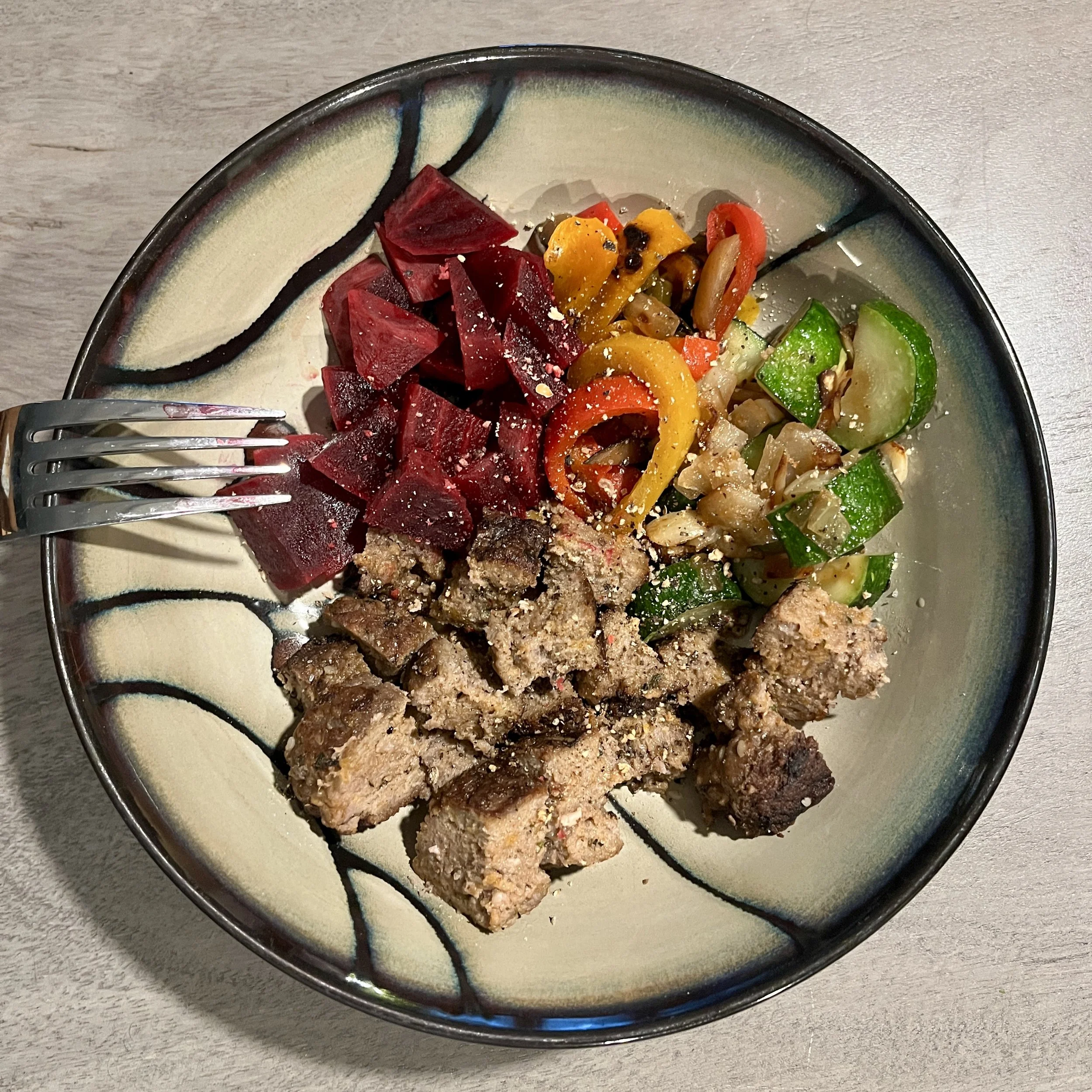
Ground beef, boiled beets and sautéed zucchini, peppers, garlic and onions
Ground Beef. Bring a pan large enough to fit the meat to med-high heat, add a tbsp of olive oil. Use 1 lbs of 100% grass fed and finished or pasture raised ground beef. In a mixing bowl add the ground beef, 6 pinches of salt, 6 pinches of black pepper, 2 tbsp mustard, 2 tbsp Primal Buffalo Sauce, 1 egg (beat it before adding it), and 1/4 cup panko bread crumbs. Mix it all together.
Make 4 equal size meatballs using your hands. Add each meatball to the pan individually and flatten until each resembles a hamburger. Cook for 4-5 minutes undisturbed and then flip for another 4-5.
Beets. Buy 3-4 loose organic beets. Remove the skin. Cut them into quarters (1/8s if they’re large). Place in a pot, add water so covered by 1-2 inches of water. Add two pinches of salt. 1 tbsp of red wine vinegar. Bring to a boil then reduce to a simmer for 60 minutes.
Peppers. Bring a pan to medium-high heat. Chop 1 slice of onion, 2 cloves of garlic and 1 jalapeno pepper. Add to the pan with 1 tbsp olive oil and two pinches of salt. Cut out the core of three peppers (red, yellow and orange) and slice into 1/8 inch strips. Toss in a bowl with 1 tbsp olive oil and 2 pinches of salt. Add to the pan once the onion, garlic, jalapeno combination starts to give off an aroma. Cook for 15 - 20 minutes depending on how you like your peppers, flipping every 5 minutes.
Zucchini. Bring a pan to medium heat. Chop one slice of yellow onion and two cloves of garlic. Add to the pan with 1/2 tbsp of olive oil and two pinches of salt. Chop a zucchini in half down the middle. Then chop the halves in half length wise. Then cut into bite size (1 inch) pieces. Toss in a bowl with 1 tbsp olive oil and two pinches of salt. Once the garlic and onion are fragrant, add the zucchini to the pan. Add a splash of water and cover. Let cook for 3-5 minutes. Uncover and flip, then cover again and let cook for an additional 3-5 minutes (until done).
Assemble. Chop one ground beef patty into bite size pieces and add it to the dish. Add two quarters of beets chopped into bite size pieces. Add a handful of zucchini. Handful of peppers and onions. Top the dish with two pinches of salt and Ume plum vinegar on the beef.
Buen Appetito!!

High Protein and Fiber Bowl!
Chicken thighs and veggie tofu bowl!

Chicken thighs and veggie tofu bowl!
Chicken thighs. Buy a pack of organic free range chicken thighs (pasture raised is best if you can get it). Preheat the oven to 425. Put the chicken thighs into a Pyrex. Coat them lightly in enough olive oil so they don’t stick to the dish. Add a pinch of salt to each one (each side), black pepper, onion powder, garlic powder and a touch of cayenne pepper. Add a little water to the dish. Leave them right side up. Cook at 425 for 20 minutes.
Broccoli. Chop two broccoli crowns into bite size pieces. Bring a pot of water to boil. Add broccoli and let cook for 3 - 5 minutes (taste test before removing from water). Once strained, add the broccoli back to the pan, add two pinches of salt and a tbsp of grass-fed butter, and mix.
Mushrooms. Organic baby bellas are good. Bring a pan to medium-high heat. Add a tbsp of olive oil. Slice the mushrooms, and add them to the preheated pan. Leave undisturbed for 5 minutes, then toss and let sit for another five.
Assemble: Chop one chicken thigh into bite size pieces add it to the bowl and drizzle with Ume plume vinegar. Add a handful of broccoli and a handful of mushrooms, drizzle with red wine vinegar. Slice up a 1/4 of an avocado, a slice of tofu and a slice of onion, add it to the bowl and drizzle with soy sauce. Sprinkle two pinches of sea salt to the whole dish.
Buon Appetito!
Get Up Earlier
A simple solution to the morning rush that stuck for me
Something simple that stuck
There was a period in my mid 20s when I was working long hours and struggling to get my workouts in. By the time I got home from work it was dinner time, and my workouts began to suffer. So I decided to start going to the gym before work, which worked for a while, until I encountered a different problem.
My morning was now rushed, and was adding more stress to already stressful work days.
I was getting up at 5:45 am and rushing to be at the gym at 6 am. Giving myself 2 hours to train, shower, change and be at my desk by 8 am. But it wasn’t working, and I really wasn’t enjoying it.
I was telling this to a friend and he made a very simple and obvious suggestion.
“Why don’t you get up earlier?”
“Why don’t I get up earlier?” Holy shit. You’re right.
Why was I waiting until 5:45 to get up and get out the door? I was embarrassed at how obvious a solution this was and why I hadn’t thought of it. The next day, I changed my routine.
I started waking up at 5 am. With the same goal of being at the gym by 6 am. But now I had a full hour to myself to have my coffee, go to the bathroom, and get my bag, breakfast and lunch ready for the day. The 45 minutes of sleep lost had a negligible impact, and, if anything, the benefits of an extra 45 minutes to get ready in the morning far outweighed the negative effects of sleeping less. Moreover, after a few weeks of getting up earlier, I started going to bed earlier, gaining back my lost sleep.
I feel stupid for even sharing that the idea of getting up earlier was not something I had thought of, and was actually a novel idea to me, but the truth is, it was. I had programmed myself to sleep right up until the point when I needed to get up, and that programming made me miss the simple solution that was right in front of me. “Get up, and give yourself extra time.”
It’s little things like this that I remind myself of constantly to try and figure out what else I might be missing if I just looked through a different lens.

Ground Beef Patty Veggie Bowl
Ground beef patty with purple sweet potato, brussels and pumpkin seeds

Ground beef patty with purple sweet potato, brussels and pumpkin seeds
Ground Beef Patty. Bring a pan large enough to fit the meat to med-high heat, add a tbsp of olive oil. Use 1 lbs of 100% grass fed and finished or pasture raised ground beef. In a mixing bowl add the ground beef, 6 pinches of salt, 6 pinches of black pepper, 2 tbsp mustard, 2 tbsp Primal Buffalo Sauce, 1 egg (beat it before adding it), and 1/4 cup panko bread crumbs. Mix it all together.
Make 4 equal size meatballs using your hands. Add each meatball to the pan individually and flatten until each resembles a hamburger. Cook for 4-5 minutes undisturbed and then flip for another 4-5.
Brussels. Set a pan to medium-high heat. Cut the stems off and quarter or halve them (if bigger). Toss in a bowl with 1 tbsp of olive oil and two pinches of salt. Add brussels to the pan. Add a splash of water to the pan and cover. Let cook undisturbed for 5 minutes. Toss and cover for another 5.
Purple Sweet Potato. Place a purple sweet potato in a microwaveable dish. Cover it in a wet paper towel. Add a 1/2 inch of water to the dish. Microwave for 8 minutes (or until done). Peel the potato and cut it up into small pieces. Mix in a bowl with two pinches of salt, chopped red onion and a tbsp of ghee.
Assemble. 1/2 of the chopped purple sweet potato at the bottom of the bowl. Add one ground beef patty. Add a handful of brussel sprouts. A pinch of pumpkin seeds. Two pinches of salt. Red wine vinegar on the beef patty.
Buon Appetito!

Wild Salmon and Zucchini Bowl
Wild salmon, zucchini, walnuts, pepitas and avocado

Wild salmon, zucchini, walnuts, pepitas and avocado
Salmon. Preheat the oven to 425. Lightly coat both sides of the salmon filet (or filets if cooking multiple) with olive oil. Place the filet skin up on a baking sheet lined with aluminum foil. Add a pinch of salt (or two) to each filet and black pepper. Cook for 8 minutes (longer if desired).
Zucchini. Bring a pan to medium heat. Chop one slice of yellow onion and two cloves of garlic. Add to the pan with 1/2 tbsp of olive oil and two pinches of salt. Chop a zucchini in half down the middle. Then chop the halves in half length wise. Then cut into bite size (1 inch) pieces. Toss in a bowl with 1 tbsp olive oil and two pinches of salt. Once the garlic and onion are fragrant, add the zucchini to the pan. Add a splash of water and cover. Let cook for 3-5 minutes. Uncover and flip, then cover again and let cook for an additional 3-5 minutes (until done).
Assemble. Add a filet of salmon. A handful of the cooked zucchini, garlic and onion. 1/4 sliced avocado. A pinch of crumbled walnuts. A pinch of pumpkin seeds. Two pinches of salt.
Buon Appetito!
A Living Document For My Life
Life lessons from racing, training, cooking and more.
A living document of lessons learned from various experiences.
Things That Cooking Has Taught Me.
You have to make a mess. If you’re not willing to make a mess then you’re not going to be able to create anything.
Things That Sport Has Taught Me.
Blood in the water. A racing term when you’re closing in on a competitor in front of you. This is your opportunity. Take it.
Where do you face? In soccer it means to look in the direction you face, instead of all around you. Usually the best option is right in front of you. In life, what is right in front of you that you’re missing.
Take the down hill. In racing, to let the momentum and gravity of the descent carry you and conserve your energy. In life, where are you putting in effort that you don’t need to be.
Race your race. In racing, don’t get caught up in the person racing next to, in front of, or behind you. You have to race the race you trained for. In life, don’t get caught up by all the things people around you have. Focus on your goal and what you came to do.
Smile. In racing, enjoy the moment. Same as life.
Anyone can show up for one training session. The key is to show up to all of them. In training, consistency is key. Showing up for one training session doesn’t mean much. Showing up for all of them is where the progress happens. Same as life. Consistency is key. Show up everyday ready to train.

Narrow Your Focus
Actions, tools, tips, observations to remember to narrow your focus
This post is to act as a living document for tips, insights, actions and observations to help narrow my focus.
Clear Your Inbox: Don’t delete the email newsletter or promotional email I never read. Unsubscribe from it.
Narrow Your Interests: What actually interests you? Not, what do you think you should be interested in based on what’s going on around you? Not, what draws your attention? But what is your actual bread and butter interests? Focus there.

The Peter Attia Drive: Dr. Tom Catena
#40 – Tom Catena, M.D.: The world’s most important doctor
The Peter Attia Drive: Dr. Tom Catena (from 2019, recently re-aired)
“I think maybe the modus operandi of my life is always looking for, what’s the opposite of greener pastures? Browner pastures (laughs)”
That’s a quote from guest Tom Catena, M.D., the only physician working in the Nubah Mountains in Sudan, where a civil war has raged for over a decade, devastating the community, injuring thousands and taking countless lives. If it sounds like this episode is going to be a depressing one, it’s far from it. On the contrary it’s quite uplifting.
Tom Catena, M.D. is a fascinating man. He knew from a young age that he wanted to be a missionary but he didn’t know in what capacity, so he become a physician. He figured he could use his profession to serve others. And that's exactly what he’s been doing for more than a decade. Sacrificing time with family, the comforts of home (the U.S.), and an easy medical practice complete with all of the modernities the states have to offer.
I loved this conversation because I don’t think I’ve ever heard someone as authentic and genuinely good as Tom Catena. In every single way he is the person we all strive in our head to be, but very few actually become.
Throughout this episode there were a few things that stood out to me.
What are you willing to sacrifice?
During the conversation Dr. Attia starts to lament on wishing he was as good a person as Dr. Catena is. After all they are both physicians, and Dr. Attia has chosen a much different path than Dr. Catena. He’s chosen to serve people in the familiarity of home, on topics (longevity, lifespan) that he is passionate about. He is not in the classical sense of the definition, a missionary.
But Dr. Catena’s response is very real. Dr. Attia’s role in this world, or specifically in this struggle in the Nubah Mountains, is to use his platform (this podcast, his newsletter, and website) to bring awareness to the struggle where there hasn’t been much (if any) before. I know I had never heard of it prior to listening to this episode.
He asks the question in a sense, to think about what it is your willing to sacrifice. For Dr. Catena the answer is comfort, friends, family and high paying job. Everyone’s answer is going to be different. But it’s important that we all don’t fall into a feeling of apathy because we believe we aren’t able to contribute in the same manner as someone else. Rather we should ask ourselves, what are we willing to sacrifice, and use that to guide us.
The bloated U.S. healthcare system.
The hospital that Dr. Catena runs operated on donations. Dr. Catena earns $350 a week for his services. He serves a community of roughly 1,000,000 people. He (Dr. Catena) explains that if he had a $1,000,000 annual budget, he could:
treat 130,000 out patients
perform 2,000 surgeries
treat 6,000 in patients
treat several thousand maternity patients
deliver hundreds of babies
vaccinate thousands of children
For comparison a surgery in the U.S. could run anywhere from $20,000 - $150,000 depending on the surgery being performed and where. The U.S. spends over a trillion dollars per year on healthcare and yet we remain one of the most unhealthy nations in the world. So where is all of our money going and how much better could we be doing. Not just monetarily, but in serving the people who need it most.
Suicide, or lack thereof, in the Nubah Mountains
In all of his time in this war torn region of the world (over 10 years), Dr. Catena has only experienced one suicide. A man who shot himself and completely shook the community.
Meanwhile in the U.S. suicide ranks among the top ten causes of death in every age demographic except 0 - 10. That’s only counting fast suicide. Slow suicide (alcohol, drugs, over consumption of food) over a lifetime makes up pretty much all ten of the top ten causes of death in this country (heart disease, stroke, cancer, diabetes etc…).
How a war torn region of people can remain so steadfast in their desire to live, compared to a nation that has everything, is described in great detail in the book Tribe, by Sebastian Junger.
The Starfish Story
Lastly, this is just a great anecdote for anyone that feels like they couldn’t possibly make a difference. The Starfish Story.
I hope you enjoy this episode as much as I did.
This short article about Tom Catena, MD is a short version of the podcast episode: He’s Jesus Christ

Chicken Thigh Soup!
Baked chicken thighs over vegetable soup!

Baked chicken thighs over vegetable soup!
Vegetable soup, courtesy of Bob’s Red Mill: Bring a pot to med-high heat. Add 1 tbsp olive oil. Chop 2 carrots, 1/2 a cup of celery, a handful of chopped onion and 2 gloves of garlic. Add the carrots, celery, onion and garlic to the pot. Allow to cook for 5 minutes.
Add 2 cups water, 2 cups vegetable broth, 1/2 can of crushed tomatoes (6-8 oz), two handfuls of Bobs Red Mill Soup Mix, a few pinches of salt, ground pepper, a sprinkle of dried parsley, and 2 bay leaves. Bring to a boil then reduce to a simmer. Cook for 20 minutes.
Chop up a 1/2 a zucchini. Add it to the pot and let cook for another 25 minutes.
Chicken Thighs: Buy a pack of organic free range chicken thighs (pasture raised is best if you can get it). Preheat the oven to 425. Put the chicken thighs into a Pyrex. Coat them lightly in enough olive oil so they don’t stick to the dish. Add a pinch of salt to each one (each side), and some black pepper. Add a 1/4 cup of water to the dish. Leave them right side up. Cook at 425 for 20 minutes.
Assemble: Drop one lattle of soup into a bowl. Cut up one or two chicken thighs into bite size pieces and place it over the soup. Add a tbsp of olive oil and 2 pinches of sea salt!
Buon appetito!