New Gym Jitters
My mother purchased my first gym membership for me when I was 15. I wasn’t even able to drive. I either had to walk or hope my brother wanted to drive me and join me for a workout.
It’s been over 21 years since then, and between moving and traveling, I’ve probably seen the inside of 40 - 50 gyms across the country and the world. And yet despite my years of experience, I still get the new gym jitters.
It happened just again this past week after moving to Colorado.
The new gym jitters can be summed up as feeling like everyone is staring at you, the “new comer,” “the outsider,” judging what you’re doing, and that you’re in everyone’s way… all the time.
It reminds me every time just how judgey a gym can feel. And it makes me think every time about the real new comers and outsiders struggling to find their place.
The person walking through the gym doors for the first time ever. The person who is trying to get back into a routine after years of letting themselves go. The people who feel uncomfortable in their body before even walking in the door.
If it takes a 20 year gym veteran who’s comfortable in their own skin a week or more to truly acclimatize and find a rhythm, how long does it take someone who’s never been in a gym before? Someone who doesn’t know what they’re doing? Who walks in the door feeling insecure? Is it a month? Months? A year? More?
It’s no wonder that the average person doesn’t want to walk into a gym in the first place, let alone come back.
It’s one of the reasons I like going to new gyms so often. It forces me to tone it all down a little bit. To consider everyone around me. To smile more. And to go out of my way to make everyone feel welcomed to join in on the fun.
And mostly, it keeps me humble and kind, because it keeps this observation front of mind.
Putting myself in new situations is one way I keep myself from getting too inflated.
If Obesity Is Treated Through Appetite Suppression, Then There's A Better Solution
I’ve been blown away with the amount of coverage that drugs like Wegovy and Ozempic, and more recently Mounjaro and Zepbound have been receiving. This coordinated promotion by the media was preceded by years of “experts” telling people that excessive weight gain, resulting in obesity and other chronic conditions, was genetic and out of their control. But now with insight into how this new class of drugs works, it’s clear that they were lying all along.
Wegovy and Ozempic work by mimicking the hormone glucagon-like peptide 1 (GLP1), while Mounjaro and Zepbound mimic GLP1 and another hormone called glucose dependent insulinotropic polypeptide (GIP). Research discovered that these two hormones help to reduce appetite, slow digestion (making you feel fuller longer), and help regulate blood sugar by increasing insulin. The combination of these three things is the reason people are experiencing a reduction in body-weight of 15 - 20% while on these drugs.
To which I say, obviously.
It’s been taboo for so long to say that over eating and consuming excessive amounts of sugar will lead to weight gain. But it’s been made taboo not because it’s insensitive to the people who are struggling (42% of adults and 20% of children are obese) but because it would require our leaders to face a harsh reality. That too many Americans lack access to healthy food, and the food that is available to them is laden with sugar, sweeteners, dyes, and a whole host of ingredients I couldn’t even pronounce.
50 million Americans (15% of the population) experienced food insecurity in 2022, defined as a lack of access to adequate healthy food that allows you to live an active life. By that definition then the real number must be 2 - 3x what was reported.
It’s not a problem they want to admit nor solve.
The government isn’t interested in a healthy population, they’re interested in one that they and their donors can profit off of (this was exemplified during the pandemic when vaccines were promoted as the only way out, despite evidence to the contrary).
Which is why these weight-loss drugs have been embraced so emphatically. They present the appearance of “doing good” while making billions in the process.
Morgan Stanley predicts that this new class of drugs will be a $77 billion industry by 2030, drawing comparisons to drugs developed in the 80s to treat hypertension (high blood pressure), that rose to a $30 billion industry in the 90s (of note, the prevalence of high blood pressure has only increased since that time).
Ozempic and Wegovy are manufactured and sold by Novo Nordisk. From January to September 2023 Novo Nordik saw operating profits grow 37%, and 48% in the third quarter. They’re projecting sales growth for their next fiscal year of 32-38%, mostly fueled by the large demand for these drugs. The market cap (the value of a company) of Novo Nordisk now trumps the total GDP of Denmark, the country it’s based out of.
Others are looking to cash in as well. WeightWatchers recently spent $106 million to acquire a telemedicine company, Sequence, so they could have the ability to prescribe these drugs.
If it feels like a feeding frenzy, that’s because it is.
But like all drugs, these don’t come without side effects. The most mild of which are nausea, hair loss, gastric distress and reflux. In some animal studies the growth of thyroid tumors was present. More concerning is the prevalence of gastric obstruction reported by type II diabetes patients who have been taking the drug for more than one year. Gastric obstruction requires surgery and can be fatal.
Most patients who take these drugs report a 15 - 20% reduction in bodyweight for as long as they’re on it. Patients who stop using the drug regain most, if not all, of the weight, thereby creating a lifelong patient (music to drug maker’s ears). Meanwhile studies have shown that 40% of the weight loss experienced is lean mass (bone and muscle).
I shudder to picture a future world in which a whole generation of children grow up taking any one of these drugs (as is now being pushed on them). The health of a whole generation is being traded for profit. What will become of children whose lean mass is compromised and are never given access to healthy foods, or to learn healthy habits and why it’s important to be active?
These drugs provide cover for our leaders, and allow them to escape accountability and sweep the real issue under the rug: Lack of access to healthy whole foods has caused a majority of the population to turn to ultra processed foods (UPFs) and sugar for their calories, and these two things are slowly killing us.
It’s no wonder that the largest federal food program in the country, the Supplemental Nutrition Assistance Program (SNAP), includes companies such as Kraft, Pepsico and Walmart amongst its biggest advocates (source: Why Snap Works, Christopher Bosso). These manufacturers and retailers prey on the less fortunate, making billions of dollars each year by selling UPFs and sweetened beverages to SNAP recipients (three person households making $32,000 or less per year), and they are not about to give that up.
The connection is undeniable. UPFs and sugar are making us sick. 67% of calories consumed by children now come from UPFs. Children as young as 2 are being diagnosed with chronic diseases once believed to be age related. Diseases such as non-alcoholic fatty liver disease, heart disease, and diabetes. It’s reasons like this that the government, try as they might, can no longer ignore the issue.
A week ago the Agriculture and Health and Human Services announced they are going to look into the connection between disease and UPFs for the first time. The results of their research can impact national guidelines, including school lunches where Dominos pizza and lunchables are currently served (look for their lobbying campaigns to impact the results).
This past year congress announced the Food Label Modernization Act. Its aim is to update food labels for the first time in 30+ years by making changes such as putting the label on the front of the package and restricting the use of the word “healthy” to describe a food. It’s not enough and we can’t get complacent in allowing them to think they’re solving the problem, because they’re not.
At best they are trying to appease us.
There needs to be a cap on the amount of sugar that retailers are allowed to put into their drinks (one account of a child with non-alcoholic fatty liver disease recalled her drinking a large Slurpee from 7-Eleven which contains 134 grams of sugar. 6x the daily recommended amount!). There needs to be tight regulations on the ingredients that go into these foods and how they’re formulated.
Attention also needs to be paid not just to what is in these UPFs, but what’s being stripped out of them. Vital nutrients, fiber, minerals and vitamins are all absent, and it is these deficiencies in part that are causing the problem.
We’re living in a time when they want you to believe it is more complicated than it is. It’s not. It’s exactly what it looks like. It’s a sickening display of greed, corruption, and incompetence at the highest levels. The only thing sicker than the greed in this country is our population, all of whom our politicians are willing to let suffer in exchange for profits.
Why I Believe Willpower Is Misunderstood
A few weeks ago I came across this article The Company That Defined Dieting Is Sorry It Told Us To Have More Willpower published by the Wall Street Journal. The title of the article is laid above a picture of skinny Oprah from the 80s.
It turns out that the article was just a press release disguised as journalism. Something that has become all too frequent in recent years as the media seems poised to endlessly promote pharmaceutical companies and their drugs.
In this case, it was another promotion for WeGovy. The company that “is sorry” is WeightWatchers, and they want you to know that through a $100 million acquisition they are now able to prescribe “weight loss” drugs to their clients. Oprah’s has shamelessly signed on to promote the new approach in exchange for financial compensation (I guess some people never have enough).
As I read through the article looking for something (anything) related to willpower and found nothing, it made me think about this often controversial topic and the things I’ve experienced and learned when it comes to my own willpower. And since they didn’t talk about it, I thought I would.
You Have It or You Don’t.
Willpower has always been viewed as something you either have or you don’t. Some people are said to have “strong willpower” and others to have “weak willpower.” But willpower is not a have it or don’t proposition. Rather willpower is a skill that is learned over time, and reinforced through daily habits and routines.
People tell me all the time that I have strong willpower. They’re right that I do, but they’re wrong in thinking that I was born with it. It is not intuitive. I have been fortunate to benefit from having a mother with strong willpower, and she had a father with strong willpower. And his willpower was born out of necessity. After suffering a heart attack at age 40 and watching all four of his brothers die early deaths from alcohol abuse, smoking and poor diet he made the necessary changes to make sure that didn’t happen to him.
The intersection of where willpower meets action is misunderstood.
Willpower is not avoiding cookies after dinner, rather it’s not buying cookies to keep in the house. Willpower is not saying no to birthday cake at the office party, it’s not going to the office party in the first place. Willpower is asking for the check before the waiter asks if you want the desert menu.
Willpower is then about repeating these habits over and over again until they become so engrained in you that you don’t even go down the cookie aisle at the grocery store. They become so well known to those around you that you don’t get offered cake anymore (it happened to me). And desert after dinner is saved for celebrating special occasions.
It’s not an all or nothing proposition.
Going cold turkey is a concept that is favored by many and hated by others. It doesn’t have to be an all or nothing proposition. If you’re struggling to clean up your diet, completely cutting out all the “bad” stuff (simple sugars, ultra processed foods, high fat foods) will likely lead to failure.
I maintain a clean diet 99% of the time. Exception made for when I travel in which case I allow myself to fully indulge. But something I’ve noticed is that after returning home, I’m unable to dive right back into my clean diet. All the sugar and processed meats and foods I’ve eaten maintain a stronghold on my cravings. If I try to just ignore them, then I feel like shit. It can take me anywhere from 7 - 10 days to wean myself off the bad stuff and back onto the clean stuff.
If you’re someone that has been struggling with their diet for years, multiply that weaning off period by 100. It’s going to take time to cut everything out. It doesn’t mean you don’t have willpower. It means you need to focus on small wins, cutting back a little everyday, accepting that you’re going to take a step back from time to time. The key is to take more steps forward than back. Do not get discouraged, stick to your plan.
Willpower is about developing confidence and clarity in your goals.
It’s the reason that people can express “willpower” for many years and then “relapse.” Something happens in their life that causes them to lose focus, or lose confidence in their ability to stay the course. Their willpower doesn’t go away, but something changed that impacted their ability to harness their willpower. That’s what makes habit and routine so important.
Developing strong habits and routines are essential to maintaining your willpower.
That all brings me to the most important piece of information when it comes to willpower. And that is the development of strong habits and routines. There are two main reasons. The first is the most obvious. Strong habits will help keep you on track. Willpower is like compounding interest in investing, the longer you’re in the game the greater return you’ll see.
The second is less obvious but it is way more important. Strong habits and routines are what allow you to get back on track quickly! Everyone will go off the rails at some point their life (myself included). Work gets stressful. You’re moving. You have to travel a lot for work. You have to take care of a loved one. The world will always conspire to interrupt your routines. They key is to get back as fast as possible. The biggest setbacks don’t happen because you fall off, they happen because you stay off too long!
If you want to learn about habits, how they are formed, and actionable steps you can take, I highly recommend reading The Power of Habit, by Charles Duhigg and Atomic Habits, by James Clear. I also suggest reading Essentialism, by Greg McKeown. While not directly about habits, Essentialism provides a framework on how to focus only on what’s its essential to you.
I think that there is a major disservice that is happening right now that has been building for some time. It’s the notion that people are not capable of doing things themselves and they need require unnatural means to achieve what they want. Humans are the strongest and most intelligent species on the planet. Capable of things beyond our wildest imagination. We don’t need drugs to make us feel better or make us lose weight. We have that ability within us. We all do. I want everyone to tap into it.
Lessons Learned Over My Last 5 Years of Investing
Over the last five years I’ve spent a lot of time paying attention to my finances. I received my last W2 paycheck in February 2019, so I’ve have a lot of incentive to. Since that time I’ve survived on money saved and money invested.
When I first left my job I did’t know much about investing. I did’t know much about the stock market and I had limited exposure to it. Aside from a company 401K (with no match) and the purchase of a 1-bedroom apartment, I had barely any money invested. If it wasn’t for a week long crash course in investing and the market during a vacation with a friend, I would’ve never gotten started.
Over the years since that trip I’ve applied what he taught me to run a mostly successful portfolio. That said, with experience has come a handful of lessons, some of which I’m sharing here.
You have to take your money off the table when you get it.
The stock market has a genius way of lulling you into thinking you’ve made money (in some cases a little, in some case a lot), and that you will continue to do so forever (as has been the case with the bull market over the last 10+ years, the brief “recession” at the beginning of COVID not included). But it’s important to realize that the only time you make money is when you take some off the table and sell some of your position. Until then it is all at risk. If you’ve sold zero shares, you’ve made zero dollars.
The feeling you’ll encounter is FOMO, missing out on more gains (greed). There’s a great saying I’ve heard multiple times recently.
“Bulls make money. Bears make money. Pigs get slaughtered.”
To overcome that fear you have to ask yourself two questions and be honest.
1. If you wouldn’t sell some shares at a 50% gain, would you really sell at 60%, 70%? Probably not. If you’re unwilling to sell at 50%, greed has likely set in a you’ve become disillusioned that your stocks will only ever go up.
2. Will you be more satisfied taking your gain or watching your gain turn into a loss? This one is obvious but it’s one that feels like it could never happen to you… until it does. Like it has to me on several different occasions.
It is a much better strategy to take gains you can live with, and wait for the next opportunity.
There will always be an opportunity to make more money.
This is a rule that applies to everything in life, but is particularly true when it comes to finance, investing and business. It’s easy to get excited when presented with an opportunity to make money, but most investment opportunities will come with little to no returns.
I’ve been presented a wide array of business ideas to invest in. An email organizer that’s a plug-in for Gmail. A women’s focused wellness brand. Hotel development. An AI focused relationship management system. I’ve passed on most, and invested in the ones with guaranteed returns (i.e. preferred rates of return in real estate).
Jumping at every opportunity thrown your way is a good way to lose a bunch of money and come unhinged. It’s something I saw at my job. Our inability to pass on growth opportunities (whether they were clearly risky or just didn’t make sense) was the main reason for the companies eventual demise.
When it comes to stocks, we all want to own the next Tesla. But picking Tesla to be a winner is a crap shoot. My friends father who is widely successful, sold all of his position in Tesla before it took off. He had a feeling it would do well (which is why he bought it) but he ultimately cashed in when he thought it was a dud.
It’s important to take some risks in your portfolio, but not every IPO (initial public offering) is going to be successful (in fact if you read this newsletter you’ll see the trend is in fact the opposite). For every Tesla missed, another one will arise. Pay attention for the one that makes the most sense for your portfolio (as Sam Dogen puts it, a company you use, like and trust).
For every opportunity missed, another one is right around the corner.
When everything is important, nothing is important.
There has been a handful of times in the last five years where I’ve had more than 20 individual stocks in my portfolio. I foolishly believed that I (since I was not working and had the time) could effectively manage a portfolio of this size. The gains in the market from 2018 up until and past the pandemic crash made me believe I was right. But once the bottom started to fall out of many of the companies in my portfolio, I quickly realized I was wrong.
Instead I’ve refocused my strategy and I’ve been focusing on thinning my portfolio down to less than 10 stocks made up of some of the main stays (Apple, Microsoft, Amazon), some diversification (Kimco real estate investment trust, REIT) and mostly the Vanguard ETF VTI. A portfolio this size, with companies I “know” is manageable.
From time to time I’ll pick up a new individual stock that seems poised for gains, but I keep making myself come back to the lesson, when everything is important, nothing is important.
Money is very personal.
This is probably the most important less of them all. It’s something that Morgan Housel talks about in his book The Psychology of Money, and it’s something that Sam Dogen (aka The Financial Samurai) talks about on his blog and in his book Buy This Not That.
The example Morgan Housel uses is paying for his house in all cash as opposed to taking out a mortgage. Almost anyone you ask will tell you that taking out a mortgage is the right choice, especially in times when interest rates are at historical lows (like they were up until the last couple of years) and the market is returning near double digit average returns. But as Morgan puts it, he just didn’t want the weight of a monthly mortgage payment hanging over him.
I’ve recently had a similar experience. Over the last few months I’ve liquidated 20 - 30% of my stock portfolio to have some extra cash reserves as my girlfriend and I make a move to Colorado. I’m a believer in compounding gains, but in this case I’d rather feel secure knowing the cash is there when we need it, then having to liquidate positions when (if) the market takes a downturn.
The thought of having to sell stocks for bills when the market is not performing is one of the main things that will keep me up at night. Conversely, even if the market takes off, and I have cash on the sideline, I feel good knowing my gains are secure. For sure the 5% return on my cash sitting in a money market fund helps, but I’ve already seen some missing gains on positions sold that I’ve had to learn to accept.
I’d rather feel secure knowing I have the cash.
The Large Turn Out for Abortion Rights Gives Me Hope For Our Health
The fact that so many people came out to vote in support of abortion rights, especially in Republican strongholds, tells me that when it comes to matters affecting one’s body and is deeply personal, it’s easy to get people motivated. Lack of abortion rights is viewed (in part) as a lack of healthcare. Then why is it that when it comes to matters of health more broadly, we seem stuck in the mud, repeating the same things over and over again?
Nearly 50 million people (17 million households) reported being food insecure in 2022. Millions more would report as food insecure (lacking access to adequate and healthy food necessary to maintain an active life) if they truly understood what healthy food and a balanced meal is. Food insecurity leads to an overconsumption of ultra processed foods and sugary (high calorie) drinks, which has direct links to obesity and chronic disease.
As of 2017 42% of the adult population was obese. Likewise, childhood obesity (nearly 20% as of 2020) is on the rise resulting in diseases such as non-alcoholic fatty liver disease that had never before been seen in children now being diagnosed in children as young as 2 at an alarming rate.
Chronic disease are becoming more prevalent with the top five causes of death steadily increasing each year. In recent years life expectancy has plateaued and subsequently decreased to its lowest level in decades. Last year infant mortality rose by a statistically significant 3% for the first time in decades (we now lag behind countries like Russia and China).
The opioid epidemic continues to wreak havoc on people and communities throughout the country (you can’t visit any major city without seeing its effects). At least 150,000 people now die each year from drug overdoses. Yet OxyContin and Fentanyl remain legal and frequently prescribed/administered despite the known destruction they have caused (I have multiple friends/family who recently went in for surgery and were given, sometimes forcefully, these drugs).
This is all in spite of spending trillions of dollars each year on healthcare. So what gives? Obviously we’re doing something drastically wrong.
Congress’ answer to all of this is the recently proposed Food Label Modernization Act. Their attempt to update food labels that have not been updated since the 80s / 90s. But what is it really? It’s an attempt to placate and quiet the public and those who are standing up and shouting for change, while protecting the companies responsible for the country’s declining health.
And for the first time (yes, the first time) the departments of Agriculture and Health and Human Services are considering the impact of ultra processed foods on disease and rates of obesity. It could impact guidelines and the meals served to children in their school lunch programs. Another category where we lag behind other countries, including Mexico. This is work that has already been done, multiple times over, and yet the government agencies want us to believe that this is some novel their doing for us.
Guidelines, recommendations and warning labels only work if people have access to the healthy alternative.
I read an article a couple of weeks ago profiling children diagnosed with non alcoholic fatty liver disease. One of the children recalls regularly consuming a large Slurpee (134 grams of sugar) and a large bag of Cheetos (1,440 calories, 90 grams of fat) every time her aunt brought her to 7-Eleven for some “snacks” when her parents were struggling to put food on the table.
I’d like for someone to explain so I can understand how the Food Label Modernization Act and new guidelines is going to do anything to help this child. It is no coincidence that the rates of obesity amongst the lowest income children versus the highest income children is double. It’s not a choice.
There needs to be limits on the amount of drugs (sugar) that producers are allowed to put into their food. It’s not enough to put it on a label. Ultra processed foods (i.e. Cheetos) are designed to be highly palatable and addictive, encouraging consumers to eat more and more, as the combination of sugar and salt is manufactured to hit that dopamine bliss point.
So the circle goes: family can’t afford or doesn’t have access to healthy foods (aka food deserts) and turns to easily accessible and affordable ultra processed food. Ultra processed food is addictive, affordable and available, so they consume more. And more. Eventually disease ensues. And round it goes.
Powerful opioids such as OxyContin and Fentanyl need to be removed from circulation. Doctors and hospitals should not be allowed to push these drugs on any patient.
It brings me back to my original point (I guess). If we are able to come out in such great numbers (as we should) for abortion rights, then what is it going to take to get us to come out in support of changing food policy, the food system and the healthcare system more generally in this country, to one that actually promotes health instead of undermining it.
We know the food, agriculture, beverage and healthcare industries control the market, but we are the market and therefore we can demand change. Somehow we’ve forgotten that. Without our dollars, they have no dollars and will need to conform to our demands.
Things Take Longer But You Don't Have To Stop Doing Them
Don’t Be Someone That Used To
There’s a certain type of story that makes me cringe when I hear it. It’s the story that starts out with, “I used to…” and ends with an excuse as to why the person doesn’t do “something” anymore. Sometimes it’s health related, other times it’s work or lifestyle. But regardless of what it is, whenever I hear it I want to shake the person and say “don’t say that, you can still do it!”
“I used to play tennis, but my knee started bothering me.”
“I used to bring my lunch to work, but now my commute is too long and I don’t have the time.”
“I used to love my job, but now it’s too stressful.”
If your knee is bothering you, figure out how to strengthen it. If you’re short on time, wake up earlier. And if you no longer love you job, start looking for a new one.
There’s one story in particular I remember.
I was at the gym earlier this year when I overheard two older men having a discussion. The one guy was telling his friend that it was his first day back working out. He had been going regularly, and in pretty good shape, but then the pandemic shut everything down. In the 2+ years since, he, in his words, “had done nothing, and put on 25 pounds.”
I just sat by my locker listening, wondering if he heard himself speaking. 2+ years of doing nothing. What’s the excuse?
Things Just Take Longer
Most people fall into the same trap as they get older. They believe that because of their advanced age that there are just certain things that they can no longer do. People say it all the time. First they state their age. “I’m 72.” Then they tell you the thing they can’t do anymore as a result. “I can’t run anymore.”
I’ve come to the realization that if you want to continue to be active as you age, you can. It just means that things are going to take longer. Speed doesn’t matter (in fact I would argue that as you get older you realize that the best results are achieved slowly).
Running at 72 doesn’t mean it’s impossible, it just means you’re not going to beat your personal best.
Going on the 5 mile hike you always loved to do is possible, but you’re going to be out on the trail a little bit longer.
If you want to go to the gym it’s going to take longer to put your shoes on, drive to the gym, and get through a full workout. But you can do it.
Having A Longevity Mindset
Having a longevity mindset means never stopping. It means catching yourself before you become the person who used to. Longevity is all about extending quality years of your life. In order to do that you need to keep going.
The Biggest Threat to Our Country Is Within Our Borders
Food Tank brought my attention this week to the USDA’s annual report on food security in America. The report revealed that 17 million households, representing 44 million people (including children), experienced food-insecurity in 2022, a statistically significant increase from 2021 and 2020 (13.5 million and 13.8 million households respectively).
Food security is defined as having “access to enough food for an active, healthy life for all household members.” Therefore food insecurity is lack of that access. But that’s not really what this report tells us. Based on the manner in which it is conducted, it really just tells us about the quantity of calories consumed, not the quality of those calories.
The report is based on the responses of 31,948 households (there are 133 million U.S. households) to a survey “about experiences and behaviors that indicated food insecurity… such as being unable to afford balanced meals, cutting the size of meals, or being hungry because of too little money for food.”
The definition of a “balanced meal” and quality of the food is left up to the respondent. Examples of the questions asked include:
1. “We worried whether our food would run out before we got money to buy more.” Was that often, sometimes, or never true for you in the last 12 months?
3. “We couldn’t afford to eat balanced meals.” Was that often, sometimes, or never true for you in the last 12 months?
11. “We relied on only a few kinds of low-cost food to feed our children because we were running out of money to buy food.” Was that often, sometimes, or never true for you in the last 12 months?
12. “We couldn’t feed our children a balanced meal, because we couldn’t afford that.” Was that often, sometimes, or never true for you in the last 12 months?
Buried in the report is the disclaimer contradicting exactly what the report claims to identify.
“This operational measure does not specifically address whether the household members’ food intake was sufficient for active, healthy lives—the conceptual definition of food security. Nonetheless, research based on other data collections found survey-based measures of food security to be statistically associated with outcomes involving health, nutrition, and children’s development in a manner that generally supports the link between the report’s survey-based measure of food security and the conceptual definition of food security.”
Therefore we don’t really know the true number of people experiencing food insecurity or a lack of access to healthy foods. But my guess is that based on other studies I’ve read, the number is drastically higher.
A study conducted in 2016 using 2011 purchase data showed that the top 5 food expenditures for households who participate in SNAP programs (who by definition of their participation are experiencing food insecurity) were:
Meat, poultry and seafood
Sweetened beverages
Vegetables
Frozen prepared foods
Prepared desserts
Another study published in 2021 identified that 67% of calories consumed by children ages 2 - 19 came from ultra processed foods.
And a number of health trends confirm these findings.
42% of adults in the U.S. are obese. Children as young as 2 are being diagnosed with non-alcoholic fatty liver disease at an alarming rate. Life expectancy in the U.S. continues to decline. And for the first time in decades, infant mortality rose by a statistically significant 3% last year (we lag behind countries like Russia and China in this category, who we claim superiority over).
But while the link between lack of access to healthy and nutritious food and declining health is clear, we are in disagreement as to the solution. Instead of putting limits on ultra processed foods (including limiting harmful ingredients that can be used) and the amount of added sugar allowed in beverages, our politicians are trying to placate us with things like the Food Label Modernization Act, while the healthcare industry pushes for more surgery and drugs.
We should expect more from our politicians and our government who should be doing everything in their power to protect and serve us. In 2022 SNAP (Supplemental Nutrition Assistance Program) operated on a budget of $106 billion (about $40 billion of which went away with the repeal of COVID relief benefits).
It is no coincidence to me that $106 billion is the exact amount requested by President Biden to fund Ukraine, Israel, Taiwan, and humanitarian aid. This request was made in addition to the $113 billion in aid already approved for Ukraine in 2022.
Every year our politicians and media convince us that the nearly trillion dollars spent on our military and foreign aid is necessary to keep us safe. Meanwhile the biggest threat to this country is not a foreign entity. But rather it is the rapidly declining health of our population and the negligence of our elected officials who pose the biggest threat to our future.
Drive Thru Lines, The Container Store and No One Else Knows Any Better
There are many metrics you can use to explain the current health of our country.
You can look at the fact that according to the CDC 42% of adults are overweight or obese. You can look at the decreasing life expectancy, or the fact that children as young as 2 are not being diagnosed with non-alcoholic fatty liver disease. But I think there’s simpler, but yes more subjective, measures than that.
The Container Store
For anyone that doesn’t know, there’s a store called the Container Store. Although I admit I’ve never stepped inside of one (and I never will), this is a store that is filled with plastic storage containers available for purchase mostly by people who have too much stuff (waste) and need a way to neatly put it out of sight. A big box, Walmart size store, filled with plastic. In an age where banning plastic straws is an act of “conservation” and makes headlines, we allow a company to sell plastic by the container load.
Drive Thru Lines
Chick-fil-a. Starbucks. The drive thru lines for fast-food is insane. Lines of cars wrap around the block, stuffed with people waiting to get their hands on sugary drinks and ultra-processed foods. Lines of cars emitting exhaust, while the occupants breath it in, because they don’t want to step our of their car. Most times the line in the store is now actually shorter than the drive thru. The drive thru used to be a quick convenience, but we’ve become so lazy that it’s now flipped. Being “comfortable” continues to proliferate throughout every aspect of our society.
Perhaps this isn’t a scientific way of taking the pulse of the nation (sweet pun), but I think it’s very telling. What we hear we want (less pollution, better health) stands in direct contrast with our actions.
These are just two anecdotal observations, but these are the types of things I see all over that give me little hope that any real change is on the horizon.
Change needs to happen from the top down. With limits on additives in food and regulations on things like plastics (real regulations, not plastic straw regulation). But they never will, because both of these fly in the face of what our politicians are really after. Money and power. And doing so would mean taking on the very same people (and corporations) that provide them with both. Money always has and always will control. It’s a sad reality. We’re a greedy species.
We Like To Think That They Know Better
I can’t take people deferring to supposed experts and someone more knowledgeable in a field. Of course there are times when this might be true, like when it comes to math, facts about science, or the truth about history. But when it comes to the present day, and what’s happening in real time, we need to be better at trusting our gut.
I was listening to a podcast today. The guest is a professional surfer. A very successful and well traveled man. He’s someone that has seen a lot and experienced a lot in his life. He began to opine about the U.S. foreign policy strategy but almost just as quickly started to back off, defaulting to “I’m sure it’s more complicated and they know better than I do.”
Specifically he was talking about being on the verge of WWIII and how we should be doing anything possible to avoid it. That doesn’t take an expert. There isn’t someone who knows better. But people always want to believe there is.
I remember when I was working our company was growing rapidly and our success attracted a buyer of our business. The company that was acquiring us was part of the largest health insurer in the U.S. Despite our success, the years of dramatic growth was causing cracks in our core business, and our executives were struggling to fix them while continuing on our growth trajectory. I was in my mid-20s at the time.
I specifically recall talking in the hallway one evening with my COO, CAO and VP of Operations. They were all discussing the relief of having this large company come in because it was assumed they had some knowledge that we didn’t that could help our business. I remember being so confused.
“What makes you think these people are any smarter than you?” I said. I knew that there wasn’t a team of healthcare geniuses that were going to fly in and solve our woes. But that didn’t matter, because they did, and that’s what they waited for.
Fast forward 10 years and the company I worked for (that was acquired) has experienced a drastic decline in performance by any measurable metric.
They didn’t know how to run our business, but they flew in thinking they did, and even worse they came in with an arrogant and pompous attitude that prevented them from listening to anyone else.
And that takes me back to the U.S. foreign policy and any policy. Politicians don’t know something we don’t. In fact, they are supposed to represent us, not tell us. But that’s what they do. They tell us they know better. They tell us they are trying to protect us. But they aren’t and they don’t.
We know the truth. We see it. We hear it. We all live it every single day. What you think is happening, actually is. Stop doubting it.
We Have An I Don’t Like It Problem When It Comes To Food
I see it all the time. Someone orders a dish out at a restaurant, proclaims they don’t like it, picks at their dish, and tosses the rest away. Someone buys something at the grocery store, tries a bite, doesn’t like it, and offers it to me before they throw it away. Children negotiate with their parents to eat something other than what was cooked or ordered for them, prompting their parents to make more food or order something else. With so much abundance and so much variety in our lives we don’t even have to consider the alternative. Eating whatever is in front of us.
There’s a respect for food that has been lost on my generation.
Our removal from the hunting, gathering, and growing process of food is one reason. The processed and pulverized nature of “food” that now resembles the factories they come out of more than it resembles something grown and raised in nature adds to our disconnect. But mostly it’s because for many of us, the amount of food available is endless.
There’s this great scene in the movie The Menu, where the chef, played by Ralph Fiennes, has just turned on his unaware and affluent guests who he says can never be satisfied. He asks one of his guests who frequents his exclusive restaurant to name one dish from their last visit. He doesn’t have an answer, but his wife whispers “cod” into his ear.
“Cod” he says.
“It was halibut. Rare fucking spotted halibut” says the chef.
The diner’s wife inquires “what does it matter?”
To which the chef replies, “it matters to the halibut Mrs. Leebrand.”
It’s a simple yet genius and powerful moment in the movie when they give life to what we simply consider to be “food.” It’s a scene that has stuck with me and one we often repeat at the dinner table.
The next time you’re unsure about what to eat, remember that scene. It matters to the halibut, and it matters to the people who are not in the fortunate enough situation to not like their food.
The CDC Released Preliminary Mortality Data for 2022
The CDC released preliminary data on the leading causes of death for 2022. Heart disease and cancer were again 1 and 2 respectively, unintentional injuries was 3, COVID-19 at 4 and cerebrovascular diseases (diseases effecting blood vessels and flow in the brain) rounding out the top 5.
Below is a graph of the top 6 leading causes of death over the last 5 years using data from the CDC Wonder Program.
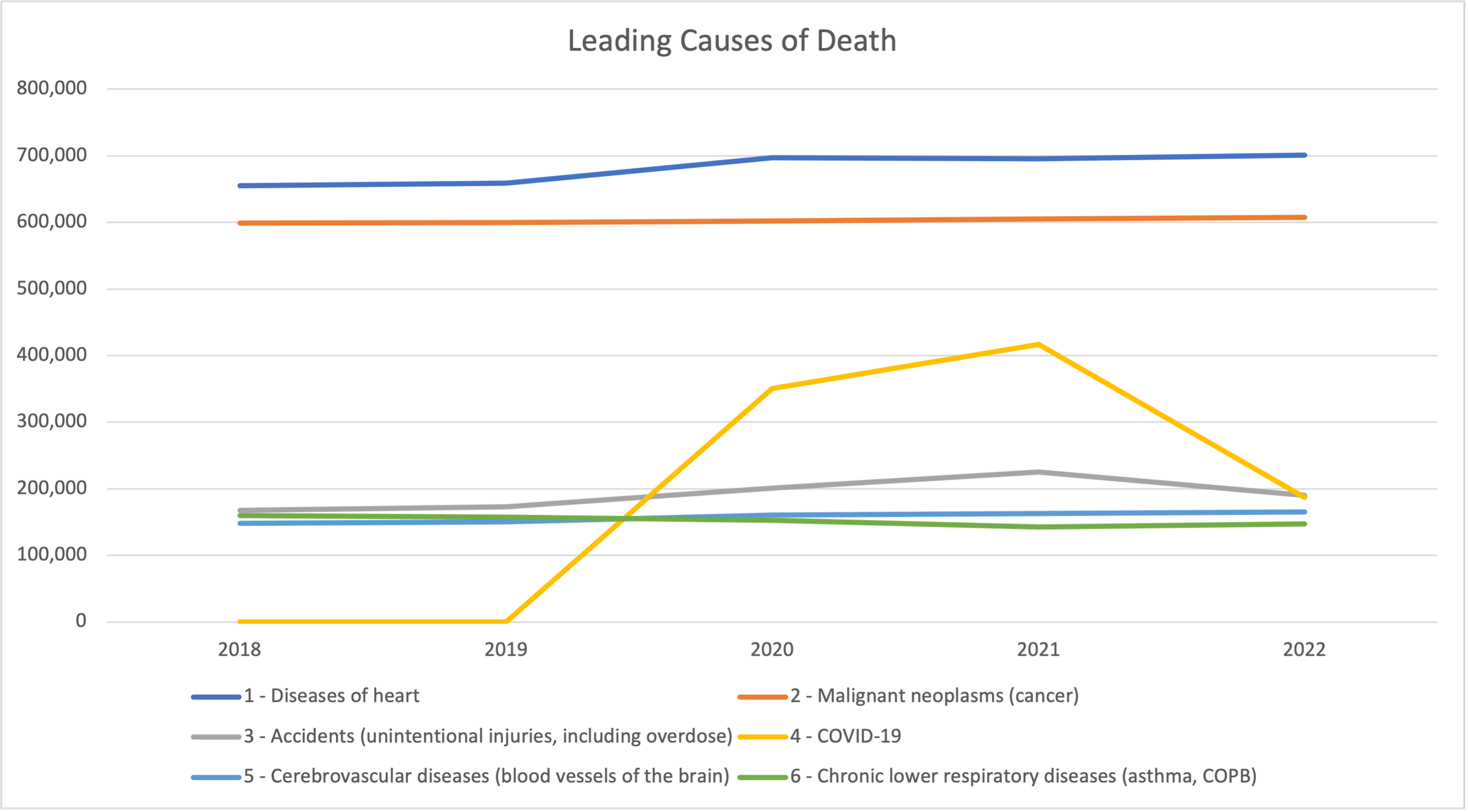
Since 2018 heart disease and cancer combined have accounted for nearly 1.3 million deaths per year (2020 through 2022 COVID-19 killed 950,000 Americans), and 2022 saw a slight increase in both, despite the fact that its estimated that 50+% of people who died of COVID also had at least 2 comorbidities. Said another way, even though a majority of people who died from COVID likely had underlying heart disease and cancer, the number of people who died from each increased.
The third leading cause of death, unintentional injuries, includes overdoses, which were estimated to be 107,622 in 2021. That would mean that overdose deaths accounted for ~50% of all deaths in this category.
In 2020 60% of overdoses were people ages 0 - 44, and its estimated that 2.1 million Americans have Opioid use disorder. Overdose deaths need their own category to help shed awareness on the issue. It is one of the main drivers for the declining life expectancy in the U.S. We have a mental health crisis that needs immediate attention.
Changing Policy is the Only Way
I finally came to the realization that the only way we will be able to positively impact health is to change policies around food. It’s something I’ve thought about and agreed with ever since reading Food Fix, by Dr. Mark Hyman, but even after I read it I still believed that if enough people, myself included, could spread information and knowledge about ways to take control of your health, that it would be enough. But I realize now it’s not. It was really driven home after hearing this bit on a Joe Rogan podcast episode with Dr. Aseem Malhorta beginning at about 2:24. It goes on for a few minutes and is worth listening to, but I found this part the most impactful.
“Do you know what the biggest healthcare breakthrough has happened in the last 40 - 50 years, in the Western world? Taxation of cigarettes. 50% of the decline in heart disease deaths has happened because of smoking. But it only happened when their were regulations imposed. In public health we call about addressing the affordability, availability, and acceptability of cigarettes.”
I couldn’t find a paper referencing these exact stats, but this article, The Short-Run and Long-Run Effects of Tobacco Taxation, from the National Bureau of Economic Research corroborates the statement.
In April 2018 the UK imposed a tax on sugary drinks above a certain threshold. While the reviews are mixed on whether or not it had an impact on consumer habits, it definitely got the attention of beverage makers who, in an effort to maintain sales volume, have been reducing the amount of sugar in their drinks to meet or be below the threshold and avoid the tax.
There is no shortage of physicians, PhDs and influencers raising awareness of what it takes to be healthy, but for so long as society makes it easy and cheap to consume unhealthy substances, than we will never see any meaningful change in the health of our nation. We need policies that promote health and incentivize the right choices.
Food, Waste and Health in this Country
There is an undeniable link between the food and health of our nation, yet there remains a disconnect at the highest levels on how each can help the other.
Understanding The Supplemental Nutrition Program (SNAP) and Its Impact
This week an article about proposed changes to SNAP benefits (Supplemental Nutrition Assistance Program, formerly Food Stamps) by House Republicans as part of their budget bill sent me down a rabbit hole. With federal spending at $3 trillion annually, why target the roughly $86 billion spent on SNAP.
Realizing I don’t know that much about SNAP, I decided to dig a little deeper and educate myself about the program. In my search I discovered that there are roughly 16 government programs (including SNAP) that reach millions of Americans each year and serve billions of meals to those in need. They range from school meals, and plans for older (60+) low income adults, to programs specifically for women, infants and children.
But SNAP is hands down the most far reaching, impacting some 42 million Americans each year. Some information on SNAP.
SNAP provides nutritional support to low income families, older adults (60+), and people with disabilities.
SNAP operates in all 50 states, and is funded by the federal government (admin costs are split with the state).
~90% of participants are in a household with a child <18, an adult >60, or a disabled person.
50% of households are white, 25% are black and 1/5 are Latin.
To be eligible, a THREE person household must meet these requirements:
Gross monthly income at or below $2,379 ($28,550 annually)
Net monthly income, after living expenses, at or below $1,830 ($21,960 annually)
Total assets must fall below $2,500!
Individuals on strike, some college students, individuals with drug felony convictions in some states, and people of certain immigration status, REGARDLESS of their income, are ineligible.
Households receive on average $127 per month, per person. Or $4.16 per day. The pandemic relief program added an additional $92 per month per person, but that’s expired.
Part of the proposed changes are to expand the age bracket of which work requirements must be met, making it harder for young adults to become eligible, as well as closing “loopholes” (limiting states ability to make exceptions for certain households). The changes are being sold as a way to save taxpayers money and encourage people to work their way out of their low income situation.
But it’s hard to work on an empty stomach, and in 2021 the US Government spent $748 billion on Medicaid (healthcare for low income adults, children and people with disabilities, a lot of the same people who benefit from SNAP) up nearly $200 billion since 2015. So if saving money is really our concern, then let food be thy medicine. Invest in SNAP and other food related programs, which will improve the health of this struggling population, and in turn reduce the absurd amount of money we spend each year on healthcare related costs, where 20 - 40% of deaths are preventable.
We have the resources, they are just being allocated incorrectly. And we surely have the food (as the next article will make clear), but for some reason the disconnect remains.
ReFED Releases New Food Waste Estimates and Calls for Increased Action by Food System
A data-driven guide for businesses, government, funders, and nonprofits to collectively reduce food waste at scale. Together, we can reduce U.S. food waste by 50% by 2030.
ReFED is a company I began following recently after applying for a job there (I didn’t get it, hence why I have the time to write this newsletter). ReFED is a national nonprofit working to end food loss and waste by advancing data-driven solutions.
A few days ago they published their annual estimates on food waste in the U.S. The numbers are not surprising, but they are nevertheless upsetting.
A few key stats:
In 2021 the U.S. generated 91 million tons of surplus (unsold or uneaten) food, equal to 38% of total food production
Food waste represented 6% of greenhouse gas emissions (food rotting in landfills), equal to driving 83 million passenger vehicles for a full year
80% of the total food surplus was edible, by only 2% was donated
To produce this surplus food required utilizing 22% of the U.S. freshwater and occupied 16% of cropland
The estimated value of the uneaten food was $444 billion and converts into 149 billion potential meals for those in need
ReFED also modeled out some 42 solutions to reducing food waste. They estimate that implementing their solutions would cost $18 billion annually but have a net positive effect on the economy of $74 billion, while saving 4.3 billion meals for those in need. It’s estimated that at least 10% of the U.S. population (or 34 million Americans) are food insecure.
That article was summarized and expanded on in a good piece by Bloomberg.
#51 - Robert Sapolsky, Ph.D.: The pervasive effect of stress - is it killing you? - Peter Attia
A few years ago I heard about Robert Sapolsky, Ph.D. while listening to an episode of the Tim Ferriss podcast. The guest recommended Sapolsky’s book, Why Zebra’s Don’t Get Ulcers. The title was intriguing and so was the description:
“As Sapolsky explains, most of us do not lie awake at night worrying about whether we have leprosy or malaria. Instead, the diseases we fear-and the ones that plague us now-are illnesses brought on by the slow accumulation of damage, such as heart disease and cancer. When we worry or experience stress, our body turns on the same physiological responses that an animal's does, but we do not resolve conflict in the same way-through fighting or fleeing. Over time, this activation of a stress response makes us literally sick.”
I immediately bought a copy, but admittedly didn’t open it for some time. It’s a dense book that required a certain mindset before diving into it. Eventually I got into it, and it ended up being one of my favorite reads. The correlation between stress and disease is far beyond anything I could’ve imagined. It’s a book that everyone should read. But since everyone can’t and wont, this 2 hour podcast at least serves as a good intro for anyone that is interested in the topic. A couple of interesting sound bites below.
Minute 32: “We belong to multiple hierarchies, and we are very good psychologically at deciding whichever hierarchy we are highest in, that’s the one we define ourselves by.”
Minute 67: “You look in some bloated corporation and there’s some guy who is the assistant manager of the mailroom and thats an incredibly status filled position for that guy, and theres some other guy who’s number 2 in the company who was just passed over to be number 1, and the only pertinent thing in his mind is not the 99,000 employees that he’s higher ranking then, its that there’s still someone ahead of me… in other words, its not being poor, its feeling poor.”
"The [stress response] system has been serving vertebrates, doing a lot of help for them for an awful long time, and it's only been a very recent modification to instead secrete [cortisol] in response to thinking about taxes." —Robert Sapolsky
Worldwide Obesity on the Rise
Many physicians, organizations and pharmaceutical companies are busy promoting obesity as genetic and pushing new “miracle drugs” (and getting paid to do it), the World Obesity Federation (WOF) and World Health Organization (WHO) are keeping it real, recognizing that diet, and specifically the “disappearance of fresh food markets, control of food chains by supermarkets, and the increasing mass production of processed foods in many countries” is the real cause.
This is a topic that irks me, because touting obesity as a genetic disorder is a disservice. The information is especially dangerous for children, where drugs and surgery for children as young as 12 is now the recommendation. These drugs however don’t just reduce fat mass, they result in a loss of lean mass, which also includes muscle and bone.
We seem intent on trying to drug ourself out of this problem as we’ve tried so many times before without success. But it’s a problem that won’t get solved until we dismantle and re-engineer the three industries who are allowed to continue to push these lies: big pharma, big food and big ag.
“Cooking” in America
The real reason we’re so unhealthy.
I’ve been diving more and more into healthcare spend and food choices as I try to figure out the best approach to helping people get healthy and therefore reduce the prevalence of disease in this country. Today I found an article by Food and Wine discussing the best selling foods of 2020 according to Kroger, America’s largest grocery retailer [link for article here].
In order, the top 5 foods that saw the largest year over year growth in sales are as follows:
Zero calorie soda drinks
Four cheese Mexican-blended cheese
Flavored potato chips
Sauvignon Blanc wine
Heavy whipping cream
Rounding out the top 10 were:
Fresh burger patties (ground meat)
Bread
Coffee pods (understandable as everyone was home)
Chocolate variety pack
Black forest ham
According to Kroger’s chief merchant he said that the year over year increase in these items indicated [emphasis mine] “how our customers not only adapted to the challenges of this unique year but embraced cooking and eating at home as part of their new routine.”
Cooking? In what household does this grocery list constitute cooking? The answer… apparently most American households as Kroger own’s and operates 2,800 stores across the country.
When we talk about healthcare in this country we’re so quick to discuss expanding healthcare. Politicians and activists want more healthcare for everyone. More medicines. More vaccines. But never do they want to discuss why we are sick in the first place.
It’s scary to think that with more time on our hands these are the items we chose to consume. When the excuse was “we don’t have time to cook,” “we don’t have time to grocery shop,” it was a hard excuse to combat. Without time it is hard to be thoughtful. But even with time on our hands, we apparently thought a good recipe for cooking was highly processed foods with zero nutritional value. It should be of little question why healthcare costs continue to increase and why disease continues to rise.

Huberman Lab Podcast w/ Dr. Andy Galpin
Summary notes from Dr. Huberman’s interview with Dr. Andy Galpin on building strength, muscle and endurance
Huberman Lab Podcast: Dr. Andy Galpin: How to Build Strength, Muscle Size & Endurance Podcast #65
After I listened to this episode I shared it with a number of people within my immediate circle. Everyone loved it but a few people expressed that they would have to listen to it multiple times in order to pick up on all the detailed information. These were people with full-time jobs and families. I decided I would go back, re-listen to the episode and take notes I could share with them. I also loved the episode so it ended up serving me way more than these notes will probably serve them. In any event, these are the notes I came away with.
10 Great Books in the Pursuit of Self and Health
After leaving my job in 2019 I went on a spiritual journey. I wanted to learn as much about myself as I could. I felt like during my decade of work I had lost who I was. So I set out on a path to rediscovering the person I lost.
Health and self improvement were always big parts of my life, so it’s not surprising that those are two topics that I dove heavily into. It started with endurance racing and travel, but I also quickly developed a new love for reading (something I didn’t make time to do while I was working).
Over the past 4 years I’ve discovered many really great and informative books that have helped me to transform myself and improve. Of all the books I’ve read, these 10 stand out to me as the most impactful.
Each one of these books awakened something new in me or set a new foundation of understanding that I didn’t have before.
Essentialism gave me the permission to focus only on the things in life that I found important, and to stop giving energy to things with little purpose in my life.
Thinking, Fast and Slow gave me insights into systems 1 and 2 and how to be better at utilizing each.
Food Fix and The Omnivores Dilemma taught me things about the food system and food policy that completely re-shaped how I view food and its importance in this country.
Why Zebras Don’t Get Ulcers, Lifespan, and The Body all gave me new insights into health, the body and the factors that impact them.
This is the order in which I read them, and while I think the order makes sense and that in some ways each one led me to the next, they by no means need to be digested in this order. Each speaks to a different point, but each one comes to the same conclusion. Understanding yourself and the situation is key to being successful.
Essentialism: The Disciplined Pursuit of Less, Greg McKeown
The Power of Habit: Why We Do What We Do in Life and In Business, Charles Duhigg
Thinking, Fast and Slow, Daniel Kahneman
The Body: A Guide for Occupants, Bill Bryson
The Omnivores Dilemma: A Natural History of Four Meals, Michael Pollan
In Defense of Food: An Eater’s Manifesto, Michael Pollan
The Lion Trackers Guide to Life, Boyd Varty
Why Zebras Don’t Get Ulcers, Robert M Sapolsky
Lifespan: Why We Age and Why We Don’t Have To, David A Sinclair, PhD
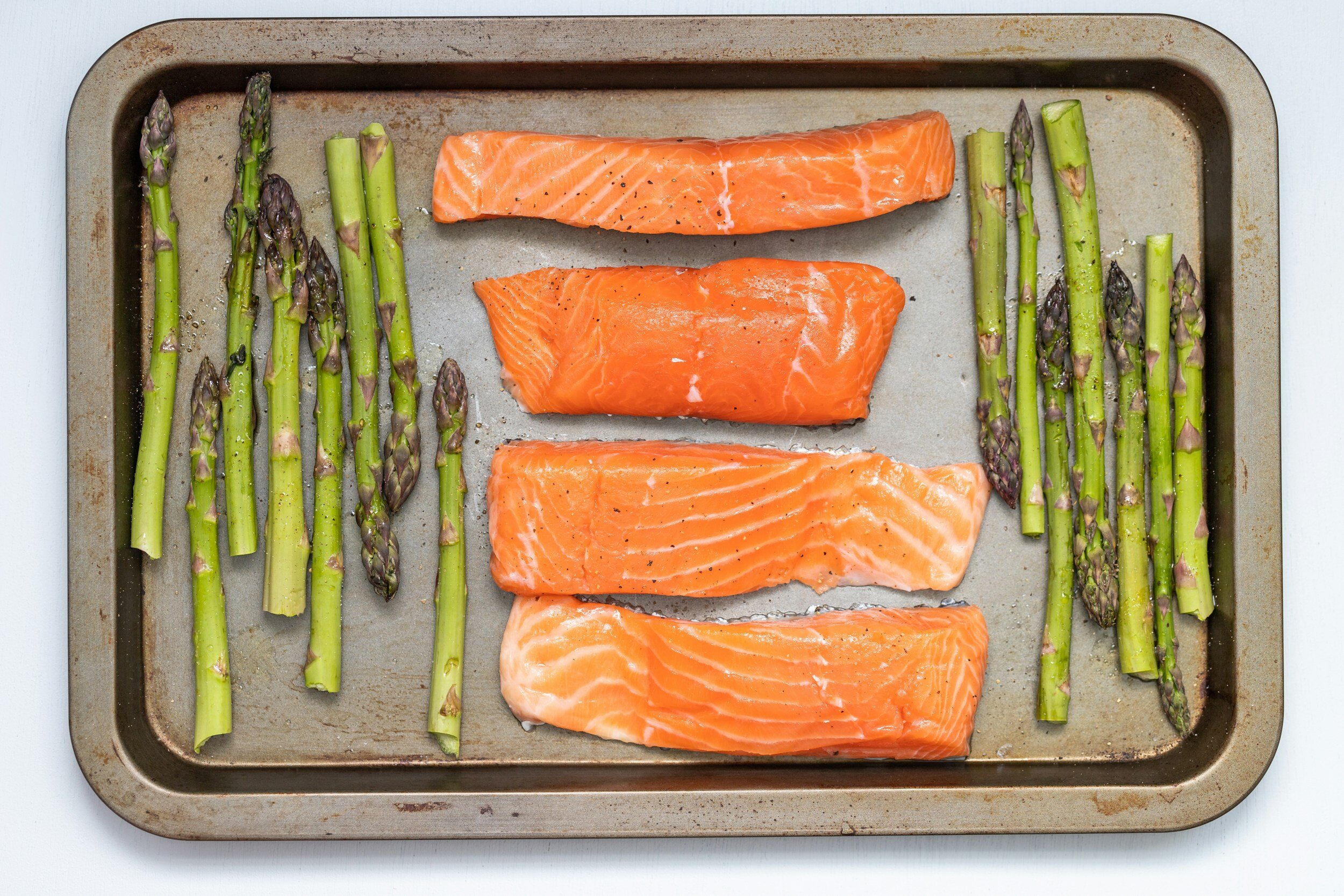
Salmon asparagus salad
Quick and easy salmon, asparagus salad
Start with wild salmon. I’ve been enjoying frozen wild sockeye salmon from Whole Foods or Sprouts (grocers closest to me). But any wild salmon will do. Try to avoid farmed salmon if you can (more to come on that in later newsletters).
Salmon - Preheat the oven to 425. Lightly coat a 4 oz salmon filet (you can cook more than on at a time if you want) with olive oil and a few pinches of salt. Place the salmon face down, skin up (make sure to salt the skin) on a cooking sheet. Cook for 8 - 10 minutes depending on the thickness of the salmon and how well you like it cooked.
Asparagus - Cut the base of the stems off. Line the asparagus on a cookie sheet lightly covered in olive oil and salt. Cook for 8 - 10 minutes if you’re cooking at 425, 12 minutes if cooking at 350. Thick asparagus will take longer. We always buy thin bunches. You’re looking for bright green color, with some snap.
Put a handful of your favorite greens in a bowl. Slice a ¼ of an avocado. Cut a slice of a red onion and dice it. Slice ½ an apple into thin pieces. Place it all on top of the greens. Lightly coat with 1 tbsp of olive oil, a generous amount of red wine vinegar and a few pinches of salt.
Place the salmon and asparagus on top and repeat the coating of oil, vinegar and salt, just lighter this time.